

Global Antisemitism, Next Month’s Israeli Election, the Ongoing Confrontation with Iran, the Mark Ruffalo Controversy, and Levels of Optimism at the Start of the New Year.
Main Finding
More Jews Attribute Rising Global Antisemitism to Israeli Policy: Two in Five Say It Contributes “to a Great Extent.” Even So, When Countries Take Measures Against Israel, Growing Shares of Connected Jews View Them as Both Anti-Israel and Antisemitic.
Additional Findings
▪ An increasing number of connected Jews see antisemitism in measures taken against Israel: Growing shares view recognition of a Palestinian state, calls for punitive measures against Israel, and academic boycotts as “both anti-Israel and antisemitic.”
▪ Israel’s election: Preference for the opposition remains steady – nearly six in ten connected Jews prefer an opposition victory.
▪ One-third follow election news very closely; nearly half follow it somewhat closely.
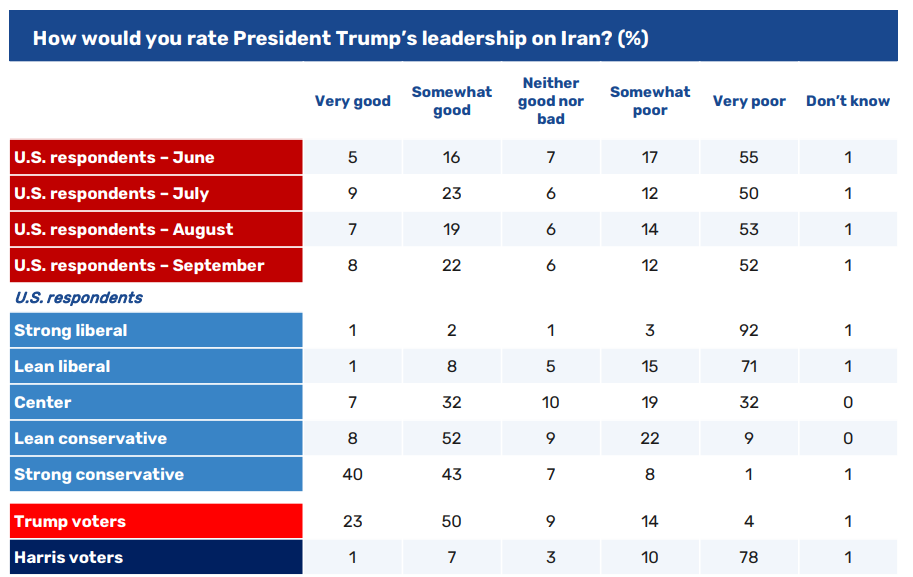
▪ A majority still rate Trump’s leadership on Iran as poor; about one-third rate it positively.
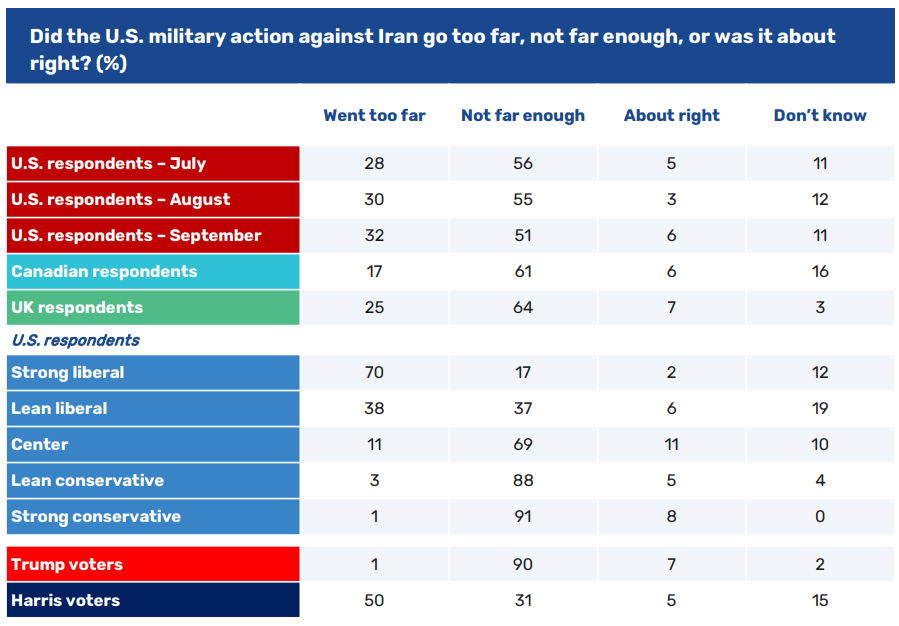
▪ Half say U.S. military action against Iran did not go far enough, while one-third say it went too far.
▪ The Ruffalo controversy: A large majority consider actor Mark Ruffalo’s remarks antisemitic rhetoric, a view that cuts across political camps.
▪ Looking ahead to the New Year: Israeli Jews are far more optimistic about Israel’s future than Diaspora Jews are about the future of their own countries.
▪ Fewer respondents than last year believe Israel is on a trajectory of continued deterioration.
▪ Political divide over the future of the United States: Nearly three-quarters of Harris voters believe the country is on a path of continued deterioration, compared with roughly one-third of Trump voters.
▪ Half of respondents know hundreds of Hebrew words or more; familiarity with Hebrew is especially strong among those who have lived in Israel.
Click here to download the PDF version.
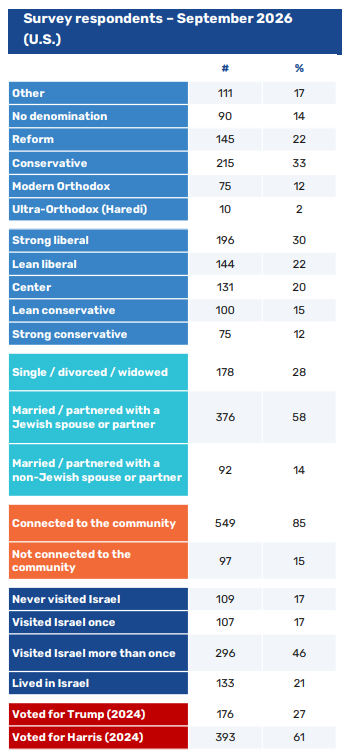
This month’s data was collected shortly before Rosh Hashanah, amid continued debate over international pressure on Israel including calls for punitive measures in response to events in the West Bank and to the humanitarian situation in Gaza – as well as public discussion of antisemitism and its relationship to Israeli policy. At the same time, preparations continued for Israel’s expected fall election and the U.S. midterm elections. Methodological note: In addition to the sample of connected U.S. Jews, 99 Canadian respondents and 59 UK respondents participated this month. Findings for these groups should be interpreted with caution given their small sample sizes. All breakdowns by ideology, denomination, or vote refer to U.S. Jews only.
Antisemitism and Israeli Policy
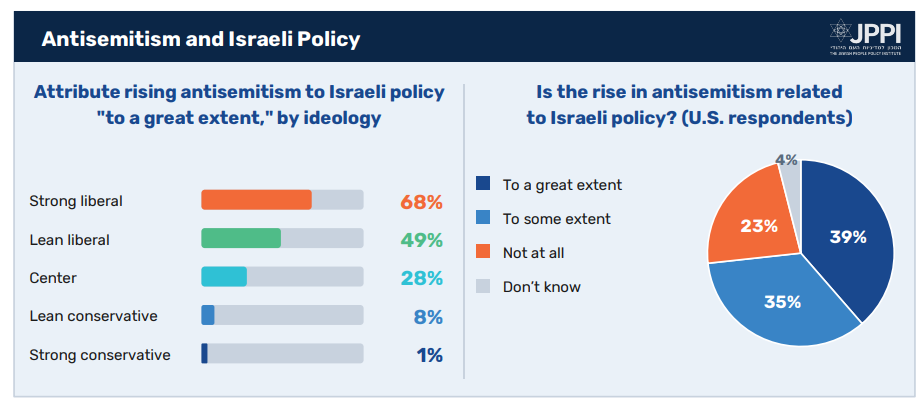
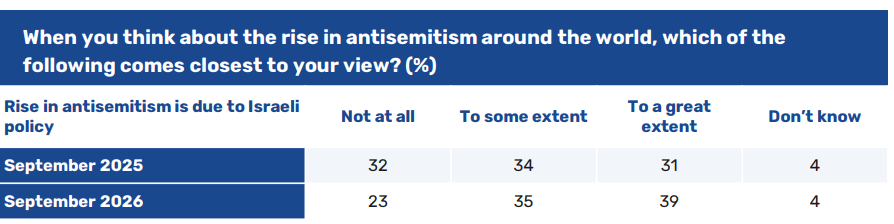
At the start of the new year, we returned to a question examined a year ago: Is the rise in antisemitism around the world related to Israeli policy? This year, responses shifted clearly in one direction – two in five connected Jews (39%) say Israeli policy contributes to rising antisemitism “to a great extent,” up from 31% in September 2025. Another 35% say it contributes “to some extent,” while just under one-quarter (23%) say the two are not related at all, down from 32% a year ago. In other words, the view that Israeli policy is connected to the rise in antisemitism has become more prevalent among connected Jews. As expected, responses differ substantially across ideological groups. A majority of strong liberals (68%) attribute the rise in antisemitism to Israeli policy “to a great extent,” compared with just 1% of strong conservatives; a majority of strong conservatives (55%) reject any connection. The divide by respondents’ 2024 vote is similarly sharp: 56% of Harris voters, compared with only 5% of Trump voters, say Israeli policy contributes to the rise in antisemitism “to a great extent.”
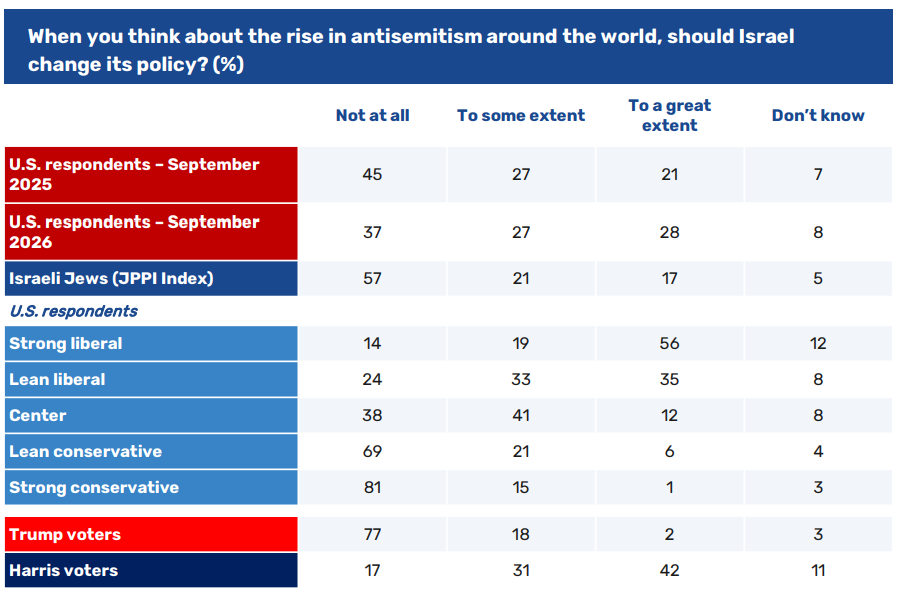
Responses also vary with respondents’ ties to Israel: among those who have visited Israel once, 48% say Israeli policy contributes to antisemitism “to a great extent,” compared with 31% of those who have lived in Israel. Comparing U.S. respondents with Israeli Jews, who were asked the same question this month in JPPI’s Israeli Society Index, highlights how much more critical connected U.S. Jews are of Israeli policy: 39% of U.S. respondents attribute the rise in antisemitism to Israeli policy “to a great extent,” compared with 28% of Israeli Jews. The share rejecting any connection is far lower among connected U.S. Jews (23%) than among Israeli Jews (44%). In Israel, the view that there is no connection between Israeli policy and rising antisemitism strengthened this year; among connected U.S. Jews, the trend was in the opposite direction. Similarly, the share of respondents who believe Israel should change its policy in response to rising antisemitism also increased this year. Just over one-quarter of connected Jews (28%) now say Israel should change its policy “to a great extent,” compared with 21% a year ago, while the share saying Israel should not change its policy at all fell from 45% to 37% (the question did not specify how Israeli policy should change).
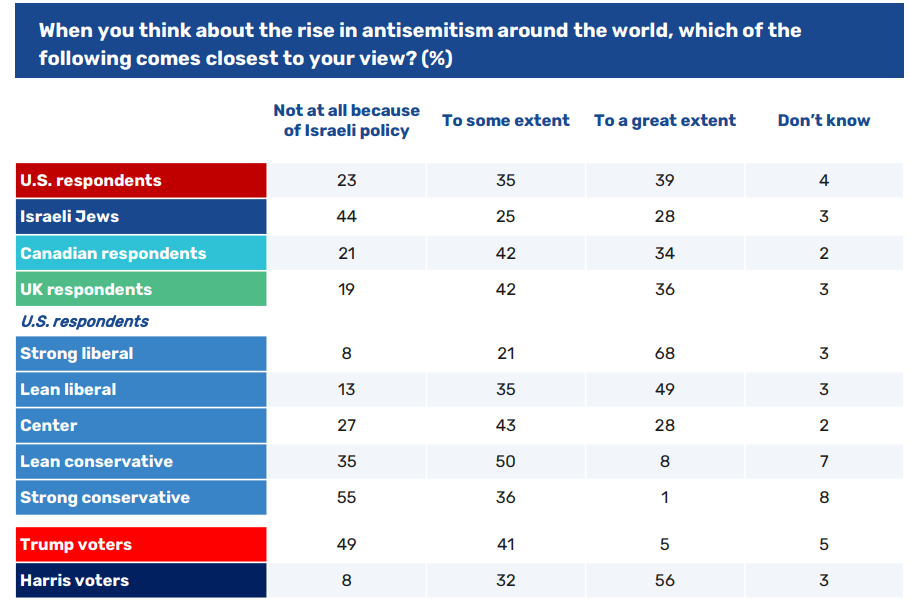
Political differences are again pronounced: a majority of strong liberals (56%) support substantial policy change, compared with only 1% of strong conservatives. Fully 81% of strong conservatives and 77% of Trump voters say policy should not change at all. The gap between connected U.S. Jews and Israeli Jews is also evident in responses to the policy-change question: 28% of connected Jews say Israel should change its policy “to a great extent,” compared with 17% of Israeli Jews. A majority of Israeli Jews (57%) say policy should not change at all, compared with 37% of connected U.S. Jews. Thus, the increase recorded this month among connected U.S. Jews widens rather than narrows the gap between them and Israeli Jews. As the next section shows, however, criticism of Israeli policy does not translate into acceptance of international measures against Israel.
International Measures Against Israel: Anti-Israel or Antisemitic?
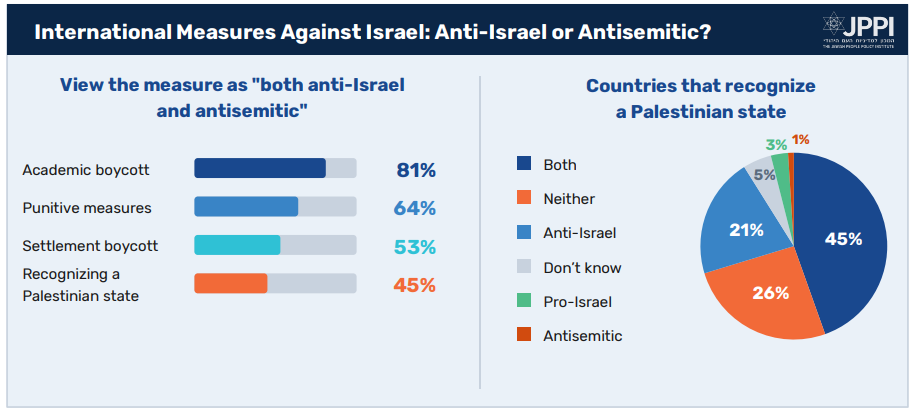
This month, we examined four types of measures countries take toward Israel, three of which were also examined a year ago. We asked respondents whether each was anti-Israel, antisemitic, both, or neither. For all four measures, the most common response is “both anti-Israel and antisemitic,” although the intensity of rejection varies. Rejection is less pronounced for recognition of a Palestinian state (45% say this is both anti-Israel and antisemitic) and especially high for an academic boycott of Israel (81%). Recognition of a Palestinian state is also the only measure that a sizable share of respondents (26%) view as “neither anti-Israel nor antisemitic.” Compared with September 2025, the share of respondents who regard these measures as both anti-Israel and antisemitic has clearly risen. The share describing recognition of a Palestinian state this way rose from 40% to 45%; calls for punitive measures against Israel because of the humanitarian situation in Gaza, from 48% to 64%; and an academic boycott, from 70% to 81%. The question about boycotting settlement products was asked for the first time this year, following related measures taken by several European countries in recent weeks. Just over half of respondents (53%) say a ban on products from Israeli settlements in Judea and Samaria (the West Bank) is both anti-Israel and antisemitic.
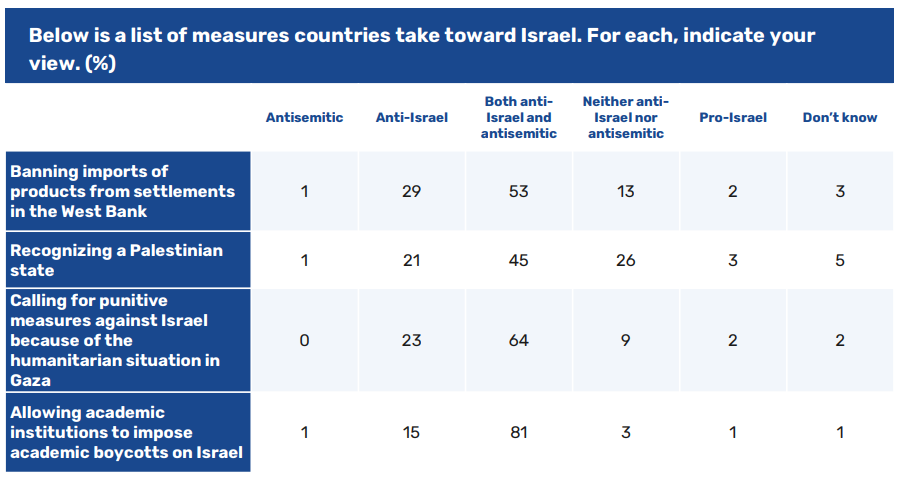
When connected U.S. Jews are compared with Israeli Jews, the pattern seen on the broader antisemitism question is reversed: connected U.S. Jews are more likely than Israeli Jews to classify these international measures as “both anti-Israel and antisemitic.” The gap is pronounced for academic boycotts (81% versus 50%), calls for punitive measures (64% versus 42%), and recognition of a Palestinian state (45% versus 32%). Israelis also view these measures as hostile, but are more likely to classify them as “anti-Israel” alone rather than as antisemitic. In other words, connected U.S. Jews are more critical of Israeli policy, yet also more likely to see antisemitism in measures taken against Israel. The rise in criticism of international measures is not uniform; it is sharper for measures perceived as more direct and harmful. An academic boycott associated with the delegitimization of Israel on campuses, a particularly sensitive issue for the connected American Jewish community draws the strongest rejection: only 3% regard such boycotts as “neither anti-Israel nor antisemitic.”
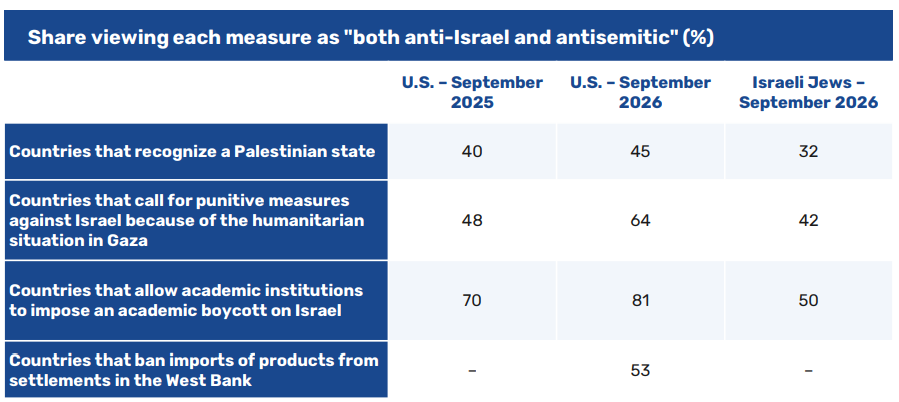
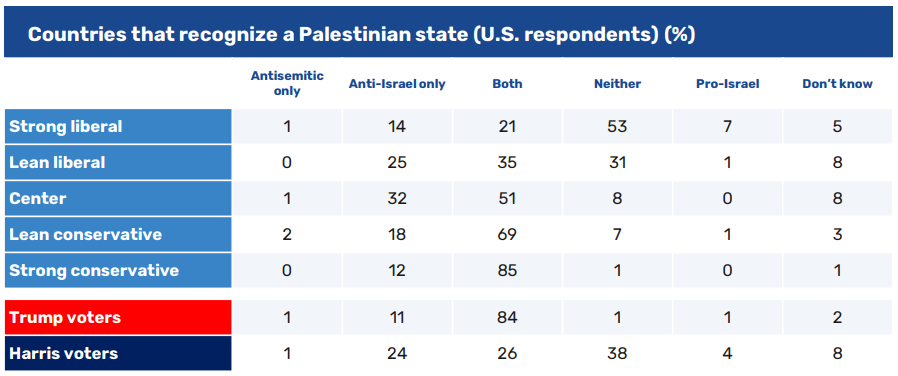
At the other end of the spectrum, recognition of a Palestinian state a diplomatic step that also has supporters on the Jewish left is least likely to be viewed as both anti-Israel and antisemitic: one-quarter (26%) regard it as neither anti-Israel nor antisemitic. The measure examined for the first time this year, a boycott of settlement products, falls in the middle (53% “both”), while 13% call it “neither” the second-highest share after recognition of a Palestinian state. This reflects the distinct status of the settlements in the eyes of some connected Jews. On recognition of a Palestinian state, just over half of strong liberals (53%) say the step is neither anti-Israel nor antisemitic, while an overwhelming majority of strong conservatives (85%) view it as both anti-Israel and antisemitic. For academic boycotts, by contrast, a majority in every ideological camp say the measure is both anti-Israel and antisemitic.
The Ruffalo Controversy
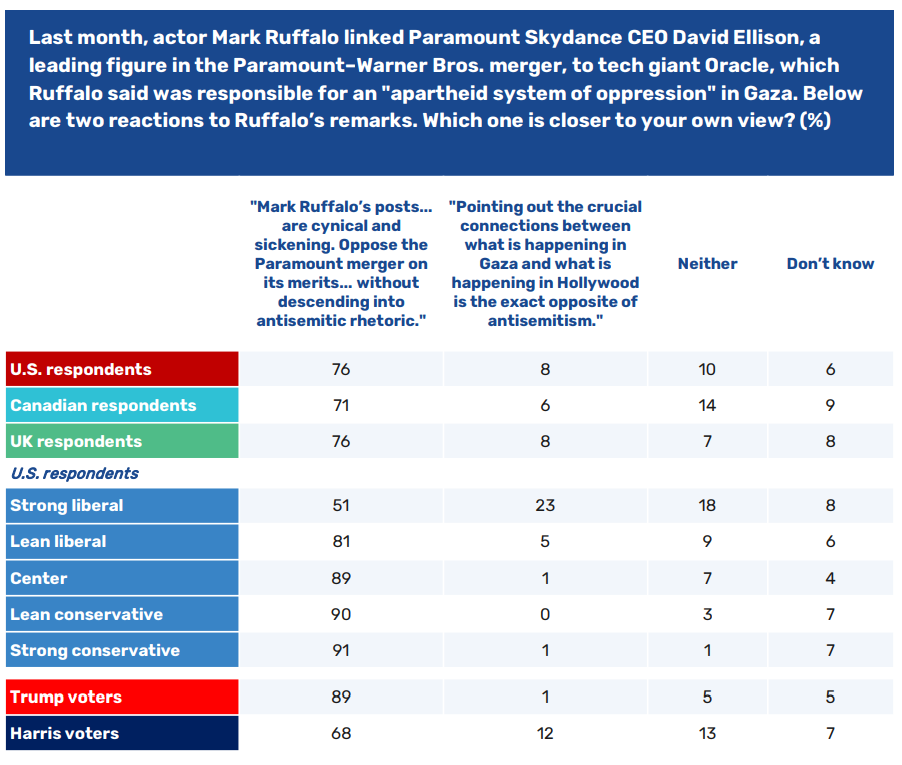
One issue that drew attention in the Jewish community this month involved actor Mark Ruffalo. In opposing a business deal, Ruffalo linked David Ellison, the Jewish CEO of Paramount Skydance and a central figure in the Paramount-Warner Bros. merger, to tech giant Oracle, which Ruffalo said was responsible for an “apartheid system of oppression” in Gaza. The remarks drew widespread condemnation from Jewish organizations, as well as letters of support for Ruffalo. We presented respondents with excerpts from two responses to his remarks one critical and one supportive – and asked which came closer to their own view. A large majority (76%) chose the view that “Mark Ruffalo’s posts… are cynical and sickening. [One can] oppose the Paramount merger on its merits… without descending into antisemitic rhetoric.” Only one in twelve respondents (8%) chose the view that “pointing out the crucial connections between what is happening in Gaza and what is happening in Hollywood is the exact opposite of antisemitism.” One in ten (10%) said neither statement reflected their view.
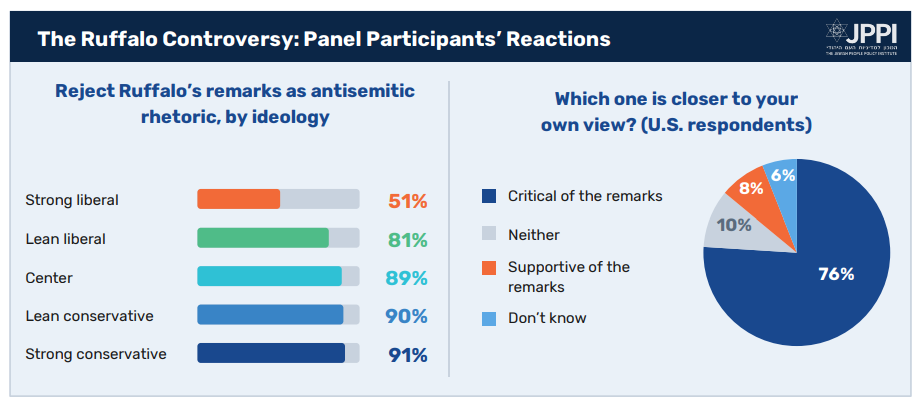
Rejection of Ruffalo’s remarks cuts across political camps. Even among strong liberals the group most inclined to criticize Israel half (51%) chose the statement rejecting the actor’s remarks as antisemitic rhetoric, compared with just under one-quarter (23%) who agreed with him. Among centrists and conservatives, the rejection is nearly unanimous. The Ruffalo controversy provides a concrete illustration of what emerges from the more abstract questions in the preceding sections: panel participants who are willing to criticize Israeli policy, and even to attribute part of the rise in antisemitism to it, still identify and reject rhetoric they perceive as antisemitic when it accompanies political criticism.
Israel’s Election
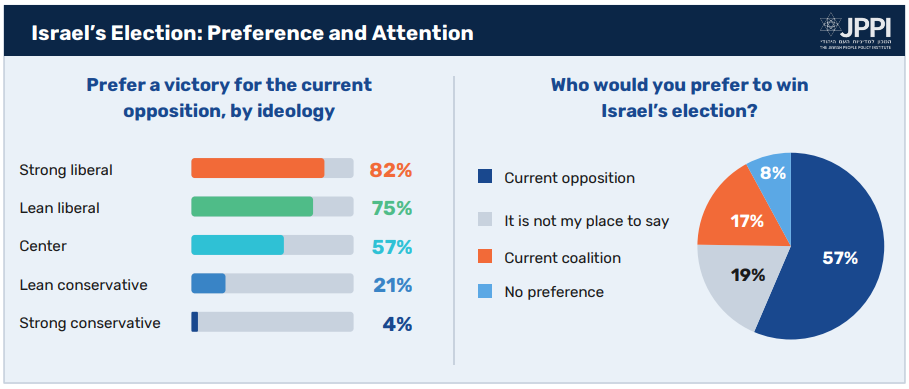
With Israel’s election scheduled for the end of October, the preference for the current opposition recorded among connected panel participants in August remained largely unchanged this month. A majority (57%) prefer an opposition victory (54% in August), compared with 17% who prefer the current coalition (14% in August). Another 8% have no preference, while 19% say it is not their place to say, down from 24% in August.
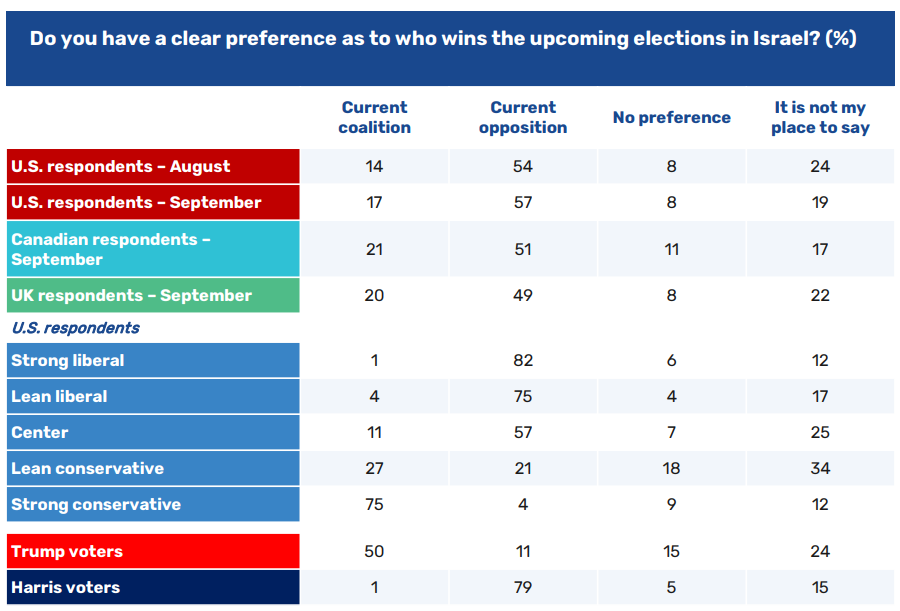
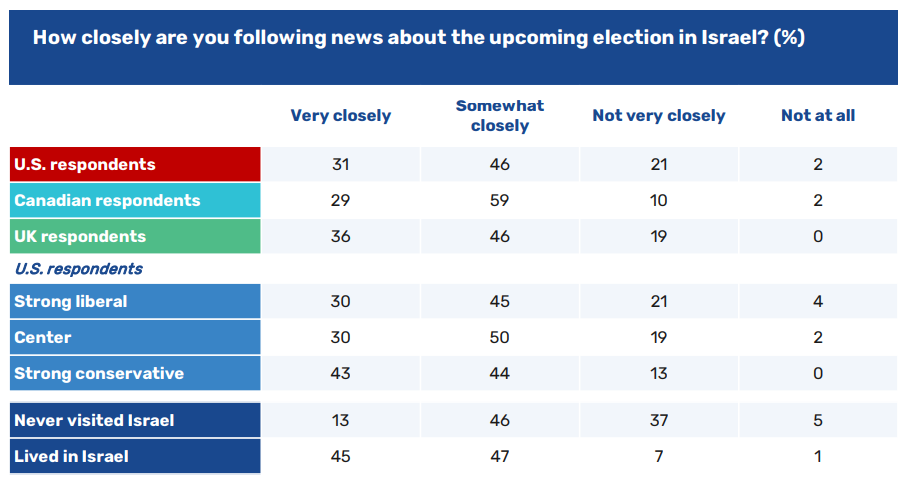
Attention to the election remains high: 77% follow election news “very closely” (31%) or “somewhat closely” (46%), even though only 8% are eligible to vote. Political preferences regarding Israel continue to mirror the U.S. partisan divide: 82% of strong liberals and 79% of Harris voters prefer the opposition, while 75% of strong conservatives and 50% of Trump voters prefer the coalition. Canadian respondents (51%) and UK respondents (49%) also lean toward the opposition. The stronger respondents’ ties to Israel, the more closely they follow the election. Among those who have lived in Israel, 45% follow the election “very closely,” and the combined share following it “very closely” or “somewhat closely” reaches 92%. Among those who have never visited Israel, by contrast, only 13% follow it “very closely,” while more than one-third (37%) do not follow it very closely. Political differences in attention to the election are more modest than those in electoral preference.
Leadership Ratings on Iran
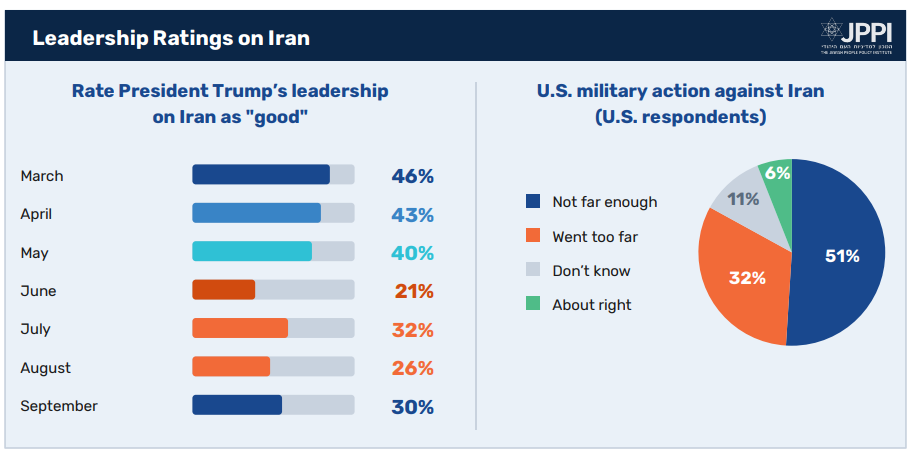
The ongoing confrontation with Iran received less news coverage this month, but the survey continued to track two related indicators. Views of U.S. military action remained hawkish and stable: 51% say the action “did not go far enough,” compared with 32% who say it “went too far.” The political divide is sharp seven in ten strong liberals (70%) feel the action went too far, while nine in ten strong conservatives (91%) favor a tougher approach. President Trump’s leadership rating on Iran, which fell to a low in June (21% “good”) and has since recovered somewhat, edged up again in September to 30%. Still, nearly two-thirds (64%) rate his leadership as “poor,” including 52% who rate it “very poor.”
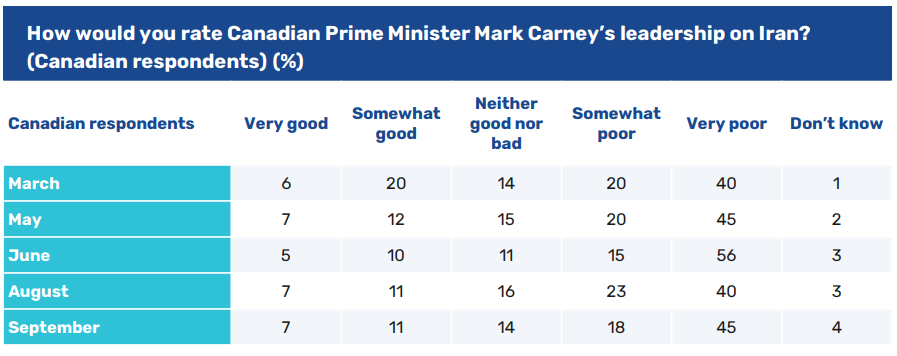
Ratings again vary substantially by political orientation: 83% of strong conservatives rate his leadership positively, while 92% of strong liberals rate it “very poor.” Among Canadian and UK respondents, their respective prime ministers continue to receive substantially lower ratings on Iran than Trump does. Only 18% rate Canadian Prime Minister Mark Carney’s leadership as “good,” while just 10% say the same of UK Prime Minister Andy Burnham, down from 16% in August. In both communities, a majority rate their own prime minister’s leadership as poor.
Looking Ahead to the New Year
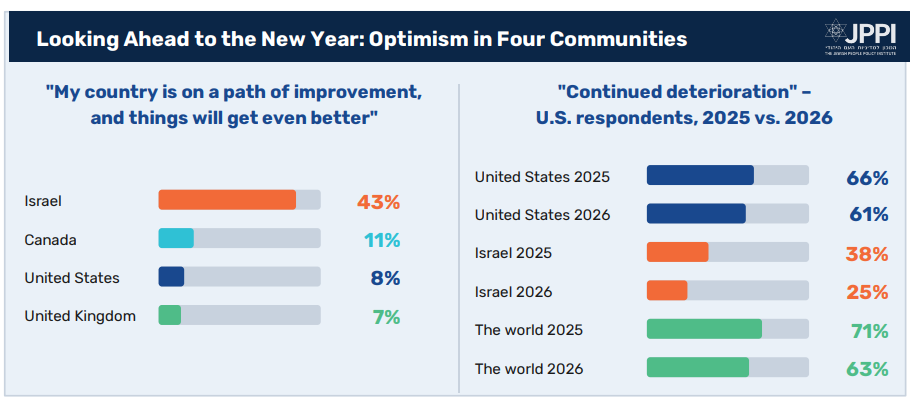
As in previous years, we examined the Jewish mood ahead of Rosh Hashanah. This time, we can compare four communities side by side: connected U.S. Jews, Jews in Canada and the UK, and Israeli Jews, who were asked identical questions in JPPI’s Israeli Society Index earlier this month. Respondents were asked how optimistic or pessimistic they are about the future of their own country, Israel, and the world as a whole. The overall picture is pessimistic, but a clear distinction emerges: in every community, the largest group of respondents fears continued deterioration in the state of the world, while views of their own country vary substantially. Israeli Jews are far more optimistic about their country’s future than Diaspora Jews are about the future of theirs. Among Israeli Jews, 43% say Israel “is on a trajectory of improvement and things will get even better,” compared with just 8% of connected U.S. Jews regarding the United States, 11% of Canadian respondents regarding Canada, and 7% of UK respondents regarding the UK. At the same time, only 24% of Israeli Jews say their country is “on a trajectory of deterioration that will continue.” compared with 61% in the United States, 58% in Canada, and 64% in the UK.
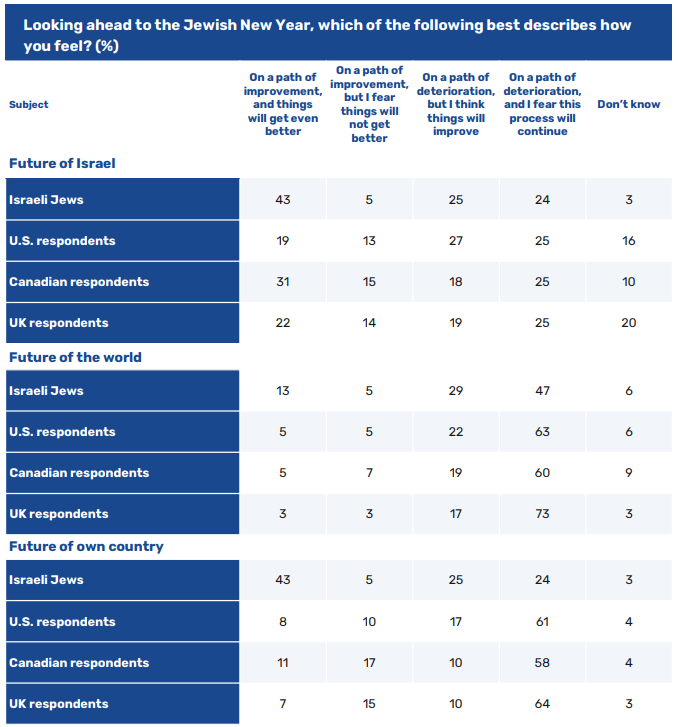
When it comes to optimism about Israel, the gap between communities narrows but remains substantial. While 43% of Israeli Jews choose the most optimistic response about their country’s future, only about half that share of connected U.S. Jews (19%) choose that response about Israel’s future. However, the share who see Israel as being on a “trajectory of continued deterioration” is nearly identical across all four communities about one-quarter in each. By contrast, all four communities are pessimistic about the world as a whole: pessimists constitute either a majority or the largest group in each, ranging from 47% among Israeli Jews to 73% among UK respondents, with U.S. respondents (63%) and Canadian respondents (60%) in between. In other words, Israeli Jews stand out in their confidence that their country can emerge from its current situation and secure a better future a confidence that has no parallel in the Diaspora and does not extend to the world as a whole. Panel participants are more optimistic about Israel than they were a year ago: the share who see its condition as deteriorating and expect that deterioration to continue fell from 38% in September 2025 to 25% this month.
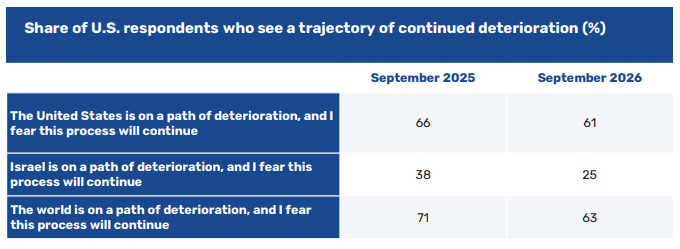
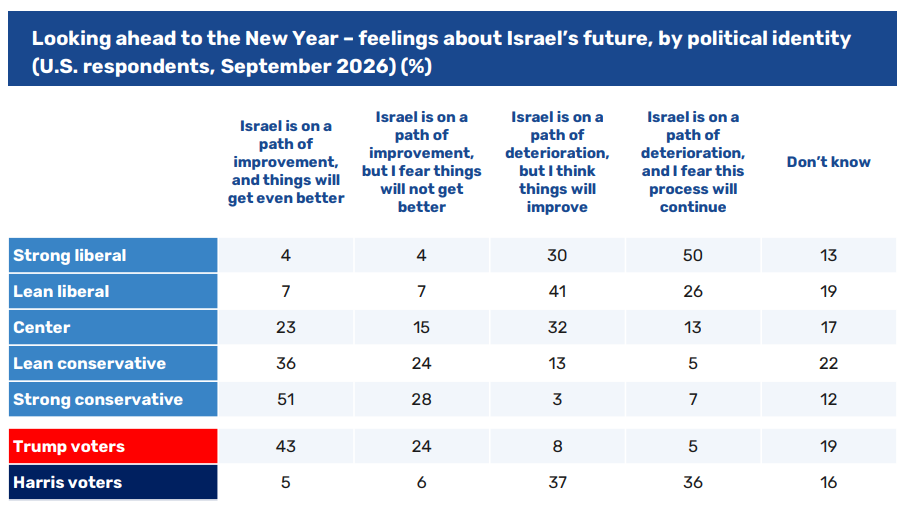
The picture regarding the United States is more pessimistic and has changed less: 61% see continued deterioration, compared with 66% a year ago. Pessimism is greatest about the world as a whole, although it, too, has declined, from 71% last year to 63% this month. Notably, 16% of panel participants say they do not know how to answer the question about Israel’s future, compared with only 3% of Israeli Jews. A breakdown by respondents’ 2024 vote shows that nearly three-quarters (73%) of Harris voters say the United States is on a trajectory of deterioration that will continue, compared with 37% of Trump voters; among Trump voters, 22% say the United States is on a path of improvement and will continue to improve. On Israel, ideological differences are also pronounced: half of strong conservatives (51%) are highly optimistic about its future, compared with just 4% of strong liberals, half of whom (50%) fear continued deterioration.
Hebrew and Yiddish Proficiency
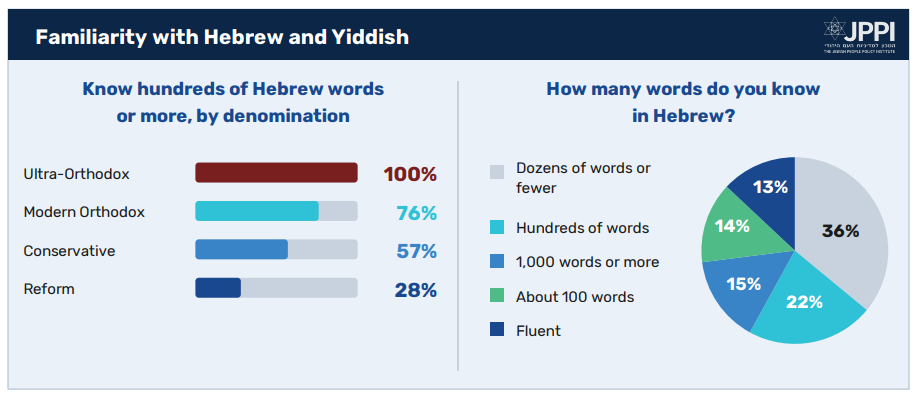
To mark the New Year, we also examined a dimension of cultural identity: panel participants’ familiarity with Hebrew and Yiddish. Knowledge of Hebrew is fairly widespread half of connected Jews (50%) report knowing “hundreds of words or more,” a finding that sheds light on the composition of the panel (13% are fluent, 15% know at least a thousand words, and 22% know hundreds of words). Only 2% say they do not know a single Hebrew word. Yiddish, by contrast, is far less familiar: 18% know hundreds of words or more, and the most common response is “dozens of words” (36%).
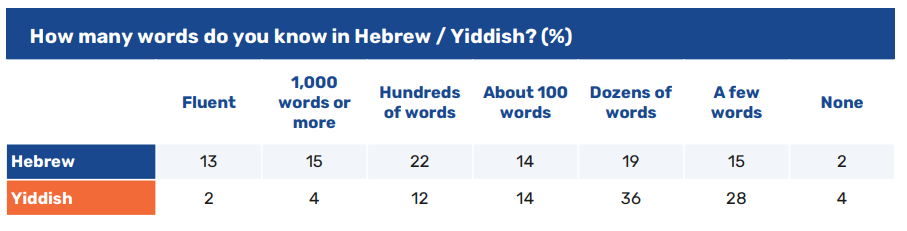
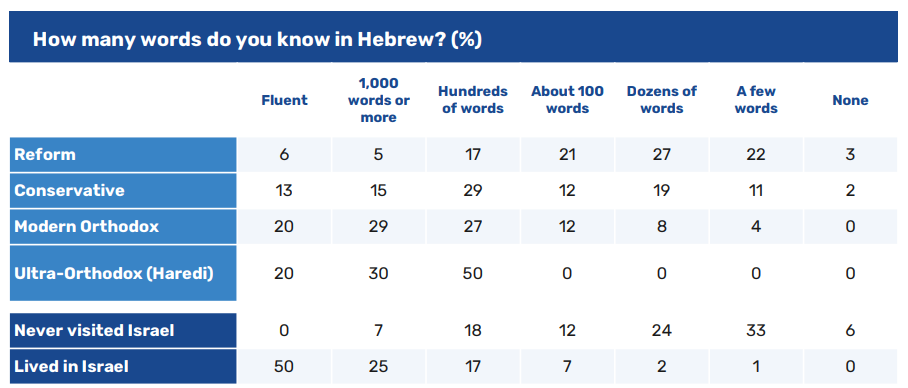
Familiarity with Hebrew increases with the strength of respondents’ ties to Israel and also varies by denomination. Among those who have lived in Israel, half (50%) are fluent Hebrew speakers and one-quarter (25%) know at least a thousand words. Among those who have never visited Israel, none are fluent and one-third (33%) know only a few words. Denominational differences are also sharp: among Modern Orthodox and Haredi respondents, a majority know hundreds of words or more, compared with fewer than one-third of Reform respondents. Familiarity with Yiddish is likewise greatest among Modern Orthodox and Haredi respondents.
Survey Data and Implications
This report is based on a survey conducted September 15-17, 2026, among participants in JPPI’s Voice of the Jewish People respondent panel. The survey primarily reflects the views of “connected” Jews those with relatively strong ties to the Jewish community, Israel, and/or Jewish identity and is not representative of all U.S. Jews. The survey included 646 U.S. respondents, 99 Canadian respondents, and 59 UK respondents. Unless otherwise noted, the results apply to U.S. respondents only; Canadian and UK findings should be interpreted with caution given their small sample sizes. JPPI’s Voice of the Jewish People Index survey was conducted by JPPI fellows Shmuel Rosner and Noah Slepkov, with research and writing assistance from Yael Levinovsky. Prof. David Steinberg provided statistical oversight.