


The uprising is a textbook liberation movement, but supporting it could serve Israeli interests – and this doesn’t fit the oppressor-oppressed binary.
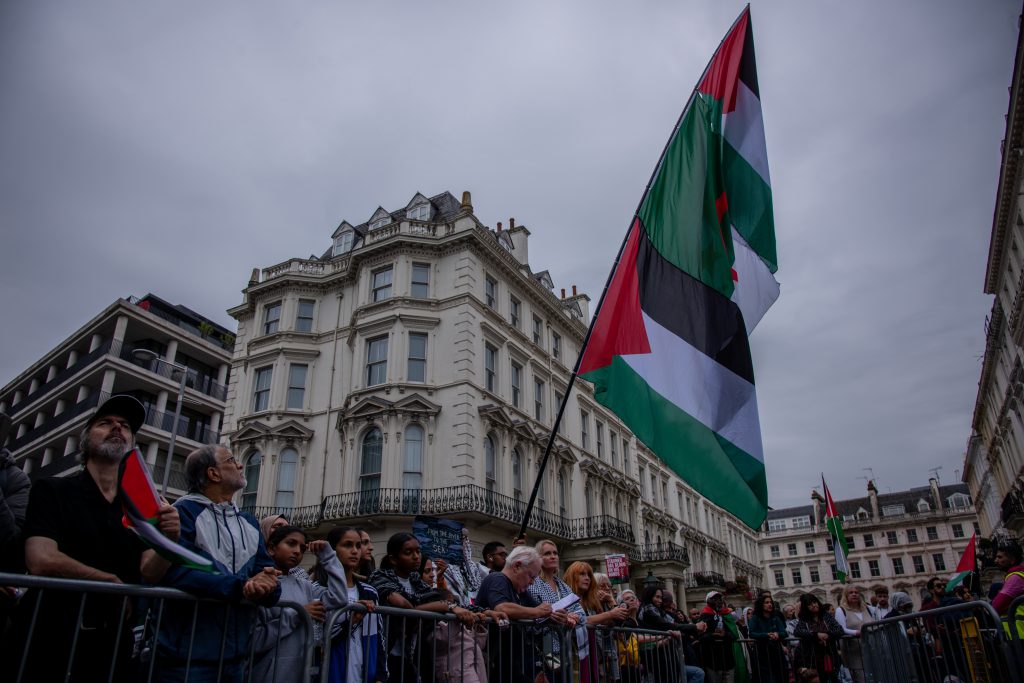
Over the past year, Europe’s streets have been chock full of protesters. Hundreds of thousands have turned out in London, Paris, Berlin, Madrid, and Brussels – demonstrating on behalf of Gaza. Parliaments have convened emergency sessions. Millions have signed petitions. Several governments have halted arms sales to Israel. For much of the time, Gaza has dominated Europe’s political discourse, particularly on the left.
Meanwhile, in Iran, something remarkable is unfolding. Women are tearing off their hijabs in open defiance. Students are facing down security forces. Workers are walking off the job. Protesters are being dragged to prison, tortured, and executed after trials in kangaroo courts. And Europe’s response? A few statements. Some vigils. NGO reports that barely make the news. Nothing remotely approaching the mobilization for Gaza.
This isn’t about compassion fatigue or lack of information. The images are there. The stories are brutal. The gap reveals something fundamental: certain causes carry an ideological cost, and that cost determines which struggles ignite mass solidarity. The uprising in Iran checks every box that should matter to progressive Europeans. It targets a theocratic regime that subjugates women, censors thought, executes dissidents, and denies basic freedoms. The protesters in Iran demand exactly what the European left claims to defend as universal human rights: free speech, bodily autonomy, and the dignity of self-determination. By any measure, what is happening from Tehran to Iranian backwaters is a textbook liberation movement.
Yet it remains marginal in Europe’s political imagination. The reason is structural, not moral. Iran is Israel’s primary ideological and military adversary. For decades, Tehran has funded Hamas and Hezbollah and built its regional strategy around confronting the Jewish state. This creates an uncomfortable reality: Israel and the Iranian protesters share, at minimum, a common adversary. Whether through intelligence cooperation, cyber operations, or simple geopolitical alignment, any weakening of the Iranian regime potentially serves Israeli interests.
That overlap – real or perceived – is precisely what makes the Iranian revolt so difficult to integrate into the current framework of the European left.
Consider what each cause offers symbolically. Supporting Gaza reinforces moral identity, provides clear political positioning, produces a coherence of activism, and fits seamlessly into existing frameworks that rely on Western guilt and the rejection of colonialism. Supporting Iranian protesters, by contrast, requires condemning a regime that positions itself as “anti-imperialist,” complicates familiar geopolitical narratives, and creates potential alignment – even indirect – with Israeli interests. The cognitive dissonance and ideological ambivalence are too much to bear,
The numbers tell the story. Pro-Gaza demonstrations regularly draw 100,000 to 300,000 protesters across European cities. London saw over half a million at one march. The European Parliament has debated Gaza repeatedly. National governments have faced sustained public pressure.
When it comes to Iran? A few thousand show up on good days. Parliamentary initiatives are sparse and symbolic. The news cycle barely pauses when the Iranian regime executes dissenters. No government has faced a political cost for its inaction. This isn’t a judgment about sincerity. Many on the European left genuinely feel sympathy with Iranian protesters. But acting on that sympathy carries a price – an ideological price they’re reluctant to pay.
Fully embracing the Iranian uprising would mean acknowledging uncomfortable truths: that a regime presenting itself as anti-Western can be profoundly oppressive; that Israel might find itself aligned with forces of liberation; that the oppressor-oppressed binary doesn’t always map cleanly onto geopolitical reality.
In the current climate – particularly after October 7 – these acknowledgments have become nearly impossible. The demand for moral simplicity outweighs the supply of solidarity. Israel has been cast in the role of absolute antagonist, the embodiment of colonial sin and Western complicity. Supporting a movement that might indirectly benefit Israel threatens this entire structure. So, silence becomes the path of least resistance. Not because of indifference to Iranian suffering, but because the ideological cost of full-throated support exceeds what the political moment can tolerate.
This produces a paradox: the European left is capable of extraordinary mobilization when solidarity reinforces its existing worldview. It becomes cautious, measured, and suddenly attentive to “complexity” when solidarity risks disrupting that worldview. Iranian women beaten in the streets, young people executed after sham trials, students expelled, journalists tortured – their struggle disappears into the distance not because it lacks merit, but because it arrives with the wrong geopolitical baggage.
What we’re witnessing isn’t hypocrisy in the conventional sense. It’s something more structural: a political movement sorting causes not by their justness, but whether they fit comfortably within established ideological parameters. The question isn’t whether the European left cares about Iranian protesters. Many do. It is whether that care can survive interaction with a framework that makes full solidarity ideologically expensive.
So far, the answer appears to be no. And that tells us something important about how ideological architecture determines which struggles merit action and which fade into background noise, regardless of their moral urgency.