


When freedom of worship is not upheld—especially for minorities—even when doing so clearly serves the state’s own interests, something is profoundly wrong.
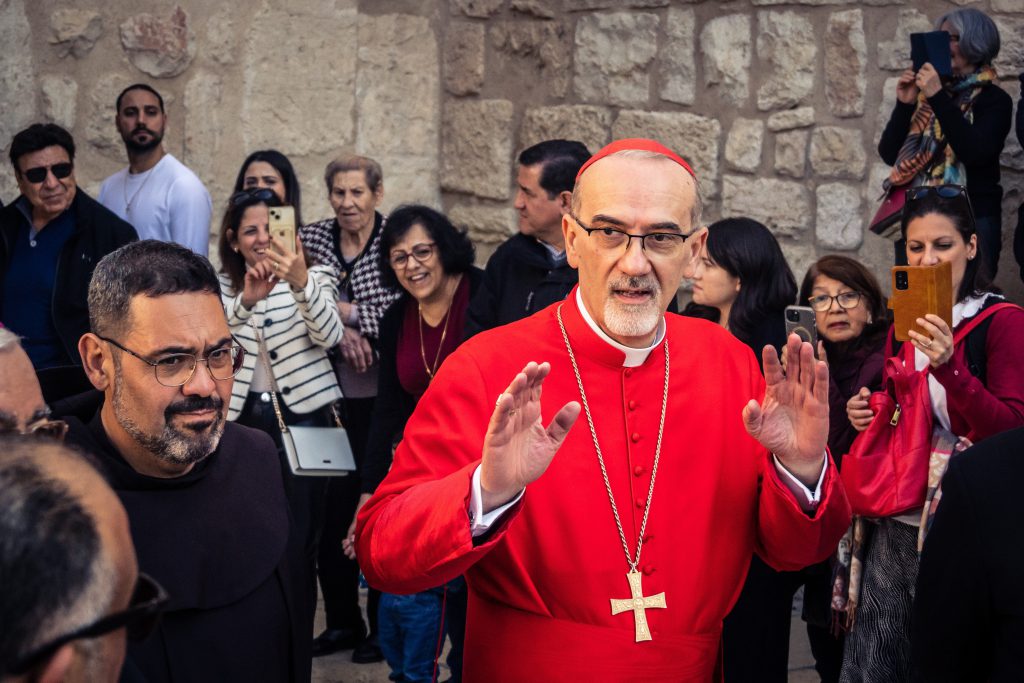
Recently, the Israeli police prevented Cardinal Pierbattista Pizzaballa, the Latin Patriarch of Jerusalem, and the Custos of the Holy Land on behalf of the Vatican, Francesco Ielpo, from entering the Church of the Holy Sepulcher as they made their way to the Palm Sunday Mass. The two were stopped en route, without any procession or public ceremony, and were forced to turn back. The incident, justified on the grounds of “ensuring their safety,” places Israel on a collision course with the Catholic Church—still the most powerful religious institution in the world—on the eve of the holiest days in the Christian calendar.
This is an unprecedented event: for the first time in centuries, the heads of the Church have been prevented from conducting one of Christianity’s most important rites. It constitutes a direct violation of freedom of worship and a dramatic departure from the long-standing status quo and the most basic norms of respect for holy sites and believers worldwide. One can only imagine how such a policy is being interpreted. When a state takes so drastic a step without even the appearance of concern for the religious rights of millions of Christians around the world, it sends a deeply troubling message. The contrast between the closure of holy sites and images of large ultra-Orthodox weddings proceeding undisturbed likewise does little to convey a sense of equality.
This outrageous decision must also be read alongside last week’s controversy, when, at a press conference with international media, Prime Minister Benjamin Netanyahu paraphrased the American historian Will Durant to argue that justice and morality are insufficient to overcome the forces of evil, adding that “Jesus Christ has no advantage over Genghis Khan.” The remarks, widely perceived as offensive to Christians, were swiftly denied by Netanyahu and dismissed as “fake news.” In his clarification, he insisted that Christians “are protected and flourish in Israel.”
The wide resonance of those earlier remarks compelled Netanyahu to respond in both cases. His political engagement with Christian audiences—particularly evangelical ones, whose relationship with the Catholic Church is marked by deep rivalry into which Israel would do well not to enter—is well known. Yet the real issue is not political alignment or shared interests, but something far more fundamental: freedom of worship is a foundational principle of any society that seeks not merely to survive, but to truly live.
A state that does not protect the right of Christians to practice their faith with dignity fails at something far deeper than diplomacy. And that, today, is precisely the situation in Israel.
Since its founding, Israel has had to navigate the complex task of governing religious minorities whose significance extends far beyond its borders—above all Christianity, for which Israel is both birthplace and home to its most sacred sites. Over time, a delicate status quo emerged, regulating Christian life in Israel: its institutions, its sacred spaces, and the millions of pilgrims who visit them.
We should not mistake the Prime Minister’s words of reassurance for a reflection of current policy. They are closer to wishful thinking than to reality. The condition of Christians in Israel today is far from ideal, and the recent events at the Church of the Holy Sepulchre once again make this clear.
Christian communities in Israel face significant structural challenges. The absence of a clear legal framework governing religious and property registration creates ongoing difficulties for church leadership. Burial arrangements remain insufficiently regulated. Disputes over municipal taxation persist. Bureaucratic restrictions at times limit the conduct of religious ceremonies. Christian ecclesiastical courts receive unequal funding. Christian educational institutions suffer from chronic underfunding, despite their longstanding contributions to Israeli society. Many holy sites endure ongoing neglect, and Christian holidays and events often pass without any official acknowledgment by the state—reflecting a troubling indifference.
At the same time, issues of personal security have intensified significantly. Since the late 2000s, numerous incidents of vandalism and violence against churches, monasteries, cemeteries, and clergy have been documented. According to annual reports by the Center for Freedom of Religion Data, since 2023 there has been a sharp increase in harassment and violence against Christians, including spitting, verbal abuse, physical assaults, property damage, and disruptions of religious ceremonies—particularly targeting priests and monks. While the police have taken certain steps, such as installing cameras and increasing their presence in sensitive areas, many investigations are closed for lack of evidence, leaving communities with a persistent sense of vulnerability.
As a scholar of religion, I can say this: when freedom of worship is not upheld—especially for minorities—even when doing so clearly serves the state’s own interests, something is profoundly wrong. But one need not be a scholar to recognize the point: a society that fails, in practice, to safeguard the religious freedom of its minorities undermines its own foundations.