


Fewer Israelis believe that the war in Iran will lead to positive long-term change in the Middle East than a month ago.
Additional Findings
- There has been a decline in the public’s overall sense of victory since the start of Operation Roaring Lion.
- A majority believes that if a U.S.-Iran agreement is reached that does not meet Israel’s objectives, the fighting should be halted.
- The achievements of the 12-day June 2025 war are perceived less positively than before.
- The achievements of the Lebanon campaign in fall 2024 are perceived less positively than before.
- Most Israelis believe that additional rounds of fighting will be required in Iran, Lebanon, and Gaza.
- Most Israelis say violence by Jews against Palestinians in Judea and Samaria (West Bank) must be confronted.
- Most Israelis are dissatisfied with the 2026 budget.
- Surging support for additional funding for the rehabilitation of the North and South, with a marked preference for cuts to the ultra-Orthodox (Haredi) sector.
- Election priorities: on the center-left, replacing the government; on the right, judicial reform.
- Only a quarter of Israelis are satisfied with the range of political options ahead of the upcoming elections.
- The prevailing perception of the main difference among candidates for prime minister: “wisdom” (right) and “caring” (center-left).
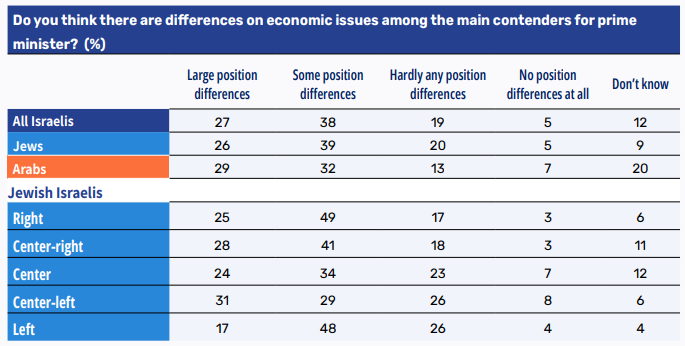
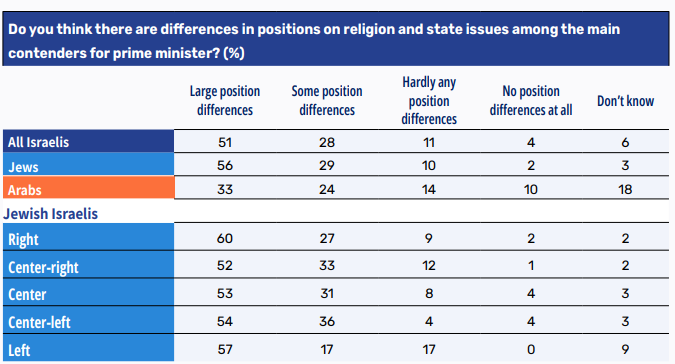
- Differences in perceptions of candidates’ positions are most pronounced on religion and state issues, less so on security and the economy.
To download the PDF file, click here.
The Iran War
This April survey was conducted before Passover, in the midst of the war with Iran, alongside a sharp escalation on the northern front in Lebanon. After four months of relative calm – beginning with the ceasefire in Gaza and the return of all hostages – Israel returned to a state of war. This round of fighting, Operation Roaring Lion, lasted 40 days until the United States and Iran announced their acceptance of a Pakistan-brokered ceasefire. The “Islamabad Agreement” stipulated a two-week ceasefire during which negotiations for a long-term cessation of hostilities would be held. In parallel with the calm on the Iranian front, the fighting with Hezbollah continued in Lebanon.
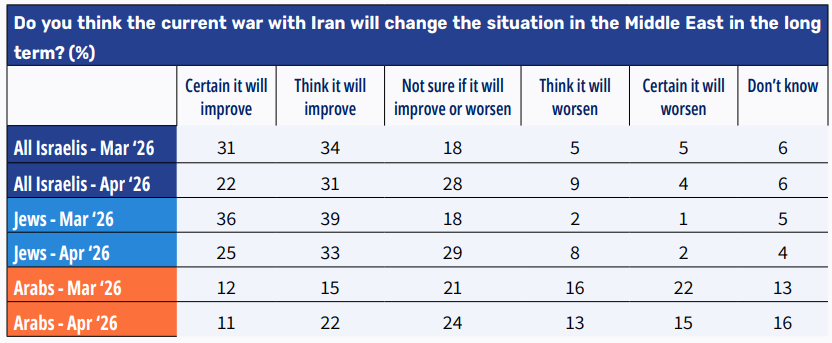
This month saw a decline in optimism about the effect of the Iran war on the Middle East. Half of Israelis (53%) believe the situation after the war will improve in the long term (22% are certain and 31% think so). At the same time, 28% are unsure, and 13% think the situation will worsen (9% think so and 4% are certain). Among Jewish Israelis, optimism is slightly higher: 58% anticipate positive change, 29% are unsure, and 10% foresee a worsening. Among Arab Israelis, 33% anticipate positive change, 24% are unsure, and 28% believe the situation will worsen.
Compared with last month, the survey points to a weakening belief that the current war will improve the situation in the Middle East over the long term. The share of Israelis who are certain that the situation will improve fell from a third (31%) to a fifth (22%), while the share who are unsure rose from a fifth (18%) to a quarter (28%). This weakening was recorded only among Jewish Israelis, where the figure fell from 75% to 58%. Among Arab Israelis, by contrast, there was a slight increase in the expectation of positive change, from a quarter (27%) to a third (33%).
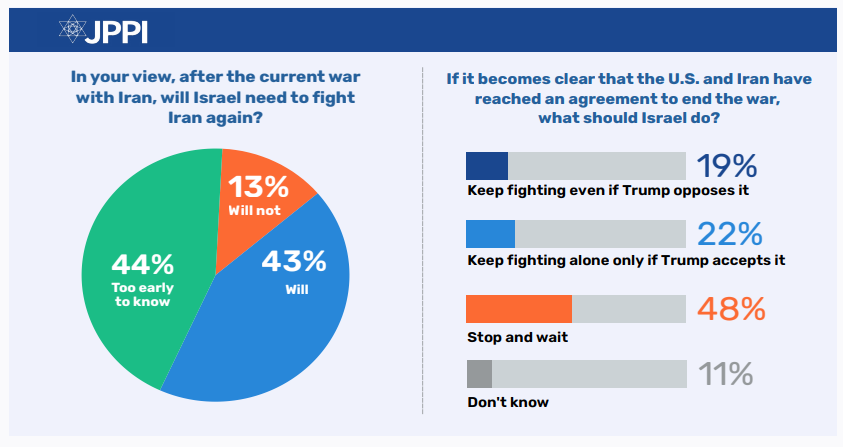
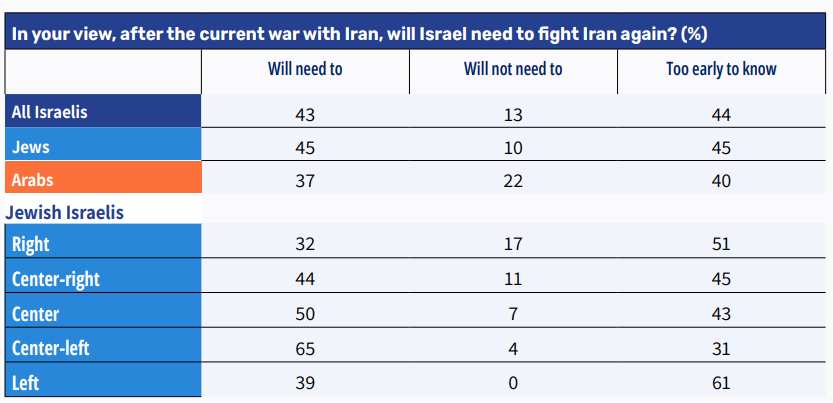
Forty-three percent of Israelis believe that, once the war ends, the situation in Iran will not have changed enough to prevent another war. A similar share (44%) says it is too early to tell. Only 10% think that no additional war with Iran will be required. This finding is broadly consistent with the shift in recent weeks in Israelis’ views of the war’s possible effect on the Middle East.
Twenty-two percent of Arab Israelis believe that Israel will not need to return to fighting Iran after the current war. This share is significantly higher than the share of Jewish Israelis who think so (10%). Broken down by ideological orientation (Jewish Israelis only), center and center-left respondents tend to believe that Israel will need to fight again (50% and 65%, respectively). The share is lower (32%) on the right, but most respondents (51%) say it is too early to know. In none of the ideological groups does the share who believe Israel will not need to return to fighting Iran after the current war exceed one-fifth.
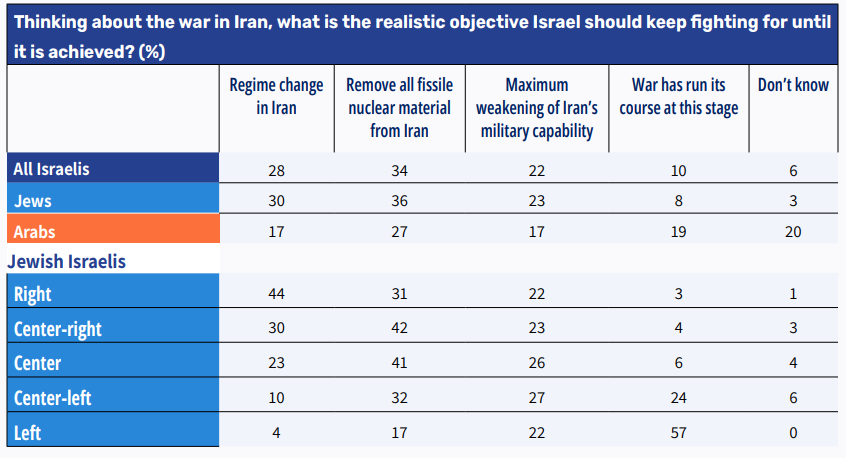
This month, we asked respondents what realistic objective Israel should continue fighting for until it is achieved. Thirty-four percent of respondents think the removal of all fissile nuclear material from Iran is the ultimate objective, followed by regime change (28%) and the maximum weakening of Iran’s military capability (22%). Alongside these responses, 10% of Israelis believe the current war has already run its course. Among Arab Israelis, 17% support regime change, 27% support the removal of nuclear material, and 17% support military weakening. A higher share of Arab Israelis (19%) believes the war has run its course than their Jewish counterparts, and 20% do not know.
Broken down by ideological orientation (Jewish Israelis only), regime change is the leading objective on the right (44%), while there is a clear preference for removing the nuclear material among center-right and centrist respondents (42% and 41%, respectively). There is a broader distribution among the center-left: military weakening (27%), nuclear material (32%), and the view that the war has run its course (24%). On the left, the view that the war has run its course is especially prominent (57%). In other words, the farther left one moves along the ideological spectrum, the lower the support for continuing the fighting to achieve broad objectives and the stronger the tendency to see the war as having already run its course.
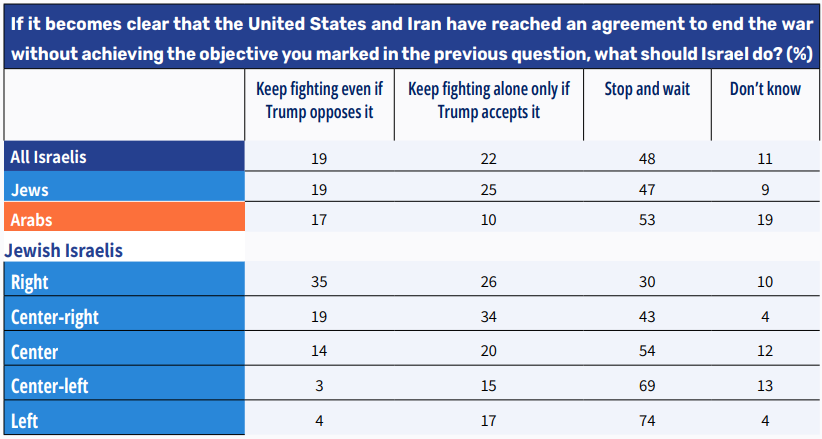
Following the question about war aims, we asked respondents what they think Israel should do if the United States and Iran reach an agreement to end the war without achieving the objective they had identified. This question takes on an acute relevance in light of recent events, as it is possible that the current ceasefire will lead to a long-term agreement between the U.S. and Iran to end the war, thus realizing the scenario described in the question. Half of Israelis (48%) think that in such a case, Israel should stop and wait for further developments. Only a minority supports continued independent fighting – a fifth (19%) favors continuing the war even without President Trump’s support, and another fifth (22%) favors continuing only if he accepts it. Among Jewish Israelis, the tendency to condition continued fighting on American approval is somewhat stronger (25%), whereas among Arab Israelis, the preference for stopping and waiting is more robust (53%), alongside a relatively high share (19%) who did not know.
Here, too, substantial gaps were found between ideological cohorts. On the right, there is a strong willingness to continue fighting: 35% support doing so even without approval, 26% only with approval, and 30% prefer stopping if there is a U.S.-Iran agreement without the Israeli war aim having been achieved. The opposite approach becomes stronger as one moves toward the center and the left: half (54%) of those who self-identify as centrist favor stopping, and the majorities become even more substantial among the center-left and left (69% and 74%, respectively). The center-right also leans toward stopping (43%), but with significant weight given to continued fighting in coordination with the United States (34%).
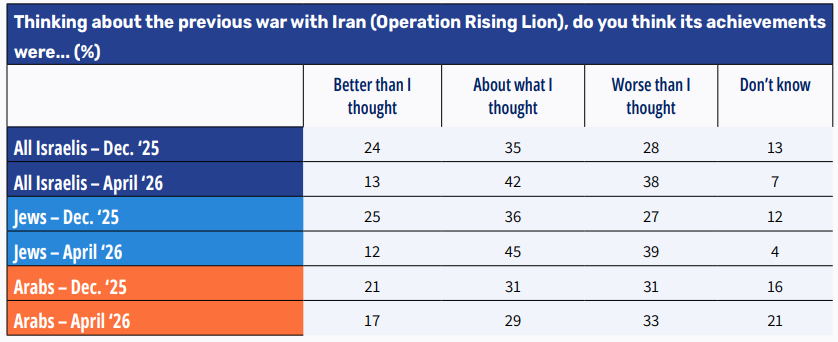
The difficulty of achieving the objectives hinted at the beginning of the campaign, likely requiring another one, appears to have eroded Israelis’ sense of achievement looking back at the June 2025 campaign, Operation Rising Lion. Four in ten Israelis (38%) now say it achieved less than they had previously thought. Forty-two percent say that their perception of the results of Rising Lion was about what it had been, and 13% think the results were better than they had previously thought. This is a significant change relative to four months ago, when we asked the same question half a year after the war. Since December 2025, the share of Israelis who think the war results were better than they had previously thought declined, and the share who think the war results were worse than they had thought increased by ten percentage points. The share who think the results of “Rising Lion” remained unchanged since last December also rose by ten percentage points.
The War in Lebanon
In recent weeks, there has been a sharp escalation of fighting with Hezbollah on the northern front. The IDF has expanded targeted ground activity in southern Lebanon in an effort to push Hezbollah forces north of the Litani River and destroy the organization’s underground infrastructure. Hezbollah, for its part, has responded with drones and extensive rocket fire, targeting communities along the border with Lebanon and into central Israel. Residents of the North, who only a year ago returned to their homes after a year and a half as evacuees, are once again coping with heavy fighting, and some have again left their homes voluntarily.
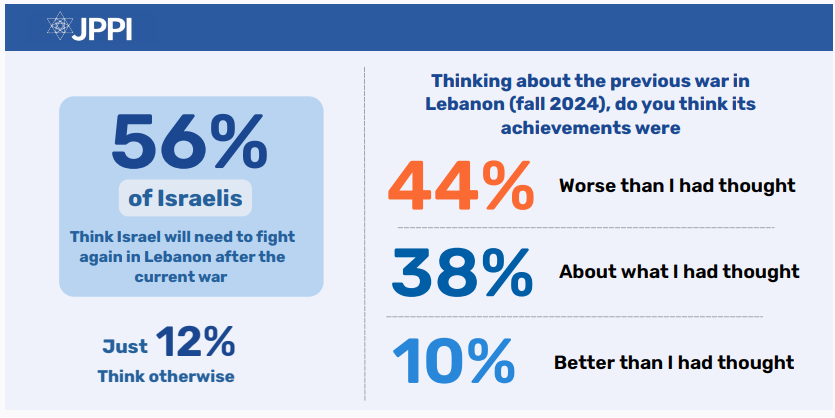
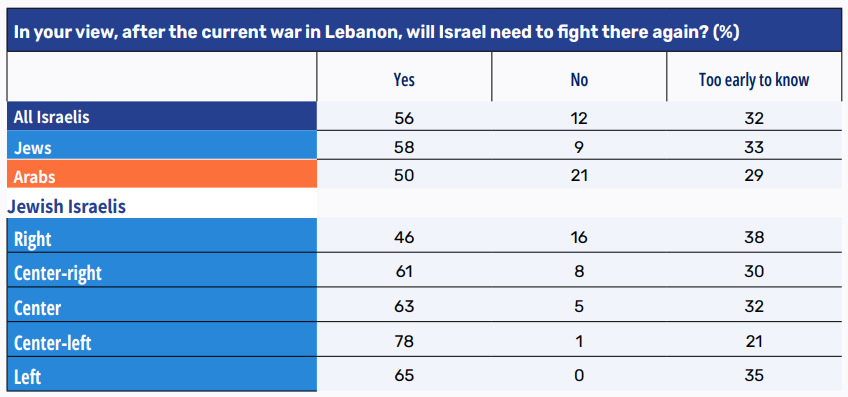
A majority of Israelis (56%) believe that the current campaign in Lebanon will not be the last, with just 12% thinking otherwise and 32% saying it is too early to tell. Among Jewish Israelis, this pessimistic assessment is even more pronounced, with 58% saying that renewed fighting on the northern front will be required and only 9% believing it will not. Half of Arab Israelis (50%) believe additional fighting will be required, compared with 21% who think it will not, and 29% who say it is too early to know.
Broken down by ideological orientation (Jewish Israelis only), the expectation that renewed fighting will be required increases as one moves leftward along the spectrum: 61% among the center-right, 63% among centrists, 78% among the center-left, and 65% among the left. The share is lower on the right (46%), which also includes a relatively high share who believe it is too early to know (38%).
Similar to our solicitation of retrospective assessments of the achievements of the June 2025 campaign against Iran, we examined how Israelis now perceive the achievements of the previous campaign in Lebanon, a year and a half ago. Only 10% of Israelis believe the achievements were better than they had thought in the past, while 38% say they were in line with previous assessments, and 44% say they were worse than they had previously believed. Among Arab Israelis, the share who think the achievements were worse than they had thought is lower (36%), alongside a higher share (17%) who now assess the achievements of the previous war in Lebanon more positively than they had in the past.
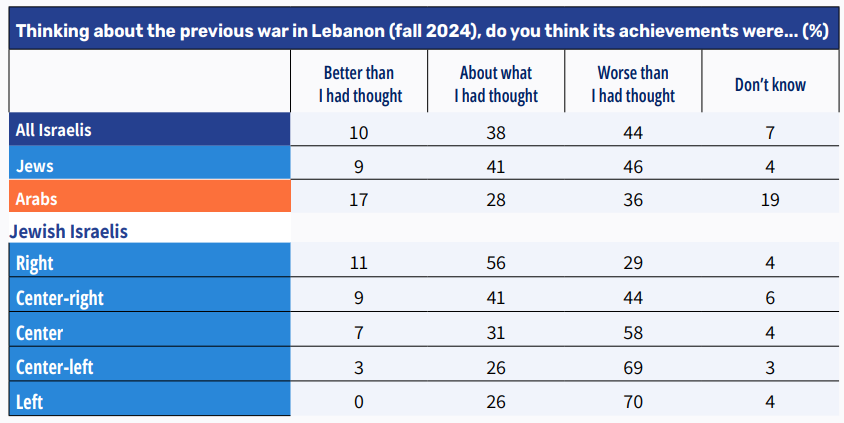
A majority (56%) of Jewish Israelis who self-identify as right-wing now assess the achievements of the war on the northern front as they had in the past, compared with 29% who view the achievements as less favorable than they had previously thought, and 11% who now view the achievements of the previous war with Lebanon more positively. Among centrist and left-wing Jewish Israelis, the picture is more critical: 58% of centrists, 69% among the center-left, and 70% on the left believe the achievements were worse than they had once thought. Taken together with the findings from the previous question, the data produces a consistent picture: a sense of only partial achievement translates into a broad expectation that the conflict is not over and may resume in the future. In other words, doubt about past success leads to the assessment that instability will continue.
The War in Gaza
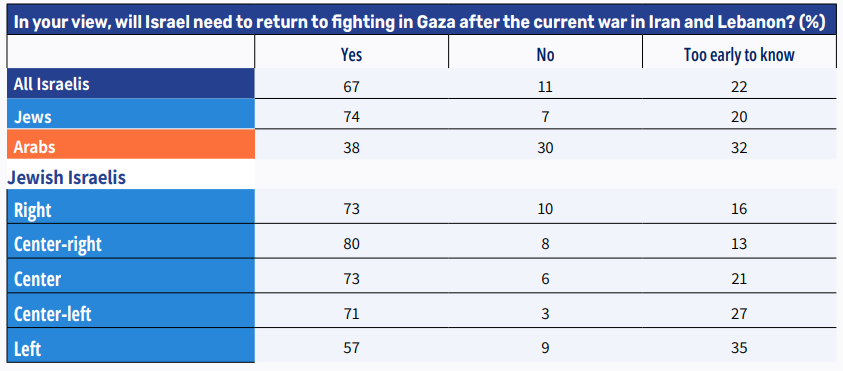
When identical questions are asked about the Gaza front, a 67% majority of the Israeli public believes that Israel will need to return to fighting there after the current war in Iran and Lebanon. By contrast, 11% think it will not, and 22% say it is too early to know. Among Jewish Israelis, the expectation that a return to fighting will be necessary is even clearer, with three-quarters (74%) anticipating renewed fighting and fewer than one-tenth (7%) believing it will not be necessary. Among Arab Israelis, the picture is different: 38% believe additional fighting will be required, 30% estimate that it will not, and 32% stress that it is too early to tell.
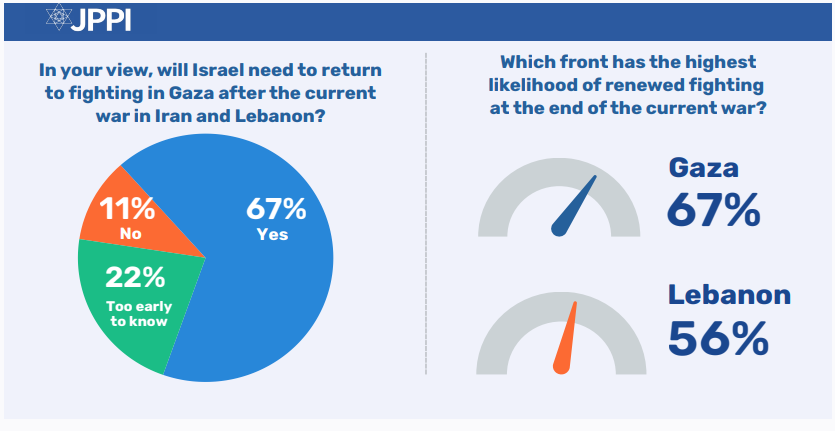
A breakdown by ideological orientation (Jewish Israelis only) shows broad agreement that Israel will need to return to fighting in Gaza. In every cohort, a majority estimates that additional fighting will be required, but this majority is firmer among the right than among the left. Accordingly, as one moves leftward along the ideological spectrum, the share who say it is too early to know rises from 16% on the right to 35% on the left. At bottom, there is a broad perception that the confrontations in the Gaza Strip have not ended and may resume once the current war in Iran and Lebanon concludes.
Trust in Leadership and Confidence in Victory
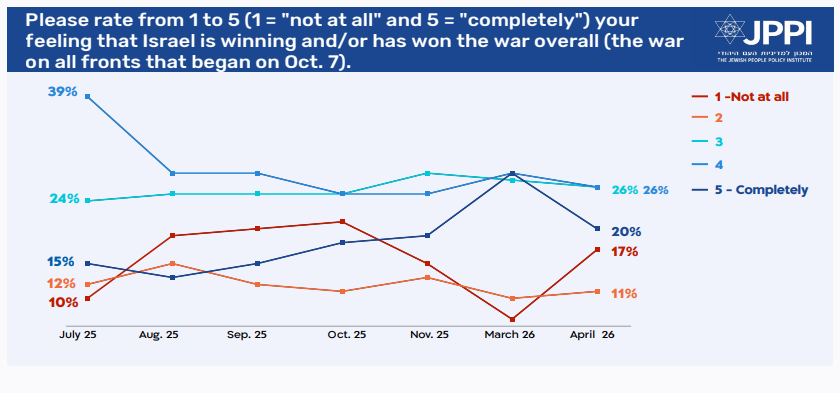
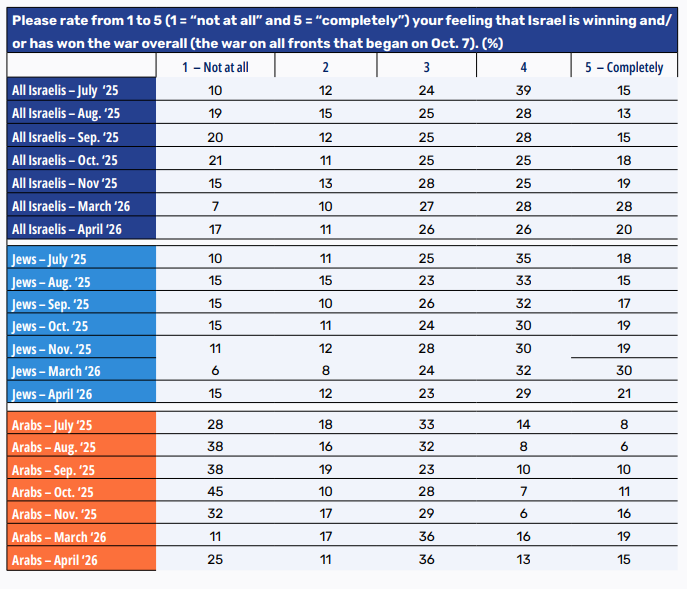
This month, JPPI’s Israeli Society Index found a decline among both Jews and Arabs on the general question of Israelis’ sense of victory in the war across all fronts. Whereas last month, with the beginning of the campaign in Iran, a majority of Israelis reported feeling that Israel was winning the war overall – the highest sense of victory recorded in the past year – this month saw a drop in confidence in victory – a return to the levels recorded six months ago. Among respondents in the two right-wing cohorts (center-right and right), most placed themselves at the higher levels of confidence in victory (4 or 5 out of 5), whereas among the centrist and left-wing cohorts (center-left and left), the mood is more pessimistic.
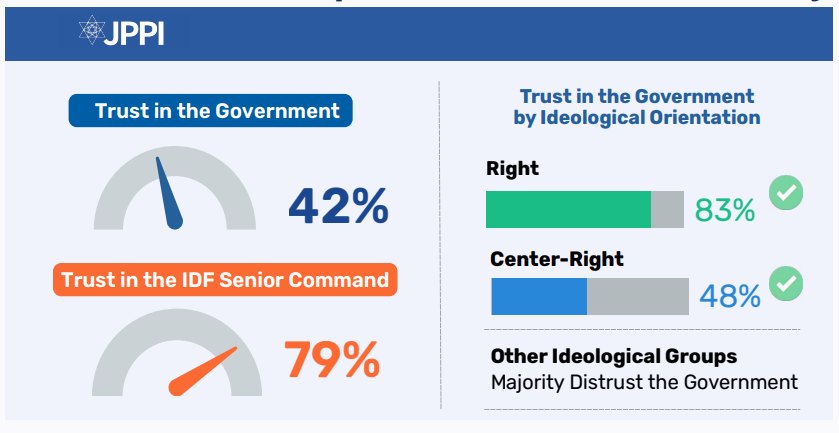
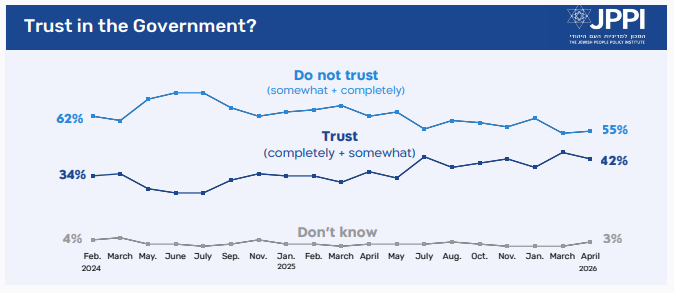
Following the peak of trust in the government recorded last month, with the outbreak of the Iran war, there has been a slight decline in Israelis’ level of trust in their government. A majority of the public (55%) reports not trusting the government, alongside 42% who do. Among Arab Israelis, the share of respondents who do not trust the government (63%) is higher than that of their Jewish counterparts (53%).
Broken down by ideological orientation (Jewish Israelis only), a majority in the right-wing cohorts (right-wing and center-right) trust the government (83% and 48%, respectively), whereas a majority of respondents in the center and left-wing cohorts do not trust the government. This majority grows as one moves leftward along the ideological spectrum.
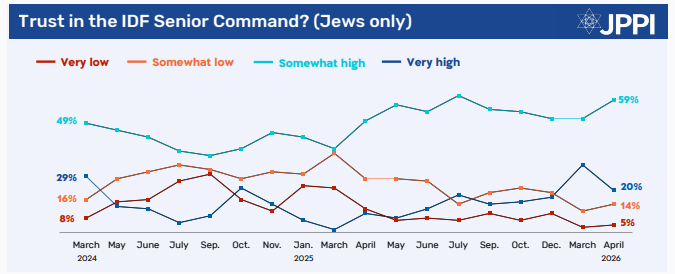
A 79% majority of Israelis express trust in the IDF senior command (20% completely and 59% somewhat). Among Jewish Israelis, the figure is even higher, at 79%, while a 52% majority of Arab Israelis also express trust in the IDF senior command. Compared with last month, the share of Jews who trust the IDF senior command has declined. The March survey was conducted a few days after the start of the Iran war and its successful opening strikes, in which the supreme leader and other senior Iranian leaders were killed. It is possible that the early successes generated a temporary increase that dissipated within a few weeks.
U.S.-Israel Relations
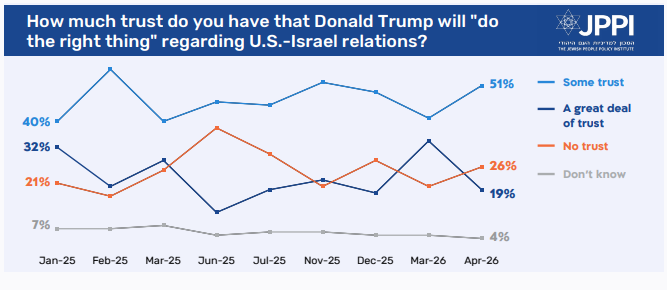
The ongoing cooperation between the United States and Israel in the Iran war is unprecedented. Still, this month saw a decline in Israelis’ trust that President Trump will “do the right thing” regarding U.S.-Israel relations. This may reflect the fact that the survey was conducted during a period in which there were several reports of Trump’s desire to bring the war to a rapid end. Nineteen percent say they have “a great deal of trust” in the president on this issue, 51% place some trust in him, and 26% say they have no trust that he will do the right thing regarding relations between the two countries. Despite a decline relative to last month, there is still a higher level of trust in him than recorded in the aftermath of the June 2025 12-day campaign. At that time, trust in the U.S. president stood at 64% (July 25), whereas this month it is 70%. The main difference lies in the share of respondents reporting “some trust” in Trump – 51% this month, compared with 45% in the survey conducted last July.
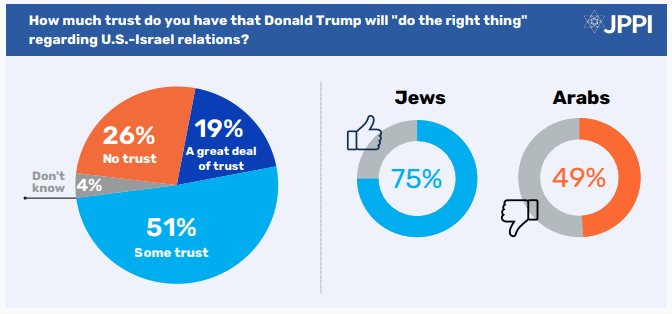
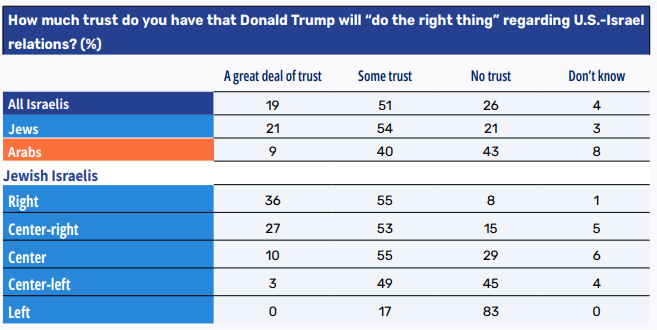
Trust that Trump will act appropriately in the context of U.S.-Israel relations is especially high among Jewish Israelis: 75% express trust in the president, while 26% say they have no trust in him. Among Arab Israelis, by contrast, the level of trust is much lower – 49%, with 43% reporting that they do not trust him. Broken down by ideological orientation (Jewish Israelis only), the trust increases as one moves rightward along the ideological spectrum.
Among the right-wing cohort, the highest level of trust is recorded (36% a great deal and 55% some). Among center-right respondents, a large majority expresses some level of trust (80%). In the center, the level of trust is still high at 65%, but among center-left and left-wing respondents, a different picture emerges: 83% of left-wing respondents say they have no trust in Trump, and just 17% report some trust in him. Compared with last month, trust in Trump has decreased across ideological cohorts, with the sharpest drop among those who identify as right-wing. At the start of the current Iran war, the share expressing “a great deal of trust” in Trump stood at 60%; this month it is only 36%.
Violence in Judea and Samaria (West Bank)
In the past month, several violent incidents perpetrated by Jews against Arabs in Judea and Samaria (West Bank) made headlines. We asked respondents to address a public appeal issued last month by Major General Avi Bluth, who heads the IDF Central Command, to the leaders of the Jewish communities in Judea and Samaria. In his letter, Bluth wrote that a “violent group of lawbreakers is operating in the area in violation of the laws of the state, the values of the Jewish people, and the values on which Zionism is founded. These people are harming a Palestinian population that is not involved in terrorism… Beyond the fact that these actions are illegal and immoral, they constitute a real danger.” Respondents’ reactions to Bluth’s letter indicate that most of the Israeli public does not condone the violence, but they are not uniform in their views of its scope and significance.
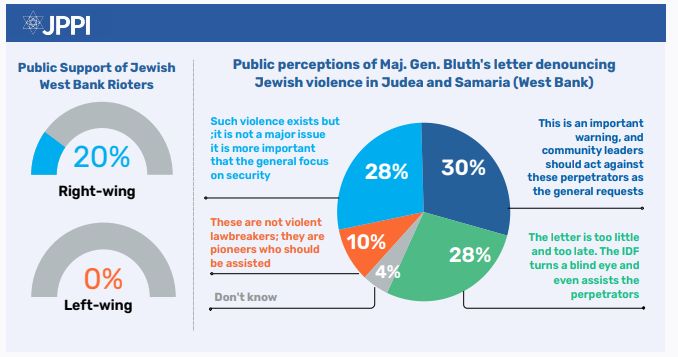
Thirty percent of respondents believe that Bluth’s letter is an important warning and that community leaders should act against those involved in the violence. One-quarter (28%) believe that Bluth’s condemnation is too weak and argue that the IDF turns a blind eye to, and even assists, the rioters. By contrast, 10% of respondents claim that “these are not violent lawbreakers; they are pioneers who should be assisted.” Another quarter does not attach much importance to the phenomenon: 28% chose the response that such violence does exist, but is not significant, and that it would be better for the regional commander to focus on security tasks.
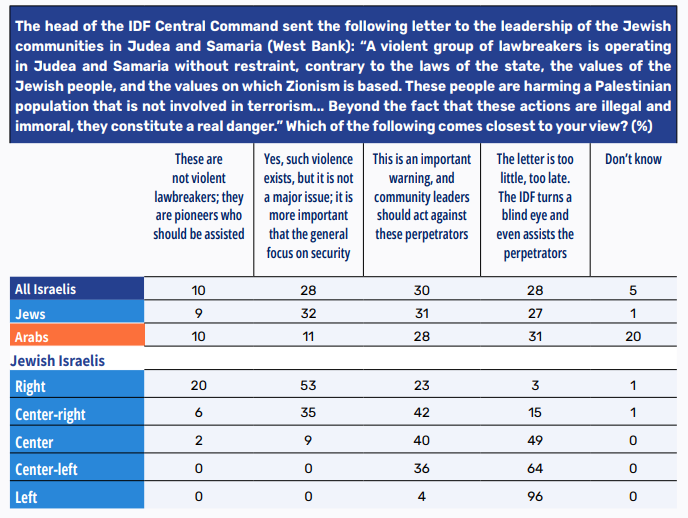
About half of the right-wing respondents (53%) believe that such violence indeed exists, but that “it is not a big deal, and it is more important that Bluth focus on security.” One-fifth (20%) of Jewish right-wing respondents believe that “these [the perpetrators] are pioneers who should be assisted.” That is, three in four right-wing respondents do not see the reported violence as a significant phenomenon that should be addressed with high priority. A breakdown by party affiliation is particularly striking: 36% of Otzma Yehudit voters say that “these are not violent lawbreakers; they are pioneers who should be assisted,” and 58% of them believe that the phenomenon of violence is marginal.
The head of the IDF Central Command sent the following letter to the leadership of the Jewish communities in Judea and Samaria (West Bank): “A violent group of lawbreakers is operating in Judea and Samaria without restraint, contrary to the laws of the state, the values of the Jewish people, and the values on which Zionism is based. These people are harming a Palestinian population that is not involved in terrorism… Beyond the fact that these actions are illegal and immoral, they constitute a real danger.” Which of the following comes closest to your view? (%)
The State Budget
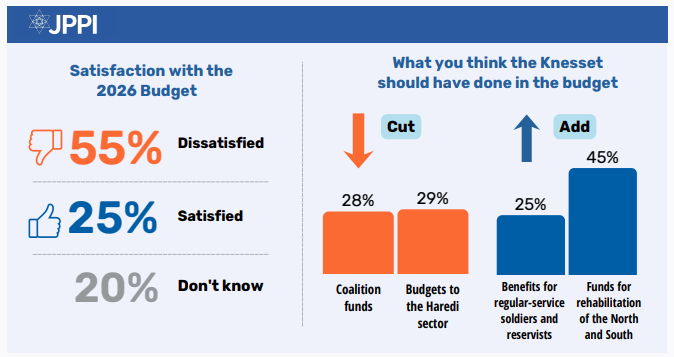
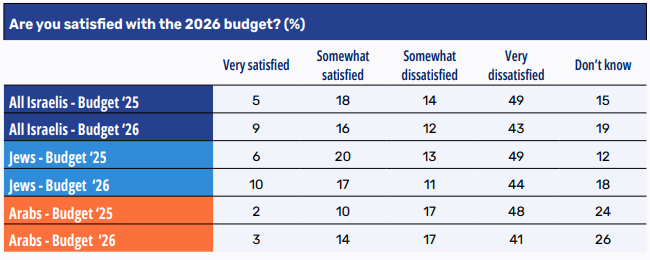
At the time of data collection for April’s Israeli Society Index, the 2026 state budget was approved by the Knesset. On the night the budget passed, an additional ILS 800 million allocation for the Haredi community was unexpectedly approved. As was the case last year, a majority of Israelis (55%) say they are dissatisfied with the budget, while one-quarter (25%) say they are satisfied with it. One-fifth (19%) of the public did not know how to answer the question – a relatively high rate, recorded among both Jews and Arabs. The share of Jewish Israelis satisfied with the budget (27%) is higher than the share of Arab Israelis (17%). Compared with last year, when we asked the same question about the 2025 budget, satisfaction with the budget is slightly higher. That said, this figure might have been different had the survey been conducted after the full scope of the late-night transfer of additional funds to the Haredi sector became clear.
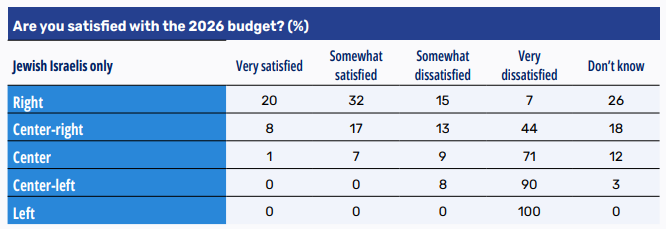
A breakdown by political camp shows sharp gaps in the level of satisfaction with the budget. On the right, satisfaction is relatively high, with 52% expressing satisfaction (20% very satisfied and 32% somewhat satisfied), alongside a minority expressing dissatisfaction (22%) and a relatively high share (26%) who did not know how to answer. By contrast, as one moves leftward along the political spectrum, satisfaction declines and criticism increases: among the center-right, 57% are dissatisfied (44% very dissatisfied), in the center, a clear 80% majority is dissatisfied (71% very dissatisfied); and among the center-left and the left there is almost no satisfaction, with 90% and 100%, respectively, expressing dissatisfaction. The findings point to deep political polarization around the budget, with support concentrated mainly on the right (though even there, it is only half of respondents), whereas the other camps show broad and unequivocal opposition.
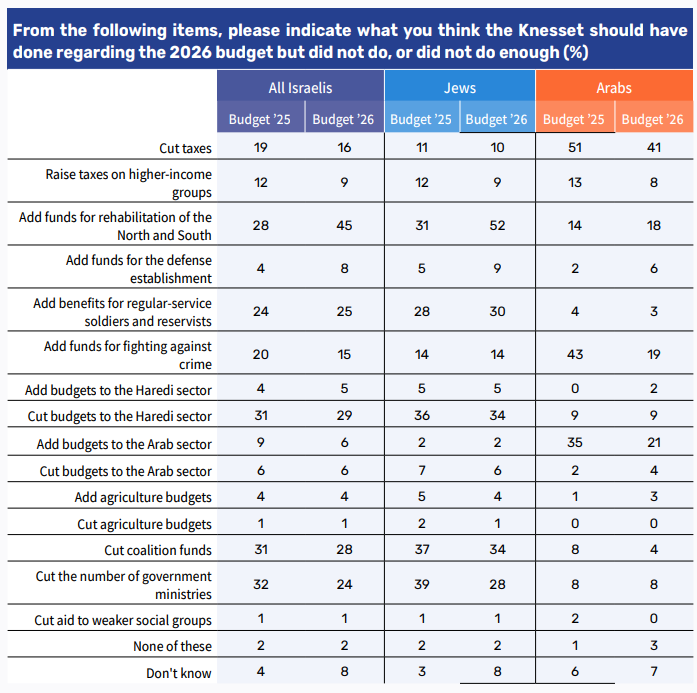
In addition to Israelis’ satisfaction with the state budget, we also examined what they think the Knesset should have done in the budget but did not do or did not do enough. Respondents were offered 17 response options and asked to mark the three items they considered most important to add to or cut from the budget. Unlike last year, the most prominent demand is to add funds for the rehabilitation of the North and South (45% marked this item as one of their three priorities). This is followed by calls to cut funding for the Haredi sector (29%), cut coalition funds (28%), and reduce the number of government ministries (24%). Also notable is the desire to add benefits for regular-service soldiers and reservists (25%). Among Jewish Israelis, the demand for rehabilitation of the North and South is even stronger (52%), whereas among Arab Israelis, different demands stand out – chiefly tax cuts (41%), alongside support for additional funding earmarked for the Arab sector (21%).
Compared with last year’s budget, several central trends stand out: as noted, there was an increase in the demand for investment in the rehabilitation of the North and South (from 28% to 45% among the public overall, and from 31% to 52% among Jews), alongside a slight rise in the demand to strengthen security. By contrast, there was a decline in the demand to step up funding to fight crime (from 20% to 15%) and in calls to reduce the number of government ministries (from 32% to 24%). Demand for cuts in coalition funds also weakened somewhat, although it remains high. Among Arab Israelis, especially notable changes were recorded over last year: a sharp and surprising decline in demand for additional funding to fight crime (from 43% to 19%), alongside a decline in demand for tax cuts and a moderate increase in demand for investment in reconstruction and budget allocations for the Arab sector.
2026 Elections
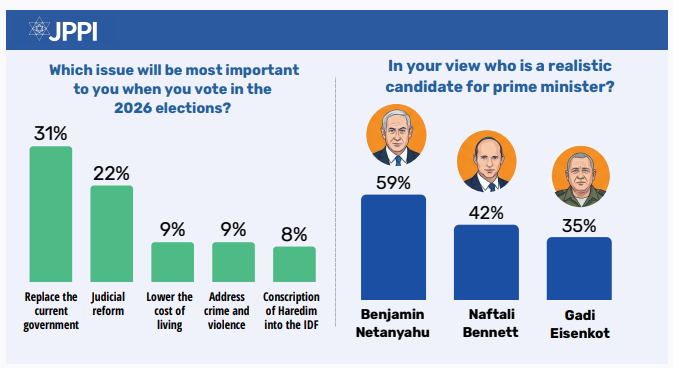
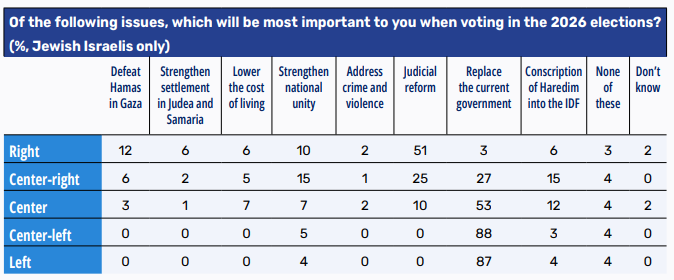
The most important issue for Israelis in the upcoming elections is replacing the current government (31%), followed by judicial reform (22%). Security-related issues, such as defeating Hamas in Gaza (6%) and encouraging settlement in Judea and Samaria (2%) are emphasized less, while addressing crime (7%) and lowering the cost of living (9%) still rank high on the list of decisive issues. Among Jewish Israelis, replacing the government (34%) and judicial reform (27%) clearly lead the list. Among Arab Israelis, by contrast, the central issue is crime and violence (29%), followed by lowering the cost of living (27%) and replacing the current government (20%). Compared with responses recorded two months ago, two notable changes have occurred among Arab respondents: the share ranking “addressing crime and violence” as the most important issue in the upcoming elections fell from 48% to 29%, and the share ranking “replacing the current government” rose from 8% to 20%.
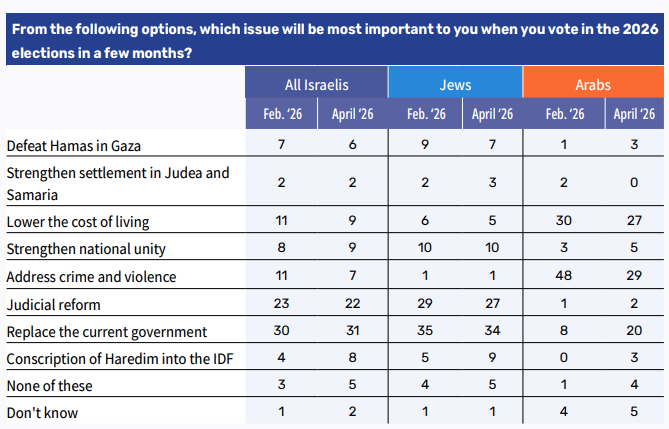
A breakdown by ideological orientation (Jewish Israelis only) shows that replacing the current government is the most important issue for most voters in the upcoming elections in the center, center-left, and left-wing cohorts, where it leads with shares of 53%, 88%, and 87%, respectively. On the right, by contrast, judicial reform carries relatively greater importance (51%). Among the center-right group, a wider dispersion of issues is evident: replacing the government leads (27%), followed by judicial reform (25%). Strengthening national unity (15%) and Haredi conscription (15%) also occupy meaningful places.
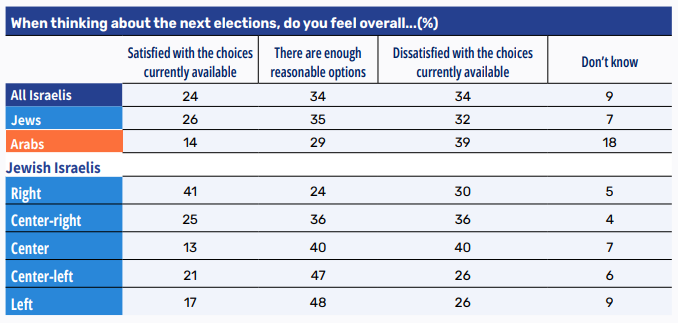
When considering the upcoming elections, a quarter of Israelis (24%) are satisfied with the existing parties and candidates, a third (34%) believe there are enough reasonable options, and another third (34%) expresses dissatisfaction with the existing options. Among Arab Israelis, dissatisfaction is higher (39%), and the share who are satisfied is lower (14%). The right-wing cohort has the highest share of respondents (41%) who are satisfied with the existing options. In the center and left-wing groups, by contrast, satisfaction levels are lower: 13% among centrists, 21% among center-left respondents, and 17% in the left-wing cohort.
Alongside examining Israelis’ satisfaction with the available options, we examined the differences that respondents think exist between the leading contenders for prime minister. The main difference Israelis attribute to the candidates concerns their level of wisdom and grasp of reality (34%), followed by differences in how much they care about the people and the state (24%). Ideological gaps are seen as less central (14%), as is acceptability across social groups (11%). One in ten Israelis (11%) believes there is no significant difference between the candidates. Among Arab Israelis, a relatively small share emphasizes differences in wisdom, alongside a higher share who believe there are ideological differences, as well as a higher share who believe there are no significant differences among the different candidates (19%).
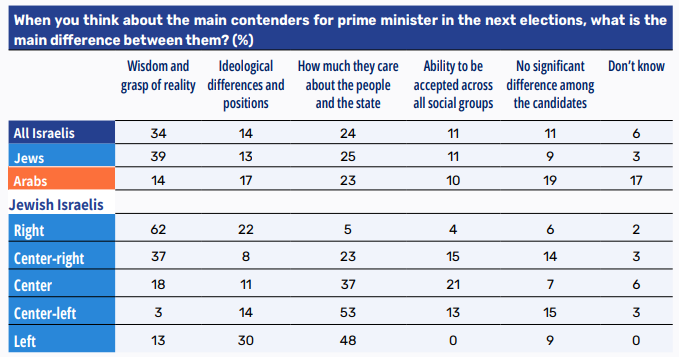
A breakdown by ideological orientation (Jewish Israelis only) reveals sharp gaps in perceptions of the differences: on the right there is a clear emphasis on wisdom and grasp of reality (62%), while in the center and center-left the claim that the main gap concerns how much the candidates care about the people and the state is especially prominent (37% and 53%, respectively). This claim also recurs when responses are examined by party affiliation. For example, 74% of Likud voters cited “wisdom and grasp of reality” as the main difference between the candidates for prime minister, while among supporters of Naftali Bennett or Gadi Eisenkot, the most prominent response is “how much they care about the people and the state” (48% and 42%, respectively).
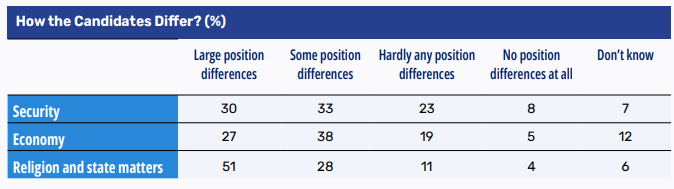
One-third (30%) of the Israeli public believes there are significant differences on security issues among the leading contenders for prime minister; 33% see some differences, and another 31% believe that there are hardly any differences or no differences at all. Among Jewish Israelis, a larger majority identify either large or some differences, and the share who did not know how to answer is negligible. Among Arab Israelis, by contrast, only half identify differences (25% large and 25% some), while a third (30%) believe there are no differences or hardly any, and a fifth (21%) did not know how to answer.
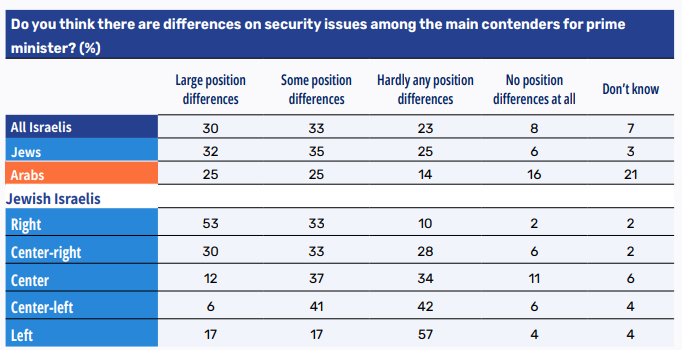
Among the right-wing cohorts (right and center-right) there is a clear perception of substantial gaps, with a majority (53%) identifying large differences and another third (33%) seeing some differences. As one moves leftward along the ideological spectrum, this perception diminishes: in the center, only an eighth (12%) see large differences; on the left, the share rises slightly to a sixth (17%). Among the center-left and the left-wing cohorts, the feeling that the differences are small or almost nonexistent intensifies (48% and 61%, respectively). In other words, respondents in the right-wing cohorts tend to see substantive differences between the candidates on security, whereas in the center and left-wing cohorts, the tendency is to see their positions as more similar.
By voting intention in the upcoming elections, half (46%) of Religious Zionism supporters, and majorities of United Torah Judaism voters (56%), Likud voters (57%), and Otzma Yehudit voters (78%), believe there are large differences in positions between the leading contenders for prime minister. By contrast, only 19% of Bennett supporters, 11% of Yesh Atid supporters, 11% of Yisrael Beiteinu supporters, 8% of Eisenkot supporters, and 7% of The Democrats supporters believe so.
On economic issues, more moderate differences are found in how the candidates for prime minister are perceived: 27% believe there are large differences, 38% see some differences, and 24% see hardly any differences or no differences at all. Among Arab Israelis, a somewhat different picture is evident: although a majority still identify differences (29% large and 32% some), a higher share of respondents (20%) did not know how to answer this question.
Variation is also evident according to ideological orientation (Jewish Israelis only), though it is less pronounced than on security issues. At the ideological extremes, half of the respondents believe there are some differences in positions on economic issues, compared with lower shares in the center groups. As one moves along the ideological spectrum from right to left, the share who think there are hardly any differences between the candidates increases. Interestingly, the highest share who believe there are large differences in positions on economic issues is found in the center-left cohort.
With respect to religion and state issues, half of Israelis (51%) believe there are large differences in positions between the candidates, and a quarter (28%) identify some differences, meaning that roughly eight in ten see some degree of difference. Among Arab Israelis, the perception is less pronounced: a third (33%) identify large differences, a quarter (24%) see hardly any or no differences at all, and a fifth (18%) did not know how to answer this question. By ideological orientation (Jewish Israelis only), every group records a majority that sees large differences, with especially high shares at the extremes – on the right (60%) and on the left (57%).
Compared with the previous two issues (security and the economy), it is clear that religion and state matters are seen as more strongly differentiating the candidates. Whereas on security and economic issues, many tended to see moderate differences or even a similarity of positions, the public sees sharp and substantive gaps when it comes to issues of religion and state. The contrast is especially evident in the center and left groups, where, on the whole, respondents thought the differences vis-à-vis security were limited, while a clear majority of them identified large differences on religion and state matters.
The data indicates that the Israeli public perceives only a limited number of candidates as realistic contenders for prime minister, led by Benjamin Netanyahu (59%), followed by Naftali Bennett (42%) and Gadi Eisenkot (35%). The other candidates included in the question receive much lower levels of support as serious contenders.
On the right, there is near-total consensus around Netanyahu (89%), while Bennett and Eisenkot are viewed as realistic candidates at relatively lower rates than in the other groups. By contrast, in the center and center-left cohorts, Bennett and Eisenkot lead (71%-74% and 60%-64%, respectively), while Netanyahu receives lower shares viewing him as a realistic candidate for prime minister. On the left, a high share of voters view Netanyahu as a realistic candidate (65%), yet Bennett (87%) and Eisenkot (78%) are viewed as even more realistic.
Passover
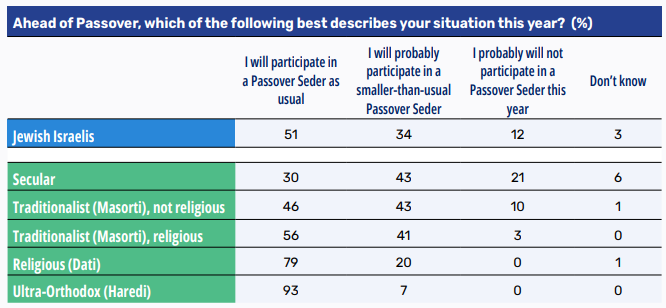
Ahead of Passover and against the backdrop of the war, we examined how many Jewish Israelis in Israel chose to observe the holiday in a different format from usual. The data, collected before the holiday, shows that most Jews intended to participate in a Passover Seder this year, though often in a more limited format: 51% said they would celebrate the Seder as usual, 34% said they expected to participate in a smaller-than-usual Seder, and 12% thought that they would not participate at all. Examining this question by religiosity shows that the more religious respondents are, the greater the likelihood that they will hold the Seder as usual. Among Haredi (93%) and religious Jews (79%), very large majorities planned to hold a regular Seder, whereas among secular Jews, only a third (30%) said so, and many expected to hold a smaller Seder (43%) or to forgo it altogether (21%). The traditionalist groups lie in between, with a strong tendency toward participation, though often in a smaller format.
JPPI’s April 2026 Israeli Society Index was conducted March 26-29, 2026. Data collection was by theMadad.com internet panel (541 Jewish respondents), and Afkar Research (202 Arab respondents, approximately half online and half by telephone). The data was analyzed and weighted by voting pattern and religiosity to represent the views of Israel’s adult population. The JPPI Israeli Society Index is compiled by Shmuel Rosner and Noah Slepkov, with research, production, and writing assistance from Yael Levinovsky. Prof. David Steinberg serves as statistical consultant.