

Israel-U.S. Relations, Agreements with Iran and Lebanon, Gaza, Confidence in Leadership, the Haredi Public and the State, Approaching Elections, and Annual Indicators of Interpersonal Trust and Political Positioning
Additional Findings
- Erosion in relations with Washington: the share expressing a great deal of confidence in Trump fell from 34% in March to 7% in July.
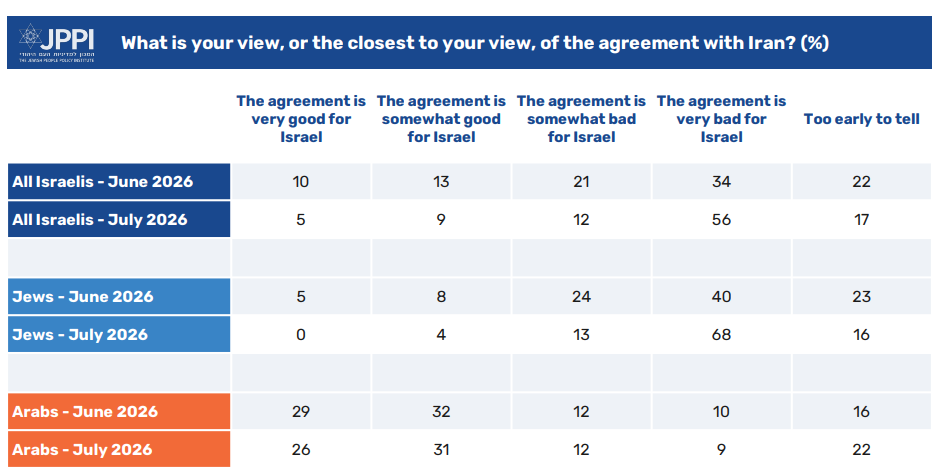
- Opposition to the agreement with Iran: the share of Jewish Israelis viewing the agreement as very bad jumped from 40% to 68%.
- On the right, 48% believe that the United States is more of a true friend to Israel today than in recent years; on the left, 54% say less so.
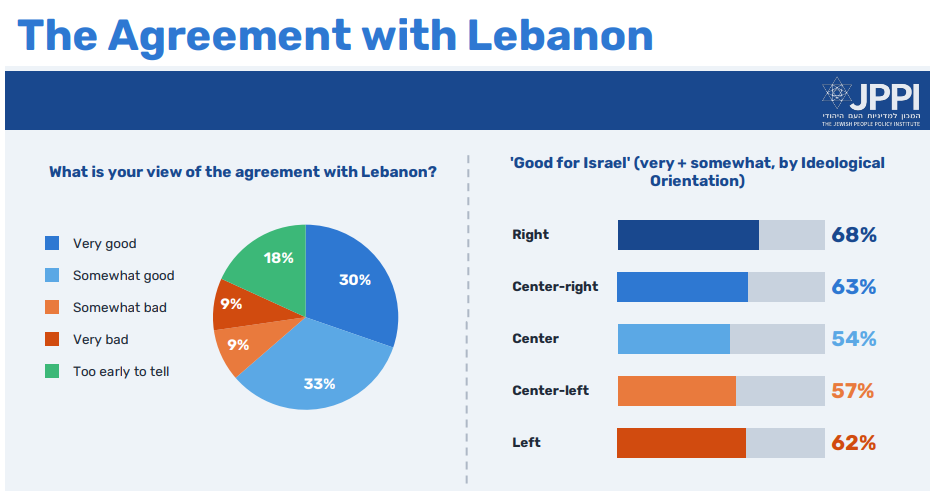
- A majority (63%) believes the agreement with Lebanon is good for Israel.
- Gaza continues to divide: 68% on the right favor a return to combat; in all other ideological cohorts, majorities favor an economic-diplomatic path.
- The sense of victory in the war has eroded from 54% to 38% in the last year.
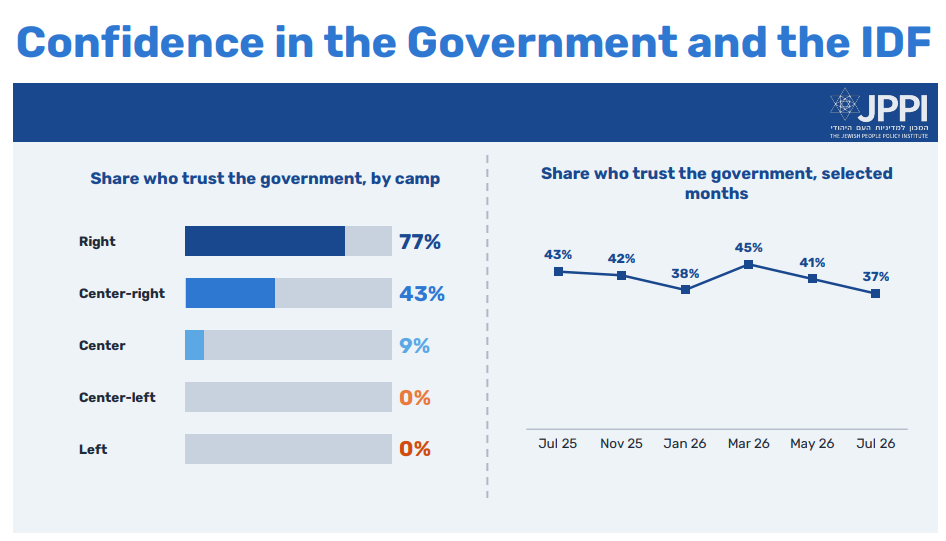
- Confidence in the government is lower than it has been in over a year (37%); among secular respondents, only 19%.
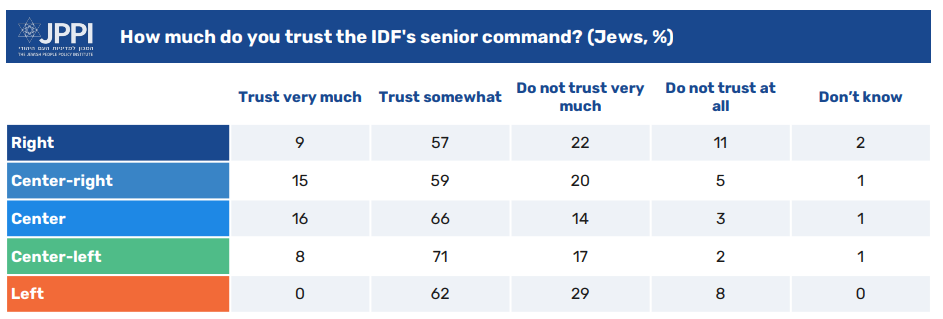
- Erosion of trust in the IDF’s senior command: 71% of Jewish Israelis trust it, compared with 82% in March.
- Haredi conscription: 46% support additional sanctions and pressure; among the Haredi public, only 9% disapprove of the recent road-blocking protests.
- Ahead of the elections: 53% say they are completely certain whom they will vote for; the center-right and centrist cohorts have the highest share of undecided voters.
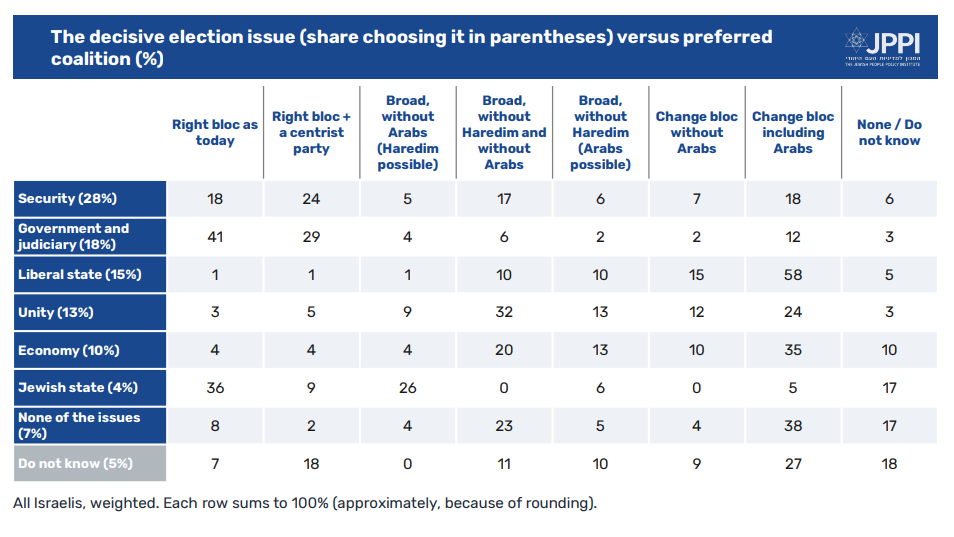
- A significant gap in identifying the central election issue: relations between the government and the judiciary versus advancing Israel as a more liberal state.
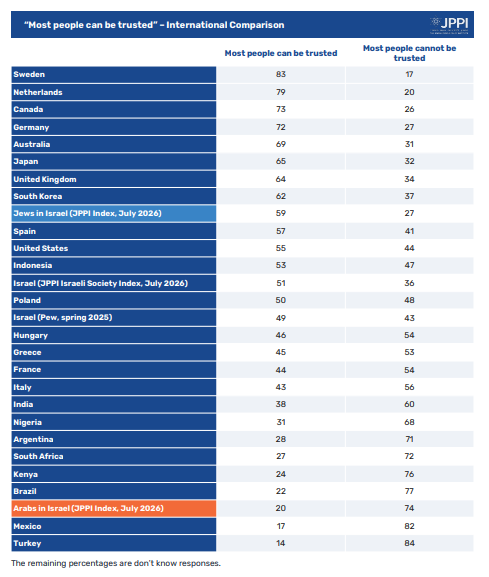
- The annual index of trust in other people: a slight increase in Jews’ trust in Arabs (from 22% to 26%) over last year.
To download a PDF version, click here.
Confidence in Trump at a Low Point
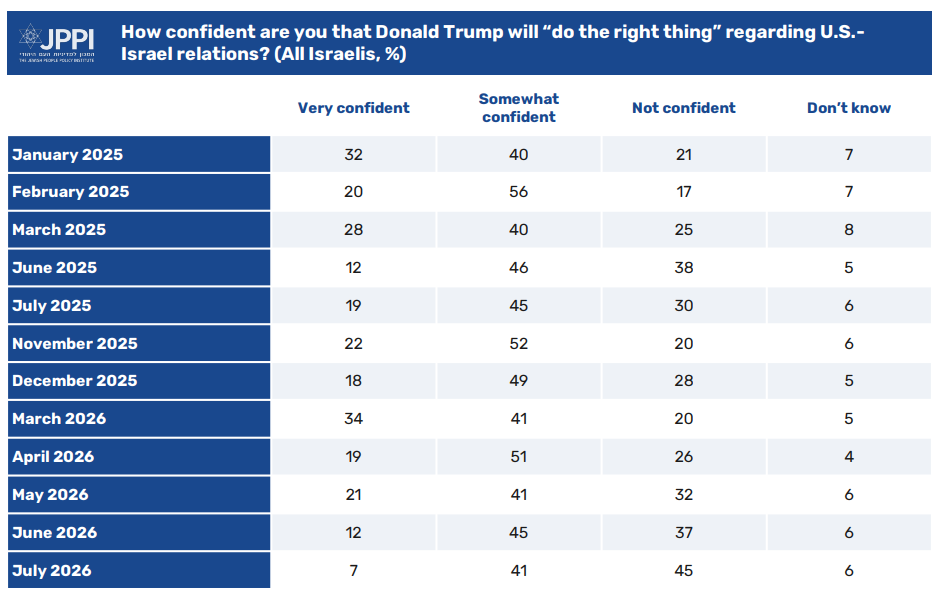
Since the beginning of President Trump’s second term, Israelis have frequently been asked how confident they are that the U.S. president will “do the right thing” with respect to U.S.-Israel relations. The July survey recorded the lowest confidence levels since measurement began: only 7% of Israelis have a great deal of confidence in Trump, 41% express some confidence, and 45% say they have no confidence. By comparison, in January 2025, when he entered office, 32% of Israelis had a great deal of confidence in him, and only 21% said they had no confidence in him.
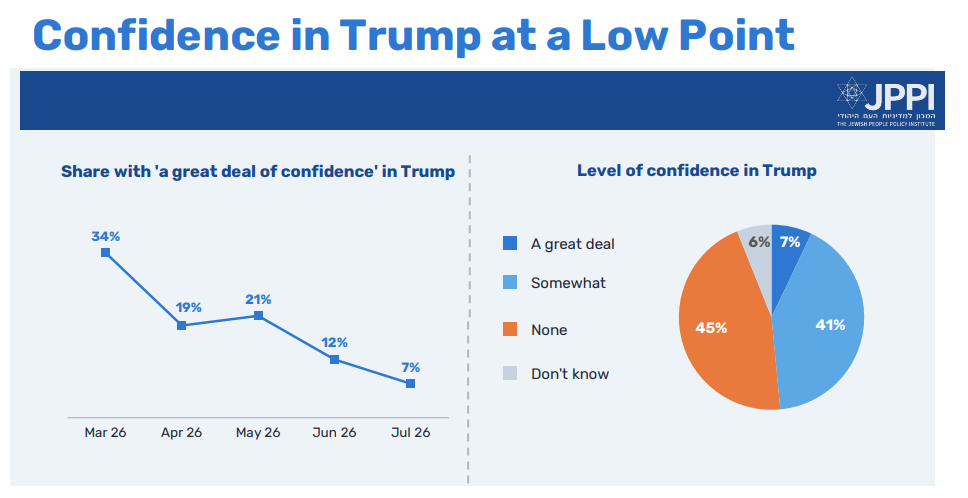
The current decline is especially sharp against the background that only four months ago, in March 2026, at the beginning of the war with Iran, the share expressing a great deal of confidence in Trump reached a peak of 34%. The events that followed the war, including the agreement signed with Iran and various statements by the president, led the Israeli public to gradually but consistently lose confidence in him: 19% in April, 21% in May, 12% in June, and 7% this month. Among Jewish Israelis, the picture is even sharper: only 5% now express a great deal of confidence, while 46% have no confidence in him at all. Among Arab Israelis, a higher share has a great deal of confidence in the president (15%) – presumably for the opposite reasons, against the backdrop of satisfaction with the end of the war.
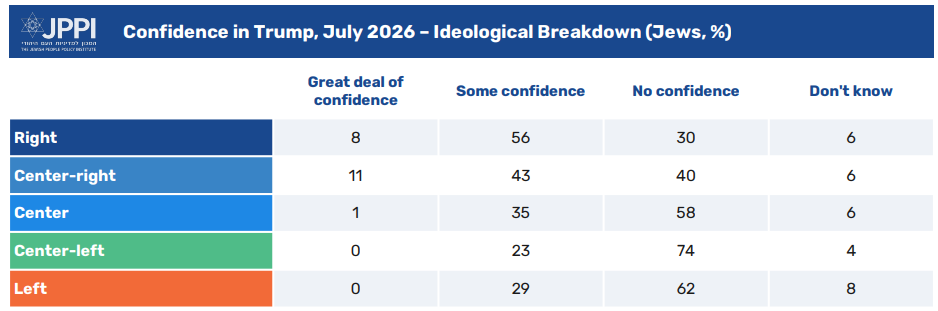
Although disappointment with Trump cuts across camps, an ideological breakdown reveals clear differences in attitudes toward him. Among those who self-identify as right-wing, a majority continue to have some level of confidence in the American president (8% a great deal and 56% some, compared with 30% no confidence). Nevertheless, compared with last July, not long after the 12-day war with Iran, the change among right-wing Jewish Israelis is clear: exactly one year ago, 29% of the right expressed a great deal of confidence in Trump and only 14% had no confidence in him. Today the ratio has almost reversed. Moving leftward along the ideological spectrum, confidence in the president diminishes. In the center, 58% have no confidence in Trump; in the center-left, 74%; and on the left, 62%; in the latter two cohorts, no respondent expresses a great deal of confidence in the president. Similarly, a breakdown by religiosity also reveals a marked gap: among secular Jews, 56% have no confidence in the president, whereas among Haredim, 27% have no confidence in him and almost two-thirds of Haredi respondents (64%) maintain some confidence in Trump. Likud voters (in the 2022 elections) maintain the highest level of confidence in Trump (15% a great deal and another 58% some); among voters for the center and left parties, the share expressing no confidence ranges from 58% (National Unity) to 77% (Meretz).
Is the United States a True Friend of Israel?
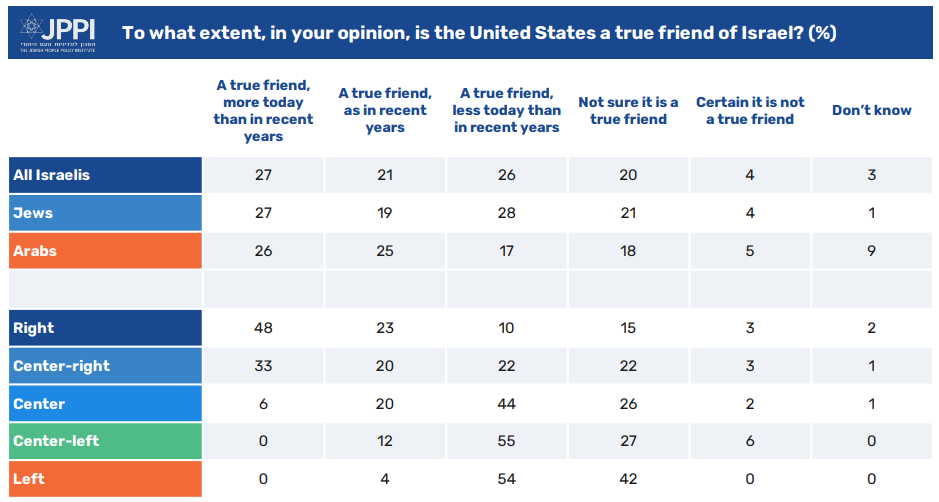
Three in four Israelis (74%) view the United States as a true friend of Israel – but behind this agreement lies a significant dispute over relations between the two countries. In fact, the public is divided almost equally among those who believe that today the United States is a friend of Israel more than in recent years (27%), as it has been in recent years (21%), and less than in recent years (26%). Another fifth of respondents (20%) are not at all certain that it is a true friend, and 4% are certain that it is not a true friend.
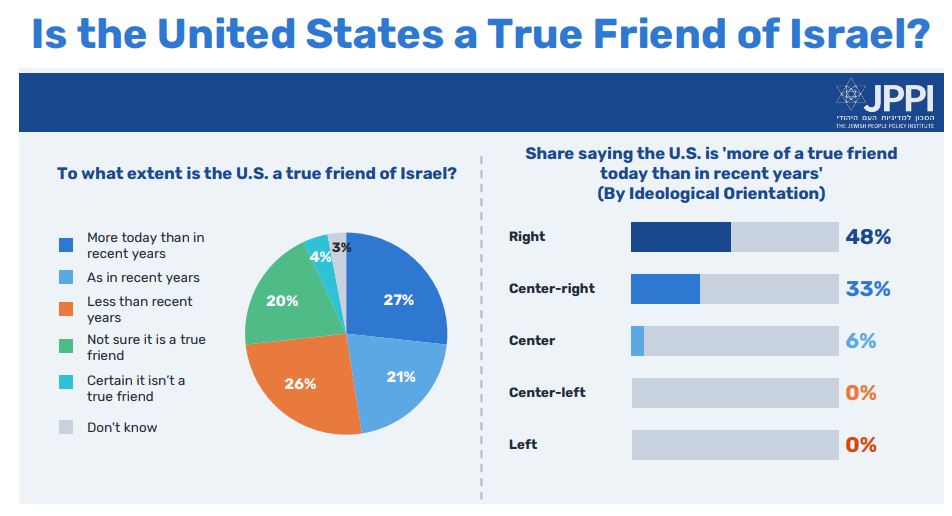
An ideological breakdown reveals an almost perfect right-left mirror image: on the right, nearly half of respondents (48%) believe that the United States is a stronger friend now than in recent years. By contrast, among the much smaller cohort of left-wing respondents, no one thinks so (0%); instead, a majority (54%) say that the United States is less of a friend of Israel today than in the past, and another 42% question the friendship itself. The same diplomatic reality is read in diametrically opposite ways in the two camps a finding that corresponds to the gap concerning confidence in Trump. A similar pattern emerges by religiosity: 48% of Haredim view the friendship as strengthening, compared with only 14% of secular Jews. Among Shas and Likud voters (in the 2022 elections), a majority or near-majority believe that the friendship has strengthened (64% and 53%, respectively); among Yesh Atid voters, only 2% do so.
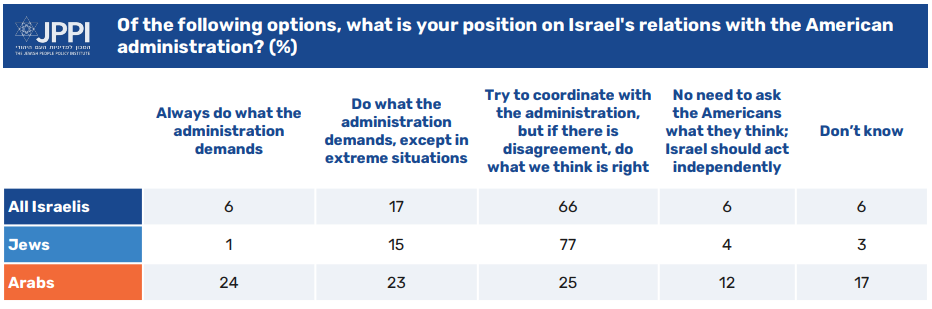
How should Israel conduct its relations with the American administration? There is broad agreement in Israel: two-thirds of Israelis (66%) and three-quarters of Jewish Israelis (77%) choose the middle position: Israel should try to coordinate with the administration, but if there is disagreement, it should do what it considers right. This position is the majority view across Jewish ideological camps, from the right (81%) and center-right (86%) to the left (54%). Only 6% believe Israel should always accede to U.S. demands, and 6% believe there is no need to ask the Americans at all what Israel should do. A notable difference on this issue exists between Jews and Arabs: about half of Arab Israelis (47%) believe that Israel should accede to Washington – either always (24%) or in extreme situations (23%).
The Iran Agreement
Last month, when the memorandum of understanding (MOU) between the United States and Iran was taking shape but had not yet been signed, we found that 55% of Israelis were concerned about it. This month, after the signing, it emerges that reservations have not merely failed to moderate they have intensified considerably: 68% of Israelis now believe the agreement is bad for Israel (12% somewhat bad and 56% very bad), compared with 14% who believe it is good and 17% who think it is still too early to know whether the agreement is good or bad. The share choosing the emphatic position, ‘very bad for Israel,’ jumped within one month from 34% to 56% among the public as a whole, and from 40% to 68% among Jews. At the same time, the share waiting to see (too early to tell) shrank from 22% to 17%. In other words, as the details of the agreement become clearer, skeptics are joining the camp that rejects it.
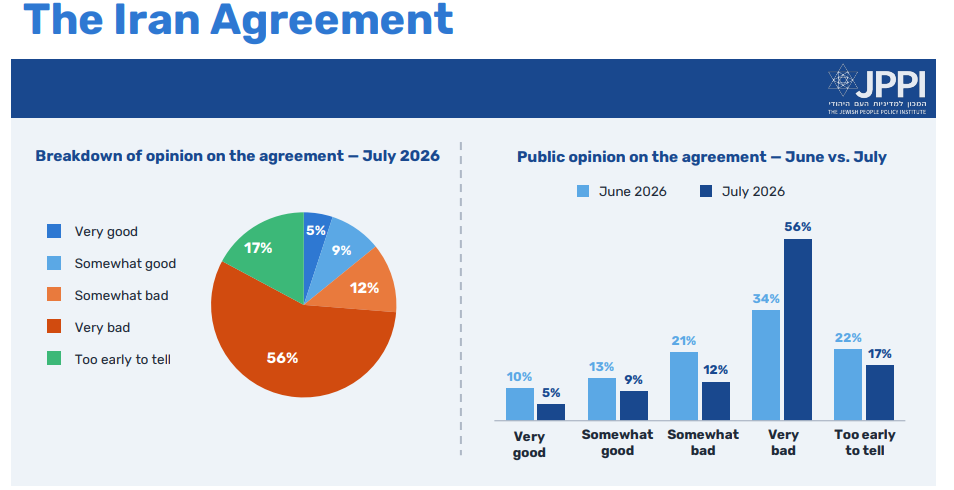
Opposition is rife across Jewish ideological cohorts: the share choosing very bad ranges narrowly from 65% on the right and center-right to 75% on the left. It is also predominant among all Jewish religious cohorts from secular Jews (69%) to Haredim (73%) the negative assessment is similar. Cross-camp agreement is also evident when the public is examined by voting pattern: a majority rejecting the agreement is recorded among voters for all Jewish parties, from Likud (72%) and Religious Zionism (89%) to Labor (91%) and Meretz (81%). The reverse picture holds in the Arab sector, where 57% believe the agreement is good for Israel; among Hadash-Ta’al-Balad voters, the figure is 72%. It is worth noting that not a single Jewish respondent not one chose the option that the agreement is very good for Israel.
The Agreement with Lebanon
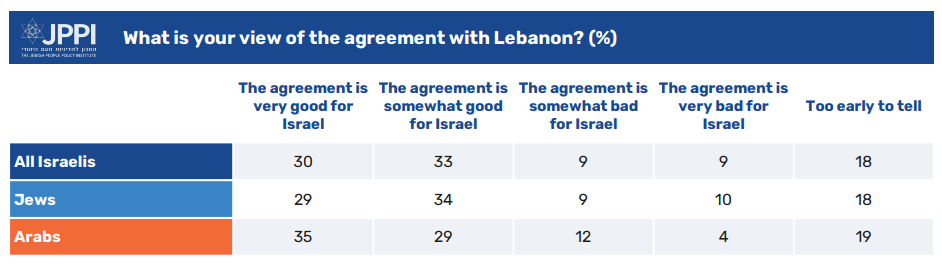
In contrast to the agreement with Iran, the agreement with Lebanon enjoys broad support: close to two-thirds of Israelis (63%) believe it is good for Israel (30% very good and 33% somewhat good), and only 18% believe it is not good for Israel. Jews and Arabs alike share this positive assessment (63% and 64%, respectively) a rare concordance between the sectors. The ideological breakdown, which on diplomatic-security issues usually displays a sharp gradient, is almost flat here. Majorities in every cohort regard the agreement as good for Israel: on the right (68%), center-right (63%), center (54%), center-left (57%), and left (62%). In other words, the same camps that are united in opposition to the agreement with Iran are united in favor of the agreement with Lebanon.
Gaza
Whereas there is considerable agreement regarding Iran and Lebanon, the Gaza front continues to divide the Israeli public along familiar lines. The largest share of Israelis (43%) prefers trying to weaken Hamas through economic and diplomatic measures, but more than one-third (35%) prefer returning to fighting until the stated objectives are achieved (without Hamas rule), and a minority (14%) believes that the current situation is reasonable and should be maintained. The Jewish public is divided into two camps: half (50%) support an economic-diplomatic path, and four in ten (41%) support a return to fighting. In the Arab sector, half (51%) prefer maintaining the current situation.
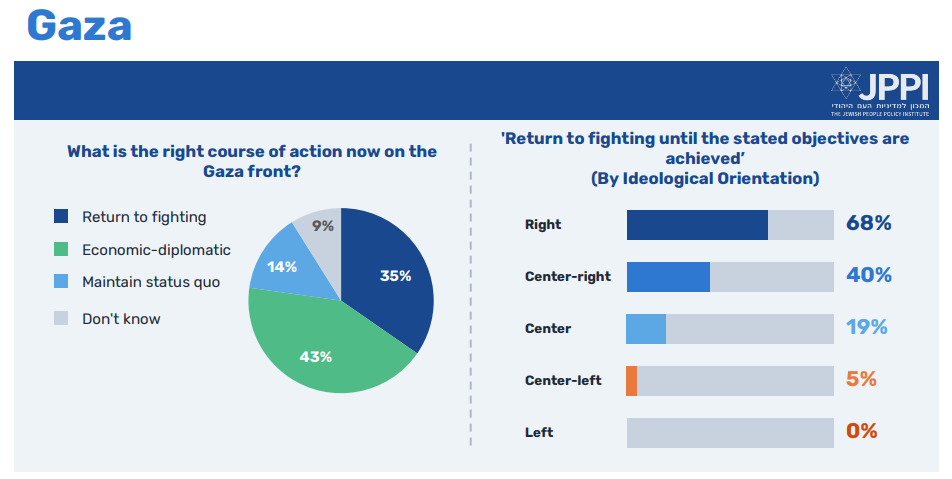
The ideological gradient remains as sharp as ever: on the right, a clear majority (68%) supports a return to fighting; in the center-right, the balance already tilts the other way (55% favor economic weakening versus 40% fighting); and in the center, center-left, and left, overwhelming majorities 70%, 90%, and 92%, respectively – prefer the economic-diplomatic track, with no one on the left supporting a return to fighting.
A Year of Erosion
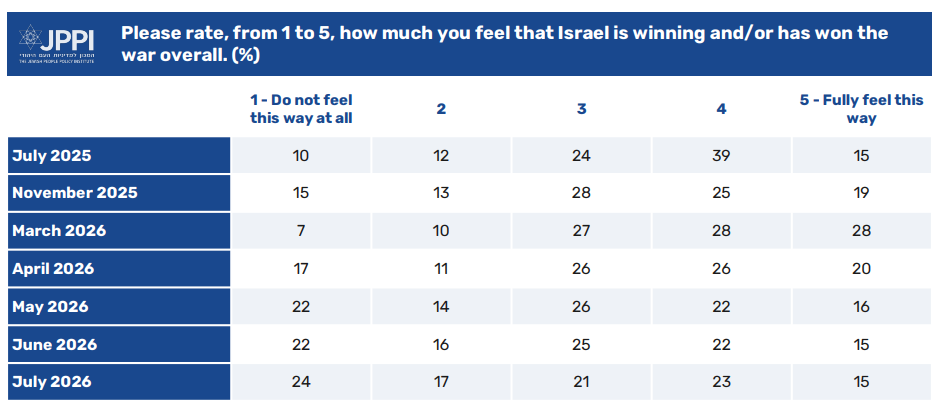
As in past months, we again examined the extent to which Israelis feel that Israel is winning or has won the war that began on October 7, 2023, across all fronts. This month, 38% express a sense of victory (a rating of 4 or 5 on a 5-point scale), 41% do not feel that way (a rating of 1 or 2), and 21% are in the middle – figures similar to those recorded in May and June. Israelis’ sense of achievement and victory naturally depends on developments on the ground: periods of fighting and of calm, and feelings of achievement or missed opportunity. A month-to-month view may be volatile, whereas a look back over a year allows the current findings to be anchored against an earlier point. In July 2025, exactly one year ago, 54% of Israelis felt that Israel was winning and only 22% rejected that view. That was the outcome of Operation Rising Lion. This month the picture has almost reversed. This is the outcome of Operation Lion’s Roar and what followed it. The positive peak in the sense of victory recorded in March 2026, during the operation (56%), has been entirely eroded.
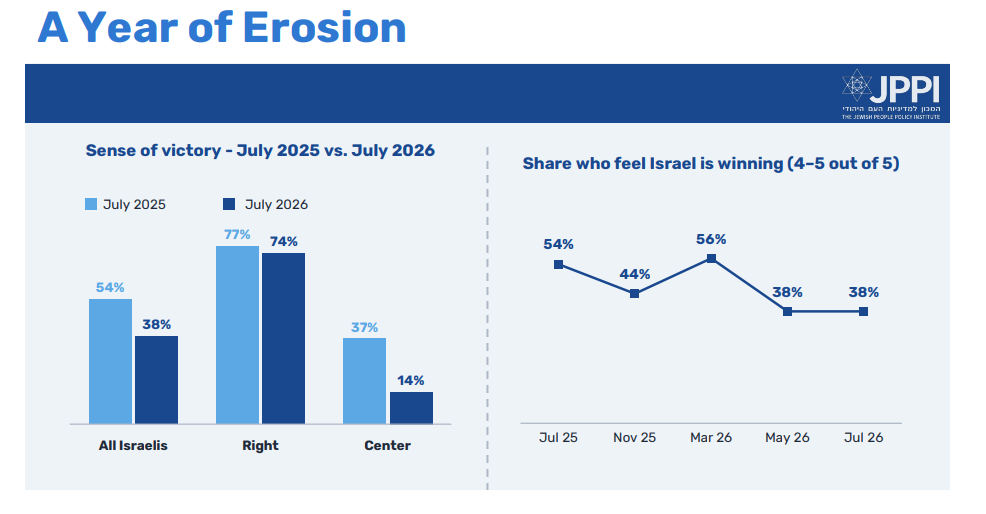
The sense of victory is deeply affected by respondents’ location on the ideological scale. On the right, 74% feel a sense of victory; on the left, 71% choose not at all, and no one chooses the high ratings. By religiosity, Haredim stand out for their positive assessment of Israel’s achievements: 81% expressed a sense of victory, compared with 23% of secular Jews. Comparing the breakdowns with July 2025 data reveals that the annual erosion in the sense of victory occurred almost entirely outside the right-wing group, where the sentiment barely changed (77% last year). By contrast, among those who define themselves as center, the sense of victory fell from 37% to 14%.
Confidence in the Government and the IDF
Thirty-seven percent of Israelis trust the government (15% very much and 22% somewhat), while 62% do not trust it including 48% who chose the emphatic option of no trust at all. This is the lowest level of confidence measured since May 2025, following a prolonged period in which confidence ranged between 38% and 45%. The polarization regarding confidence in the government is predictable and sharp: on the right, three-quarters (77%) trust it; in the center-right, 43%; in the center, only 9%; and in the center-left and left, zero, with 100% of left-wing respondents choosing no trust at all. The breakdown by religiosity is no less interesting, with a gap almost as deep: three-quarters of Haredim (75%) trust the government, compared with only one-fifth of secular Jews (19%), 75% of whom do not trust it at all.
Two-thirds of Israelis (66%) trust the IDF’s senior command a figure much higher than the level of trust in the government, one that reflects some erosion, nonetheless. Among Jewish Israelis, the share of respondents who trust the IDF command fell from 82% in March (the onset of the Iran war) to 79% in April, 75% in May, and 71% this month – eight points below the level measured in July 2025 (79%). The intensity of confidence is also relatively low: only 11% of Jewish Israelis trust the senior command very much, while the majority choose the more qualified option, trust somewhat. Unlike the case of confidence in the government, trust in the IDF leadership is highest in the center of the map – 82% in the center and 79% in the center-left, compared with 66% on the right and 62% on the left. In the Arab sector, 42% trust the senior command.

The Haredim: Protests and Conscription
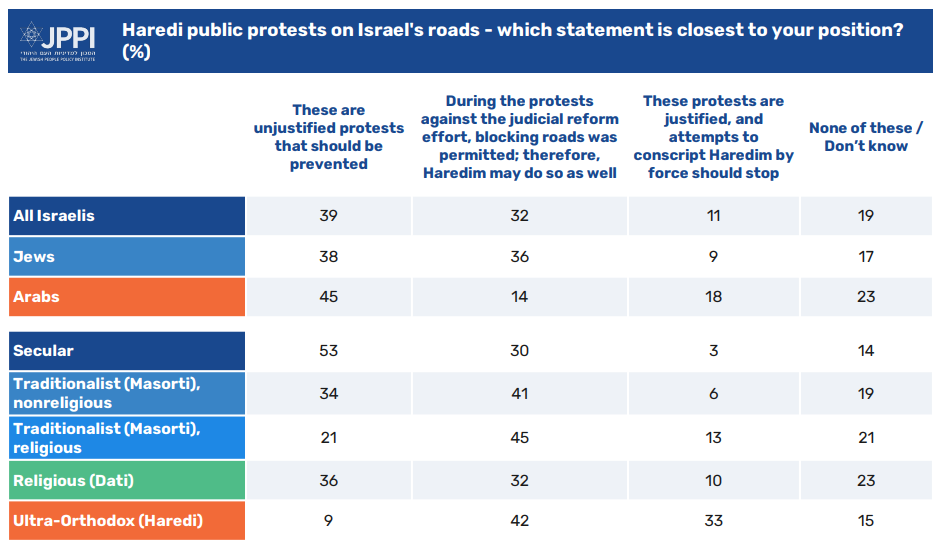
Against the backdrop of traffic-blocking Haredi protests on Israeli roads against the arrests of draft evaders, this month we presented respondents with three positions that are commonly heard in the public discourse. The position that received the highest level of agreement (39%) was: these are unjustified protests that should be prevented.
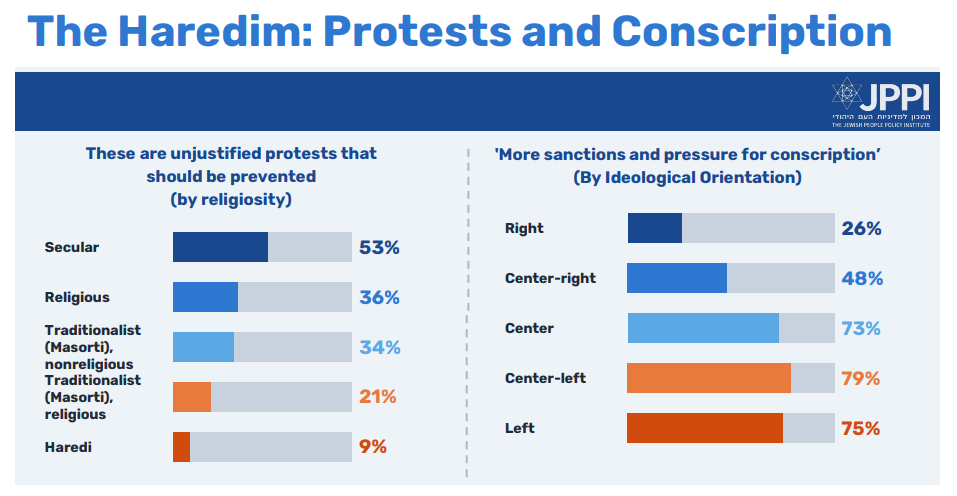
Almost one-third (32%) chose another position, which entails a degree of tolerance: during the protests against the judicial reform, it was permissible to block roads; therefore, the Haredim may do so as well. This logic of reciprocity, and therefore of the protests’ legitimacy, is especially common among Israelis who identify as right-wing (48%) and among Likud voters (51%). Among the public as a whole, only 11% chose the option stating that the protests are justified in themselves and that attempts to conscript Haredim by force should stop. The religiosity breakdown shown in the table indicates significant gaps: among secular Jews, a majority (53%) rejects the protests, a share that declines as religiosity rises; among the Haredi public itself, only 9% reject them, 42% justify them based on reciprocity, and one-third (33%) believe they are justified and that forced conscription should stop.
As for conscription policy itself: close to half of Israelis (46%) and half of Jews (50%) believe that it is possible to conscript young Haredi men and that additional sanctions and pressure should be applied. About one-third (31%) prefer conscription only by agreement with the Haredi leadership, and 11% believe there is no chance of conscripting young Haredi men into the IDF and that attempts to do so should stop. The political gradient in responses to this question is fairly predictable: the demand for sanctions predominates in the center and the left (73% to 79%), whereas a majority (59%) on the right prefers the agreement track a pattern that, among other things, reflects the price of coalition partnership. Among Haredi respondents, 36% say there is no chance of conscription, but notably, 45% acknowledge that Haredim can be conscripted by agreement with the leadership and 15% even support sanctions. Among voters, most of whom self-identify as right-wing, there is a striking gap between Likud supporters (75% favor the agreement track) and Yisrael Beiteinu supporters (84% favor sanctions).
Political Positioning
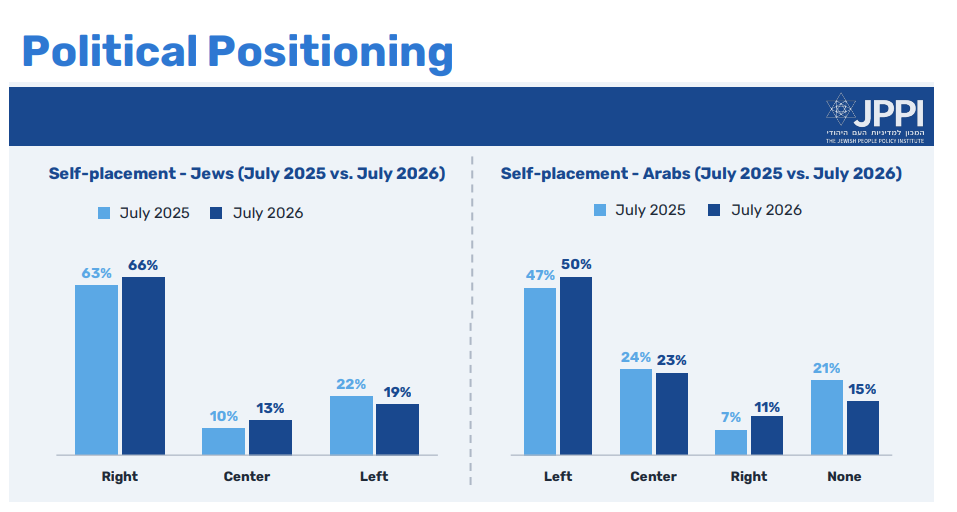
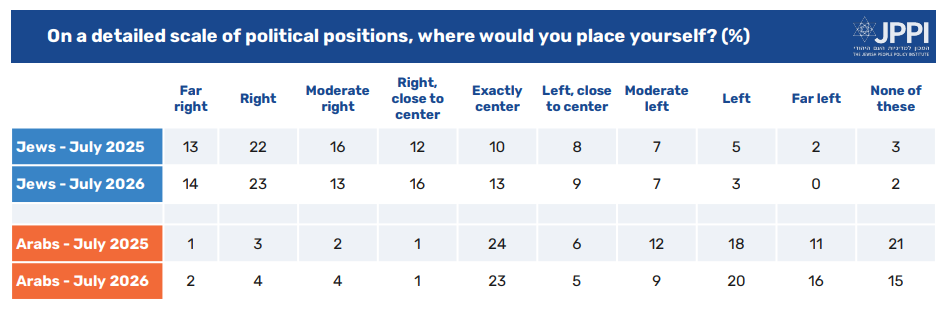
We also examine from time to time the detailed political scale of nine categories, from far right to far left. Such a scale makes it possible to detect smaller movements in ideological positions than the three- or five-point scales we use in most cases (right, center-right, center, center-left, left). Compared with July 2025, there is a slight strengthening of the right and the center in the Jewish sector at the expense of the left: 66% of Jewish Israelis place themselves in one of the four right-wing categories (63% last year), 13% exactly in the center (10% last year), and 19% in one of the left-wing categories (22% last year). It is worth noting that the Jewish left is concentrated close to the center: the categories left and far left are almost empty (3% and 0%). In the Arab sector, half place themselves on the left (47% last year), but the noteworthy change is the decline in the share of those who do not find themselves anywhere on the scale – from 21% to 15% perhaps an early sign of political deliberation ahead of the elections.
Ahead of the Elections
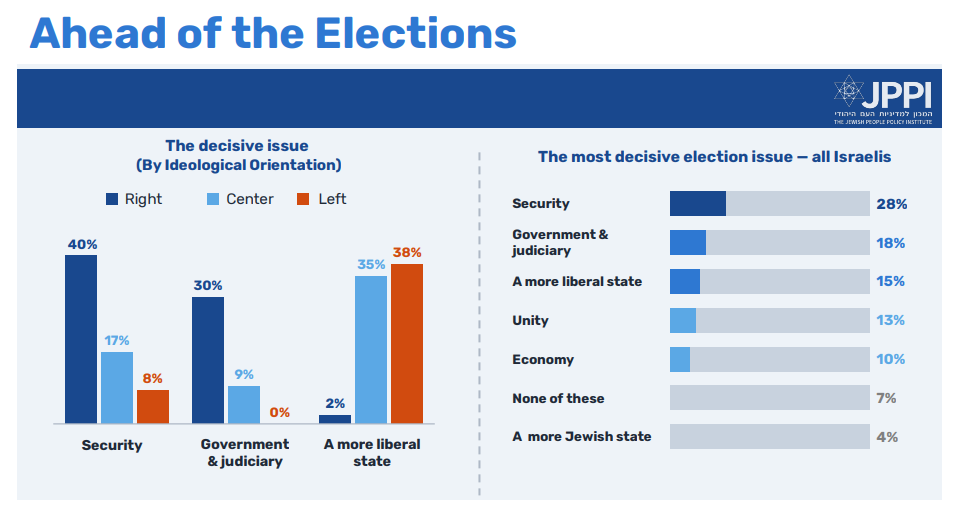
Ahead of the elections expected in the fall, we examined a series of questions about the state of the campaign. The first finding: the campaign may only be beginning, but most voters have already decided what their choice will be. More than half (53%) say, yes I am already completely certain whom I will vote for, and another 29% say they are fairly certain. Fourteen percent report that they are still undecided, and 4% say they do not intend to vote. The highest level of decisiveness is recorded at the ends of the spectrum: 71% on the left and 58% on the right are already certain for whom they will vote, while the undecided are concentrated in the middle of the political map. In the center-right, 22% are still waiting to see all the parties, and in the center only 44% are completely certain about their vote. In other words, the real battlefield of the campaign is concentrated in the center of the map. Another indication: among those considering voting for a hypothetical party between the blocs, only 16% are completely certain of their choice.
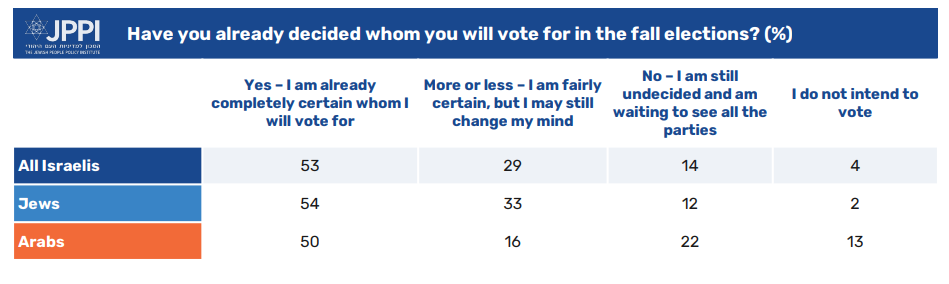
What coalition do Israelis want after the elections? No formula receives a majority, but the option with the highest support is a coalition of the change bloc including Arabs (27%). Coalitions of the right bloc – either in its current composition or with the addition of a center party together receive 30%, and the three variations of a broad coalition from both blocs together receive 29%. The ideological breakdown shown in the table outlines the boundaries of the next coalition negotiations, at least as voters see them today (the election results may of course change their views): on the right, 68% want a coalition of the right bloc; in the center-left and left, large majorities (73% and 75%) prefer the option of the change bloc including Arabs; the middle is divided: in the center-right, the most common option is a broad coalition without Haredim and without Arabs (29%), while in the center 35% choose the change bloc including Arabs and 18% choose it without them. It is noteworthy that among prospective Likud voters, 42% prefer specifically a right-wing bloc with the addition of a party from the center a hint of some fatigue with the current composition even within Likud’s base.
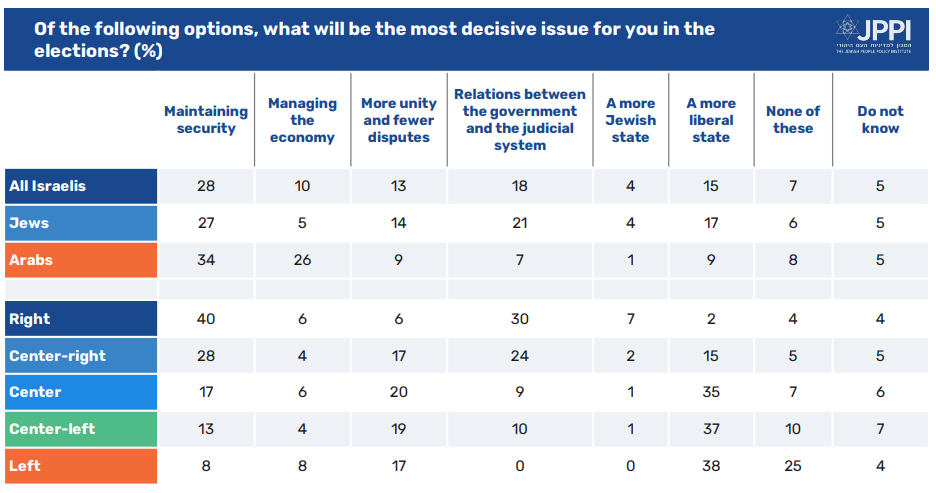
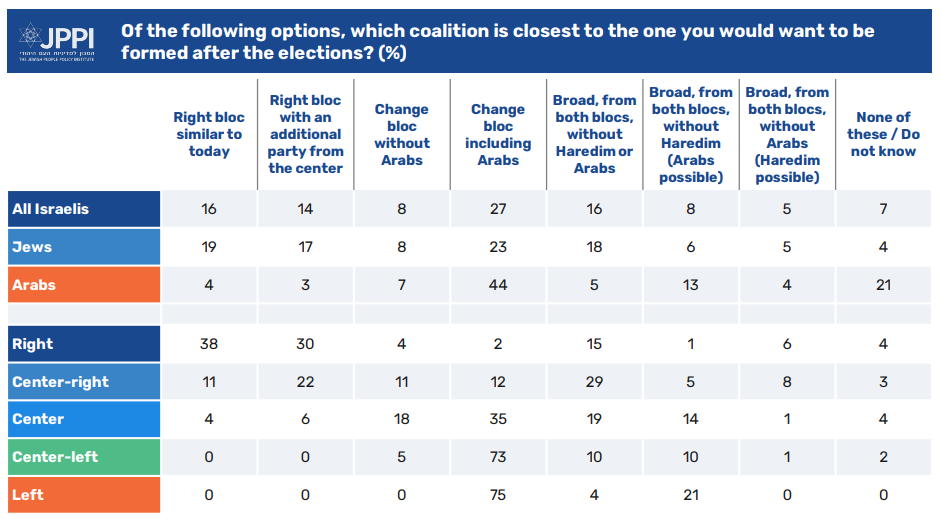
And what is the main issue that will determine how Israelis vote? The most common issue is security: 28% of Israelis say the decisive consideration for them is who will contribute most effectively to maintaining security. It is followed by relations between the government and the judicial system (18%), advancing Israel as a more liberal state (15%), and more unity and fewer disputes (13%). Yet this order of priorities is an average of two entirely different election campaigns taking place simultaneously: on the right, security (40%) and government-judiciary relations (30%) lead; in the center, center-left, and left, the leading issue is a more liberal state (35%-38%). In the Arab sector, security (34%) and the economy (26%) lead – whereas the economy barely appears as a decisive consideration in the Jewish sector (5%).
A parallel examination of the two questions the one concerning the main issue in the election campaign and the one concerning the preferred coalition after the elections yields several interesting findings. Relations between the government and the judiciary form the main connective tissue of the right-wing bloc, more than the security issue. Seventy percent of those for whom this is the decisive issue prefer a clearly right-wing coalition (41% as today plus 29% with a center addition). In the opposite direction: among those who want a right-wing coalition as today, 49% chose the judicial issue as the decisive issue for them, more than security (32%).
Voters for whom security is the central election issue are the only group truly split in their coalition preference: 42% choose a right-wing coalition, while 40% prefer possible centrist or change-bloc coalition options. But this finding is, at least in part, a sectoral effect: the 18% who want the change bloc including Arabs come mainly from Arab respondents (for whom security is the leading issue). Among Jews only, security voters lean much more sharply rightward: 53% want a right-wing coalition, and only 8% of them want a coalition of the change bloc including Arabs. Choosing a liberal state as the central issue of the election campaign is a perfect mirror image of coalition preference. Eighty-three percent of those who cited this issue as central chose a coalition without Haredim. Only 2% of them chose a coalition of the right-wing bloc.
Interpersonal Trust
Once a year we examine Israelis’ interpersonal trust index, using a series of questions identical to those asked in July 2025 – and similar to questions also examined in international indices in various countries.
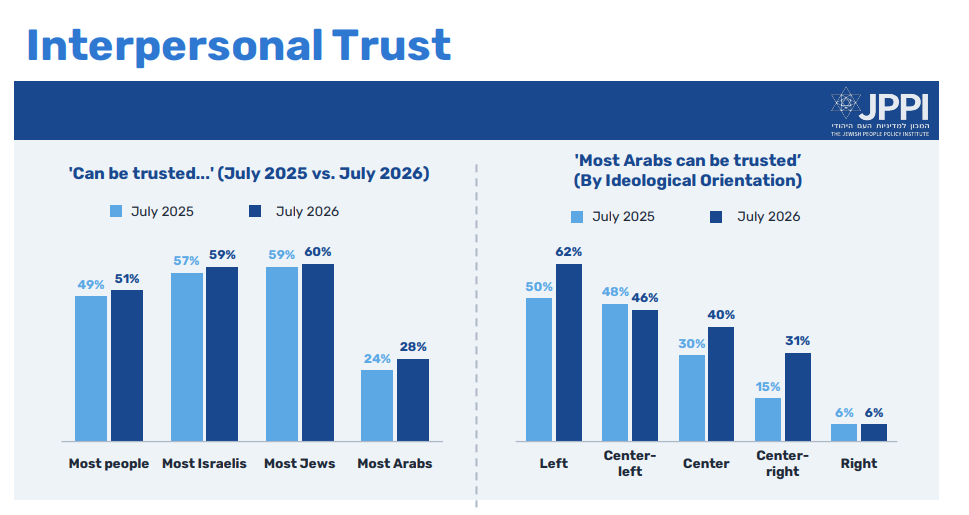
The overall picture, as the table shows, is one of stability in responses with a slight tendency toward improvement on all four items. The most noteworthy change even if moderate concerns the most sensitive item, trust in Arabs in Israel: 28% of Israelis believe that they can be trusted, compared with 24% last year; among Jews, this share rose from 22% to 26%. Nevertheless, this remains by far the lowest figure on the list.
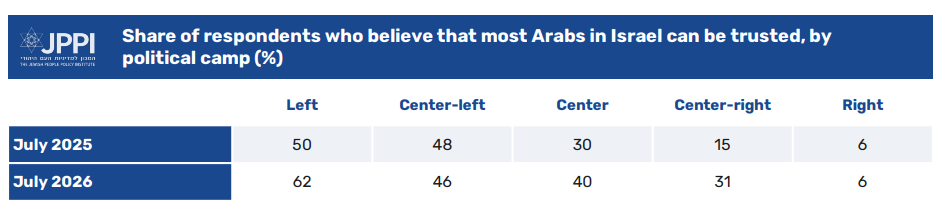
Comparing the breakdowns with July 2025 data shows that this increase is not distributed evenly. At the right end of the map, nothing has moved: 6% of the right believed a year ago that most Arabs in Israel can be trusted, and 6% believe so today. The entire movement occurred in the center of the map and to its left: in the center-right, the share doubled from 15% to 31%; in the center it rose from 30% to 40%; and on the left – from 50% to 62%. A similar picture emerges by religiosity: among religious Jews, trust doubled from 7% to 15%, and among secular Jews it rose from 33% to 39%, while among the Haredi public it remained negligible (3%, compared with 5% last year). The only exception in the opposite direction is among traditionalist (Masorti)-religious Jews, where a decline was recorded (from 33% to 26%).
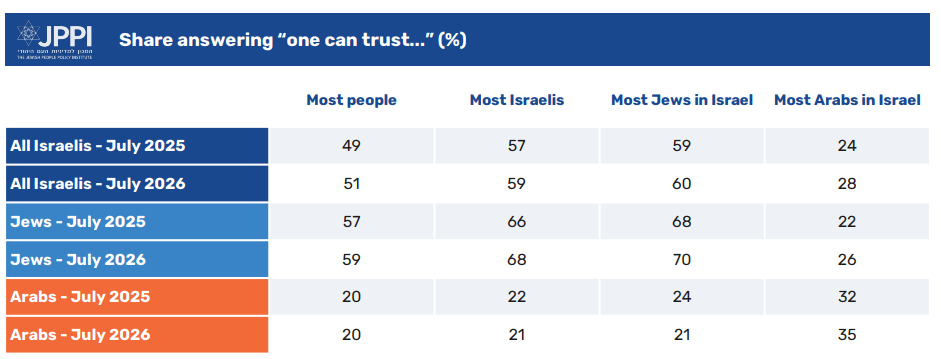
Another finding consistent with last year: the Arab sector is much more distrustful of people than the Jewish sector, and the positive movement recorded on the Jewish side is not reciprocal. Only 20% of Arabs believe that most people can be trusted (unchanged from last year), and similar shares (21%) say this about most Israelis and most Jews in Israel with trust in most Jews even declining slightly, from 24% to 21%. Only 35% of Arab respondents say that most other Arab Israelis can be trusted; nevertheless, this is the only item on which trust in the Arab sector is higher than in the Jewish sector, and it too has risen slightly (32% last year).
We present an international comparison by inserting the data obtained in our survey alongside surveys conducted by the U.S.-based Pew Research Center, which collected data in many countries. Pew’s Global Attitudes Survey is from spring 2025 (and in the United States: February 2025). The highlighted Israeli data is from July 2026. Caution should be exercised in drawing conclusions due to methodological differences: Pew’s surveys were conducted by telephone or face-to-face, whereas the Israeli Society Index survey was conducted online. In the international comparison, one can identify the large gap between Jews and Arabs in Israel, which helps explain Israel’s overall position in the ranking.
The remaining percentages are don’t know responses.
Data for JPPI’s July Israeli Society Index was collected between July 1 and July 5, 2026, from 772 respondents via theMadad.com (568 Jewish sector respondents), and Afkar Research (204 Arab sector respondents, approximately half online and half by telephone). The data was weighted and analyzed by voting and religiosity to represent the views of Israel’s adult population. Shmuel Rosner and Noah Slepkov compile the JPPI Israeli Society Index, with research, production, and writing assistance from Yael Levinovsky. Prof. David Steinberg provides statistical supervision.