

Connected U.S. Jews on the War with Iran, Confidence in World Leaders, the Midterm Congressional Elections, Public Opinion of Israel’s Image, and Optimism about the Future.
Main findings
- There has been a continued erosion of support among U.S. Jews for going to war with Iran, and a decline in the share identifying support for the war in their social environment.
- Only half of the respondent panel considers the war with Iran a success.
- There has been a shift in the definition of victory: a decline in the share conditioning the war’s success on regime change.
- Four in ten “strong liberal” respondents believe the war is a failure, regardless of the outcome.
- Most respondents support the U.S. blockade of the Strait of Hormuz.
- A regional picture of victory: Most respondents believe the wars in Gaza and Lebanon have been successful.
- Assessments of Donald Trump’s and Benjamin Netanyahu’s performance vis-à-vis Iran have eroded.
- Regarding Iran, confidence in Netanyahu’s leadership is greater than confidence in Trump’s management.
- Half of the Jews surveyed attribute the erosion of Israel’s standing in the United States to rising anti-Jewish sentiment.
- A quarter of the Jews surveyed attribute the erosion of support for Israel to Israel’s actions.
- Most link the restoration of Israel’s standing in the United States to changes in its policy or leadership.
- Ahead of Israel’s 78th Independence Day, there is consensus among respondents that Israel is a success story.
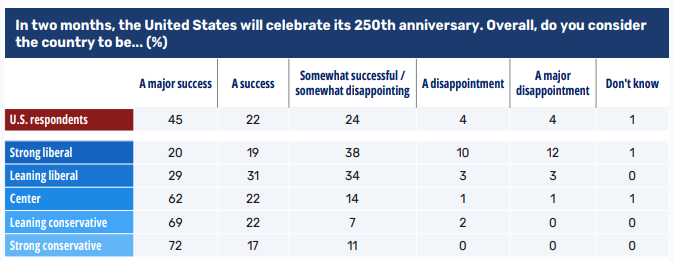
- Ahead of the U.S. 250th anniversary celebrations, two-thirds of respondents consider America a success story.
- Half of U.S. respondents say they will vote for a Democratic congressional candidate, compared
To download a PDF version, click here.
Survey Background: Data for this month’s JPPI Voice of the Jewish People Index survey was collected April 15-19. Several key events influenced both the selection of survey questions and the attitudes reflected in the Index. At the center were the war with Iran and the ceasefire in force for the duration of the negotiations. The joint U.S.-Israeli operation, which began on February 28, lasted 40 days until a Pakistan-brokered agreement was reached for a two-week cessation of hostilities, which has since been extended to provide time for negotiations on a long-term arrangement. The survey was conducted one week after the pause took effect, alongside the start of the U.S. blockade of the Strait of Hormuz and President Trump’s announcement of a temporary ceasefire between Israel and Lebanon.
Methodological Note: In recent months, we have begun to survey the views of Jews in Canada and the UK. In both countries, panels are taking shape and growing, albeit slowly. In April, about 50 respondents from the UK and 110 from Canada participated in the survey. Accordingly, the data on attitudes of Jews in these countries should be treated with caution. When the report presents data broken down by ideological orientation, denominational affiliation, or voting pattern, it refers only to U.S. respondents.
Support for the Iran War
After 40 days of fighting, including extensive U.S. and Israeli strikes against military infrastructure and nuclear facilities in Iran, a two-week Pakistan-brokered ceasefire took effect on April 8. Just before it was set to expire, President Trump announced an extension. This ceasefire was still in force at the time of this writing.
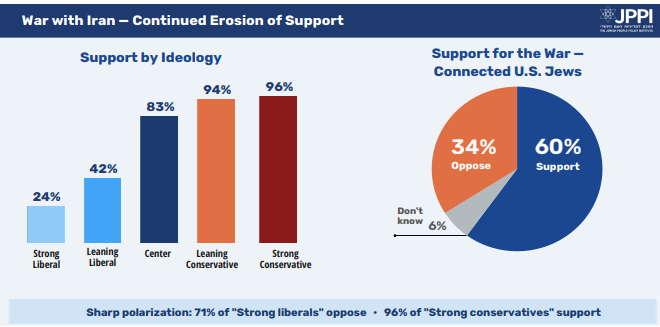
We have examined support for the U.S. decision to go to war against Iran several times through the JPPI Voice of the Jewish People respondent panel since the start of the war. These repeated measurements indicate a consistent erosion in U.S. Jewish support for the decision to go to war. In the war’s first week, support stood at 68% but declined to 62% in its third week and stood at 60% in the week following the ceasefire. Alongside this decline in support, there was a gradual increase in opposition to the campaign, from 26% at the outset to 34% in the present survey. Unlike this survey, which focuses on “connected” U.S. Jews, surveys with a representative sample of all U.S. Jews show that a majority oppose the war (according to a J Street survey conducted by GBAO, about 60% of American Jews opposed the war in March).
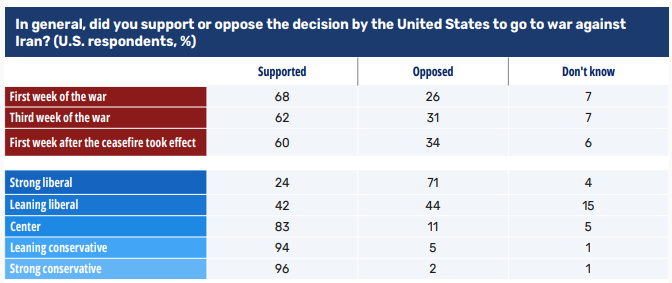
A breakdown of Voice of the Jewish People respondents by ideological orientation shows marked political polarization in perceptions of the campaign, with near-total support for the decision to launch the war among the conservative cohorts (96% among the “strong conservative” and 94% among the “leaning conservative”). High support was also recorded among centrist respondents (83%). By contrast, most (71%) of the “strong liberal” cohort opposed the move. The “leaning liberal” group emerged as the most divided and hesitant group, with an almost even split between supporters and opponents (42% and 44%, respectively) and a relatively high share (15%) who had not yet formed an opinion.
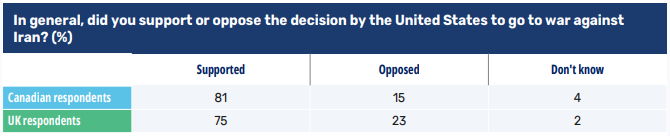
In the first week after the ceasefire went into effect, broad support for the war was maintained among respondents in the Jewish communities in Canada (81%) and the UK (75%), alongside low levels of opposition ranging from one-sixth to one-quarter.
In line with the decline in support for the Iran war (“Operation Roaring Lion” in Israel), there was also a shift in how respondents interpreted the mood within their social environment. At the beginning of the war, more than half of respondents (53%) thought most of their Jewish acquaintances supported the war, but this fell to 43% within a month. At the same time, there was an increase in the share reporting opposition to the war within their social environment (from 20% to 28%).
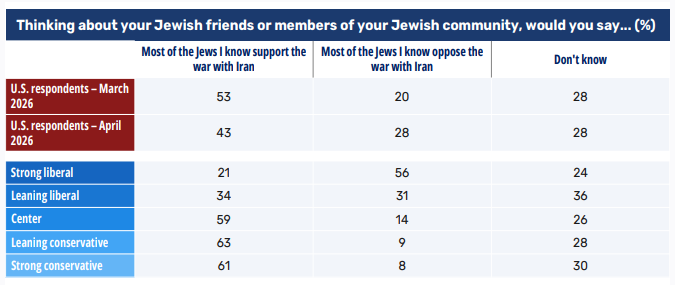
A breakdown by ideological orientation reveals deep differences in respondents’ perceptions of their social environments. At the liberal end of the ideological spectrum, a majority (56%) report opposition to the war within their social environments, compared with 21% who report support. This picture reverses as one moves rightward along the ideological spectrum. Among centrists and the conservative streams, the reported level of support within their social environment stands at 59%–63%, while the level of opposition is 14% or lower. Notably, the share of respondents selecting “don’t know” on this question is relatively high, which may indicate avoidance of discussing the issue.
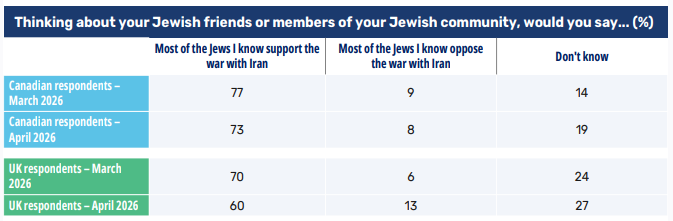
Data from Canadian and UK respondents indicate substantially higher levels of support, though in those countries, too, erosion is evident. Still, reported support fell below half among U.S. respondents; in Canada and the UK, it remained relatively robust at 73% and 60%, respectively. At the same time, the erosion rate among UK respondents is similar to that of their U.S. counterparts, with a 10% decline in support and a doubling of the opposition rate (from 6% to 13%). Among Canadian respondents, relative stability was recorded.
Success in the Iran War
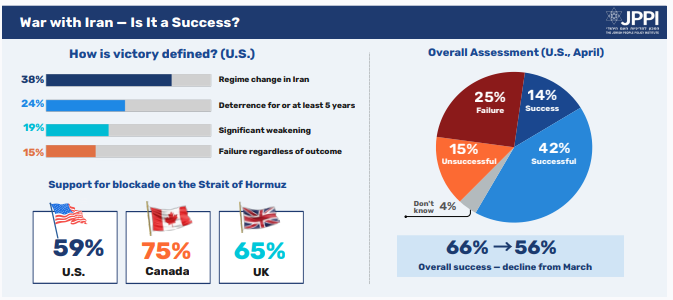
This month, there was a decline in the assessment of U.S. respondents regarding the war’s achievements compared with last month. The share of respondents characterizing the campaign as a “major success” fell from one-quarter (24%) to one-eighth (14%), while the share seeing it as a “failure” rose from one-eighth (14%) to one-quarter (25%). Overall, whereas in March a roughly two-thirds majority (66%) interpreted the war as successful (major success plus somewhat successful), in April this fell to 56%, alongside an increase in the share assessing the outcome negatively (from 26% to 40%).
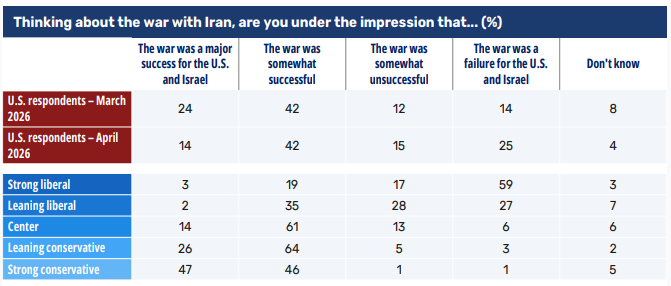
As with other questions on this subject, a breakdown by political orientation reveals substantial gaps in the assessment of the war’s results. Among conservatives, there is broad agreement that the campaign was successful, with 93% of the ‘strong conservative’ cohort and 90% of the ‘leaning conservative’ cohort defining it as fully or partially successful. By contrast, among the “strong liberal,” a majority (59%) see the war as a failure, and only one-fifth (22%) define it as successful to some degree.
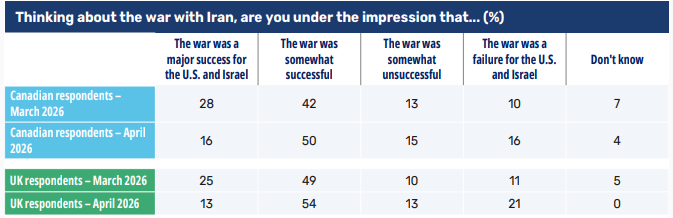
As in the United States, among Canadian and UK respondents, there was a decline in the share characterizing the war as a “major success,” this month in favor of a more moderate evaluation.
Last month, nearly half of respondents in the United States (46%) believed that the war’s success depended on regime change in Iran, but the figure fell to 38% this month. At the same time, there was a slight increase in the share of respondents satisfied with goals of deterrence and threat reduction: 24% of respondents believe that preventing another war for at least five years qualifies as success, and 19% are satisfied with a significant weakening of Iran even if it means future conflict. The share of respondents who see the war as a failure, regardless of how that is defined, rose only slightly over the past month.
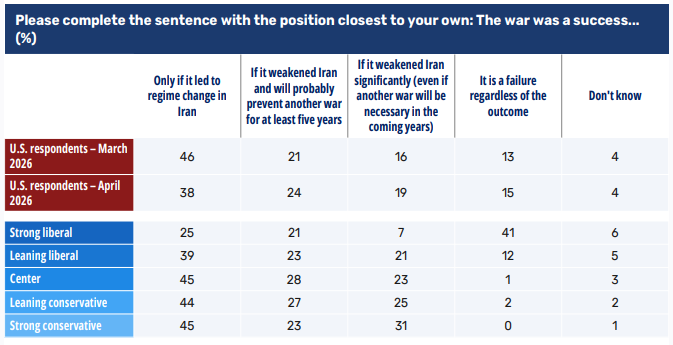
A breakdown by ideological orientation reveals differences in defining the campaign’s goals, with the “strong liberal” cohort showing a striking figure: 41% believe the war is a failure regardless of its outcomes, compared with negligible shares among centrist and conservative respondents. Among the conservative and centrist cohorts, the primary criterion for success remains regime change.
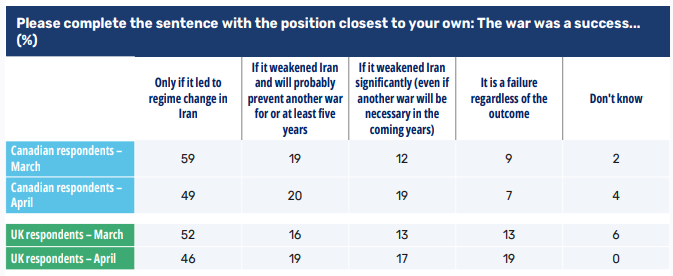
As among U.S. respondents in April, there was also a decline in the share of Canadian and UK respondents who condition the war’s success on regime change in Iran. In Canada, the share supporting this objective fell from 59% to 49%, and in the UK, there was a decline from 52% to 46%. At the same time, in both countries, there was a growing willingness to settle for weakening Iran and achieving deterrence over a defined time horizon, consistent with the diplomatic reality after the ceasefire took effect.
The Strait of Hormuz remains one of the most complex focal points of strategic tension in the campaign. The United States is using a military blockade of the Strait of Hormuz as a policy tool, while Iran is blocking passage through the strait as a policy instrument serving its own interests.
Among the respondent panel, there is broad support for imposing a military blockade of the strait. A majority of U.S. respondents (59%) support this move (strongly or somewhat), compared with 28% who oppose it. Among Canadian respondents, 75% support the move, most of them (56%) strongly. In the UK, support was recorded at 65%, compared with 16% who oppose it.
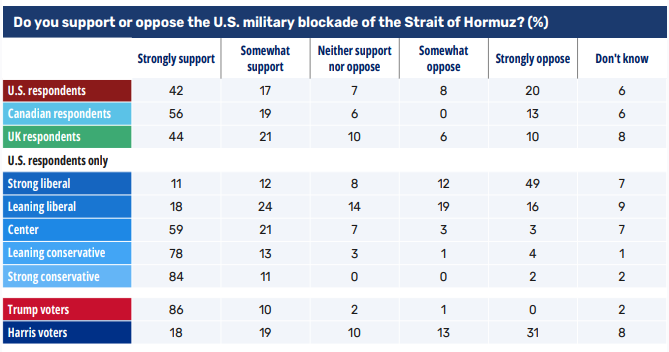
Among the conservative U.S. respondent cohorts, there is near-total agreement with the move (95% of strong conservatives and 91% of leaning conservatives). Broad support is also evident among the centrist cohort (80%). By contrast, the “strong liberal” cohort opposes the move (61% opposition versus 23% support). This gap is also reflected in a breakdown by vote in the 2024 presidential election: an overwhelming majority (96%) of Trump voters support the blockade, but Harris voters are split, with 44% opposing the move and 37% supporting it.
The War in Gaza
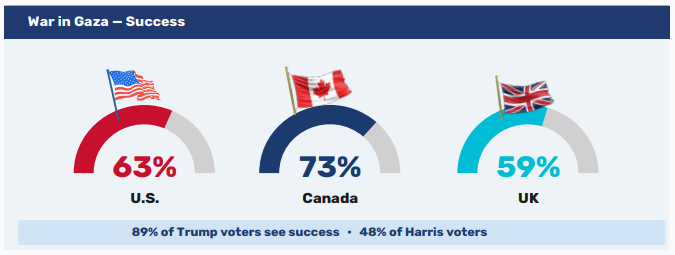
While global attention is focused on Iran, most survey respondents share a largely positive assessment of the results of the war in Gaza, albeit with differing degrees of intensity. Among the U.S. Jews surveyed, two-thirds (63%) perceive the war fought in Gaza as successful, whereas one-fifth (21%) define it as a failure. In the UK, the picture is similar, with six in ten (59%) assessing the campaign as a success versus two in ten (19%) who see it as a failure. Canadian respondents present the most positive view, with three-quarters (73%) seeing the war as a success (13% as a major success and 60% as somewhat successful), and only 10% regarding it as a failure.
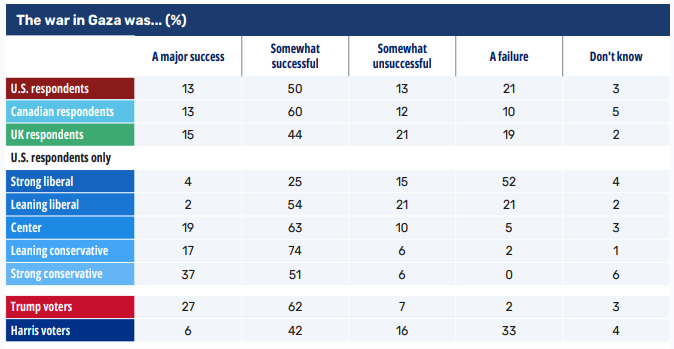
Among U.S. Jews in the strong liberal cohort, half (52%) think of the war as a failure, and only a negligible share regards it as a major success. The opposite picture emerges from the strong conservative cohort: 88% assess the war as successful, and a negligible share considers it a failure. This gap is also reflected in a breakdown by vote in the 2024 presidential election: a majority (89%) of Trump voters see the war as a success, while the picture is divided among Harris voters – half (48%) see it as a success, and a third (33%) view it as a failure.
The War in Lebanon
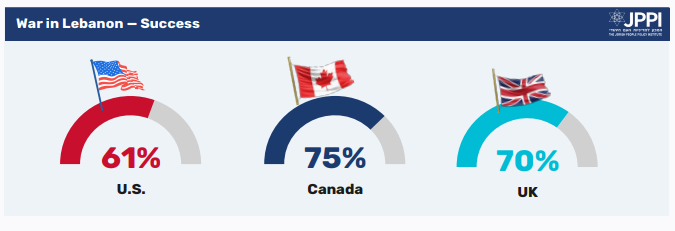
Against the backdrop of efforts to stabilize the ceasefire agreement with Iran, a temporary pause in fighting with Hezbollah in Lebanon also came into effect. Trump’s announcement of the Israel-Lebanon ceasefire was made as data were being collected for this survey. That is, for some respondents, Lebanon was still an active front, but for others the pause in fighting had already taken effect.
A majority of U.S. respondents (61%) consider the war a success (11% as a major success and 50% as somewhat successful), while 27% see it as somewhat unsuccessful or even a failure. By contrast, a higher level of confidence in its success was registered among Canadian and UK respondents.
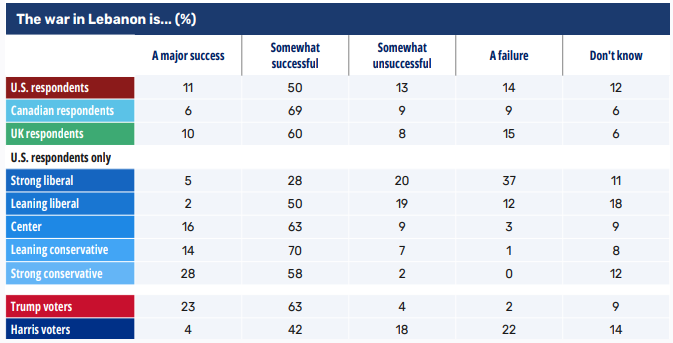
A breakdown by ideological orientation shows a very high level of satisfaction with the Lebanon campaign among conservative respondents, with 86% of the strong conservative cohort and the same share of Trump voters considering it a success; only negligible shares in these groups regard it as a failure. By contrast, a more critical tone is evident in the strong liberal cohort, with 37% characterizing the war as a failure and only 5% regarding it as a major success. The same pattern holds among Harris voters, with 46% perceiving the war as a success and 22% seeing it as a failure; a relatively high share (14%) of Harris voters had not yet formed an opinion on the issue.
Confidence in Leaders
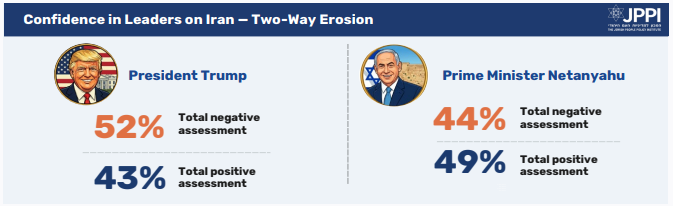
In the past month, there has been some erosion in evaluations. During the active phase of the Iran war, the share of respondents assessing his leadership as very good stood at 28%; this month the figure fell to 23%. At the same time, criticism of his performance increased: the share of respondents rating the president as a very poor leader rose from 37% to 43%. Together, negative assessments constituted a 52% majority of U.S. respondents.
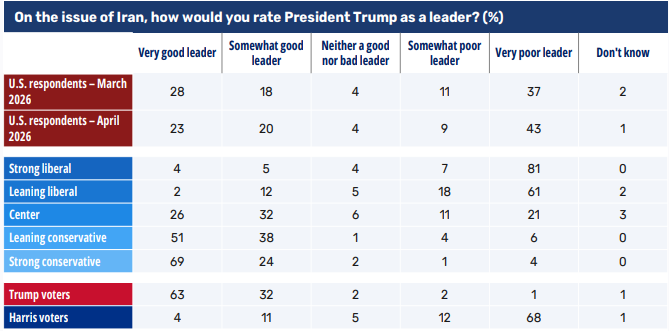
Leadership assessments are made largely through an ideological lens. Among conservative respondents, support for the president is almost unanimous, with 93% of the strong conservative cohort and 95% of Trump voters evaluating his leadership positively. The reverse picture appears among liberal respondents, with 88% of the strong liberal cohort and 80% of Harris voters evaluating Trump’s leadership as poor (with 81% and 68%, respectively, rating his leadership as very poor). Centrist respondents take a mostly positive stance, with 58% assessing his leadership positively and 32% assessing it as poor.
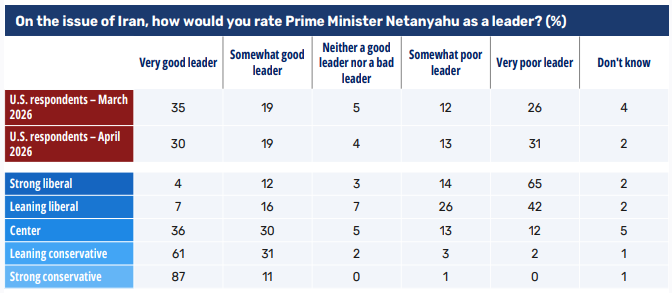
This month, there was also a slight erosion in respondents’ assessments of Prime Minister Netanyahu’s leadership on Iran. The share rating Netanyahu as a “very good leader” dropped from 35% to 30%, and positive assessments now total 49% rather than the 54% recorded last month. At the same time, the share viewing him as a poor leader (very poor or somewhat poor) rose from 38% to 44%, mainly because of the increase in the share evaluating his leadership as very poor. Nevertheless, Netanyahu enjoys a higher overall positive evaluation than Trump (49% versus 43%) and a substantially lower share rating his leadership as very poor (31% versus 43% for Trump). In other words, the connected U.S. Jews surveyed tend to place greater trust in Israeli leadership than in American leadership in the context of the Iran war.
As with previous questions, this question also revealed significant gaps between ideological groups.
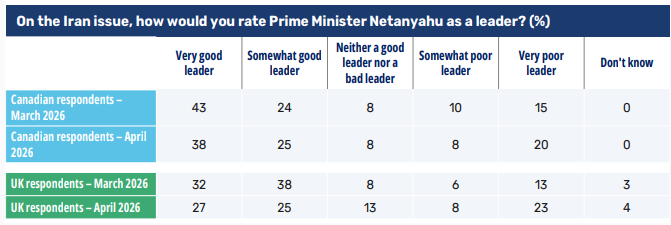
Among Canadian and UK respondents, too, there has been a decline in confidence in Prime Minister Netanyahu’s leadership on Iran. In Canada, the share rating Netanyahu as a very good leader fell from 43% to 38%, while the share rating him as a very poor leader rose to 20%. In the UK, a more substantial decline was recorded, with total positive assessments falling from 70% to 52%, alongside an increase in the share rating his leadership as very poor. Of the Jews surveyed, Canadian respondents tend to view Netanyahu’s leadership on Iran most positively (63%), followed by UK respondents (52%), and U.S. respondents (49%).
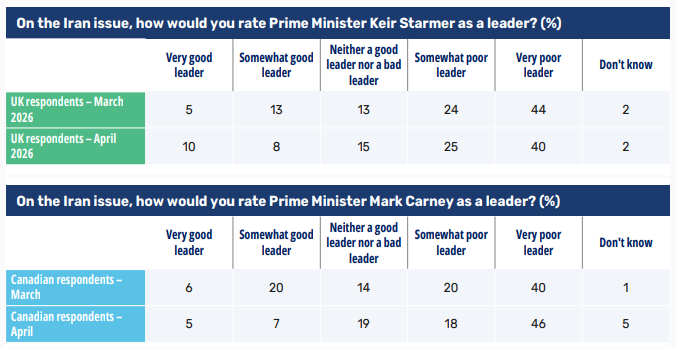
Jews in Canada and the UK evaluate their own national leadership in relation to Iran negatively overall. In the UK, assessments of Keir Starmer’s leadership remained mostly negative (65%), with only one-fifth (18%) rating him positively. In Canada, confidence in Prime Minister Mark Carney vis-à-vis Iran declined by more than half over the past month. At the same time, the share rating him as a “very poor leader” increased.
The Erosion of Israel’s Image
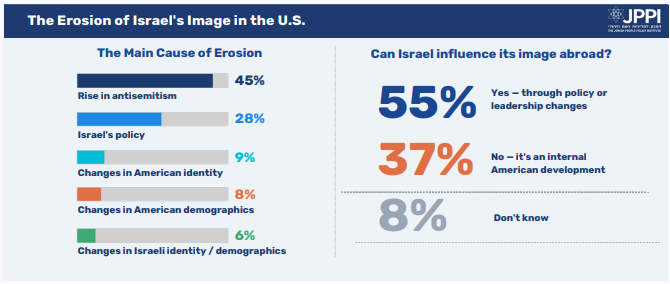
New surveys of Israel’s standing in the United States (Pew, Gallup) reveal substantial erosion across nearly all audiences. JPPI’s Voice of the Jewish People panel of connected Jews believes that the rise in antisemitic attitudes in the United States is the primary factor behind this erosion. Nearly half of respondents (45%) identify antisemitism as the central reason for the erosion in Israel’s standing, while changes in Israeli policy are seen as the second most important factor (28% of respondents). Smaller groups chose other reasons presented in the survey.
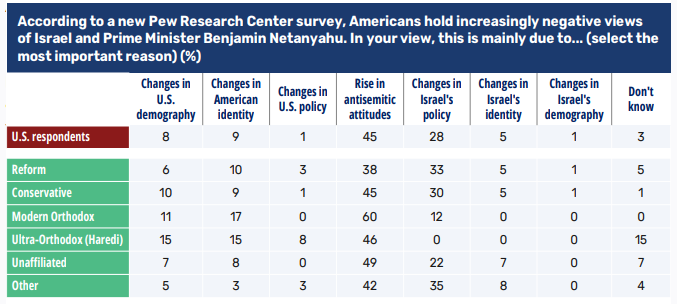
A denominational breakdown points to differences in identifying the source of the erosion. The more religiously observant the stream, the greater the tendency to attribute the situation to antisemitism. Among Modern Orthodox respondents, a 60% majority blames rising antisemitism, while only 12% point to Israeli policy as the central factor in the erosion of Israel’s standing. By contrast, 33% of Reform respondents attach significant weight to Israeli policy, a figure just five percentage points less than the weight they give to antisemitism (38%).
A majority of the respondent panel (55%) believes that the State of Israel could positively influence its image in the United States by changing its policies or leadership. By contrast, 37% of the panel believes the erosion stems from developments within the United States, and that Israel therefore has no real ability to improve its image.
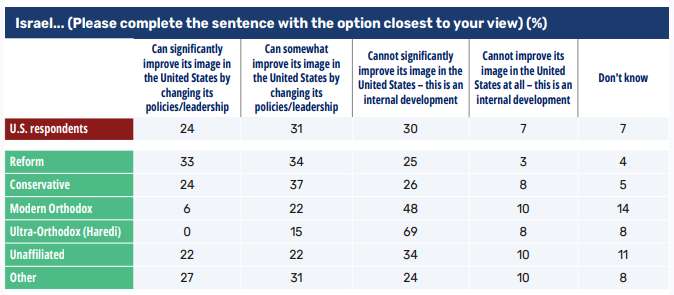
A denominational breakdown reveals a similar pattern in how respondents characterize both responsibility and Israel’s capacity to improve its image. Among Reform and Conservative respondents, a majority (67% and 61%, respectively) believes a change in Israeli policy or leadership would lead to significant or partial improvement of its standing. Among respondents from the Orthodox streams, the picture is reversed: a majority of Haredi (77%) and Modern Orthodox (58%) respondents believe that the erosion of Israel’s Image is the result of internal American processes not under Israel’s control. This is especially striking among Haredi respondents, with a negligible share believing that Israeli measures could significantly improve its image in the United States.
The Israeli Project
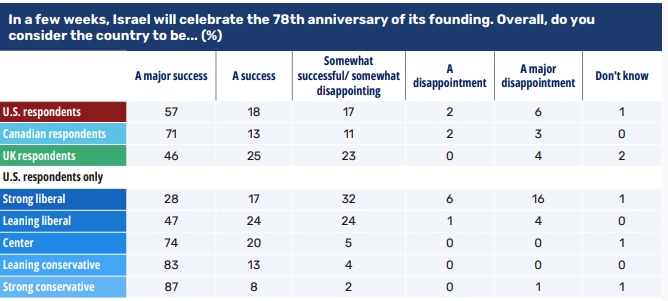
A question posed just ahead of Israel’s 78th Independence Day indicates that a large majority of the connected Jews surveyed see the State of Israel as a success story. Three-quarters (75%) of the respondents characterize Israel in this way, with an overwhelming majority (57%) seeing it as “a major success.” Among Canadian respondents, the share is even higher: 84% see the state as a success (71% say it is a major success). Among UK respondents, the share identifying Israel as a success stands at 71%.
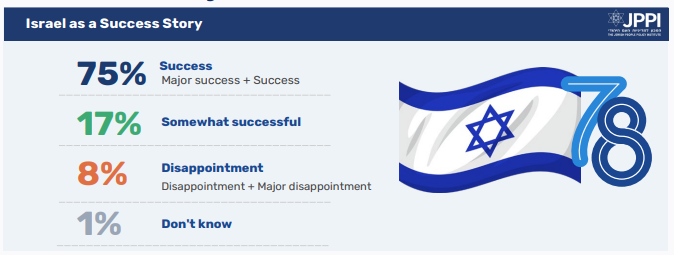
A respondent breakdown by ideological orientation shows that there is consensus among conservative respondents and those self-identifying as centrists that Israel is a success (94%–96%). A 71% majority of the leaning liberal cohort also holds this view. By contrast, less than half (45%) of the strong liberal cohort sees Israel as a success, compared with a third (32%) who have mixed feelings and a fifth (22%) who see the state as a disappointment.
The American Project
Ahead of the 250th anniversary of the United States, most connected U.S. Jews surveyed (67%) consider the country a success story, with 45% seeing it as a major success and another 22% as a success. A breakdown by ideological orientation shows broad agreement in the conservative and centrist cohorts that it is a success (between 62% and 72% consider it a major success). The picture among the strong liberal cohort is far more qualified: Only 20% see the United States as a major success; a similar 22% see it as a disappointment or major disappointment; and an especially high 38% report mixed feelings.
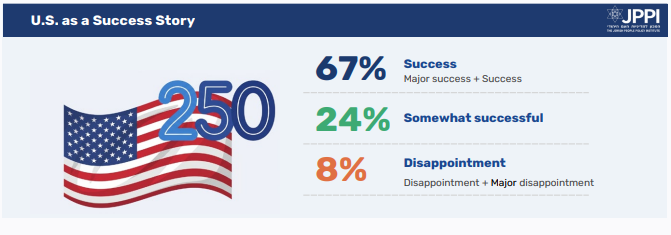
A comparison of perceptions of the success of Israel and the United States reveals that the connected U.S. Jews surveyed tend to rate Israel’s success more favorably than the success of their own country. Whereas three-quarters (75%) see Israel as a success (57% as a major success), two-thirds (67%) regard the United States as a success (45% as a major success).
Midterm Congressional Elections
As summer approaches, the American political system is gearing up for the November midterm congressional elections, which are likely to be held close to Israel’s general elections. The election campaign is unfolding amid an intense public debate over U.S. military involvement in the Middle East and the economic implications of the Iran war. In a reality of deep political polarization, the election results are expected to limit the maneuvering room of the Trump administration in shaping future foreign policy, preserving strategic alliances, and dealing with the challenges of security and antisemitism, issues of great concern for the U.S. Jewish community.
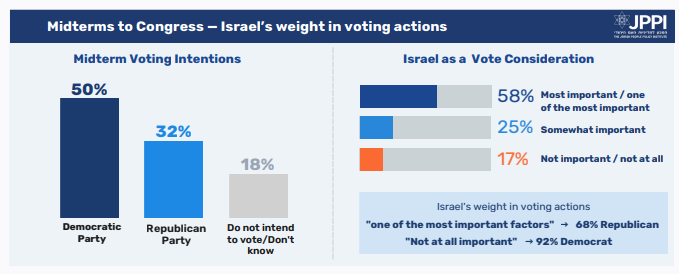
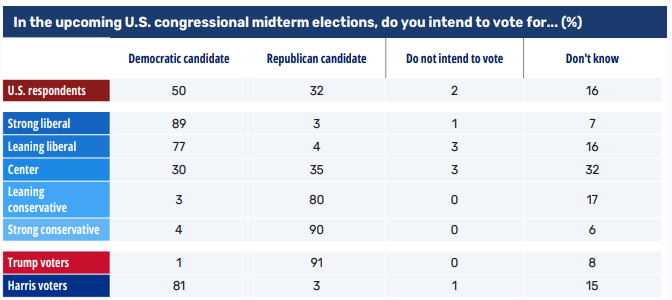
Half of respondents say they expect to vote for a Democratic Party candidate (50%), compared with one-third (32%) who expect to vote for a Republican Party candidate. A Jewish Electorate Institute survey of U.S. Jews, released in mid-April, found that 74% said they would vote for Democrats, 22% for Republicans, and 4% were undecided. As expected, there is an almost complete correspondence between ideological orientation and voting intentions, with an overwhelming 89% of the strong liberal cohort intending to vote Democratic, while an overwhelming 90% majority of the strong conservative cohort intends to vote Republican. A negligible share of respondents does not intend to vote. The data further indicate high party loyalty: 91% of Trump voters intend to support a Republican congressional candidate, and 81% of Harris voters intend to vote for a Democratic candidate.
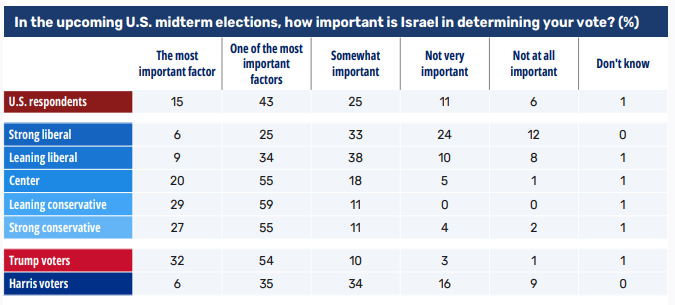
The data also show that “Israel” is an influential factor for connected Jews in determining their vote. A 58% majority of the respondent panel says that Israel will be either the most important factor or one of the most important factors in their decision. A quarter (25%) sees Israel as a somewhat important factor, while a sixth (17%) says that Israel is not an important consideration for them.
Among the ideologically conservative groups, Israel is perceived as a critical issue: 82% of the strong conservative and 88% of the leaning conservative cohorts say it is the most important factor or one of the most important factors, a view shared by 86% of Trump voters. By contrast, in the ideologically liberal cohorts, the importance of Israel in determining respondents’ votes is much lower: a third (31%) of the strong liberal cohort and fewer than half of Harris voters (41%) see Israel as a central factor in their vote. In fact, one-third (36%) of strong liberal respondents said that Israel will not be very important or not at all important to them in casting their ballots.
A cross-tabulation of the last two questions reveals a direct and significant correlation between the weight respondents assign to Israel and the party for which they will vote in the midterms. Among respondents who define Israel as “the most important factor” in deciding for whom to vote, there is an overwhelming preference for a Republican (68% versus only 12% for a Democrat). This trend persists among those who see Israel as “one of the most important factors,” where the Republican Party leads with 44% support versus 33% for the Democratic Party. The data show, not for the first time, that at the present moment Jewish voters who place ties with Israel at the top of their priorities are more likely to see the Republican Party as their preferred political home.
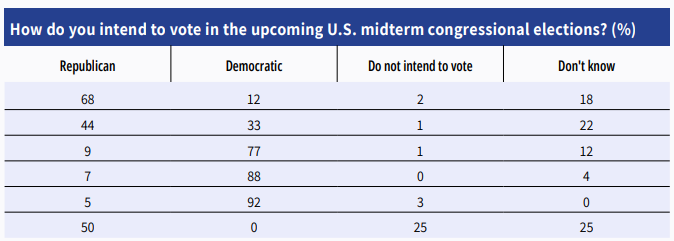
Similarly, as the importance of Israel declines among voters’ considerations, support for Democratic candidates rises sharply. Among respondents who believe that Israel is a “somewhat important” factor, three-quarters (77%) intend to vote Democratic, and this share rises to 88% among those for whom Israel is “not very important,” and to 92% among those for whom it is “not at all important.” In other words, the Jewish-Republican voting bloc is influenced to a large extent by attachment to Israel, whereas the Jewish-Democratic bloc is composed mostly of those who consider Israel a secondary priority compared with other issues on the agenda.
Optimism about the Future
This month, we once again examined respondents’ degree of optimism regarding the future of their country, the future of Jews in their country, and the future of the State of Israel. We compared these data with data from identical questions asked last year. Optimism and pessimism were rated on a scale from minus 5 (pessimism) to plus 5 (optimism), and the results presented here are the respondents’ average optimism scores on each of the questions.
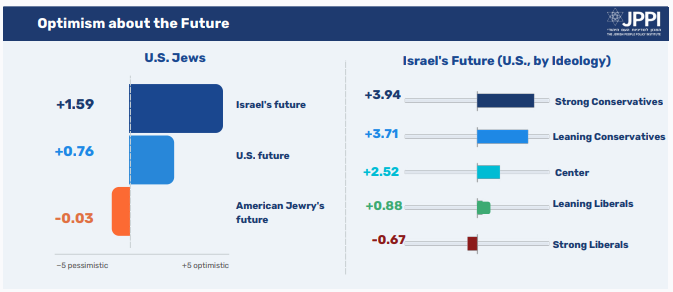
Among the connected U.S. Jews surveyed, there is greater optimism regarding the future of the State of Israel (1.59) than regarding the future of the United States (0.76) or the future of the U.S. Jewish community (-0.03). The slight pessimism regarding the future of American Jewry is notable.
The ideological breakdown shows that whereas conservatives express substantial confidence in the future (especially regarding Israel, with an average of 3.94), liberals present a much gloomier picture. The strong liberal cohort is the only one that reports pessimism on all three measures, including an unusual negative score regarding Israel’s future (-0.67).
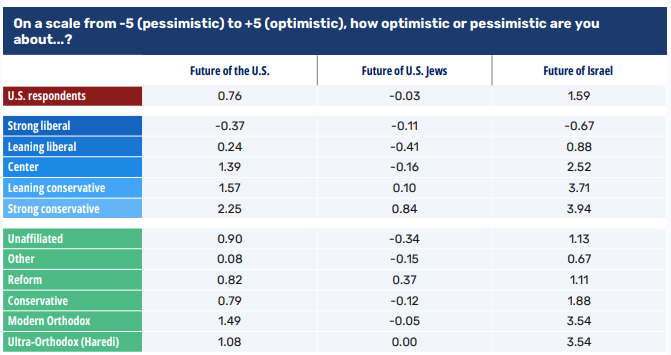
A denominational breakdown shows that Israel serves as an anchor of optimism for all groups, but this is especially true among Modern Orthodox and Haredi respondents (3.54). The Reform cohort is the only one with some degree of optimism regarding the future of U.S. Jewry (0.37), whereas respondents from the other denominational cohorts tend toward pessimism or neutrality.
There appears to be some increase in the level of optimism among U.S. Jews on all measures compared with last year. The largest change was recorded with respect to the future of the United States, which rose from a pessimistic level of -0.6 to an optimistic score of 0.76, meaning an uptick of 1.4 points. At the same time, optimism regarding Israel’s future reached 1.59, the highest figure since we initiated this metric in February 2025. Nevertheless, the data indicate that the future of U.S. Jews remains the most worrying and least stable issue for respondents. Despite a slight rise of 0.3 points over the past year, the score remains on the threshold of pessimism (-0.03).
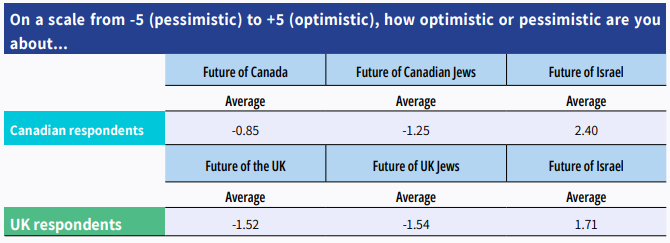
The same question was asked of Canadian and UK respondents. The findings show that, similar to the trend observed in the United States, the State of Israel is perceived as an anchor of optimism (2.40 in Canada and 1.71 in the UK). At the same time, unlike in the United States, where respondents are relatively optimistic about the future of their own country (0.76), Canadian and UK respondents are pessimistic about their respective countries’ futures (-0.85 in Canada, and an especially low score of -1.52 in the UK).
The comparison of the three countries highlights the sense of insecurity felt by Canadian and UK respondents relative to their U.S. counterparts. The Canadian Jews surveyed are the most optimistic with respect to Israel’s future (2.40).
Engagement in Jewish Activity
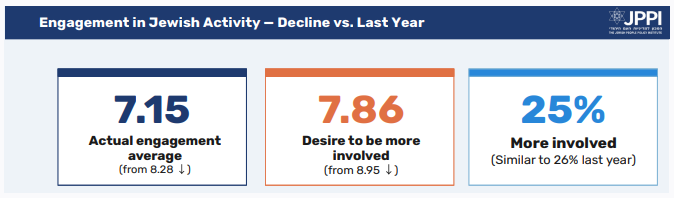
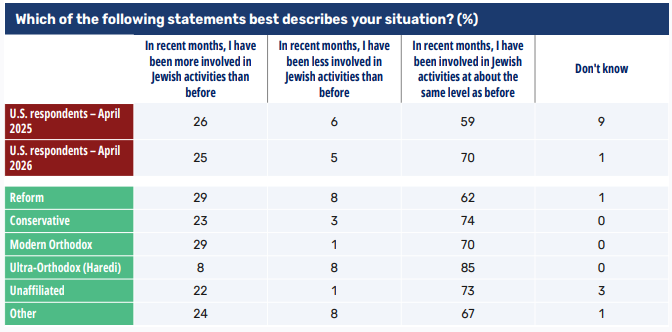
As part of another comparison with last year, this month we examined the extent of the respondent panel’s involvement in Jewish activity. The share of respondents reporting increased activity was similar to last year, but it remains to be seen whether this reported increase by such a large group indeed indicates that growing numbers of individual Jews are participating in Jewish activity (25% this year versus 26% last year). The main change in the data is in the group reporting a level of activity “the same as before” (70% versus 59%).
A denominational breakdown shows that most respondents across all cohorts report no change in their level of involvement in recent months. Especially notable are Haredi respondents, among whom 85% report the same level of activity as before, and only 8% report an increase (this, of course, stems from the intensity of communal life in Haredi society, which means that there is little room for an increase).
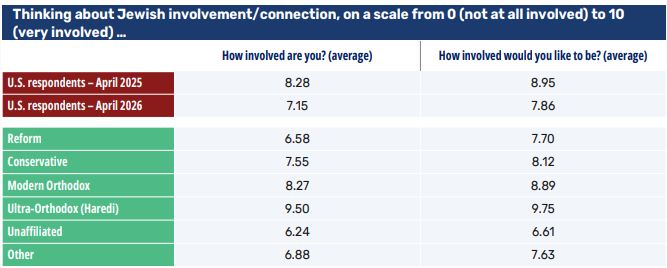
At the same time, suggesting a possible internal contradiction in the data, responses to another question show a significant decline this year in the reported levels of involvement and Jewish connectedness among U.S. Jews relative to last year’s data. Whereas last year the average practical involvement stood at 8.28 (on a question asking respondents to place their level of activity on a scale from 0 to 10), this year it fell to 7.15. A similar trend was recorded in the degree to which Jews want to be more involved, which fell from 8.95 to 7.86. This question raises the possibility that after the rise in communal involvement that characterized the period following the outbreak of the war in October 2023, a stabilization occurred at lower levels, perhaps indicating a return to routine or some erosion in the intensity of communal connection over time.
Despite the downward trend, the data show that in all religious streams there is a consistent “aspiration gap” – respondents express a desire to be more involved than they actually are. This gap is especially pronounced among Reform respondents: the aspiration for involvement (7.70) is higher than actual involvement (6.58). By contrast, Haredi respondents (a small number of survey participants) display the highest level of involvement, with an average of 9.50, and the smallest gap between actual and aspirational involvement. Unaffiliated respondents present the lowest levels of connectedness in the table, and only a small actual/aspirational gap is recorded, indicating a limited desire to strengthen involvement (6.61 versus 6.24), which points to a small, unrealized potential for communal connection in this group.
Survey Data and Implications
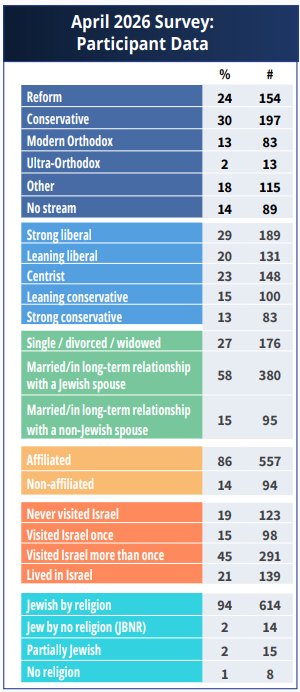
This report is based on a survey of 806 Jews registered for JPPI’s Voice of the Jewish People panel. Broadly speaking, the survey reflects the views of “connected” American Jews – that is, those with a relatively strong connection to the Jewish community, and/or to Israel, and/or to Jewish identity. The survey also included 48 participants in the UK and 108 in Canada. Unless otherwise noted, the results reflect the views of U.S. respondents only. JPPI’s Voice of the Jewish People Index surveys are conducted by JPPI fellows Shmuel Rosner and Noah Slepkov, with assistance from Yael Levinovsky. Statistical supervision: Prof. David Steinberg.
This table includes data on the U.S. survey respondents for April 2026.