

Extremist rhetoric has a mobilizing power, and that is its purpose, but it also upends the ground on which we all stand.
You don’t have to be a philosopher of language – or George Orwell – to know that language is not just a tool for describing reality; it also shapes it. Speech changes reality. And yet, it seems that many fail to internalize this and deploy their words with dangerous haste.
The discourse of the government’s supporters is full of examples. Some of them do not hesitate to fire up the “poison machine” that paints not only the opposing camp’s politicians but also state institutions – primarily the judicial system – in the darkest shades of black. And they are not content with sharp language alone. They also call for action, from disobeying these institutions to leveling them altogether. But critics of the government, too, do not hesitate to use caustic language, which, in my view, is destructive. Thus, the leader of a major party warns that “if we lose the elections, it will be the destruction of the Third Temple.” A historical metaphor like this frames the elections not as a political process, but as an existential event. A prominent liberal leader declares that “Israel is no longer a liberal democracy,” thereby, by virtue of his stature, implants in the public consciousness the notion that a decisive change in the state’s character has already occurred.
Former senior officials – prime ministers, heads of the security services, leaders of the justice system – who watch with alarm what has been happening in recent years, use dramatic language according to which Israel is, or is on its way to becoming, a “dictatorship,” bearing “fascist” characteristics; whose government is “revolutionary” and includes elements “more deadly than external enemies.”
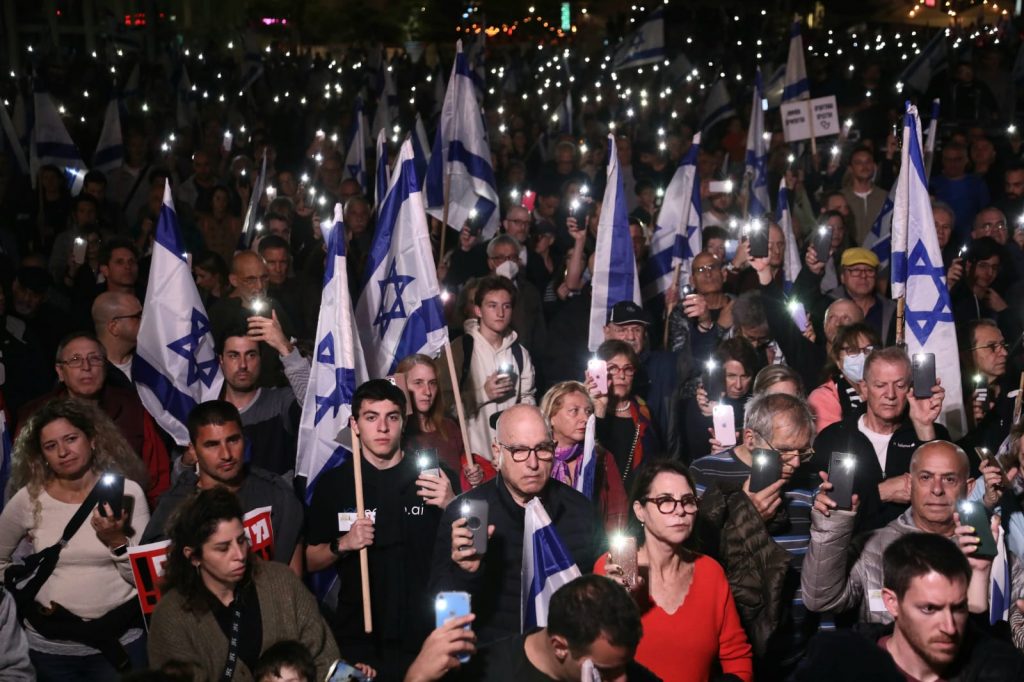
This hyperbolic rhetoric is intended to emphasize the depth of the peril the speakers feel regarding our future and to spur their followers to actively protest. That is, of course, a most worthy form of civic engagement. But the speakers, as people of public and national stature, must understand the explosive force of language – “Death and life are in the power of the tongue” (Proverbs 18:21). Extreme depictions of the situation influence public perceptions of reality and exacerbate political and social tensions. Paradoxically, proclaiming a dystopian future, even when the intention is to prevent it, may advance its realization, a self-fulfilling prophecy. Social correction, even when accompanied by an authentic sense of urgency, must be undertaken with discretion, caution, and responsibility.
Thus, if the next elections are described as existential, as having the potential to usher in the state’s annihilation, someone may find moral justification for taking drastic measures to avert the threat. So that I do not commit the very sin I seek to prevent – altering the perception of reality for the worse through dystopian description – I will not elaborate. But all of our imaginations together could fill an entire book of apocalyptic prophecies. Is that what those sounding the alarm intend?
It is possible and proper – indeed vital – to conduct our internal identity struggles candidly, without cosmetic euphemisms. But black-washing reality is dangerous. Israel is not a dictatorship – the broad social protest of 2023 succeeded in preventing the judicial overhaul. The criticism that many in Israel level against the government is not being silenced. There is no doubt that aspects of Israeli democracy are being eroded – a serious undermining of its gatekeepers is one important example – and there is a tendency within the current government to deepen that erosion through radical legislative initiatives. Still, this is a far cry from the factual determination that Israel is no longer a liberal democracy and that single-camp rule prevails here.
The confidence of Israel’s citizens in the continued existence of their state should not be subject to political manipulation. Israel is a well-established nation, and its future depends on the sense of security it projects internally and externally. Extremist rhetoric has a mobilizing power, and that is its purpose, but it also upends the ground on which we all stand. The necessary remedy, for the benefit of us all, is to stabilize the system of government through entrenched constitutional arrangements that secure the democratic rules of the game by which we will conduct this continuing identity struggle. Unfortunately, we are unable to agree on a constitutional bill of human rights; but if, after the next elections, a broad coalition is formed, it could establish a “thin constitution” that would include power-sharing arrangements preventing a “victory” by either side – and thereby ensure Israel’s future as a stable and thriving liberal democracy.