


The 2026 Elections, Trump’s Leadership, Perceptions of Victory in the War, Women in the IDF, Haredi Conscription, and Crime in the Arab Sector.
Main Finding
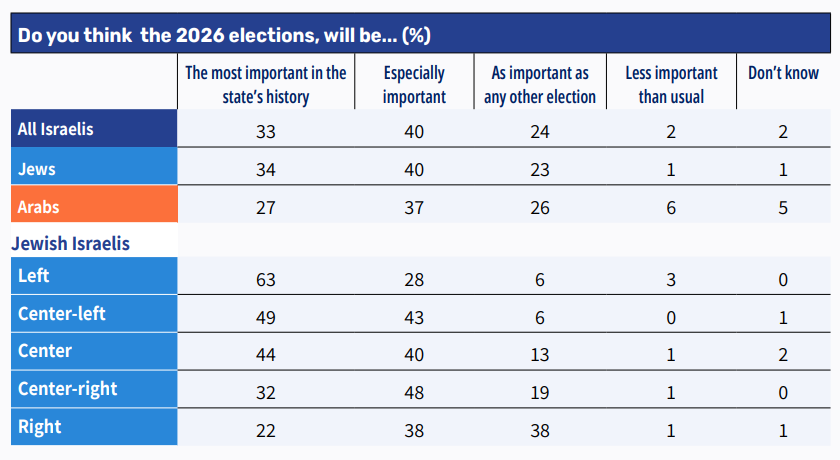
One-third of Israelis believe that the 2026 elections will be the most important in the state’s history. Replacing the current government and judicial reform are the two issues the public considers most important in these elections.
Additional Findings:
- 73% of Israelis believe the 2026 elections are of exceptional importance.
- One-third of the public considers them the most important elections in the country’s history.
- The further left respondents are on the political spectrum, the higher the perceived importance of the elections.
- One in three Israelis thinks the primary goal of the 2026 elections is replacing the current government.
- A quarter of the public views judicial reform as the most important voting issue.
- Half of Arab respondents define addressing crime and violence as the most important voting issue.
- Israelis are less likely than Americans to characterize Trump as a “bad” president.
- A majority on the political right sees Trump as one of the best presidents the United States has had.
- Trump is perceived as far better for Israel than he is for America.
- Most of the public believes Israel won the war in Gaza, but that the victory was “not large enough.”
- Most Israelis support the rising trend of women serving as combat soldiers.
- Most Israelis oppose the Bismuth Outline for conscription-exemption; one-third view it as a “reasonable compromise.”
To download the PDF file, click here.
2026 Elections
The Israeli public ascribes very high importance to the 2026 elections. A clear majority of Israelis regard the elections as exceptionally significant: one-third (33%) believe these are the most important elections in the state’s history, and four in ten (40%) characterize them as especially important. One-quarter (24%) view them as elections of regular importance, and a negligible share thinks they are less important than usual. Among Arab Israelis, the importance attributed to the elections is somewhat lower than among Jewish Israelis.
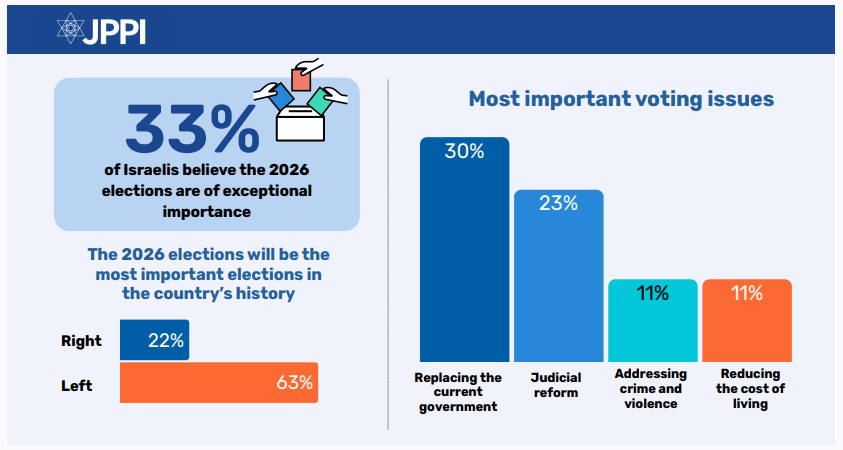
A breakdown by ideological orientation reveals substantial gaps in perceptions of the elections’ importance. Still, across ideological cohorts, a majority of Israelis believe these elections are of special importance (most important + especially important). Among Israelis who self-identify as right-wing, the elections are regarded as less important than in other groups: a sizable share (38%) of right-wing respondents consider them to be as important as any other election. Among center-right respondents, there is a heightened sense of the upcoming elections’ importance: half (48%) believe these are especially important elections, and one-third (32%) consider them the most important in the state’s history. In the centrist cohort, the sense of importance strengthens further, and there is an additional marked increase among center-left respondents. A large majority of center-left respondents believe the elections are especially important, and 49% consider them the most important in the state’s history. Left-wing respondents ascribe peak importance to the 2026 elections, with 63% regarding them as the most important in the state’s history.
Priorities
The voting issue selected as most important by the largest share of respondents is “replacing the current government” (30%). This issue was chosen from a list of ten options by nearly one-third of respondents. The second-highest-ranked voting issue was “judicial reform” (23% of respondents). Socioeconomic issues, such as reducing the cost of living and addressing crime and violence, also received substantial weight (11% each as a first choice), whereas security and diplomatic issues, such as dismantling Hamas and settlement expansion in Judea and Samaria (the West Bank) received relatively low rankings. In other words, when it comes to voters’ first choice, political and institutional considerations outweigh security issues, despite Israel being in a post-war period (after an exceptionally long war), and against the backdrop of unresolved security considerations (Iran, the rehabilitation of Gaza, and the like).
When examining the issues ranked second and third in importance, a more complex picture of the election emerges. Reducing the cost of living stands out as the second- and third-most highly ranked issue (20% and 22%, respectively), indicating the centrality of the economic picture even though it doesn’t top the list. Addressing crime and violence and strengthening national unity also appear in relatively high positions. Overall, the data reflects a wide dispersion of priorities, while also indicating that judicial, economic, and internal political issues are the most dominant voting considerations ahead of the upcoming elections.
Among Jewish Israelis, choosing priorities related to Israeli politics and governance is even more pronounced, with a strong emphasis on replacing the government (35%) and judicial reform (29%). Civic issues, such as addressing crime, are not perceived as a primary priority. By contrast, among Arab Israelis, the picture differs for self-evident reasons: the most dominant issues for them are addressing crime and violence (48%) and reducing the cost of living (30%). Among Israel’s Arab citizens, structural political and security issues – including judicial reform, dismantling Hamas, and replacing the government – are relegated to the margins.
There are significant differences between ideological camps ahead of the 2026 elections. Among right-wing adherents, who constitute the lion’s share of coalition party voters, judicial reform is the central issue (49%) in the lead-up to the elections. Security issues, such as dismantling Hamas, also take high priority for this sector. Among those on the center-right, a more evenly spread pattern emerges, with replacing the government (31%) and judicial reform (25%) sharing the top position, and significant weight is placed on civic issues. In the centrist and the left-wing cohorts, replacing the current government is the most dominant issue by a considerable margin (60% in the center, 88% in the center-left, and 80% in the left-wing cohorts). Support for all other issues is significantly smaller.
Crime in Arab Society
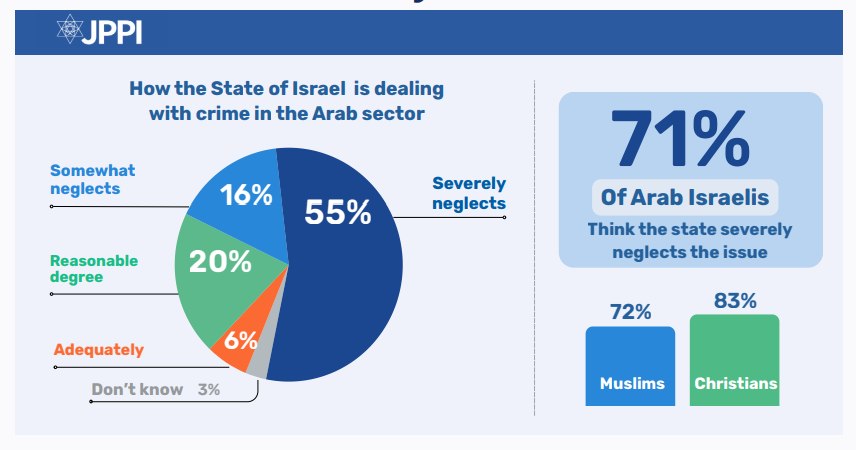
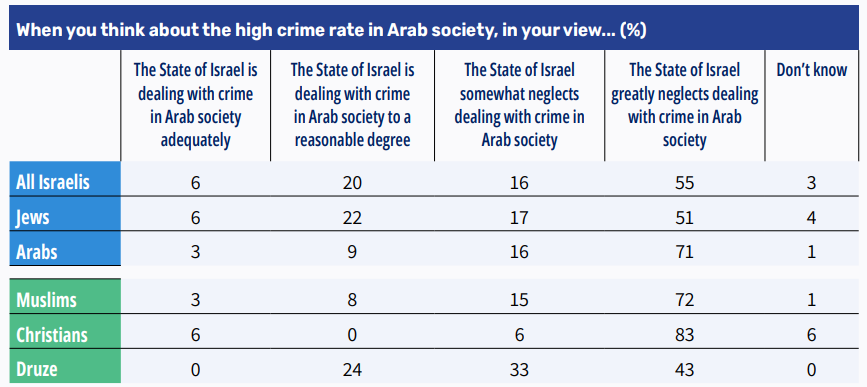
In recent months, reports have indicated a continued upward spiral of crime rates in Arab society. Most Israelis (55%) believe that the State of Israel severely neglects dealing with crime in Arab society. One-fifth (20%) believe it addresses the phenomenon to a reasonable extent, one-sixth (16%) think it somewhat neglects the issue, and only a small percentage believe that the state is adequately addressing crime in Arab society. Half (51%) of Jewish Israelis think the state severely neglects the issue, while almost three-quarters (71%) of Arab Israelis think so.
An internal breakdown of Arab respondents shows that Muslims and Christians, in particular, express an acute sense of neglect (72% and 83%, respectively), but the picture is more complex among Druze respondents, with a higher proportion believing the state’s response has been reasonable. Overall, the data reveal a lack of trust in the state’s ability or willingness to confront crime in Arab society effectively – particularly among Arab Israelis themselves.
Perceptions of the War
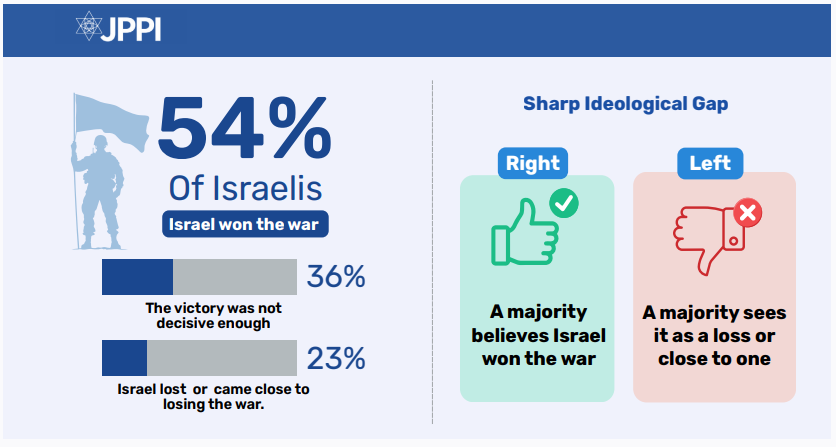
Against the backdrop of relative calm and uncertainty about the implementation of the second stage of the end-of-war agreement – the disarmament of Hamas and the rehabilitation of Gaza – a majority of Israelis (54%) believe Israel won the war. Of these, 36% believe it was a victory that was not decisive enough, while 18% think the victory does not require qualification. One-fifth (20%) of Israelis believe Israel neither won nor lost the war; one-eighth (13%) think Israel lost the war; and one-tenth think Israel may not have lost the war, but came fairly close. Among Jewish Israelis, the share who believe Israel won the war but that the victory was not decisive enough is slightly higher than the average (42%), while one-quarter (26%) of Arab Israelis believe Israel lost the war.
As expected, there are significant gaps in how different ideological groups perceive the outcome of the war in Gaza. A majority of respondents in the right-wing cohorts (right and center-right) believe Israel won the war, while a majority of respondents in the smaller left-wing (left and center-left) groups think Israel lost the war. Put simply, the further one moves rightward along the ideological spectrum, the stronger the perception that Israel won the war against Hamas.
A breakdown by voting pattern shows that a majority of coalition-party voters believe Israel won the war, but not by a sufficiently large margin. However, as the question of victory will likely be central in the discourse leading to the 2026 elections, it is worth noting that a majority of Likud voters (51%) believe Israel’s victory in the war was “not large enough,” and an even larger majority (69%) of Religious Zionism voters think so as well. The only party whose voters tend to think Israel lost the war (or came close to losing) is The Democrats (52%).
Perceptions of Trump’s Leadership
At the one-year mark of U.S. President Donald Trump’s second term, we examined how Israelis perceive his performance – both from an American perspective (insofar as Israelis can assess it) and from the Israeli perspective. The responses pertaining to the American perspective are compared with an identical question from a Siena College/New York Times poll published last month.
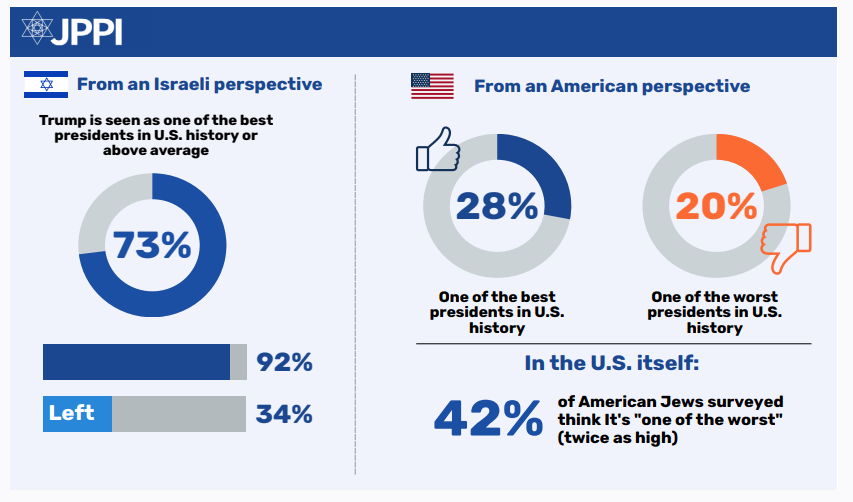
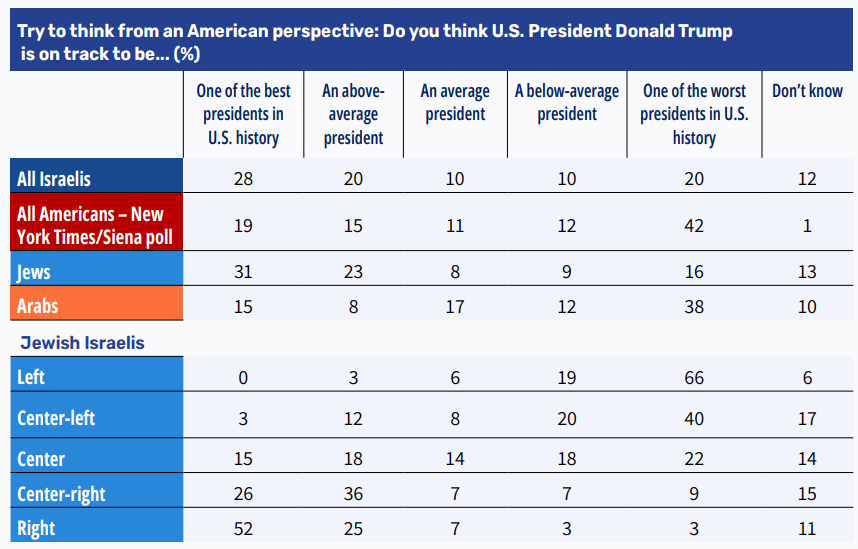
From an American perspective, more than a quarter of Israelis (28%) believe Trump will be remembered as one of the best presidents in U.S. history, while a fifth (20%) view him as an “above-average” president. Overall, half of Israelis assume that even from the standpoint of those who elected him, Trump will be remembered as a president with a positive record. At the same time, one-fifth of Israelis (20%) estimate that Trump will be remembered as one of the worst presidents in U.S. history (this is how American presidential historians currently rank him); another fifth (20%) believe Trump is on track to be an average or below-average president; and an eighth (12%) do not know or did not answer. Among Jewish Israelis, a more positive assessment of Trump is evident, with one-third (31%) regarding him as one of the best presidents in U.S. history. Among Arab Israeli respondents, attitudes toward Trump are negative – 38% see him as one of the worst presidents in U.S. history.
The Siena College/New York Times poll of American voters conducted last month shows that Americans’ assessments of Trump’s chances of being judged favorably by history appear more skeptical than those of Israelis. Whereas 28% of Israelis believe Trump is one of the best presidents in U.S. history (from an American perspective), only 19% of Americans said so. A similar pattern appears at the other end of the scale: one-fifth of Israelis (20%) say Trump will be remembered as one of the worst presidents in U.S. history, while 42% of Americans think so.
Among Israel’s ideological right, the belief that Trump will be remembered as an outstanding president is particularly pronounced, with more than 50% regarding him as one of the best presidents in U.S. history. Among center-right Israelis, there is also substantial support for this view, with a majority defining Trump as an above-average president. By contrast, among center-left and left-wing Israelis, attitudes toward Trump are negative, with most seeing him as a below-average president or as one of the worst presidents in U.S. history.
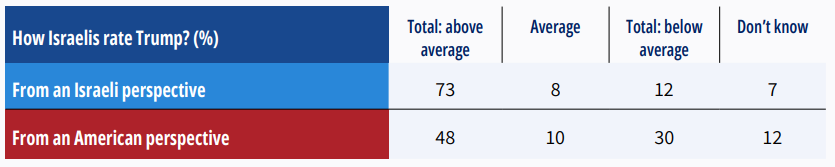
Following the question that explicitly asked respondents to try to evaluate Trump’s term from the standpoint of American voters, we asked them to consider Donald Trump’s presidency from an Israeli angle. Unsurprisingly, Israelis’ assessment of Trump from their own perspective is far more positive than their assessment from the American angle. A majority of Jewish Israelis (54%) view him as one of the best U.S. presidents, and a further quarter (25%) rate him as an above-average president. Among Arab Israeli respondents, the evaluation of Trump is substantially lower: 29% view him as one of the United States’ best presidents (from an Israeli perspective), while one-fifth (21%) consider him one of the worst. Comparing responses from both perspectives – the American perspective and the Israeli perspective – yields an overall picture that is much more positive from the Israeli angle: the share of Israelis who rate Trump as good or above-average with respect to Israel is 73% (49% exceptionally good and 24% above-average), compared with only 48% who rate him that way from an American perspective. Among Jewish Israelis, the gap is even more pronounced: 79% rate him as having a positive record from an Israeli viewpoint, compared with 54% who rate him that way from an American viewpoint.
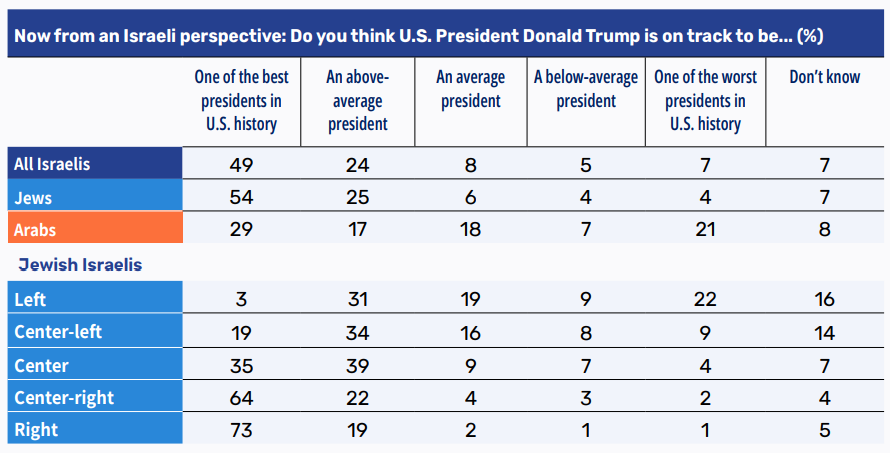
As expected, an ideological breakdown shows substantial differences in how different groups evaluate Trump. On the right, there is an almost across-the-board positive assessment of Trump: 73% view him as one of the best presidents, and a further 19% view him as an above-average president (from the Israeli perspective). In the center-right, there is also substantial support (64% as one of the best presidents; 22% above average). By contrast, the left-wing and center-left cohorts hold considerable reservations about Trump, even from an Israeli perspective.
Haredi (Ultra-Orthodox) Conscription
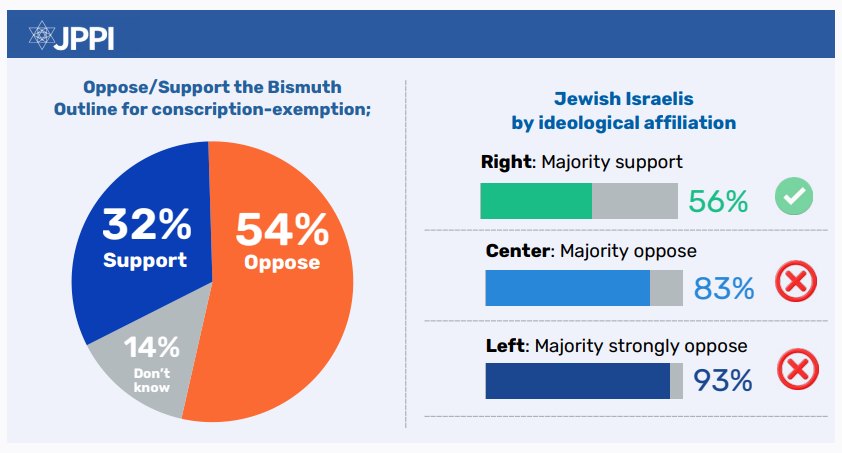
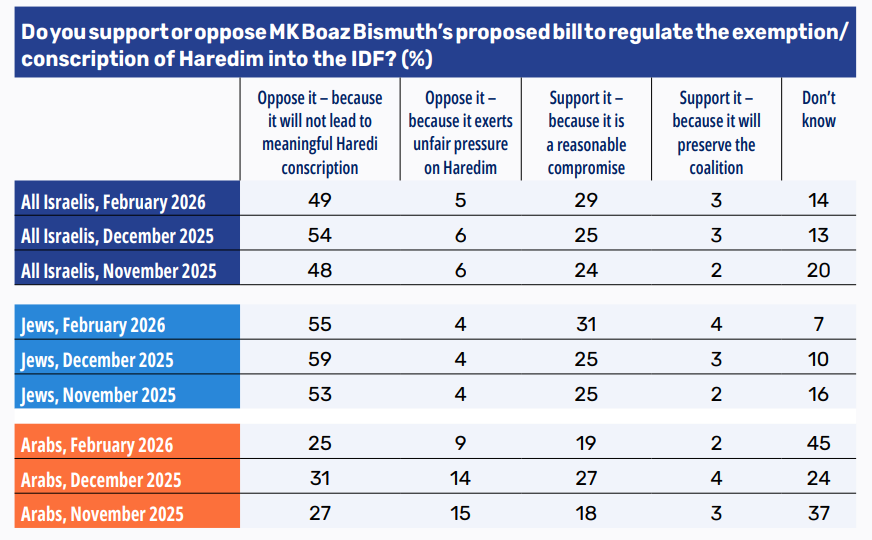
Most Israelis (54%) oppose the coalition’s proposed bill (the Bismuth Outline) to regulate the exemption/conscription of Haredim into the IDF. Forty-nine percent oppose it because they don’t think it will lead to meaningful Haredi conscription, and 5% oppose it because they think it exerts unfair pressure on Haredim. By contrast, one-third (32%) support the bill – 29% because they see it as a reasonable compromise, and 3% because they say passing the bill will preserve the coalition. Among Jewish Israelis, higher shares are recorded for both opponents (59%) and supporters of the bill (35%). Among Arab Israelis, by contrast, lower shares are recorded for both supporters (34%) and opponents (21%) of the Bismuth Outline; the explanation is that almost half (45%) did not know how to answer the question about the bill. Compared with JPPI’s December 2025 Israeli Society Index, there has been a slight decline (6 percentage points) in the share of Israelis opposing the bill, and a slight increase (4 percentage points) in the share supporting it. A breakdown by ideological orientation shows that a majority across all cohorts except the right-wing group oppose the bill because it will not lead to meaningful Haredi conscription (59% in the center-right, 83% in the center, 97% in the center-left, and 94% in the left-wing cohorts). Among right-wing respondents, 56% support the bill as a “reasonable compromise” and another 7% because it will “preserve the coalition” (overall, 63% support it, alongside a non-negligible 10% who answered “don’t know”).
Among supporters of the Haredi parties, some oppose the bill because it is regarded as being unfair toward Haredim (about one-quarter of Shas supporters and one-third of United Torah Judaism supporters). No opposition to the bill was recorded among Likud voters, while about a quarter of Religious Zionism voters oppose it; about a fifth (19%) of respondents answered “don’t know.”
Women in the IDF
In recent years – and even more so since October 2023 – women’s service patterns in the IDF have changed: increased integration into combat units, a surge in reserve-duty reporting rates, and a steady rise in enlistment rates among religious women. The expansion of combat roles and the demonstrated operational capability in front-line units have led to the normalization of female combat soldiers. In parallel, women’s reserve service expanded and was further institutionalized during the Israel-Hamas war. In recent weeks, figures reflecting these changes have been published following criticism in certain circles (primarily Religious-Zionist right-wing circles) of these trends – in principle or in connection with the debate over the Bismuth Outline. In a Channel 14 report that drew many responses, harsh criticism was voiced against the integration of women in combat roles. In response, IDF spokesperson Effie Defrin and other senior officials issued statements of unequivocal support for female combat soldiers. The second event that brought the issue of women’s participation in IDF combat units to the fore was a December 2025 letter sent by the Rabbis of Torat HaAretz HaTova (Rabbis of the Good Land) organization to the Minister of Defense Israel Katz. The letter demanded that the IDF cease its efforts to encourage religious girls to enlist, and that it halt its efforts to do so within religious ulpanot (girls’ high schools).
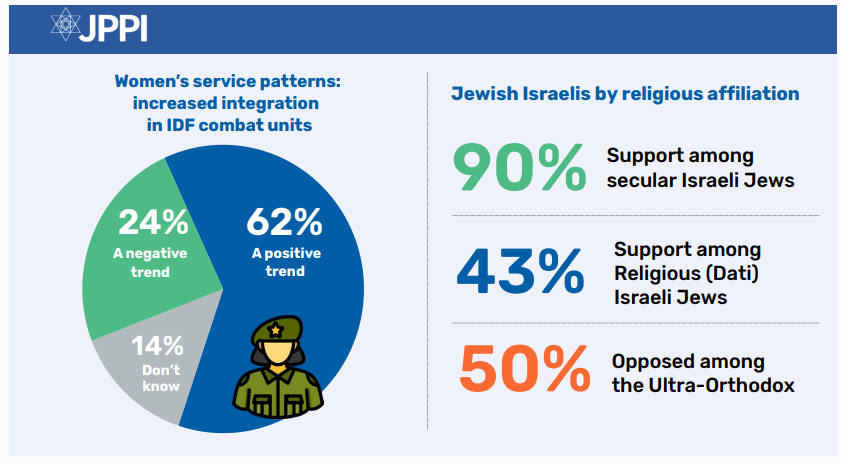
Most Israelis (62%) believe that the uptick in the number of female combat soldiers, women serving in the reserves, and religious women enlisting in the IDF is positive. Only a minority hold reservations about this trend. One-tenth (11%) think this is “not good news” but that “there is probably no choice” – that is, they would prefer the trend did not exist but assume security constraints make it necessary to accept it. One-eighth (13%) view it as a negative trend that should be reversed. Among Jewish Israelis, support for female combat soldiers and for women serving in the IDF is even higher: nearly seven in ten characterize the trend as positive. By contrast, Arab Israeli respondents have a far more reserved stance: one-third (35%) view the trend as positive, and an equal share indicated that they do not know.
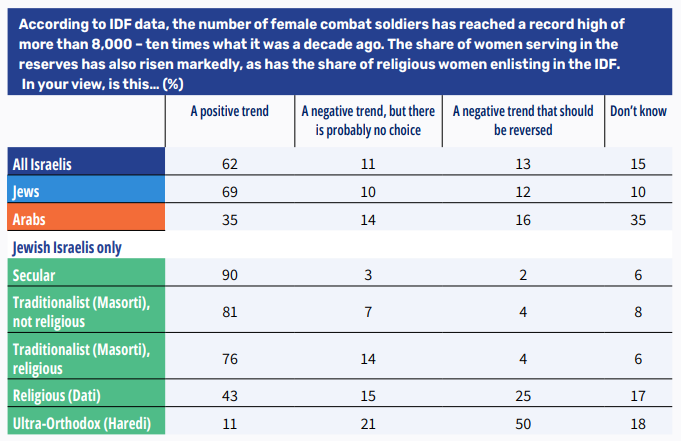
A breakdown of Jewish respondents by religious affiliation reveals sharp differences in attitudes toward women’s enlistment. Among secular respondents, support for the trend is almost unanimous (90%), and among non-religious and somewhat religious traditionalists (Masortim), a large majority also see the rise in the number of female combat soldiers as a positive development. The more one moves along the spectrum toward more observant religiosity, the lower the support for women’s service and the stronger the opposition: among religious (Dati) respondents, support falls to 43%, with 25% believing the trend should be reversed. Among the ultra-Orthodox (Haredi) public, half view it as a negative trend that should be reversed, and only 11% consider it positive.
Against the backdrop of recent cases that generated a sense of tension between women’s service in the IDF and religious sensitivities, the question has again arisen as to how religious soldiers should act in situations where they perceive a contradiction between the demands made of them by the army and Halacha (Jewish law). In this context, we examined what the Israeli public thinks religious soldiers should do at an IDF ceremony that includes a woman singing.
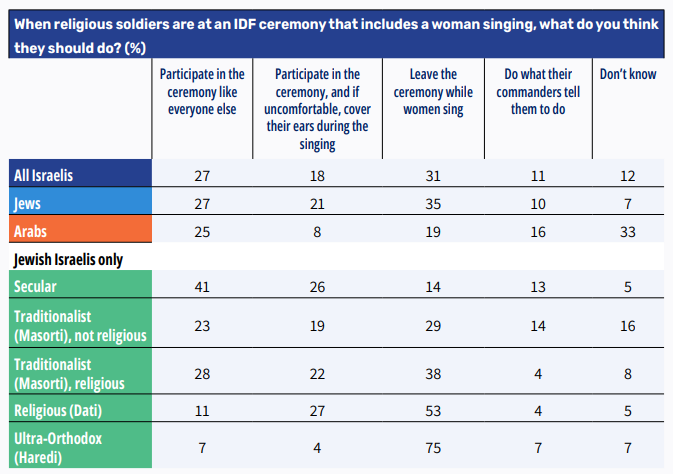
According to the data, Israeli society is divided on this issue. One-third of Israelis (31%) believe religious soldiers should leave the ceremony during the singing, whereas one-quarter (27%) believe they should participate like everyone else. One-fifth (18%) propose a solution of participating while covering one’s ears during the singing, and one-tenth (11%) believe soldiers should act in accordance with commanders’ instructions.
Breaking down the responses of Jewish Israelis by religious affiliation shows that most secular respondents support participation in the ceremony: 41% without reservations, and 26% propose covering one’s ears if soldiers feel uncomfortable. By contrast, the stronger the level of religious observance, the greater the support for leaving the ceremony while women sing: among religious (Dati) respondents, just over half hold this position (53%), while the vast majority of Haredi respondents do so.
Survey Data and Methodology
Data for JPPI’s February 2026 Israeli Society Index was collected February 1–4, 2026. Data collection was conducted via the “theMadad” website panel (588 Jewish respondents in an online survey) and Afkar Research (207 Arab respondents, roughly half online and half by telephone). The data was analyzed and weighted by voting pattern and religiosity to represent the views of the adult population in Israel. The JPPI Israeli Society Index is compiled by Shmuel Rosner and Noah Slepkov with research, production, and writing assistance by Yael Levinovsky. Prof. David Steinberg serves as statistical consultant.