
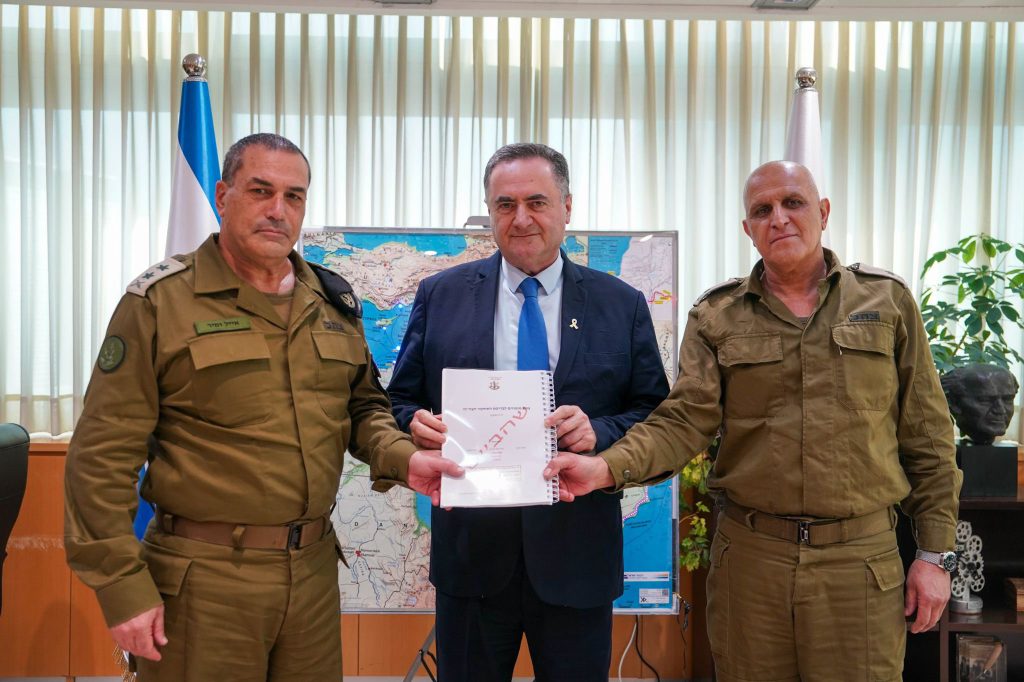


What Katz did to Zamir this week is not about professionalism, governance, or oversight. It is about keeping the spotlight on the IDF and away from the government.
If someone landed in Israel this week, they could be forgiven for thinking the war is completely over. They could be forgiven for thinking that Israel no longer has troops deployed behind enemy lines in Syria, Lebanon, and, of course, deep inside Gaza. They could even be excused for forgetting that Hamas still holds the bodies of two hostages in Gaza or that the IDF continues to carry out nightly raids and ongoing operations from Jenin to Khan Yunis.
A visitor arriving today might look around and assume everything is fine, that Israel is simply experiencing another routine week in the Middle East. They would see the fight dominating the headlines between IDF Chief of Staff Lt.-Gen. Eyal Zamir and Defense Minister Israel Katz and conclude that if the two most senior defense officials in the country have the luxury to wage a public battle over officer appointments, then surely Israel must be a country at peace.
The problem is that it is not.
As we saw vividly this week, every “ceasefire” across the region is fragile to the point of fiction. In Gaza, Hamas continues trying to reassert itself, reconstitute its rule, and attack IDF forces. The much-touted second phase of the Trump plan – which was to include the disarmament of Hamas, the establishment of a new governing authority, and the deployment of a multinational force – remains elusive. No one is stepping in, and no one is taking responsibility. Instead, the vacuum remains. In Lebanon, the elimination of Hezbollah’s top military commander, Haytham Ali Tabatabai, by Israel just days before the one-year anniversary of the ceasefire only underscores the obvious: There is no ceasefire at all.
Over the past year, Israel has killed more than 300 Hezbollah operatives and struck hundreds of targets deep inside Lebanon, while the Lebanese government has taken zero meaningful steps to curb or dismantle the Iranian-backed militia. Hezbollah is not deterred. It is simply holding its fire as it regroups and rebuilds. And in Iran, the ayatollahs are rebuilding nuclear facilities, accelerating long-range missile production, and constructing new launch sites to replace those destroyed by Israel in June. The question, according to Israeli defense officials, is no longer “if” there will be another confrontation with Iran, but “when.”
Yet amid this reality, the defense minister and the chief of staff are locked in a public, petty, and destructive fight. You have to wonder what the soldiers in Gaza, Lebanon, Syria, and the West Bank think when they hear about this. What goes through the mind of a reservist sitting in an APC (armored personnel carrier) in Rafah or a Golani soldier sitting atop a frozen hill in southern Lebanon when they read that their leadership is fighting over promotions and investigations? What do they make of it? What message does it send?
This has to be said clearly: What Katz did to Zamir this week is not about professionalism, governance, or oversight. It is about keeping the spotlight on the IDF and away from the government. When Zamir took over from Herzi Halevi earlier this year, he inherited a military still in the midst of a high-intensity war and still reeling from the trauma of October 7. Shortly after the war began, Halevi set up multiple investigative teams examining intelligence failures, operational breakdowns, and structural deficiencies. When Zamir replaced him, the two discussed these probes and agreed that they needed to be reviewed comprehensively before deciding on consequences.
This is how Zamir ended up appointing Maj.-Gen. (res.) Sami Turgeman to lead a panel reviewing all the internal probes and delivering recommendations. Turgeman did exactly that. But instead of accepting the findings – and respecting the chief of staff’s authority to restructure the IDF and remove officers who failed – Katz responded by demanding yet another review by the Defense Ministry’s ombudsman.
Here’s the absurdity: The IDF has already investigated itself twice, while the government has not investigated itself even once. Katz is pushing for more reviews not because they are needed, but because they delay the accountability that should fall on the cabinet just as much as on the generals. This is what Katz wants, and it is also what Netanyahu wants: to keep the conversation focused on tactical failures inside the military rather than strategic failures of the political echelon. Look, for example, at the government’s decision last week to establish a ministerial committee that will recommend the mandate and scope of the commission of inquiry the government is considering establishing. The only thing missing are auditions for who gets to serve on the panel.
Imagine you are suspected of a crime and are brought to a police station. Do you get to choose which detectives will interrogate you? Of course not. That would be a mockery of justice. Yet that is precisely what the government is trying to engineer – a commission that is not independent but rather is designed to stay focused on the IDF, the Shin Bet (Israel Security Agency), and Zamir’s removal of officers this week. This is why, for example, government ministers openly talk about the need for a commission to go back to the 1990s and look at the Oslo Accords and to 2005 to talk about the Disengagement from Gaza. They want to investigate the role of the attorney-general, the Supreme Court, and the protesters against judicial reform. In other words, everyone but them.
And this fits a deeper pattern.
Earlier this week, Education Minister Yoav Kisch was on the radio discussing a new initiative. The conversation shifted to the Supreme Court, and Kisch repeatedly referred to Supreme Court Chief Justice Isaac Amit simply as “Justice Amit,” pointedly dropping his title. When asked why, he deflected and then finally claimed that Amit was under suspicion for building violations that had never been properly investigated, and therefore, he could not refer to him by his official title. As the interviewers noted, these are mere allegations. Yet Kisch felt comfortable diminishing the head of Israel’s judiciary on live radio. It is worth remembering that the prime minister is also on trial under charges of corruption, yet no one calls him by anything other than his official title.

But this is the pattern: The government wants civil servants – the IDF chief of staff, the judges, the professionals who are supposed to be independent – to be subordinated to them. Of course the IDF is subordinate to the government; that is how democracies work. But the constant need to interfere in every appointment and to demand endless reinvestigations shows a deeper agenda.
An independent commission of inquiry is existential for Israel since if we do not learn the lessons of what happened, they will repeat themselves. Accountability is also not a luxury; it is the moral backbone of a country. A society where leaders refuse responsibility cannot expect its soldiers to shoulder it for them. Because here is the truth: The IDF’s soldiers who are deployed right now behind enemy lines – the reservists who leave their families again and again and the units freezing in outposts on the Lebanese border – all look up to political leaders to set an example.
If what they see are political games and a government desperate to avoid scrutiny, then the damage is not just institutional; it is moral. Israel’s strength has never come solely from tanks, jets, or intelligence. It comes from a shared ethic of responsibility. Our soldiers deserve leadership that is worthy of their sacrifice, and our society deserves a government that seeks truth, not excuses.