
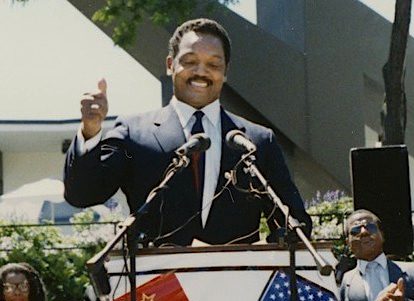


Ironically, Jackson’s impact stemmed from never becoming president—and not participating in what many deemed a defining confrontation in America’s culture wars.
Jesse Jackson mesmerized America for decades. He championed civil rights in the 1960s. His Operation PUSH rode the waves of black empowerment and employment in the ’70s. He challenged young Americans “to put hope in their brains and not dope in their veins.” It was in the ’80s, however, that Jackson, who died Tuesday at 84, made history. While rebranding America as a “rainbow” nation, he proved that African-Americans—a term he popularized—could be presidential candidates.
Ironically, Jackson’s impact stemmed from never becoming president—and not participating in what many deemed a defining confrontation in America’s culture wars.
Jackson’s 1984 campaign tapped Democrats’ growing reliance on minorities. In his convention concession speech, he recalled his impoverished South Carolina childhood, repudiated Ronald Reagan—whom he had long accused of committing “economic genocide”—and heralded America’s multicultural future. “Our flag is red, white and blue, but our nation is a rainbow,” he said.
Many resisted. A January 1985 Harris poll found that two-thirds of Americans wanted their fellow citizens to see themselves as Reagan did: “patriots,” not “first and foremost as part of a racial or religious minority.” Four years later, Jackson became the first black candidate to capture a majority of Democratic primary voters under 30. While running, Jackson shaped four decades of campus wars and culture wars. In January 1987, he marched with 500 Stanford students as they chanted “Hey hey, ho ho, Western culture’s got to go.” One editorial snapped: “We’re tired of reading books by dead white guys.”
The Battle of Stanford yielded an enduring—and false—notion. Many imagined that Jackson’s march and Education Secretary William Bennett’s Stanford speech the following year epitomized America’s culture wars.
True, Bennett said: “The West is the culture in which we live. It has set the moral, political, economic and social standards for the rest of the world.” Bennett argued presciently that by kowtowing to radicals, “a great university was brought low by the very forces which modern universities came into being to oppose: ignorance, irrationality and intimidation.”
Yet Bennett and Jackson never clashed in Palo Alto. Bennett visited in April 1988, 15 months after Jackson. Still, Jackson’s march advanced academia’s shift toward wokeness and away from Western values, patriotism and traditional liberalism.
Inevitably, the rush for post-civil-rights spoils, the War on the West, and DEI regimes judging people by race and sex, not, as Martin Luther King wanted, “the content of their character,” overreached. One form of bigotry replaced another. Jackson was caught in 1984 indulging in antisemitism, calling New York “Hymietown.” He often favored certain colors of his rainbow coalition.
Jackson’s death comes amid a backlash moderating this illiberal essentialism. Still, the transformations he fostered were remarkable. He personified America as the empire of “hope”—a favorite Jackson word.
“Leadership can part the waters and lead our nation in the direction of the Promised Land,” he said in his 1984 convention address. “Leadership can lift the boats stuck at the bottom.” That formula for progress still resonates.
Published in The Wall Street Journal