
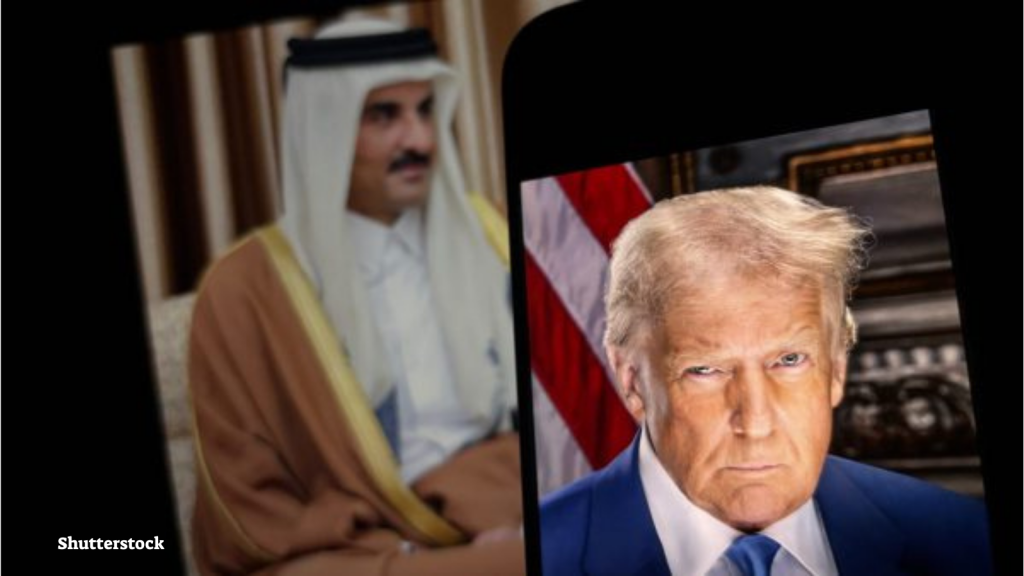


While Qatar publicly presents itself as cooperating with the United States, the English-language network Al Jazeera, which is affiliated with the Qatari regime, has broadcast strongly anti-war messages.
To download the PDF file, click here.
Since February 28, 2026, an intense war has been raging by the United States and Israel against Iran. In the opening days of the war, Iran’s Supreme Leader, Ayatollah Khamenei, was killed.
Iran, for its part, launched attacks against the Gulf states and the American bases located in them, including Qatar. It should be noted that Qatar hosts the largest American base in the Middle East. In addition, Qatar intercepted Iranian aircraft that were intent on striking the base.
Nevertheless, the findings presented here point to a different picture in the media sphere. Al Jazeera, a major international media network funded by the Qatari government, routinely engages in incitement against the United States and Israel. It often directly attacks President Trump, including by promoting claims that President Trump initiated the war to divert attention from the Epstein affair.
In addition to Al Jazeera’s coverage of the war, the network’s social media arm, AJ+, was also examined. AJ+ disseminates short-form messages aimed at the international community. Its criticism of the war has been sweeping but has almost entirely ignored what is taking place in the Gulf states, as reflected in the playlist “War on Iran.”
Methodology
The analysis was based on two primary sources: articles and opinion columns on the Al Jazeera website, and content from the AJ+ channel.
Al Jazeera English-language articles were collected from the LexisNexis database between January 28 and March 8. After publications containing overlapping content were filtered out, 52 articles and opinion pieces dealing with the confrontation between the United States and Israel, on the one hand, and Iran, on the other, were selected using the ChatGPT API. For the purposes of the analysis, the items were divided into two periods: Before February 28 – articles referring to a possible confrontation with Iran or threats of war with Iran; and After February 28 – articles referring to the war itself.
Content from AJ+’s YouTube channel was also analyzed. To this end, transcripts were collected from the network’s dedicated playlist covering the war with Iran:
It should be noted that the dates used to divide the two periods were included as part of the prompt (instructions to ChatGPT) to distinguish between the period preceding the outbreak of the war and the period that followed it.
Analyses
Analysis of Al Jazeera coverage:
- Before February 28 – coverage of a possible confrontation or of threats by the United States and Israel to go to war with Iran.
- After February 28 – coverage of the war itself.
Analysis of AJ+ coverage:
- Assessment of attitudes toward the war.
- Examination of whether the 21-video playlist contained any reference to Iran’s attacks on the Gulf states (such references were found on Al Jazeera).
Findings
Sentiment analysis of the articles examined on Al Jazeera
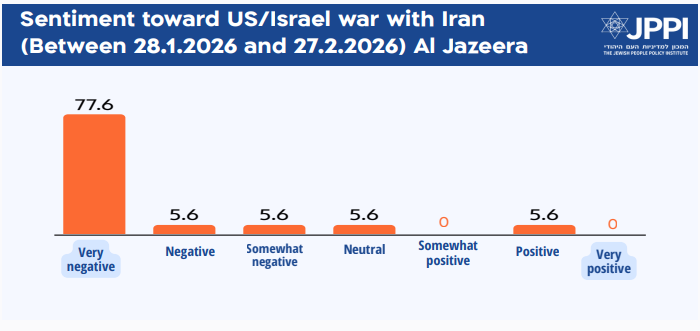
The following chart shows the sentiment classification for the 18 identified articles that referred to a possible confrontation with Iran before the onset of the war.
The following chart shows the sentiment analysis for the 34 articles referring to the war with Iran after its onset.
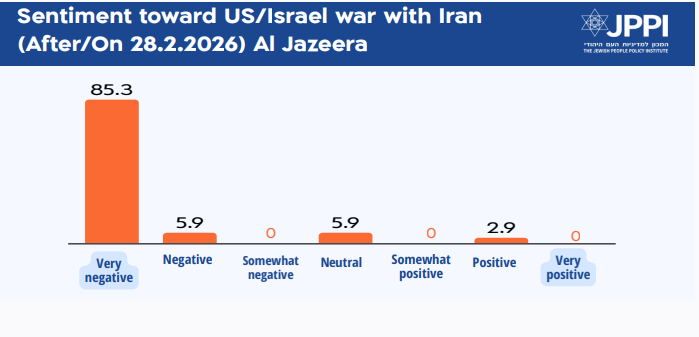
It is evident that both before and after the war began, Al Jazeera’s opinion columns and articles expressed a highly negative attitude toward the war waged by the United States and Israel against Iran.
Moreover, several examples illustrate just how sharp this criticism was,including criticism directed at Trump himself.
Because the Al Jazeera website is blocked in Israel, access to the links is limited. Several prominent examples are presented below:
1. Article: “Epstein and the Politics of Distraction”
The article opens with the quote: “After the beginning of Trump’s second term, the connections between capitalism, white supremacy, and imperial domination became increasingly clear.” The text links Trump and the United States to white supremacy and capitalism. Although the article refers only indirectly to a possible confrontation with Iran, it explicitly advances the claim that war serves as a strategy for distracting attention from internal crises.
In addition, the article vehemently criticizes Maduro’s abduction and U.S. support for Israel:
www.aljazeera.com/opinions/2026/2/26/epstein-and-the-politics-of-distraction
2. Opinion piece implying that the attack on Iran was intended to obscure the Epstein affair
“ Analyst says interest in Epstein files plummeted after war on Iran launched”
The article argues that public interest in the Epstein files declined after the war with Iran began. Among other things, it quotes an analyst who argues that the move had domestic political motives in both the United States and Israel, and that the war may serve as a distraction from political and economic crises.
Quotation from the article:
“The attack and its timing are all about domestic politics… with very little strategic rationale behind it.”
“ Al Jazeera spoke to Shaiel Ben-Ephraim, an analyst with Atlas Global Strategies and a former Israeli diplomat, about the motives for the attack on Iran.
He said the attack and its timing are all about domestic politics in both the US and Israel, with “very little strategic rationale behind it”.
“The current approval numbers for Trump are the worst they’ve ever been, some of the worst this early in a term I can remember. And there’s signs that the economy is going to get worse, so he really needs a distraction from that in the form of a war,” he said.
“And if you look at searches on Google for the Epstein files, they’ve plummeted since this started. So, at least temporarily, it’s succeeding. It’s taking up Congress’s time and it’s taking up the media’s time,” he added.”
Alongside the broad criticism of the war, a small number of articles were found that presented a position justifying the war against Iran, even if indirectly.
For example:
Iran’s legal case for striking the Gulf collapses under scrutiny:
www.aljazeera.com/opinions/2026/3/7/irans-legal-case-for-striking-the-gulf-collapses-under-scrutiny
“The Gulf states have spent years trying to broker peace between Iran and the West: Qatar brokered nuclear talks, Oman provided back-channel diplomacy, and Saudi Arabia maintained direct dialogue with Iran through 2024 and into 2025. Iran attacked them anyway. The idea that the Gulf states have a responsibility, a moral one, to protect Iran from the consequences of its actions because of good neighborliness is now grotesque in context.”
This article sharply criticizes Iran and rejects its arguments for justifying the attacks on the Gulf states. It implies that Iran’s actions precipitated the escalation and that the Gulf states had long sought to prevent war.
For example:
“This is the collective punishment of sovereign nations that went to extraordinary lengths to avoid the conflict.”
The analysis of AJ+, the network’s social media arm, similarly points to a critical trend like the one found on Al Jazeera:
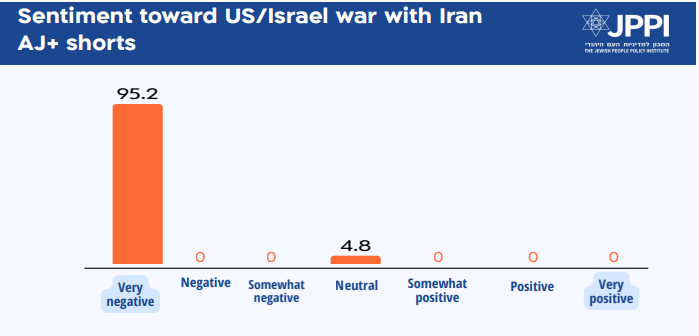
Our analysis of AJ+ videos shows that all the video clips posted on the platform convey a highly negative attitude toward the war against Iran.
Several examples are presented below:
“Why did Cyprus join the war? The answer: colonialism”
The video argues that Cyprus’s entry into the war is linked to British colonialism. It also claims that the war with Iran is “illegal.”
“A video criticizing Trump: ‘Is this what a president of peace looks like? ’”
A video claiming that Israel has set itself the goal of “bringing the region to its knees”:
In addition, it contains a written segment (not part of the transcript) stating that the Omani foreign minister announced that Iran had agreed to stop uranium enrichment, and that despite this, Israel and the United States attacked.
The following is the only video we found that could be classified as relatively neutral in sentiment:
This video is more informative and less directly critical of the war. It focuses on the importance of the Strait of Hormuz and the war’s possible consequences. Even here, however, the overall sentiment is borderline negative. Notably, of the 21 videos in the playlist dedicated to the war, not a single video presents the attack on Iran in a positive light or raises the possibility that the circumstances justifying the attack existed. Mentions of attacks on the Gulf states appear only marginally and seem to have been introduced only after the fact.
Summary and Conclusions
Although Qatar supports the United States, not least by hosting the largest American military base in the Middle East, in the media sphere – through Al Jazeera and AJ+ – it has promoted a highly critical narrative against the war.
This critical rhetoric includes, among other things:
- Claims regarding American colonialism and imperialism.
- Insinuations or direct claims that the war with Iran was intended to divert attention from the Epstein affair (in which Trump has been implicated).
- Claims that the war is illegal.
In other words, while Qatar intercepts Iranian aircraft and hosts a major American base on its territory, in the media sphere it works to undermine, and even deny, the legitimacy of the war waged by the United States and Israel against Iran.