


This report examines the diplomatic arena; confidence in leadership and the sense of victory; the electoral landscape ahead of the October elections; the future of Diaspora Jewry; and questions of morality.
Additional Findings
- Cross-camp skepticism: Most Israelis do not expect the Hamas disarmament agreement to be implemented.
- One-third believe Israel’s chances of achieving its objectives in Iran have worsened in recent weeks.
- The future of Judea and Samaria (the West Bank): Four in ten Jewish Israelis favor annexing the entire territory; one-third favor partition.
- The dominant position on the right: Israel’s objective should be to annex the West Bank and relocate the Arab population.
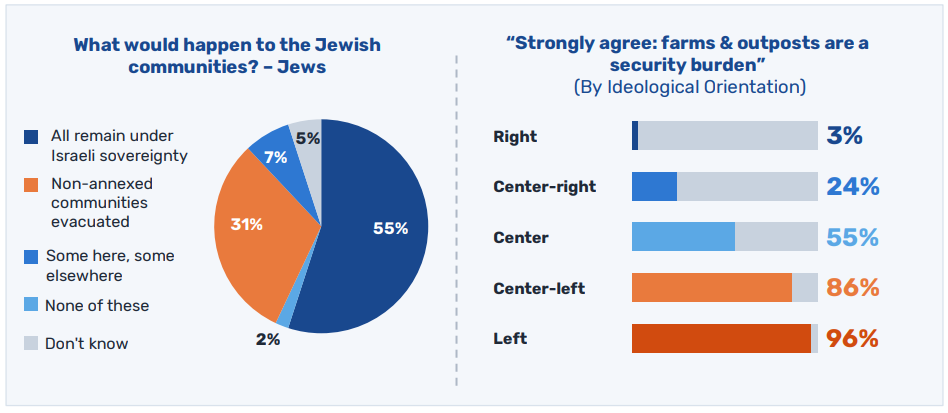
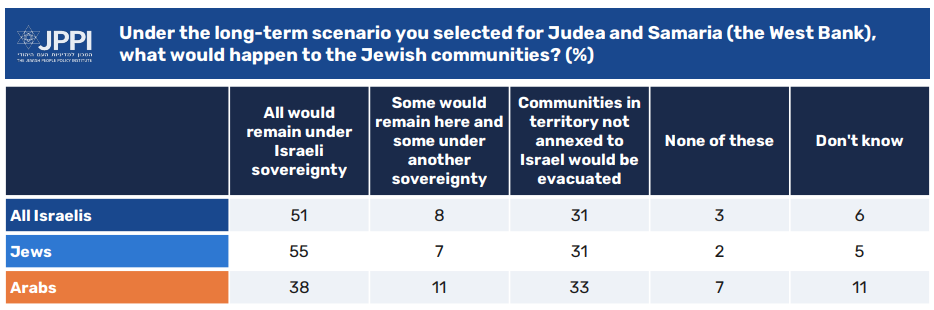
- The settlement question: 55% of Jewish Israelis say all Jewish communities in the West Bank should remain under Israeli sovereignty.
- A Jewish majority or the entire Land of Israel: 60% of Jewish Israelis prefer a Jewish majority, even at the cost of relinquishing territory.
- Half of Jewish Israelis, but fewer than half of Israelis overall, reject the claim that Jewish farms and outposts in the West Bank burden the IDF and harm security.
- Ahead of the elections: 55% of Israelis are completely certain whom they will vote for, 29% are fairly certain, and 12% remain undecided.
- Security remains the decisive election issue, followed by relations between the government and the judicial system.
- The share of Jewish Israelis who are pessimistic about the future of Diaspora Jewry has increased.
- Half of Israelis attribute global warming to human industrial activity.
- Israel’s moral map: Broad stability, with a very slight shift toward more conservative attitudes.
To download a PDF file, click here.
Skepticism and the Disarmament of Hamas
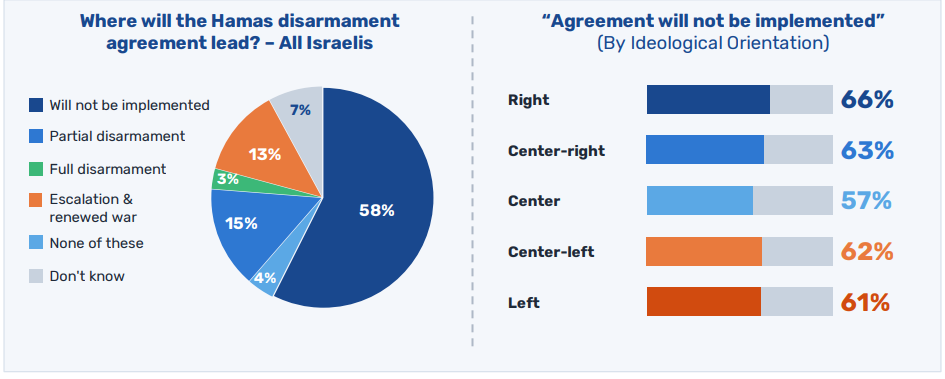
U.S. President Donald Trump’s announcement of an agreement to disarm Hamas in Gaza has met with widespread skepticism among Israelis. Fifty-eight percent believe the agreement will not be implemented and that the current situation in Gaza will remain roughly unchanged; among Jewish Israelis, 63% say so. A further 15% expect a partial outcome in which Hamas relinquishes some of its weapons and Israel withdraws from part of the Gaza Strip. Another 13% expect the agreement to lead to escalation and renewed war. The full scenario Hamas relinquishing all of its weapons and Israel withdrawing from the entire Gaza Strip – is considered likely by only 3% of Israelis and by virtually no Jewish respondents. Among Arab Israelis, 12% expect the full agreement to be implemented, still far short of a majority.
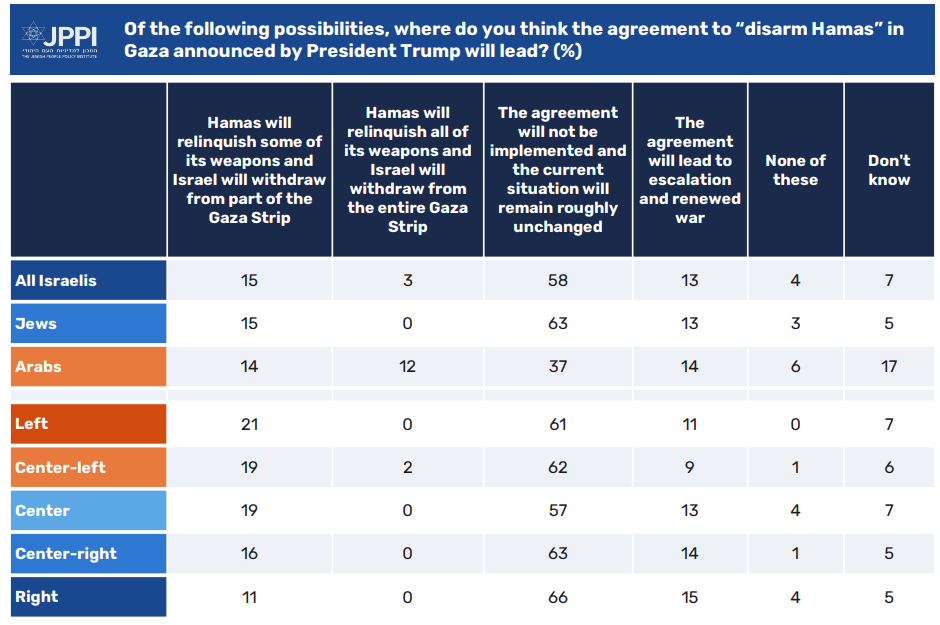
What stands out about the Gaza agreement is not only the depth of skepticism but also how evenly it is distributed across the political map. Unlike other diplomatic questions in the survey, which generally reveal a clear ideological gradient, that gradient nearly disappears here. The share who believe the Gaza agreement will not be implemented falls within a narrow range across all five self-defined political camps – from 57% in the center to 66% on the right. The pattern is similarly flat by religiosity: 62% of secular Jews and 66% of Haredim expect the agreement not to be implemented. This is one of the rare cases in which Israelis across the political spectrum express nearly the same view of a major American initiative.
Confidence in Trump at a Low Point
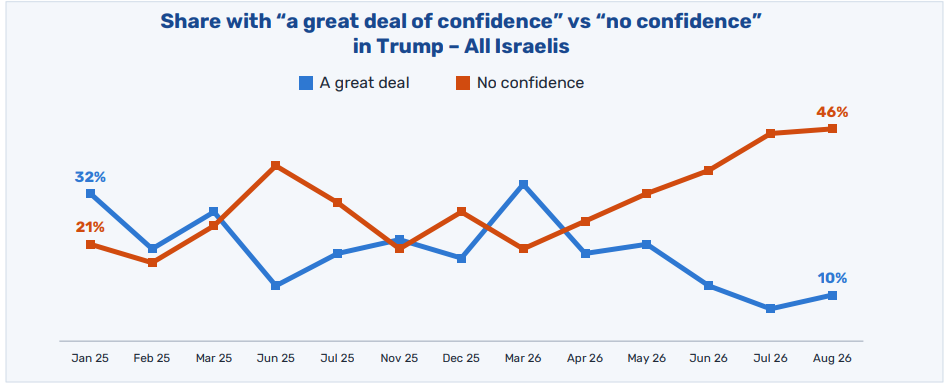
After last month’s sharp decline, confidence in the American president appears to have stabilized at a new low. One in ten Israelis (10%) express “a great deal of confidence” that Donald Trump will “do the right thing” regarding U.S.-Israel relations, compared with 34% in March. At the same time, the share saying they have “no confidence” in the president rose to 46% – the highest level measured since the beginning of his current term in January 2025.
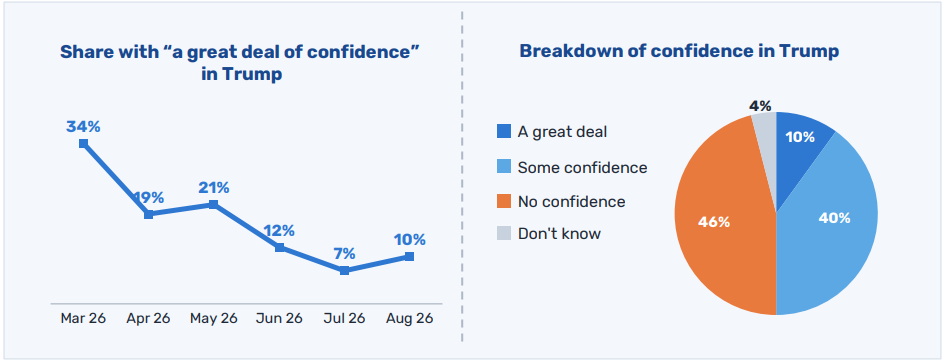
The ideological breakdown still reveals clear differences: confidence in Trump declines as respondents move leftward on the political spectrum, yet even on the right only 15% now express “a great deal of confidence” in him. At the positive end of the scale, however, the gap between Jewish and Arab Israelis has almost disappeared: one in ten in both sectors express a great deal of confidence in the president. Among Arab Israelis, the share with no confidence in Trump remains higher than among Jewish Israelis – 56% versus 44%.
Israel’s Objectives in Iran
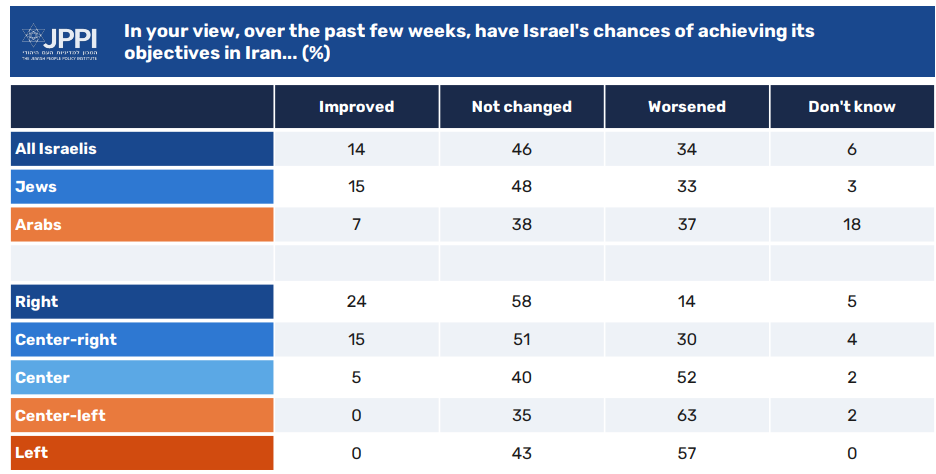
Nearly half of Israelis (46%) believe that Israel’s chances of achieving its objectives in Iran have not changed in recent weeks, a period in which U.S.-Iran tensions rose and fell and war at times appeared close to resuming. One-third (34%) believe Israel’s chances have worsened, while one in seven (14%) believe they have improved.
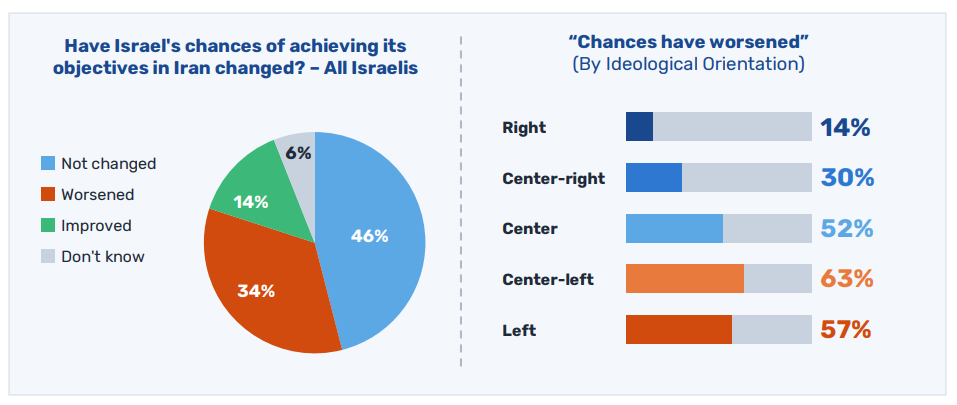
Here, unlike on the Gaza agreement, a clear ideological gradient reappears. On the right, 24% believe Israel’s chances of achieving its objectives in Iran have improved in recent weeks, while 14% say they have worsened. In the center-right, the relationship reverses (15% versus 30%). In the center, the share saying “improved” falls to 5%, while “worsened” rises to 52%.
In the center-left and on the left, virtually no respondents believe the past few weeks improved Israel’s chances of achieving its objectives in Iran, while 63% and 57%, respectively, say the outlook has worsened.
This month’s finding is clearer when viewed as part of a longer trend. Since Operation Lion’s Roar in March, Israeli public opinion has shown declining expectations regarding the war and its achievements across a series of questions asked each month. In March 2026, during the operation, 72% of Israelis said the decision to strike Iran again (one year after Operation Rising Lion) was correct, and 65% believed the war would change the Middle East for the better in the long term. By May, support for the decision to attack had fallen to 59%, while optimism about long-term regional improvement fell to 52%. In June, when respondents were asked directly whether Israel had achieved its objectives, only 37% said it had achieved most or a large share of them. In July, after the U.S.-Iran ceasefire agreement was signed, only 14% of respondents believed the agreement was good for Israel, including just 4% of Jewish Israelis. The August finding – that 34% see a further deterioration in recent weeks – continues this trend rather than breaking it.
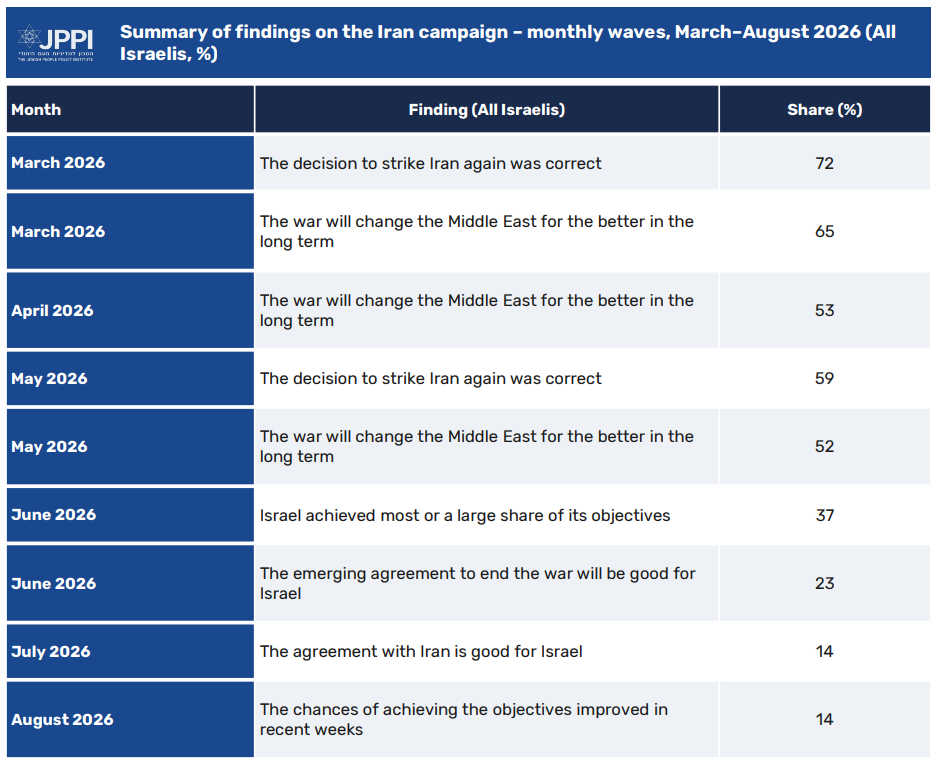
Summary of findings from separate questions asked in the monthly waves from March through August 2026, among all Israelis. The rows do not constitute a single time series and therefore should not be compared directly; rather, they should be read as a sequence of public assessments of the same campaign.
Victory and Confidence in Netanyahu
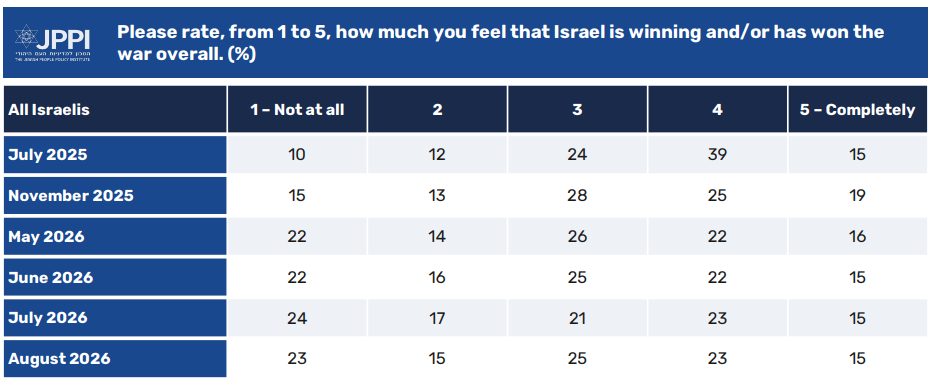
Israelis’ overall sense of victory in the war is unchanged this month. Thirty-seven percent rate the sense that Israel is winning or has won the war at 4 or 5 on a 1-to-5 scale, essentially the same as in July (38%) and June (38%). By contrast, 38% give ratings of 1 or 2. Over the longer term, the series shows a substantial decline in the sense of victory: in July 2025, 54% of Israelis chose 4 or 5; since then, roughly one-third of that group has fallen away. Since May, the sense of victory has remained at a stable low.
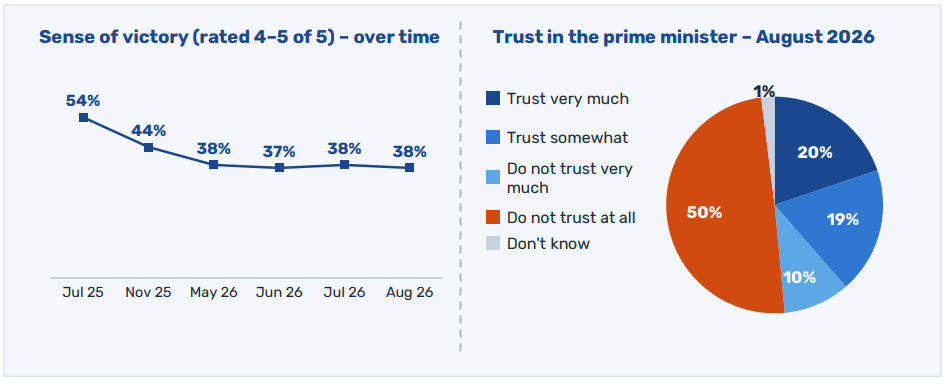
Beneath this overall stability lies a deep ideological divide. Among respondents who identify with the right, 67% rate the situation at 4 or 5; in the center-right, 45%; in the center, 17%; in the center-left, 5%; and on the left, no respondents do so. A similar gradient appears by religiosity: 76% of Haredim and 59% of religious Jews feel that Israel is winning or has won the war, compared with only 19% of secular Jews. Among Arab Israelis, one-fifth (20%) feel that Israel is winning or has won the war.
At first glance, trust in the prime minister also appears stable: 38% of Israelis trust him (20% “very much” and 19% “somewhat”), while 60% do not. Among Jewish Israelis, 44% trust him. Within the negative responses, however, there is a notable shift: the share saying they do “not trust him at all” – the strongest negative response rose to 50%, compared with 44% in June and 43% in December. At the same time, the share saying they “do not trust him very much” fell from 14% to 10%. In other words, the overall share who do not trust the prime minister has not risen substantially, but softer distrust has hardened. This is the highest share reporting no trust at all since the wording of the question was changed from “have confidence in” to “trust” at the end of 2025.
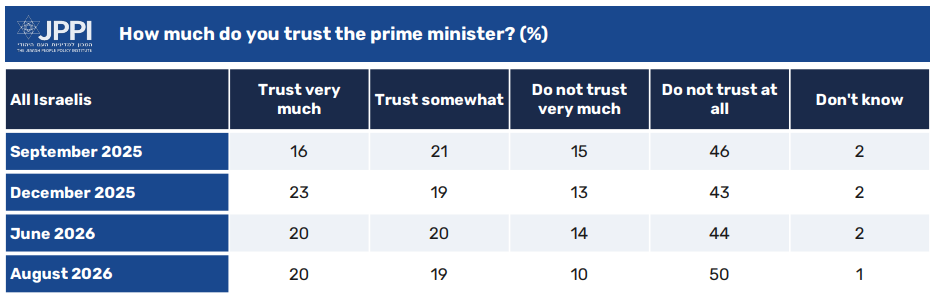
The breakdown by religiosity reveals an interesting pattern among secular Jews: 14% trust the prime minister “very much,” but only 5% trust him “somewhat.” In other words, even within the minority of secular Jews who trust him, that trust tends to be strong. At the other end of the spectrum, 84% of Haredim and 64% of religious Jews trust the prime minister.
The Future of Judea and Samaria (the West Bank)
This month, respondents were asked to choose what they regard as Israel’s realistic long-term strategic objective for the West Bank and the communities located there. The question explicitly asked for an option that is “both feasible and preferable, even if it can be achieved only many years from now.” Respondents were presented with ten options, drawn from proposals voiced by various Israeli public figures and grouped into four broad clusters: annexation of the entire territory (in three versions, differing in the status of the Arab population); partition of the territory (between Israel and Jordan or a Palestinian state); transfer of the entire territory to another sovereign entity; and continuation of the status quo.
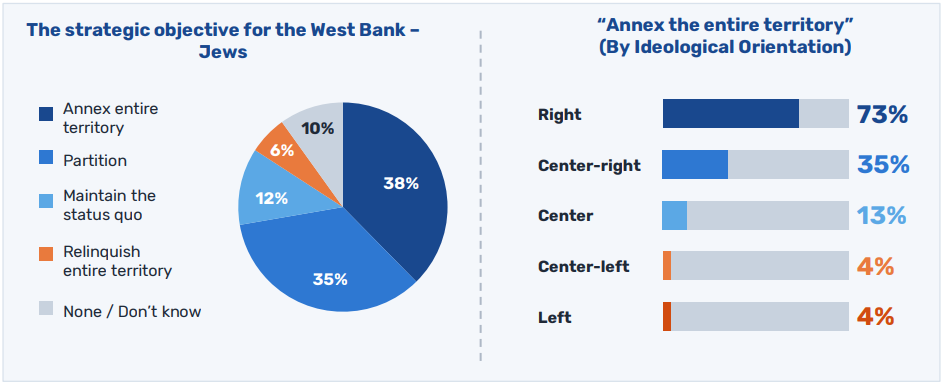
Among Jewish Israelis, support for the two main clusters is divided almost evenly: 38% choose annexation of the entire territory and 35% choose partition. Within the annexation camp, the most common version is also the one that poses the greatest human, legal, and practical challenges: 22% of Jewish Israelis choose “the entire territory is annexed to Israel and the Arab population moves to other countries,” compared with 14% who choose annexation with autonomy for Arab residents but without Israeli citizenship, while virtually none choose annexation with full citizenship for Arabs living in the territory. Among respondents who favor partition, the leading option is a Palestinian state in the Arab-majority part of the territory (21%), followed by annexation of the Arab-majority area to Jordan (14%). Another 12% of Jewish respondents believe the status quo is the only solution for several more decades.
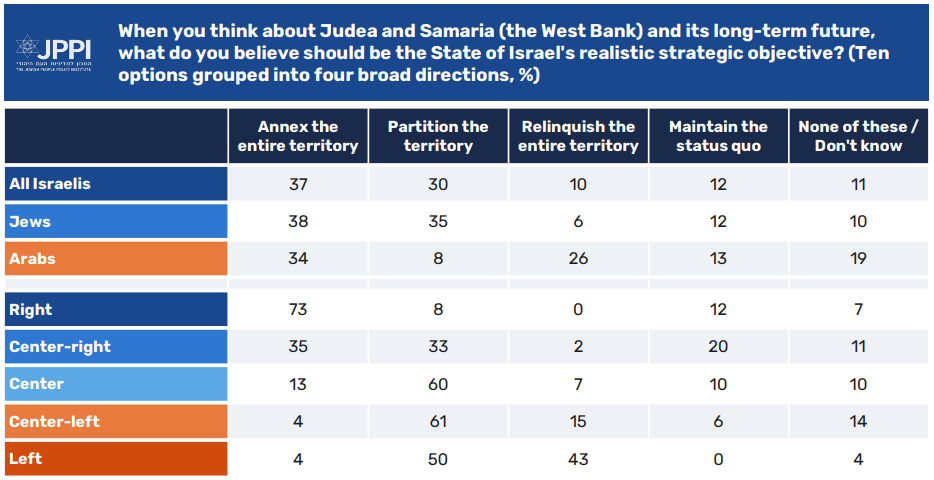
“Annexation of the entire territory” combines three options: “The entire territory is annexed to Israel and the Arab population receives Israeli citizenship, including the right to vote for the Knesset”; “The entire territory is annexed to Israel and the Arab population receives autonomy without citizenship”; and “The entire territory is annexed to Israel and the Arab population moves to other countries.” “Partition of the territory” combines two options: “Part of the territory, with an Israeli majority, is annexed to Israel, and the Arab-majority part is annexed to Jordan”; and “Part of the territory, with an Israeli majority, is annexed to Israel, while a Palestinian state is established in the part with an Arab majority.” “Relinquishing the entire territory” combines: “All (or almost all) of the territory is annexed to Jordan”; and “A Palestinian state is established in all (or almost all) of the territory.” “Continuation of the status quo” was presented in the questionnaire as: “The current situation is the only solution for several more decades; only then will it make sense to discuss what comes next.”
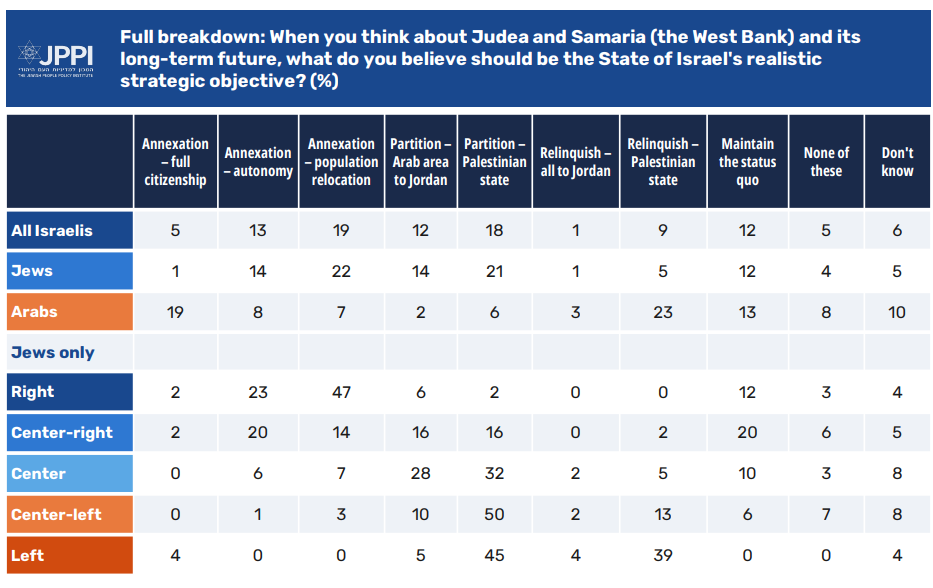
Among Arab Israelis, too, annexation of the entire territory receives the highest level of support. In this group, however, annexation does not mean relocating the Arab population or establishing autonomy without citizenship; it means annexation followed by full citizenship for the entire Arab population within the State of Israel. Because the differences among these versions of “annexation” are substantial, the broad clusters alone can obscure important distinctions. The detailed breakdown shows a dominant position on the right (though not the center-right) in favor of full annexation and relocation of the Arab population to other countries. From the center leftward (among Jewish Israelis), the largely dominant position favors partial annexation to Israel, with the remainder transferred to a Palestinian state or annexed to Jordan.
Religiosity among Jewish Israelis shows a similarly clear gradient: 17% of secular Jews, 36% of traditionalist (Masorti), nonreligious Jews, 56% of traditionalist (Masorti), religious Jews, 68% of religious Jews, and 70% of Haredim choose annexation of the entire territory.
Rows are ordered according to the categories grouped in the previous table: three annexation variants, two partition variants, two relinquishment variants, continuation of the status quo, and other. Political-camp rows include Jews only. In small cohorts, especially the left, a value of zero in a single cell does not necessarily indicate no support in the population; it may reflect the small sample base. Totals are approximate because of rounding.
These findings are consistent with trends observed in JPPI surveys in recent years. Each year since 2024, we have presented respondents with three statements representing different worldviews on the future of relations with the Palestinians. This series has shown a clear shift to the right: the share of Jewish Israelis choosing the statement “Israel should strengthen its control over the Palestinians, expand the settlements, consider dismantling the Palestinian Authority, and perhaps annex territory in Judea and Samaria (the West Bank)” rose from 38% in March 2024 to 47% in March 2025 and 48% in March 2026. At the same time, the share choosing the statement supporting a peace agreement and a Palestinian state fell from 17% to 14%. This month’s finding that 38% of Jewish Israelis choose annexation of the entire territory is consistent with that picture, while adding a new dimension: when respondents are asked what should happen to the Arab population under such circumstances, most choose neither citizenship nor autonomy, but relocation of the population. The question did not specify how such relocation would be carried out or to which countries.
Respondents were then asked what would happen to the Jewish communities under the long-term scenario they had selected for the West Bank. For example, if a respondent chose “partial annexation,” what would that imply for the communities; if the respondent chose “autonomy,” what would that imply; and so forth. The majority answer is clear: 51% of Israelis and 55% of Jewish Israelis say that “all of them will remain under Israeli sovereignty.” Another 31% say that communities in territory not annexed to Israel would be evacuated, while 8% choose a mixed solution in which some communities remain under Israeli sovereignty and others do not.
At first glance, there appears to be a tension: 38% of Jewish Israelis chose annexation of the entire territory as the strategic objective, yet 55% want all Jewish communities to remain in place. Cross-tabulating the two questions largely resolves this gap.
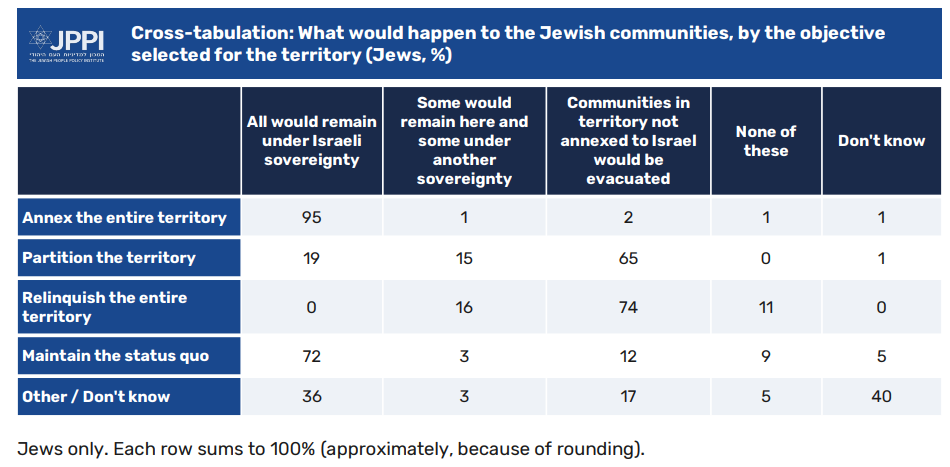
Among those who chose full annexation, 95% say all communities would remain a natural consequence of annexing the territory. The second group contributing to the majority that wants all communities to remain consists of those who chose continuation of the status quo: 72% of them say all communities would remain, again a consistent position because the status quo implies no evacuation. Together, these two groups account for 82% of those who want all communities to remain. The group that reflects a genuine tension is much smaller: 19% of those who chose partition nevertheless say that all communities should remain under Israeli sovereignty about 7% of all Jewish Israelis. These respondents accept territorial partition but not evacuation, perhaps envisioning Israeli enclaves within territory transferred to another sovereignty.
Looking in the opposite direction, the picture is even sharper. Those who chose partition are divided: 65% favor evacuation, 19% would leave all communities in place, and 15% prefer a mixed arrangement – meaning that even among supporters of partition there is no consensus on evacuation. Even among the small group that chose to relinquish the entire territory, only three-quarters say the communities should be evacuated. There is also a notable difference within the partition camp: those who prefer transferring the Arab-populated area to Jordan are much more likely to leave all communities in place (30%) than those who prefer an arrangement establishing a Palestinian state (11%). The Jordanian option is therefore associated with less support for evacuation.
Jews only. Each row sums to 100% (approximately, because of rounding).
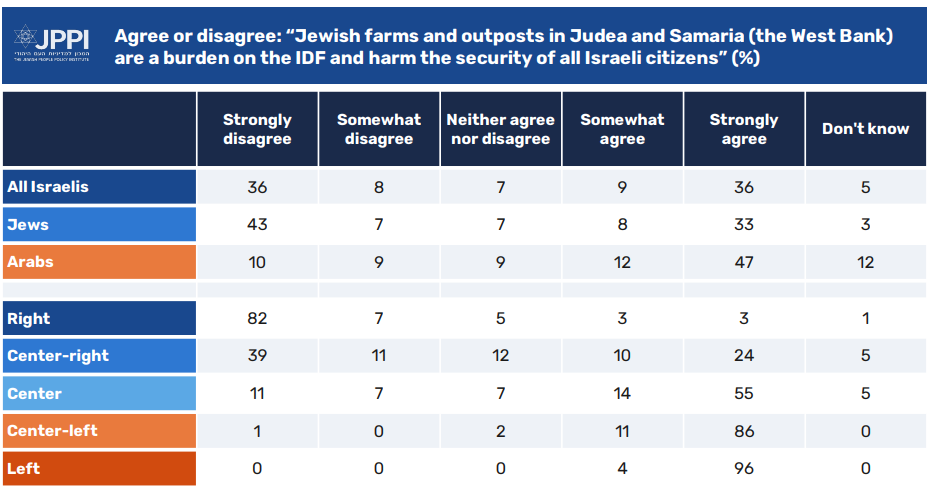
In recent months, Israel has seen extensive public discussion about the proliferation of farms and outposts in the West Bank, in part following several incidents including murders near these Jewish settlement sites. In contrast to earlier questions about “communities” or “settlements” in general, this month we asked specifically whether “Jewish farms and outposts in Judea and Samaria (the West Bank)” are perceived as a burden on security.
This deliberately narrow wording produced a stark result: the Israeli public is split almost evenly between the two poles. Thirty-six percent “strongly disagree” that the farms and outposts burden the IDF and harm security, while 36% “strongly agree.” Only 7% choose the midpoint (“neither agree nor disagree”). Among Jewish Israelis, the balance tilts slightly toward rejecting the claim (50% disagree versus 41% agree); among Arab Israelis, it tilts toward accepting it (59% agree, including 47% who strongly agree).
As noted, the wording was deliberately narrowed so that the question addressed not all communities, but settlements of a specific type. It is therefore useful to compare this month’s results with previous surveys that asked the same “burden” question about settlements as a whole. In March 2024, 30% of Jewish Israelis strongly agreed that settlements in the territories are a burden on the IDF; in March 2025, the figure fell to 23%. This month, when the question refers specifically to farms and outposts, the figure is 33%. The distinction between “settlements” and “farms and outposts” likely helps explain the difference: Jewish respondents distinguish established settlements from outposts, and some attribute a security cost to the latter that they do not attribute to the former.
The figures at the edges of the table illustrate the divide: 82% on the right choose the strongest response in one direction, while almost all respondents in the small left-wing cohort (96%) choose the strongest response in the other. The center-right is the group with the most substantial internal disagreement: it leans toward the view that the farms are “not a burden,” yet roughly one-third take the opposite position. The religiosity gradient is similarly clear: large majorities of Haredim (79%) and religious Jews (71%) “strongly disagree” that the farms are a burden, compared with 63% of secular Jews who “strongly agree.”
A Jewish Majority or the Entire Land?
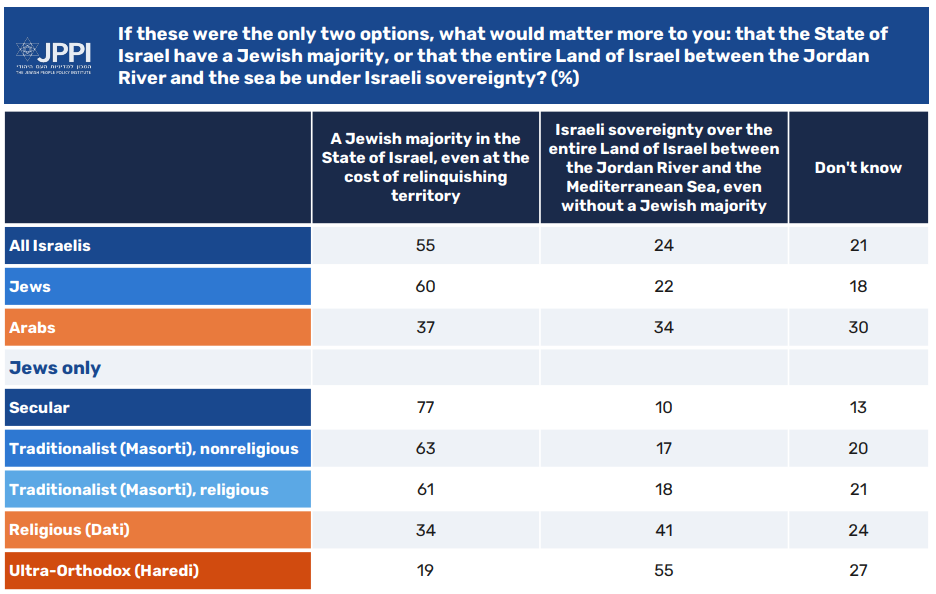
Following the questions about the future of the West Bank and its Jewish communities, respondents were asked a broader question probing a possible tension between two goals, especially among Jewish Israelis: retaining parts of the historic homeland and ensuring a Jewish majority in Israel. When the question presents these principles as mutually exclusive, the public as a whole makes a clear choice: 55% of Israelis and 60% of Jewish Israelis prefer that the State of Israel retain a Jewish majority “even at the cost of relinquishing territory,” compared with 22% of Jewish Israelis who prefer sovereignty over the entire territory “even without a Jewish majority.” Another 18% of Jewish Israelis answered, “do not know,” a relatively high share whose significance becomes clearer below.
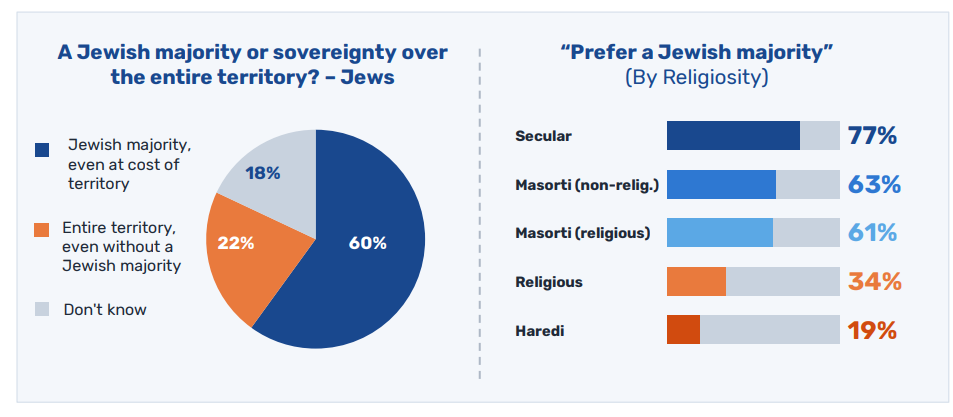
This preference is not shared by all groups and reverses in several of them. Among Haredim, 55% prefer the territory and 19% the Jewish majority; among religious Jews, the figures are 41% and 34%, respectively. Among those who identify with the right (though not the center-right), the preference also reverses, by a narrower margin: 40% choose the territory, 30% the Jewish majority, and another 30% do not know the highest share in any camp. In other words, on the political and religious right there is no clear resolution between the two principles, and a large minority declines to choose. Among secular Jews, by contrast, the preference is nearly unequivocal: 77% choose a Jewish majority, compared with 10% who choose sovereignty over the entire territory. By intended vote in the coming election, the differences are large: 85% of supporters of The Democrats and 80% of Yashar supporters prefer a Jewish majority, compared with 55% of Religious Zionism supporters who prefer retaining all the territory. Likud voters are almost evenly split: 35% versus 37%, with another 28% unsure.
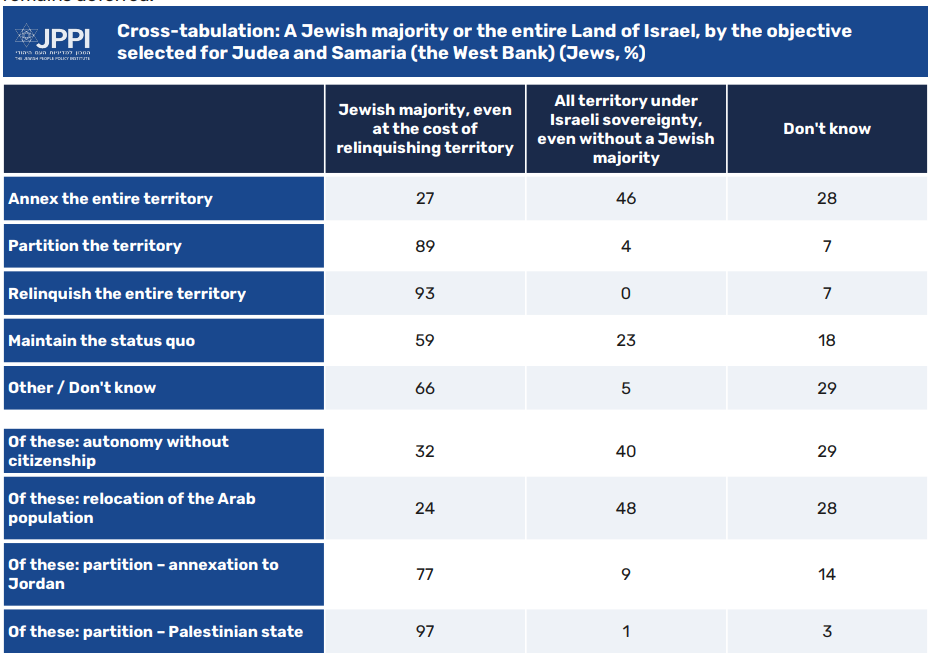
Cross-tabulating the preferred national objective (a Jewish majority or the entire territory) with the strategic objective for the West Bank shows which positions align. Respondents who chose partition are highly consistent: 89% prefer a Jewish majority, rising to 97% among those who chose a Palestinian state in the Arab-majority area. The partition camp is therefore closely aligned around its underlying national objective.
The annexation camp, by contrast, is more divided. Forty-six percent say they prefer the entire territory even without a Jewish majority a consistent position. Another 27% prefer a Jewish majority even at the cost of relinquishing territory, despite having chosen annexation of the entire territory. This too can be consistent if these Israelis expect an arrangement on the ground that avoids forcing a choice between two objectives they value. Another 28% answer “do not know,” the highest share in any group in the survey and four times the rate in the partition camp (7%). In other words, the demographic question remains unresolved within the annexation camp: roughly half either cannot decide or decline to engage with a scenario that requires a choice.
The internal breakdown of the annexation camp is also important. Those who chose the option in which the Arab population moves to other countries are consistent when they also prefer a Jewish majority – that is the objective of the option they selected. Those who chose autonomy without citizenship can likewise be consistent if, in their view, a “Jewish majority” means a majority among citizens rather than residents. The unresolved group consists of those who answer “do not know”: 29% of those choosing autonomy and 28% of those choosing population relocation do not answer the majority question. For them, the choice between territory and demography remains deferred.
Jews only. Each row sums to 100% (approximately, because of rounding). The first five rows group responses into broad directions; the final four provide detail on two options within the annexation camp and two within the partition camp. Group sizes: annexation, 185; partition, 210; continuation of the status quo, 56; other, 55; relinquishing the entire territory, 39; population relocation, 104; Palestinian state in part of the territory, 133; annexation to Jordan, 77; autonomy, 73. The annexation-with-full-citizenship option was selected by only eight Jewish respondents and is therefore not shown separately.
Ahead of the Elections
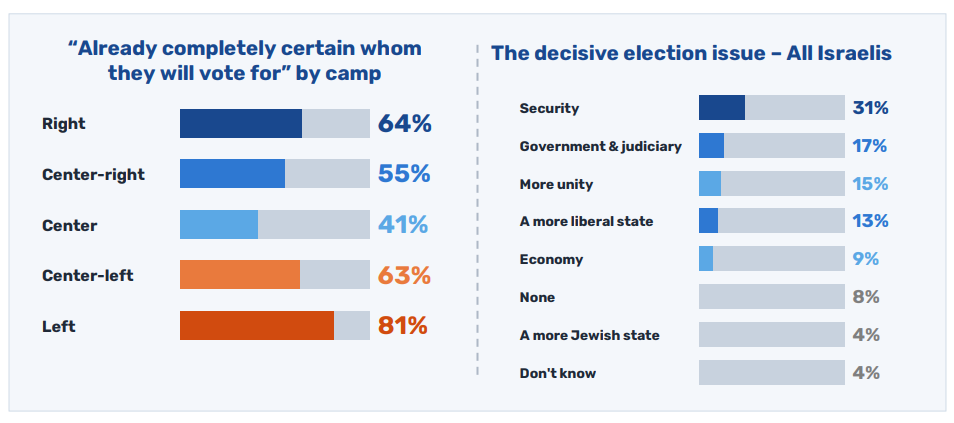
At the time this report was written, 55% of Israelis said they were completely certain whom they would vote for, up slightly from 53% in July; another 29% were “fairly certain.” The share who described themselves as undecided fell from 14% to 12%. Among Jewish Israelis, 57% have made a final decision and 10% remain undecided.
The ideological breakdown shows that uncertainty is concentrated in the center suggesting that it often reflects hesitation between parties occupying a similar political space rather than between blocs. Only 41% of self-identified centrists have made a final decision, compared with 64% on the right, 55% in the center-right, 63% in the center-left, and 81% on the left. Among Arab Israelis, the picture is different: 49% have made a final decision, 17% are fairly certain, 20% remain undecided, and another 14% say they do not intend to vote.
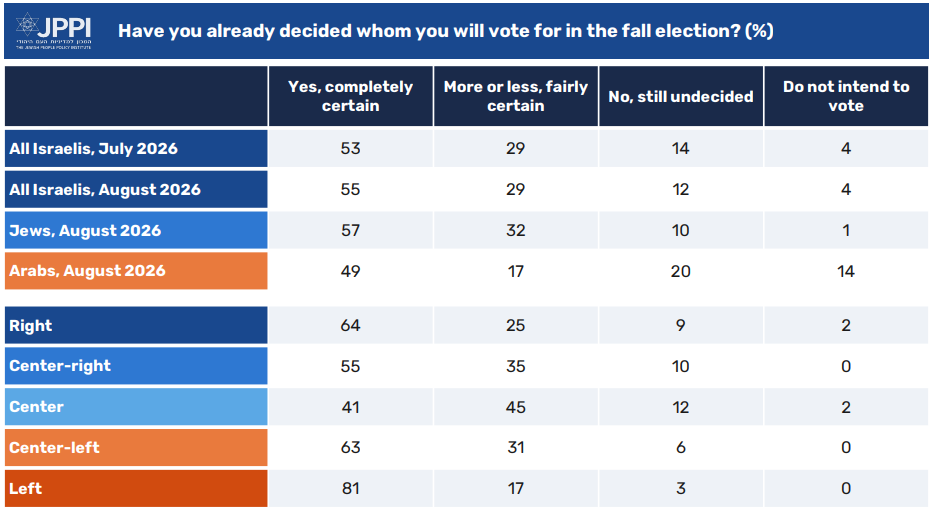
According to voters themselves, security remains the decisive election issue, and its weight has grown: 31% of Israelis choose “who will contribute most effectively to maintaining security,” up from 28% in July. Changes in what respondents believe the election is “about” were otherwise modest: relations between the government and the judicial system fell slightly (18% to 17%), the aspiration for a more liberal state also declined (15% to 13%), while “more unity and fewer disputes” rose from 13% to 15%.
Cross-tabulating the decisive issue with the certainty of respondents’ voting choice yields an interesting pattern. Among Jewish Israelis who have already decided whom to vote for, the second-most important issue is relations between the government and the judicial system (25%). Among those who have not yet made a final decision, that issue falls to 13%, while “more unity and fewer disputes” rises from 13% to 20%. In other words, undecided voters are not necessarily seeking a decisive outcome on the judicial question; they place greater emphasis on reducing conflict. This offers a clue to the kinds of messages that may appeal to them.
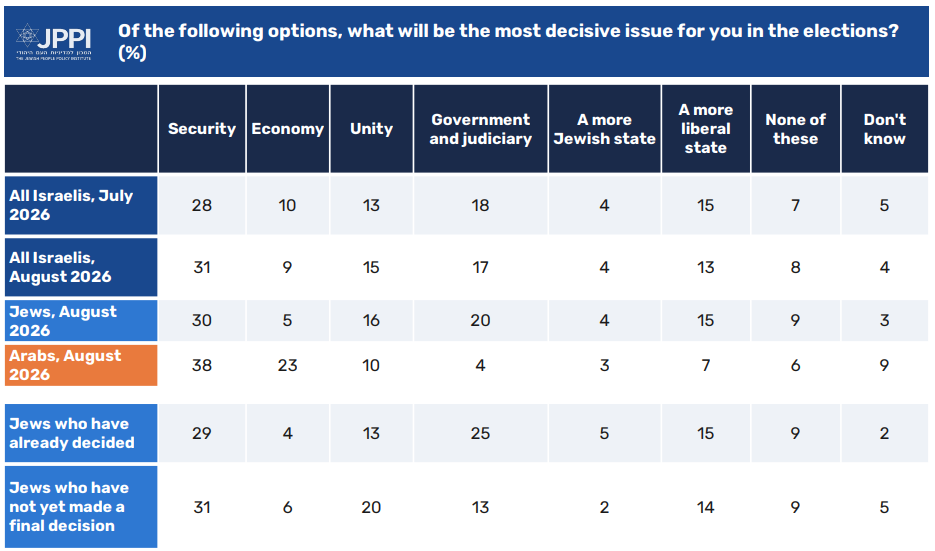
The group “Jews who have already decided” includes those who answered “Yes, completely certain.” The group “Jews who have not yet made a final decision” includes those who answered “More or less, fairly certain” and those who remain undecided.
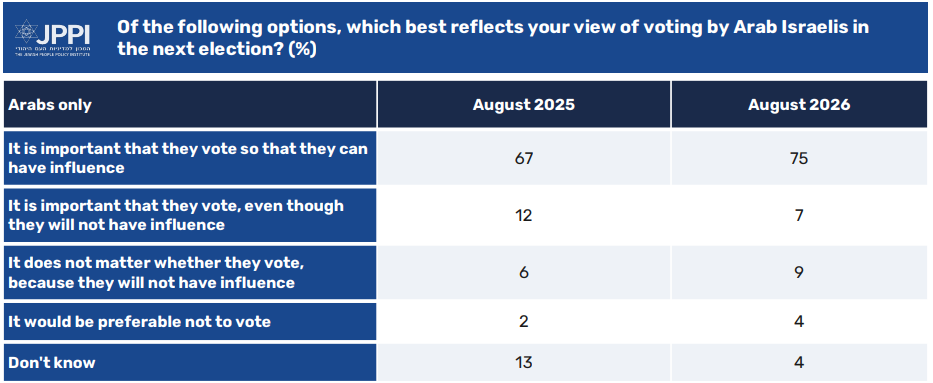
This month we also asked Arab respondents about Arab Israeli participation in the next election, a question previously asked in August 2025. Three-quarters (75%) said “it is important that they vote so that they can have influence,” compared with two-thirds (67%) a year ago. The share saying it would be preferable not to vote remained very small, at 4%, while the “do not know” share fell sharply from 13% to 4%. This may indicate greater electoral mobilization ahead of the election even though 14% of Arab respondents still say they do not intend to vote.
The Future of Diaspora Jewry
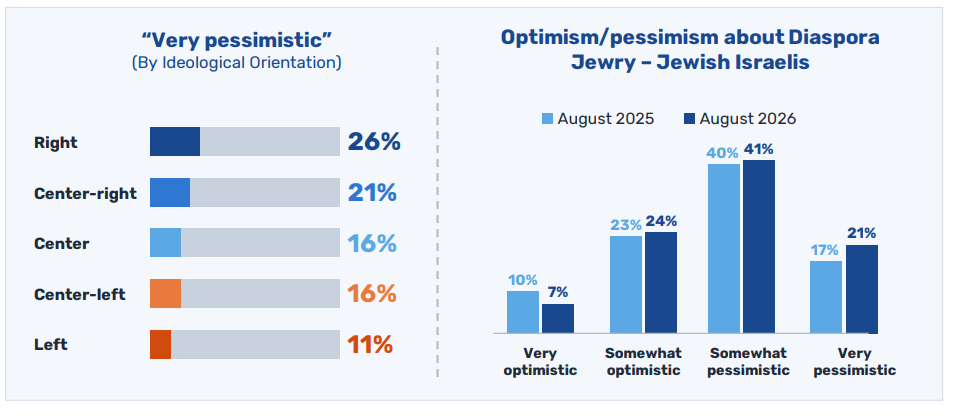
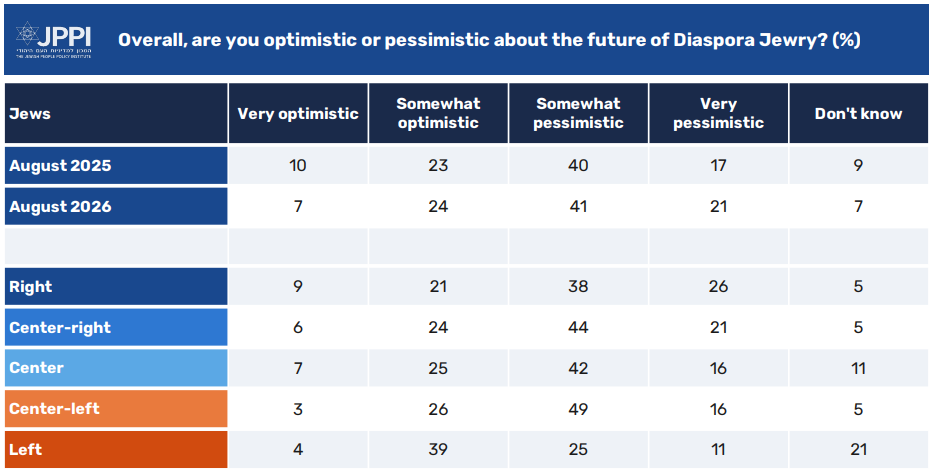
Jewish Israelis remain pessimistic about the future of Diaspora Jewry, and that pessimism has deepened somewhat over the past year: 62% are pessimistic (41% “somewhat” and 21% “very”), compared with 57% in August 2025. The share who are optimistic fell slightly from 33% to 31%. The clearest change appears at the extremes: the share who are “very pessimistic” rose from 17% to 21%, while the “very optimistic” share fell from 10% to 7%.
Pessimism cuts across political camps, but its intensity varies and generally weakens from right to left. The right has the highest share of respondents who are “very pessimistic” (26%), while on the left only 11% are very pessimistic about the future of Diaspora Jewry. By religiosity, the highest overall level of pessimism is among religious Jews (73%), and the lowest among traditionalist (Masorti), nonreligious Jews (58%).
Global Warming
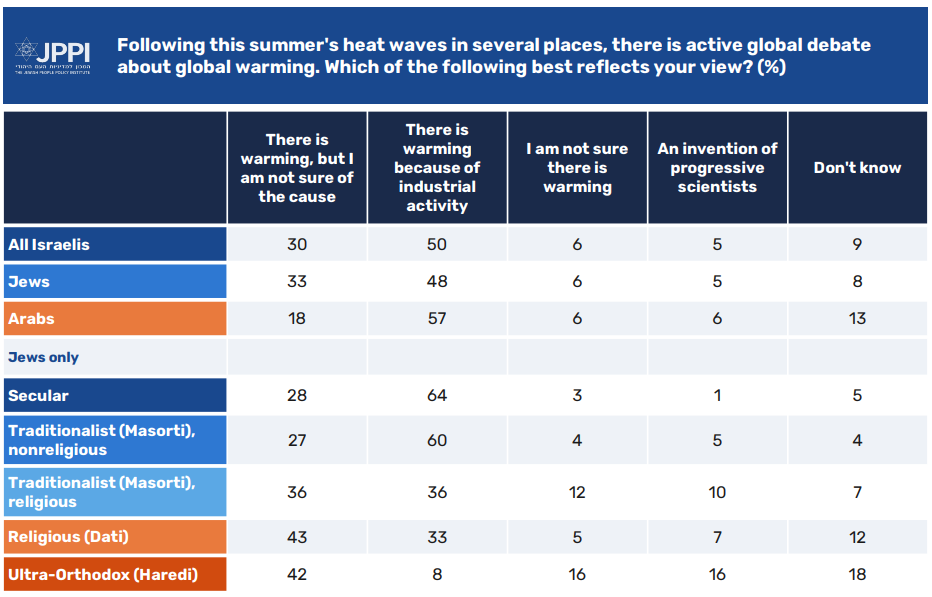
Against the backdrop of an exceptionally hot summer in several parts of the world, we again examined Israelis’ views on global warming. Half of Israelis (50%) believe global warming is occurring because of human industrial activity a very slight decline from 53% in August 2025. Another 30% believe warming is occurring but are unsure of its cause (29% a year ago), 6% are not sure warming is occurring, and 5% believe global warming is “an invention of progressive scientists.” Overall, much as last year, about 80% of Israelis recognize that global warming is occurring, while about one in ten either doubt that global warming is occurring or dismiss it as an invention – a share that has remained stable.
The ideological groups differ less over whether global warming is occurring than over what causes it. Among respondents who identify with the left and center, majorities attribute warming to human activity (60% in the center). On the right, by contrast, uncertainty about the cause is greater: 29% choose warming caused by industrial activity, while 38% say they are “not sure what the cause is.”
The Moral Map
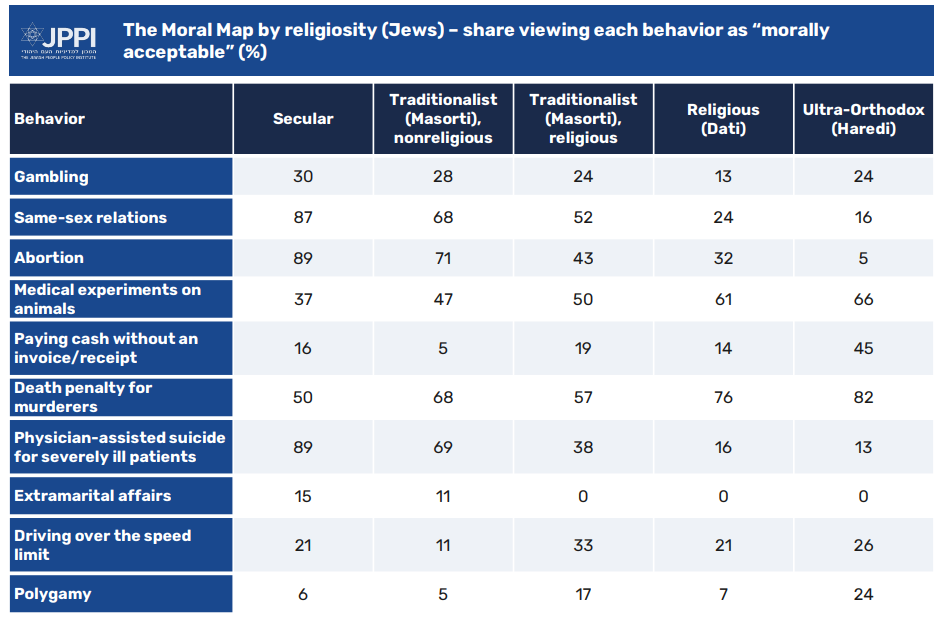
Once a year, we present respondents with a series of ten behaviors and ask them to determine, independently of what is legal or illegal, whether each behavior or activity is “morally acceptable” or “morally unacceptable” according to their own worldview. The series is based on a similar questionnaire used by Gallup in the United States, allowing two comparisons: with Israelis’ answers last year and with the American public.
The overall picture is one of stability, with a slight shift toward more conservative attitudes. In eight of the ten issues examined, the share of Israelis who regard the behavior in question as “morally acceptable” either declined or remained unchanged. The most notable declines were in abortion (55% to 51%), medical experiments on animals (45% to 42%), extramarital affairs (11% to 8%), and the death penalty for murderers (59% to 57%). A similar pattern appeared in the United States over the past year: Gallup’s May 2026 values survey found declines in acceptance of several behaviors and record lows in the shares viewing gambling, the death penalty, and animal experiments as morally acceptable. Both societies moved in the same direction this year – modestly more conservative.
Compared with Americans, Jewish Israelis are more permissive on questions of life and death and bodily autonomy abortion (61% versus 49%), physician-assisted suicide (59% versus 49%), and the death penalty (63% versus 52%) and considerably more conservative on gambling (27% versus 57%) and polygamy (9% versus 19%). On two items, the figures are almost identical in the two societies: same-sex relations (61% versus 62%) and extramarital affairs (8% versus 7%), the latter being the least morally acceptable behavior in both cases.
Among Arab Israelis, the pattern is different: the share viewing these behaviors as morally acceptable is much lower on almost every item. The two exceptions, on which Arab Israelis are more permissive than Jewish Israelis, are paying cash without an invoice or receipt (35% versus 18%) and polygamy (22% versus 9%). Two notable shifts among Arab Israelis since August 2025 are a six-point decline in acceptance of the death penalty (40% to 34%) and a seven-point increase in acceptance of physician-assisted suicide (16% to 23%).
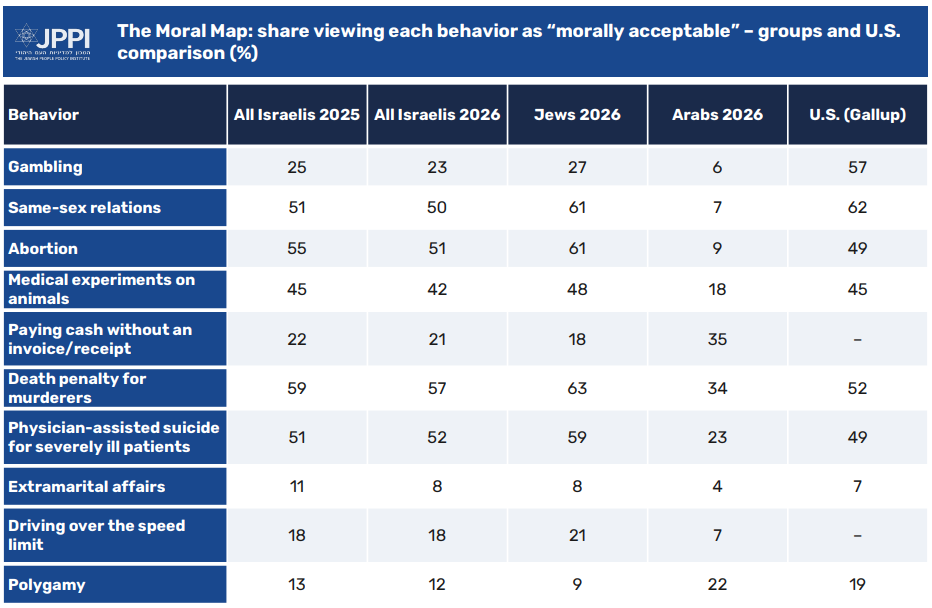
The gender gap among Jewish Israelis is one of the most stable patterns measured in the survey and has barely moved over the past year: across all ten items, the difference between the two waves is no more than three percentage points. The raw data shows that women in the sample are far more permissive regarding abortion (76% versus 49%), same-sex relations (76% versus 50%), and physician-assisted suicide (72% versus 50%), while men are more permissive regarding medical experiments on animals (59% versus 33%), speeding, gambling, and polygamy.
These figures should, however, be interpreted cautiously because they do not isolate the effect of gender. The women who responded to the survey are more secular than the men and are also less likely to identify with the right. Even after taking these factors into account, a statistically significant gap remains – though roughly half as large on abortion, same-sex relations, and physician-assisted suicide. For animal experiments, speeding, polygamy, and gambling, the gap changes little when women and men are compared within their religious and political groups. This pattern therefore appears to reflect genuine gender differences.
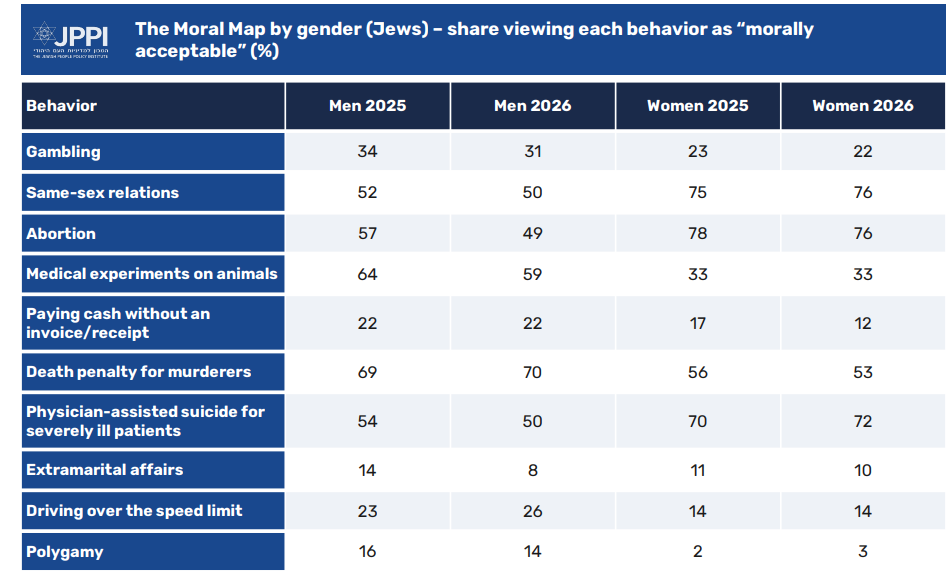
Across the religiosity spectrum, the gaps are clear and require little further qualification. Eighty-nine percent of secular Jews view abortion and physician-assisted suicide as morally acceptable, compared with 5% and 13%, respectively, of Haredim. The pattern reverses on two items. The first is medical experiments on animals, on which Haredim (66%) and religious Jews (61%) are more permissive than secular Jews (37%). The second, and more striking, is paying cash without an invoice: as last year, about half of Haredim regard this as morally acceptable, the highest share of any group in the survey, compared with 16% of secular Jews and only 5% of traditionalist (Masorti), nonreligious Jews.
Data for JPPI’s August Israeli Society Index was collected between August 2 and August 5, 2026, via the Madad.com panel (545 Jewish-sector respondents) and Afkar Research in the Arab sector (203 respondents: 126 online and 77 by telephone). The data was weighted according to voting patterns and religiosity and analyzed to represent the views of Israel’s adult population. Shmuel Rosner and Noah Slepkov compile the JPPI Israeli Society Index, with research, production, and writing assistance from Yael Levinovsky. Prof. David Steinberg provides statistical supervision.