


The problem is the refusal to recognize that the European Union is a powerful global actor with a coherent and long-term worldview, not a collection of interchangeable politicians.
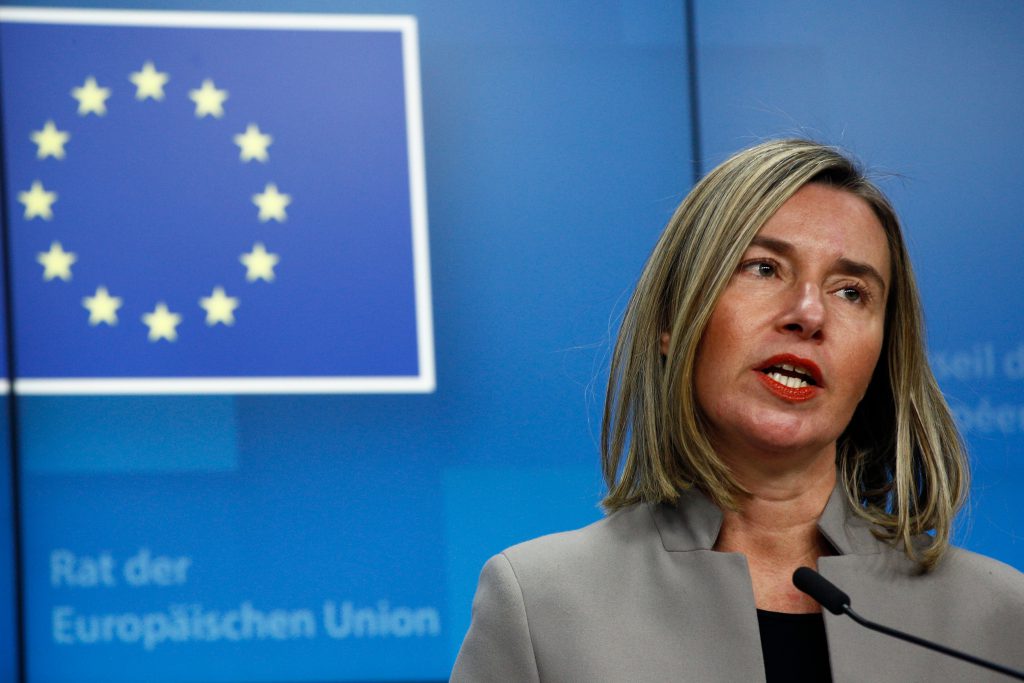
The uproar surrounding the corruption investigation involving Federica Mogherini, the former foreign policy chief of the European Union, has drawn unusual attention in Israel and among some Jewish communities in Europe. Yet the way the news was received is far more important than the event itself.
Mogherini has not been an active political figure for six years, and she left European public life long before the affair erupted. The fact that many in Israel and among Jewish communities in Europe felt the need to “celebrate” her troubles reveals how deeply Israeli and European Jewish leadership struggle to understand the nature of European Union foreign policy. Mogherini is not the real focal point. She is merely a symbol. She embodied a consistent European line, one that not only continued after her term but intensified in some areas. Her successor, Josep Borrell, was far more sharply critical of Israel. He advanced a clear agenda on human rights and international law and used much harsher language on almost every issue relating to Israel.
Even so, Borrell’s stance did not stem solely from his personal opinion. He expressed a policy shaped over many years and rooted in deep guiding principles within the institutions of the European Union. Borrell’s successor, Kaja Kallas, entered the role with a completely different set of priorities. She is focused on the war in Ukraine and on leading a firm line against Russia. Yet even during the single year she has held the position, it has become clear that she has adopted a more critical stance toward Israel than the one she brought to her term.
This development is entirely predictable. It is the result of the European Union structure, not of Kallas’s personality. Anyone who holds that office is required to represent a broad political framework of all EU member states. This framework defines the boundaries of policy rather than the individuals themselves. Nevertheless, in Israel and in parts of the European Jewish communities, many continue to view European foreign policy as a field driven by the personal inclinations of individual politicians. The understanding that this is a stable institutional system fails to take root.
The Union’s foreign policy is shaped through broad agreement among its 27 member states. It is based on international law, human rights, and democracy, and an approach that requires territorial compromise in the Israeli-Palestinian conflict. It does not truly shift with the rotation of office holders. It is only minimally influenced by the personal preferences of European Union leaders. It is a long-term system representing the collective will of all member states of the Union. Jewish communities in Europe sometimes assign too much weight to personal relationships with political figures. There, too, exists an expectation that the replacement of a public official will lead to a change in European attitudes toward Jews or toward Israel.
In practice, the picture is far more complex. The European struggle against antisemitism continues along a consistent trajectory, almost regardless of who leads the European institutions. The same is true of Israel. European criticism is not the product of any single person but of a broad political framework that seeks to outline a unified vision of the international order. Within this reality, Mogherini’s fall from grace is “celebrated” in Jerusalem. Yet zooming out reveals that anyone who is moved by the downfall of a figure who left European politics years ago shows a fundamental misunderstanding of how Israel’s foreign relations with Europe actually work. Instead of viewing Europe as an entity defined by values, principles, and structured processes, Jerusalem tends to see Brussels as a battleground of winners and losers. Such an approach prevents the creation of a coherent Israeli grand strategy toward the European Union and ultimately weakens both sides.
Here lies the true challenge for Israel and for European Jewry. The continent is under significant strain. Antisemitism is rising. European society is deeply divided in its attitudes toward Israel. The war in Ukraine and the wars in the Middle East all generate fear and instability within Europe. In such a climate, there is no real value in an imagined victory over a former politician who no longer influences events. The only meaningful step is to understand Europe as it truly is: a multilayered system that does not respond to small pressures but acts from a political worldview that transcends generations and party lines.
Only if Jerusalem and the European Jewish communities internalize that they must engage in genuine, substantive dialogue with the European Union system itself, rather than with whichever politician happens to hold office at a given moment, will a more stable and thoughtful diplomatic future be possible. Mogherini was not the problem, nor was Borrell, nor is Kallas. The problem is the refusal to recognize that the European Union is a powerful global actor with a coherent and long-term worldview, not a collection of interchangeable politicians. Israel and the Jews can gain a great deal from their relationship with the European Union, but only if they stop chasing symbols and begin seriously understanding the broad, potent, and complex political entity with which they must contend.