
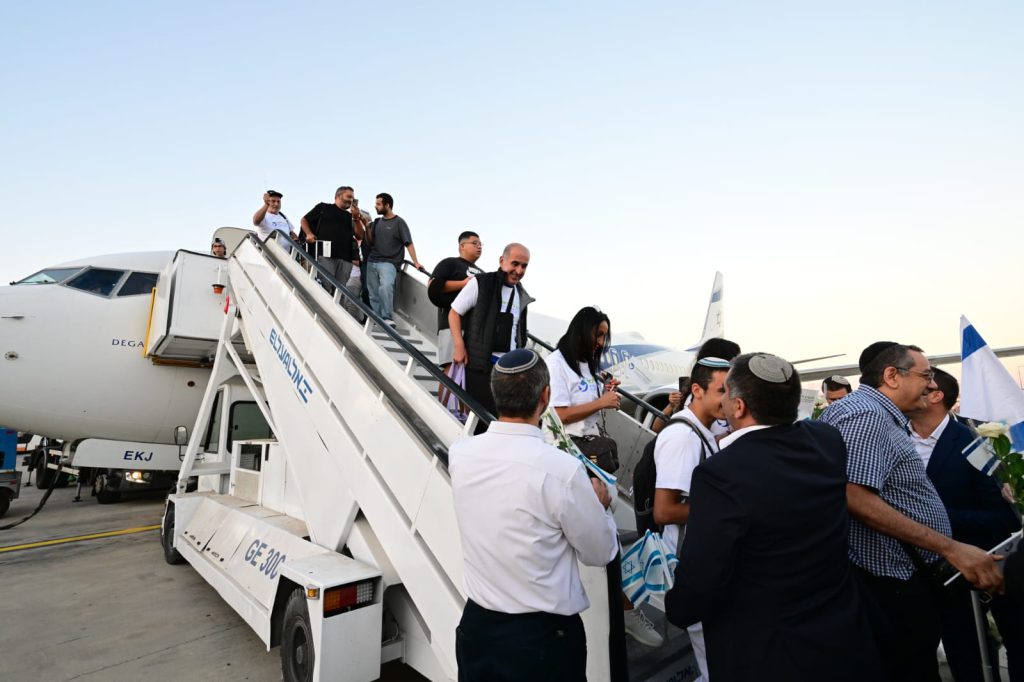


Will Israel, this time, succeed in becoming a country that attracts immigration from affluent nations?
France, like most Western European countries, is in the midst of a deep demographic and cultural transformation. Jews have become a small and visible minority, while citizens of Muslim origin are 20 times more numerous — and in some regions 50 times more. Although ethnic statistics are forbidden by law, indirect data is unequivocal: 23% of babies in France today bear Arabic-Muslim names, and one out of every four young people — 25% under the age of 35 — fasts during the month of Ramadan.
This is not a superficial change but a true demographic revolution. As the demographer Alfred Sauvy said: “Demography is the small hand of the clock — you do not see it move, but it is the one that tells the time.”
Research shows that 28% of Muslims in France support the establishment of an Islamic state, and this rate soars to almost 50% among those under 30. The deeper the religious faith, the stronger the hatred toward Jews. Contrary to the republican belief that education leads to integration, it turns out that it is precisely those with higher education who tend more toward political and religious zealotry. The universities, once engines of universalism, have become hotbeds of religious identity and anti-Israel progressivism. Anti-Zionism has become the legitimate language of a new antisemitism.
The Jewish community in France — one of the most vibrant in Europe — has become fragile and isolated in recent years. After the French Revolution and emancipation, each generation grew more distant from Judaism and community life. Yet paradoxically, from the start of this century, following exclusion and antisemitism, many have returned to synagogues, to community, and to identity. Between 80,000 and 100,000 Jews have left France since 2000 — more than 20% of the community. Some have emigrated to Israel, while others have moved to Canada, the United States, and Britain. But the remaining majority has encapsulated itself in insular ghettos — private schools, protected neighborhoods, autonomous communities. This is a process of survival, not one of free choice.
The police and judicial system move sluggishly, and politicians are bound by a cold demographic calculation: Muslim voters significantly influence elections. Strasbourg, Bordeaux, and Grenoble froze their twin-city alliances with Ramat Gan, Ashdod, and other Israeli cities, replacing them with partnerships with Arab villages in Judea, Samaria, and even Gaza. Seemingly a diplomatic gesture, but in practice, an electoral surrender.
Demography dictates the limits of public courage. The minority of today becomes the majority of tomorrow, and the majority of tomorrow reshapes the moral boundaries of today. When Theodor Herzl wrote The Jewish State, 80% of the world’s Jews lived in Eastern Europe — a vanished world. After them came the Jews of Islamic countries, who were forced to flee between 1948 and 1975, and the Jews of the former Soviet Union after the fall of communism. Now it is the turn of Western European Jews: they too face a historic decision.
The process of Kibbutz Galuyot (ingathering the exiles) that began a century ago has ripened before our eyes. It would be tragic if we failed to recognize the moment and turn this opportunity for redemption into a full historical process. Politicians and journalists ask: Why are they waiting to pack their suitcases? Don’t they see the writing on the wall? Some are indeed in denial, but most — in both England and France, and possibly soon the United States — understand that their grandchildren, and perhaps even their children, will not continue to live in their native lands.
But the problem is not only theirs — it is mainly ours. Israel loves aliyah but does not love olim. There is no real political will today to remove barriers. We are used to the model of aliyah out of distress — immigrants with little choice. They come out of compulsion, not out of opportunity; therefore, the state feels no need to ease their way — they will come even at the price of their dignity and social status.
But for Western Jews, reality is different. We saw this in South Africa: a Zionist, educated community with a solid Jewish identity which, at the moment of trial — despite its strong desire — mostly chose to emigrate to Australia, England, and the United States. Israel lost a strong, educated, and productive potential population — and did not learn the lesson. The State of Israel has proven in the past its ability to rescue Jews in distress — from Yemen and Ethiopia, from Argentina and the former Soviet Union — but struggles to absorb prosperous Jewry. Immigrants from Western countries are not refugees; they are educated professionals seeking meaning, identity, and partnership. The current absorption mechanism is slow, bureaucratic, and devoid of vision.We missed the wave of aliyah from South Africa — a Zionist, educated, and strong community that chose the United States, Australia, and Britain. Israel did not update its absorption program in time.
Professional guilds operating in Israel protect themselves from external competition. The interests of these groups — doctors, engineers, lawyers — clash with the overall national interest. This is a market failure that demands direct state intervention.
Urgent reforms are required:
Temporary work permits for certified medical and para-medical professionals from abroad.
Intensive Hebrew and training programs for teachers, psychologists, and service professionals.
Targeted recruitment and training programs in essential sectors of the Israeli economy, especially for academics dependent on their native language.
Automatic recognition of Western academic degrees, unless proven otherwise.
Immigrants from the West bring not only knowledge and talent but also a deep liberal ethos — faith in the rule of law, individual rights, and civic responsibility, rooted in Jewish tradition. Their presence can strengthen Israel as a Jewish and democratic state, where freedom and faith do not contradict but enrich one another.
The precedent already exists: the Russian aliyah of the 1990s created an economic and cultural revolution. A new Western aliyah could do the same — on a broader scale and with renewed energy.
Aliyah is not a burden — it is a national opportunity. To realize it, a governmental inter-ministerial directorate should be established within the Prime Minister’s Office, uniting all bodies — absorption, education, employment, health, and housing — headed by an executive figure with authority and courage. Of course, employment is the key. But beyond work, for Western immigrants who truly have alternatives to migrate elsewhere, Jewish identity, and the social and educational integration of their children are the main motives. Many of them know that their careers will suffer from the move to Israel and are ready to be the “desert generation” for their children’s sake. They ask for only one thing — that their children succeed in integrating, learn Hebrew, and feel at home among their people.
Israel knows how to turn disaster into redemption. If it opens its gates, it can turn the crisis of European Jewry into the next Israeli miracle — not a miracle of rescue alone, but a miracle of national revival, a renewed realization of the vision of Kibbutz Galuyot.