Required reading for anyone who wants to ensure that the oldest hatred in the world does not become a new norm in the civilization that claims to be the oldest in the world.
BY: DR. SHALOM SALOMON WALD
BY: DR. SHALOM SALOMON WALD
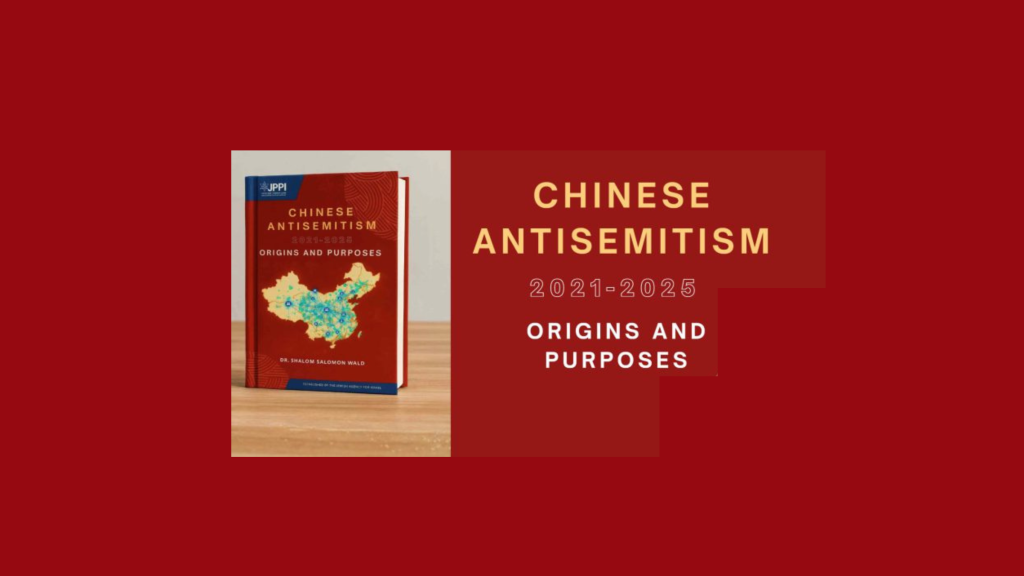
This JPPI study by Dr. Shalom Salomon Wald arrives at a moment when clarity is rare and essential. Over the past several years – punctuated by the Gaza wars of 2021 and 2023-25 – antisemitic narratives in China have intensified across state-aligned press outlets, social media platforms, and parts of academia. This is not a parochial development. When the world’s second-most populous nation and a leading architect of the information environment authorizes, amplifies, or tolerates such ideas, the effects reverberate well beyond its borders. Dr. Wald’s contribution is to bring scope, structure, and sobriety to a topic that is too often discussed in fragments.
This report advances three framing insights. First, much of what we are witnessing is not “homegrown” prejudice but the convergence of external drivers – geopolitical rivalry with the United States, alignment with Arab and Muslim partners (including Iran), and the contagious globalization of antisemitic memes – onto China’s media and university ecosystems. Second, the habitual conflation of Israel, Jews, and Judaism has become a key accelerant: critiques of Israeli policy are routinely translated into indictments of Jews as a collective, echoing patterns now familiar in the West but articulated through China’s particular ideological lexicon. Third, universities – training grounds for the next generation of decision-makers – have emerged as influential incubators, where anti-Zionist dogma and open hostility too easily pass as critical scholarship.
Dr. Wald is careful to distinguish critique from bigotry. He accepts that sharp criticism of Israeli policy is not antisemitism. But he shows, with disquieting evidence, how double standards, Nazi analogies, and claims of Jewish conspiratorial power have migrated from fringe tropes into normalized discourse. He places these trends within a longer arc of Sino-Judaic encounters – from Sun Yat-sen’s sympathy with Zionism to recent gestures in Beijing that praised the Talmud – underscoring the tragic reversal from an era in which China could proudly claim a civilization largely unmarked by antisemitism.
The policy implications are practical and immediate. Israel must continue to manage its indispensable relationship with the United States even as it protects space for constructive ties with China. It should enlist Jewish communities globally, and partner governments – especially in Europe – to call out antisemitic rhetoric and actions with consistency and consequence. Equally crucial is sustained monitoring: rigorous, language-competent tracking of state media, social feeds, and academic publishing to move beyond anecdotes to patterns. Finally, cultural and scholarly engagement – precisely the kinds of exchanges now being chilled – remain among the most effective long-term correctives to ignorance and caricature.
This is not a counsel of despair. The same report that documents deterioration also notes glimmers of diplomatic recalibration and pockets of intellectual curiosity among Chinese students. The choice facing leaders in Beijing, Jerusalem, and across the Jewish world is whether to let a meme metastasize – or to confront it with facts, principled diplomacy, and patient cultural work. Readers will find in these pages both a warning and a map. For policymakers, scholars, and communal leaders, Dr. Wald’s analysis is not merely timely; it is necessary reading for anyone committed to ensuring that the world’s oldest hatred does not become a new normal in one of the world’s oldest civilizations.
On a personal note, I am deeply grateful to Dr. Wald for his contributions and commitment to both this critical field of inquiry and to JPPI, where he has been a Senior Fellow for more than two decades.
Prof. Yedidia Stern, President
JPPI