
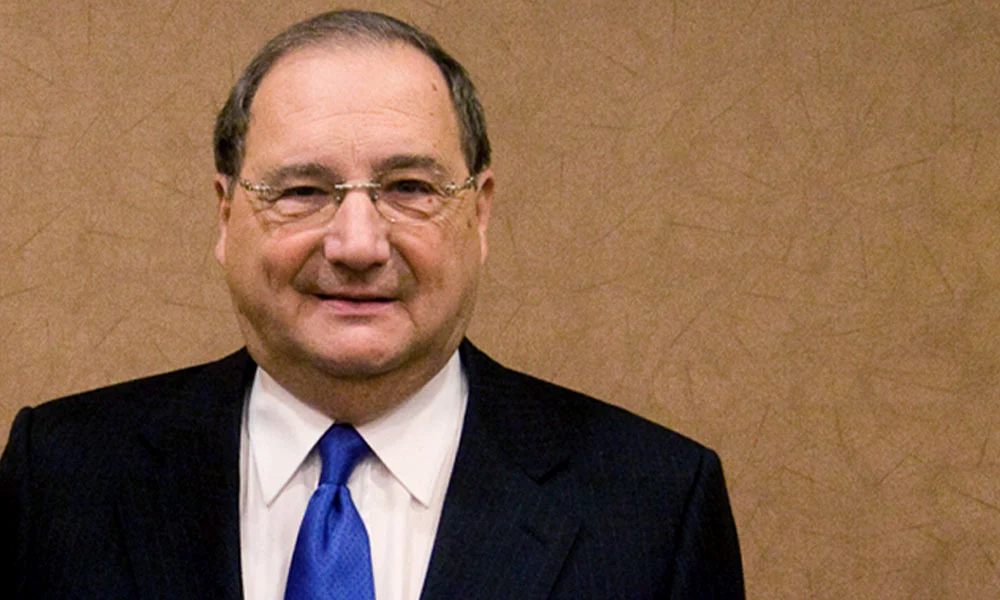


In the introduction to the book about the U.S. community I wrote about a decade and a half ago, a little story about Foxman appeared, which I thought was appropriate as a farewell to this man and to an era.
Abe Foxman, a legendary Jewish leader, and the head of the Anti-Defamation League from 1987 to 2015, passed a few days ago, aged 86. It’s been a while since we last spoke, but speaking with him had always been one of the more enjoyable perks for a person writing about U.S. Jewish life. In the introduction to the book about the U.S. community I wrote about a decade and a half ago, a little story about Foxman appeared, which I thought was appropriate as a farewell to this man and to an era. Reading through it reveals just a little of what made Foxman endearing in many ways, and it also reveals, by being so offhand, almost naïve, how much America changed in such a short time.
So here is one little story, about antisemitism, basketball, humor and Foxman. RIP.
American and Israeli basketball fans with long memories will recognize the name Michael Ray Richardson, a player who was linked to the Israeli team Hapoel Ramat Gan 15 years ago after being banished from the NBA due to drug use. Richardson, who died about a year ago, had a long history of brief scandals; in 2007, another was added to the list when he was fired from coaching the “Albany Patroons.” One of the reasons: antisemitic remarks.
This was an incident that taught me a lesson about the state of American Jewry far more than it taught me about Richardson, who never quite excelled at choosing his words. “I’ve got big-time lawyers. I’ve got big-time Jew lawyers,” he said in response to a question regarding his contract renewal. When told that some might be offended by his words, he responded: “Are you kidding me? They’ve got the best security system in the world. Have you ever been to the airport in Tel Aviv? They’re real crafty. Listen, they are hated all over the world, so they have to be crafty.” He said about us – Jews – that we’ve got a lot of power in the world, “you know what I mean?” He said “I think that’s great.” He didn’t think there’s anything wrong with that. If you look at professional sports, he said, Jews run it. If you look at most successful companies and such, most businesses, Jews run them.
In America, compliments must be given with caution. Richardson ultimately just wanted to say something nice about Jews. That didn’t prevent his suspension, nor did it stop the Anti-Defamation League (ADL) from complaining about the “pain his words caused to many people” (to be precise: an anti-gay remark was also among the reasons for his dismissal for the Patroons). In principle, the claim made by the head of the ADL, Abraham Foxman, was correct: Richardson’s description of Jews bore too much resemblance to antisemitic stereotypes.
However, as author Ze’ev Chafets noted in an op-ed published in The Los Angeles Times: “Jews, as a people, are indeed smart. And they are proud of it, too.” Indeed, around the same time, a long-form article by Charles Murray appeared in the Jewish-American magazine Commentary. Murray – one of the controversial authors of “The Bell Curve,” which caused an uproar by claiming (and this would be a highly simplistic description) that Black Americans were less intelligent than Whites and Asians – argued that the roots of “Jewish genius” lie in processes that began even before the Jews went into exile. No one accused him of antisemitism. It was a sensitive and yet an interesting article.
Reading it reaffirmed the need for a redefined, updated definition of the verbal “danger zone”: in the 21st century, given the influence and visibility of Jews in America, one shouldn’t jump at every use of a stereotype as if it were a racist event deserving of condemnation. Not every generalization justifies punishment.
The Richardson case was a minor event, worth lingering over because it masked a persistent fear of majority prejudice. It served as a reminder that this large, powerful community – the U.S. Jewish community – possesses a minority consciousness that seemingly cannot disappear. But as is the way with fears, they sometimes paralyze – paralyzing judgment, clarity of thought and the ability to put events into proper perspective.
After Richardson was suspended, I wrote in the newspaper that “merciful Jews” – another controversial generalization about our people – should call for his reinstatement. For the cancellation of Richardson’s suspension. David Stern, the commissioner of the NBA and one of the Jews who “runs professional sports,” came to Richardson’s defense and stated that he “is not an antisemite.” Abe Foxman, who initially welcomed the suspension, admitted to me in a conversation that “perhaps it really is too harsh a punishment.” He agreed that we must be careful lest, on the rocky road to eliminating antisemitism, Jews lose another beloved stereotype: that they have an excellent sense of humor.