

A JPPI study using AI-based analysis found that Tucker Carlson and Candace Owens significantly increased their anti-Israel content, with Owens also showing a rise in explicit antisemitic messaging.
A new study by the Jewish People Policy Institute (JPPI), based on artificial intelligence analysis of thousands of social media videos, identifies a troubling trend: two of the most prominent right-wing influencers in the United States, Tucker Carlson and Candace Owens, have significantly intensified their focus on Israel in recent months, accompanied by a marked escalation in anti-Israel rhetoric and, in the case of Owens, explicit antisemitism.
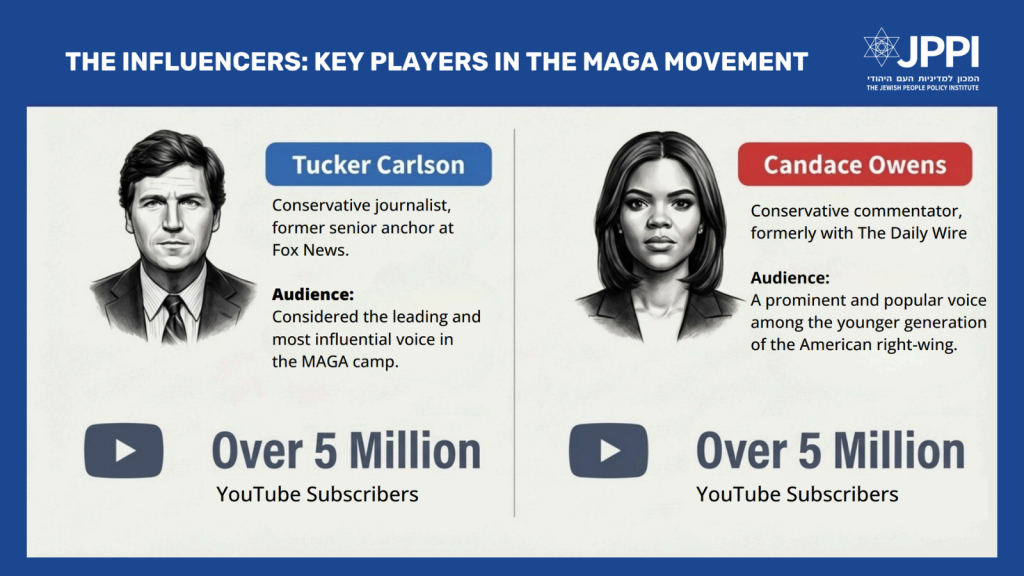
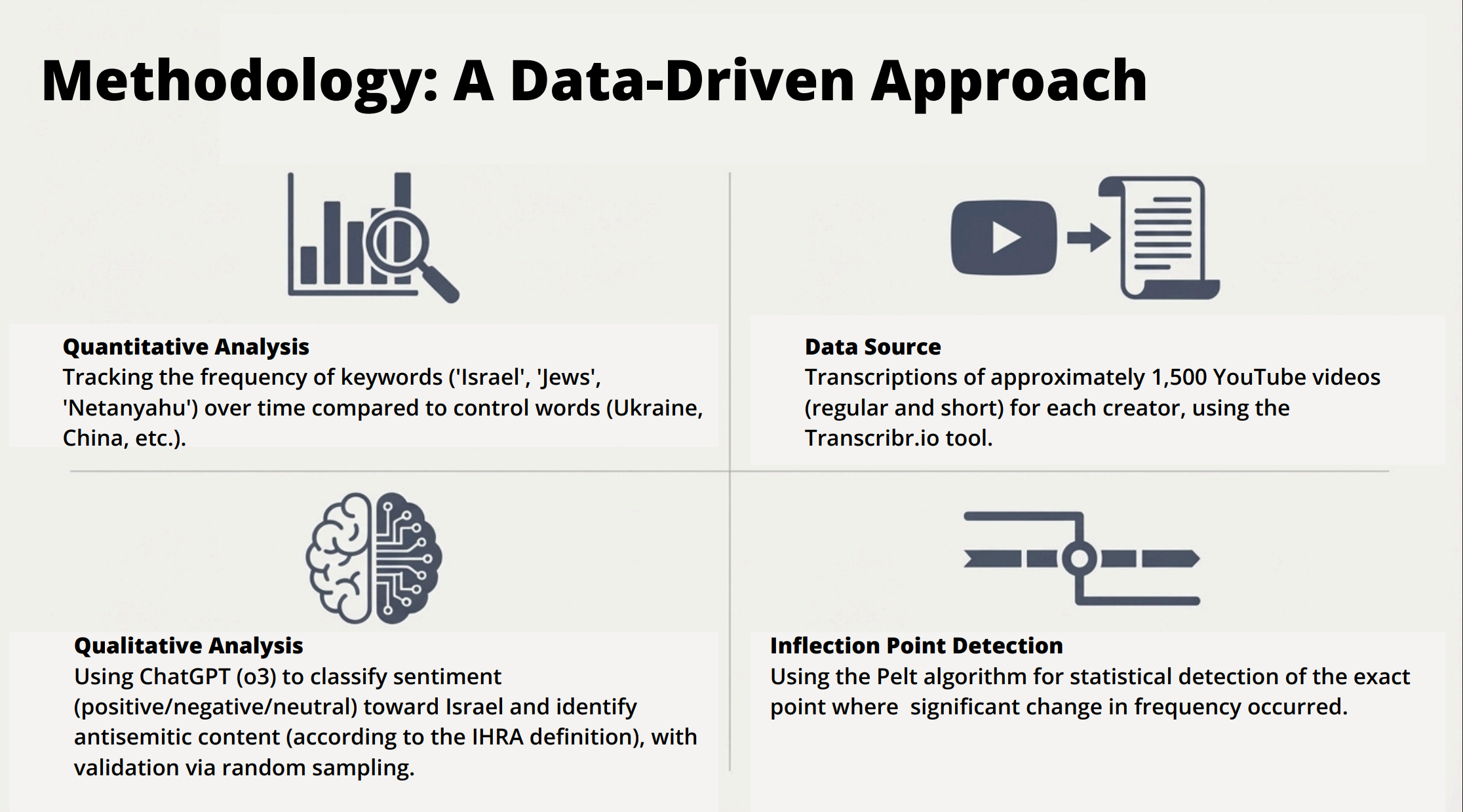
While both figures have long been known for their critical stance toward Israel, the study documents a sharp and recent increase in both the volume and intensity of negative content. The research analyzed approximately 3,000 YouTube video transcripts, including short-form videos, from Carlson and Owen’s respective channels, each of which has more than five million followers.
The analysis relied on keyword tracking and comparisons between content addressing Israel and Jews and content addressing other global issues. In addition, AI-based sentiment analysis was used to assess attitudes toward Israel, alongside the identification of antisemitic expressions in accordance with the internationally accepted IHRA definition.
The findings indicate that within the MAGA camp, increasingly hostile rhetoric toward Israel is gaining visibility and influence — a trend that has intensified over the past year.
Key Findings:
Growing Obsession with Israel:
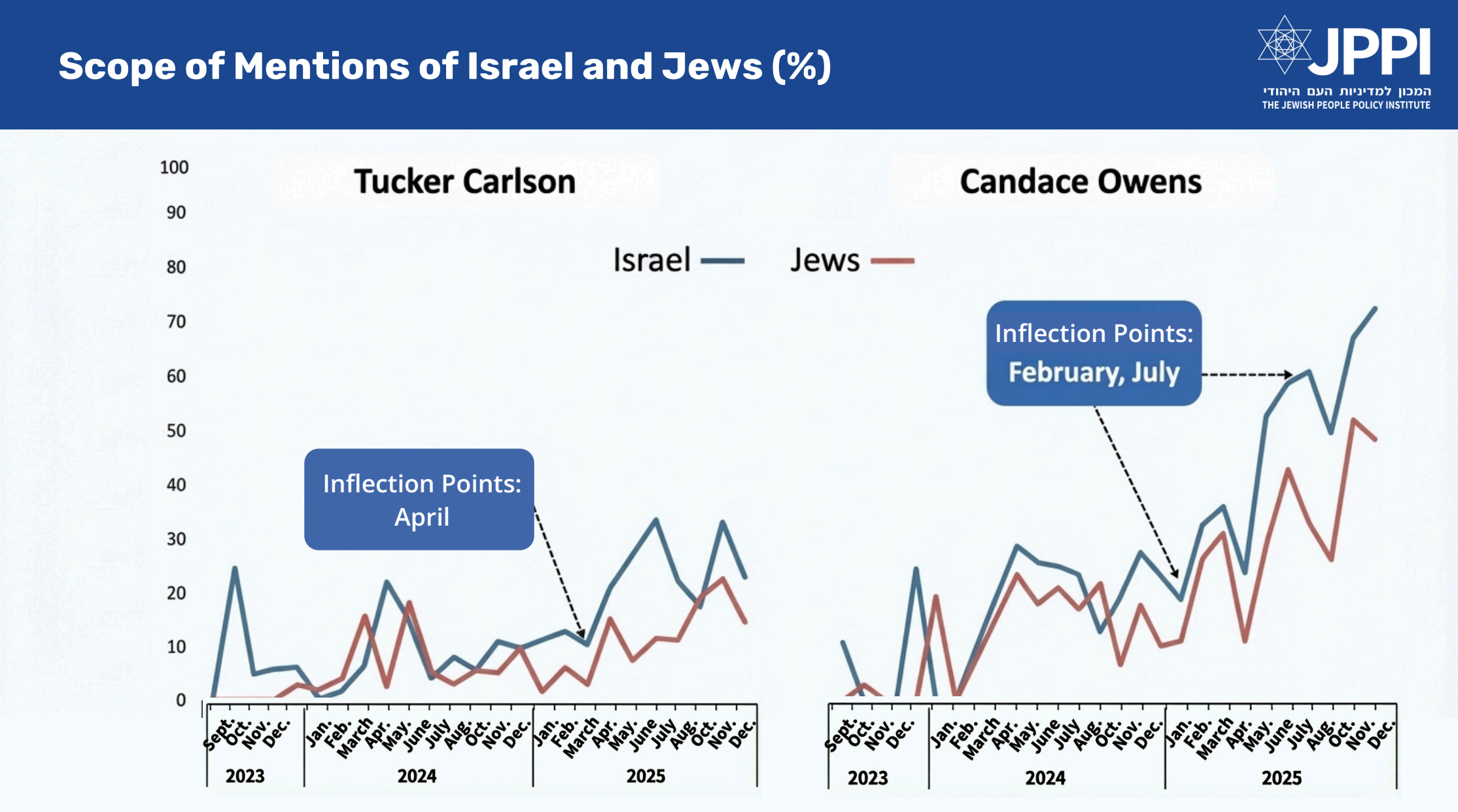
Over the past six months, there has been a sharp increase in references to Israel, Jews, and Prime Minister Benjamin Netanyahu, compared with coverage of other major international issues such as the war in Ukraine or tensions with China or Iran. The analysis shows that Israel has become a central, and at times dominant, topic in the discourse of both influencers.
For Candace Owens, this shift began in February 2025; for Tucker Carlson, in April. From those inflection points onward, references to Israel show a steep and sustained upward trajectory.
Escalation in Tone and Sentiment:
AI-based sentiment analysis reveals a significant deterioration in tone toward Israel:
Tucker Carlson: The share of negative content about Israel rose sharply from 48.9% in the previous six-month period to 70.3% over the last six months.
Candace Owens: From the outset, the overwhelming majority of her references to Israel were already classified as negative (over 96%). The primary change in her case is quantitative — a substantial increase in the overall volume of such negative content.
Across multiple videos, both figures employ sharp rhetoric, including comparisons between Israel and Hamas, use of the term “genocide,” accusations of deliberately killing children, and the circulation of conspiracy narratives alleging Israeli influence over the United States.
Manifestations of Antisemitism:
Tucker Carlson: The analysis did not identify consistent or explicit antisemitic statements according to the IHRA definition. However, Carlson repeatedly provides an uncritical platform to well-known antisemites, including Holocaust deniers and extremist ideologues (such as Nick Fuentes), without setting clear boundaries or offering meaningful critical challenge.
Candace Owens: In Owens’s case, the findings are substantially more severe. Approximately 45% of videos in which Jews are mentioned were classified by the algorithm as antisemitic. In the past six months, this figure rose to roughly 75% — nearly double the rate for the previous six-month period.
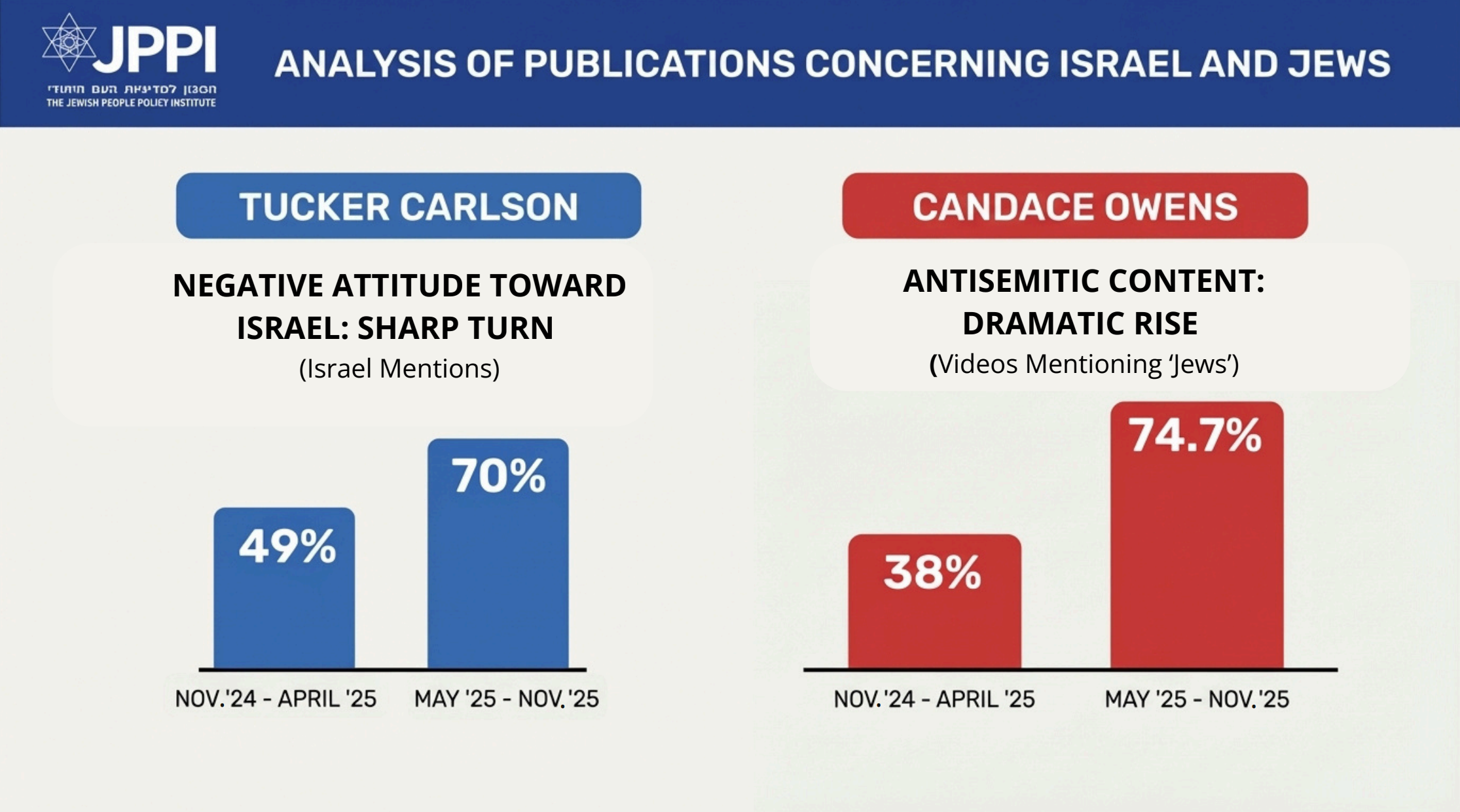
These videos include sweeping generalizations about Jews, portrayals of Jews as a “cult,” accusations of “Jewish supremacy,” and classic antisemitic tropes alleging Jewish control, deception, and manipulation. Such claims are frequently accompanied by the assertion that deployment of charges of antisemitism and antisemite are merely a “Zionist tactic.”
Summary:
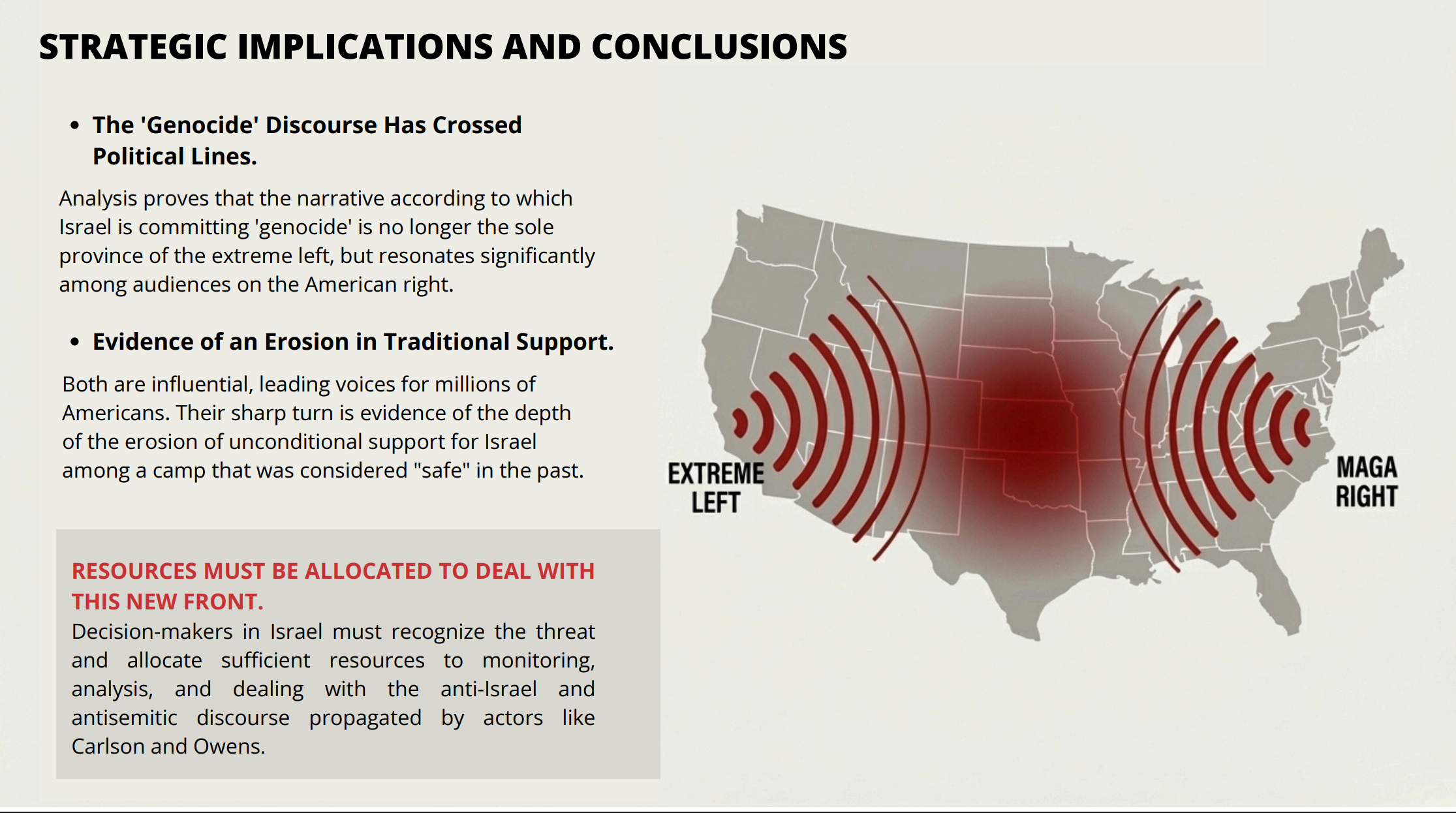
The study provides empirical evidence that anti-Israel discourse in the United States is no longer confined to the radical left or to the political fringes. It is increasingly permeating segments of the populist right and the broader MAGA camp, amplified by influencers with significant reach and impact on public opinion.
Moreover, terminology such as “genocide,” once associated primarily with radical progressive discourse, is now becoming part of the lexicon of prominent figures on the American right.
JPPI researchers argue that these findings underscore the need for a broad strategic response to address hostility toward Israel in the American public discourse — not only from the left, but also from the right. This development has the potential to erode U.S.–Israel relations over the long term.
The study also highlights the growing value of artificial intelligence as a research tool for identifying deep digital trends that may foreshadow future political dynamics.
The study was conducted by researchers at JPPI’s Diane and Guilford Glazer Information and Consulting Center: Yaakov Katz, Shlomi Bereznik, and Eli Kanai, using advanced AI-based analytical tools.
Statement by JPPI Director-General Dr. Shuki Friedman: “Antisemitism on the American far right is now overt and out in the open. The data should serve as a flashing warning light for Israel and its leadership regarding the kind of support it can expect from the right, today and in the future. Only a determined effort to counter this extremism can help preserve this vital base of support in the United States.”