


Connected Jews in the United States: The Iranian Threat, Rising Antisemitism, Closeness to Israel and Judaism
Main Findings
- Six months after the 12-day campaign against Iran: Three in five Jews see Iran as an existential threat.
- Similar to perceptions in Israel, the threat has intensified since the end of the campaign.
- Nevertheless, half believe the results of the campaign were better than they had thought at the time.
- Jewish respondents in the United States perceive Iran as more of an existential threat than do Jews in Israel.
- Broad Jewish consensus: Iran is the most serious threat to Israel.
- US Jews believe: Qatar is the second greatest threat after Iran (Israeli Jews: Turkey is in second place).
- Iran is perceived as the key Middle Eastern threat to the United States, Canada, and the United Kingdom.
- A large majority of respondents believe there has been a significant rise in antisemitism within the Republican Party.
- 85% of respondents: Israel’s image was harmed in 2025.
- Half of the Jews surveyed feel increased closeness to Israel following the events of 2025; a fifth feel more distant.
- Half are more connected to Israel compared to their parents; two in five say they are more connected than their children.
- Most feel that Jewish identity matters to them as much as it did to their parents; a third say it matters more to them than to their children.
- Half did not plan to attend a community Hanukkah candle‑lighting event this year.
To download the PDF file, click here.
The Iranian Threat
The 12-day campaign against Iran ended six months ago. At the end of December, Prime Minister Netanyahu and President Donald Trump held talks, some of which were devoted to the campaign’s results and the renewed threat from Iran, which is working to arm itself with missiles capable of striking Israel. In light of this, we asked again this month about Israel’s situation vis‑à‑vis Iran. The responses suggest that after six months, most connected Jews in the United States have returned to positions similar to their initial views, identifying Iran as a significant threat, even though many still believe that the level of threat has declined somewhat since the campaign.

As in July, in the immediate wake of the campaign, we asked the Voice of the Jewish People respondent panel whether Iran was – or was not – an existential threat to Israel. A majority of US Jews surveyed (71%) believed Iran was an existential threat to Israel before the campaign; the same share was found among Jewish Israelis who think so (according to JPPI’s early-December Israeli Society Index). For both populations, this figure remained stable relative to responses recorded six months ago: among Jewish Israelis, there was a modest increase in the perception of a high threat (from 67% in July to 71% in December), while no such change was found among US Jews. In both groups, the share who believe Iran is not at all an existential threat remains very low.

A breakdown by ideological orientation shows significant gaps in pre-campaign perceptions of the threat: the more conservative the political position, the greater the tendency to view pre‑campaign Iran as an existential threat. Less than half of the “strong liberal” cohort (44%) think Iran was a severe existential threat before the campaign, and a non‑negligible share believe it posed a minor threat or no threat at all. By contrast, a majority in the other ideological cohorts perceive pre‑campaign Iran as a great existential threat. This pattern is also reflected in a breakdown by voting pattern in the 2024 presidential election: 91% of Trump voters believe that Iran was a great existential threat before the campaign, compared with 61% of Harris voters.

Six months ago, parallel surveys of Jews in Israel and the United States found that American Jews perceived Iran as a more severe threat to Israel than did Jewish Israelis. This remains unchanged. Compared with the period immediately after the attack, December (six months later) shows an increase in the share of American Jews who believe Iran is an existential threat to Israel “to a great extent” (57% versus 34%). Today, a majority of respondents perceive Iran as a great existential threat, whereas six months ago most respondents viewed Iran as a lesser threat. Among Jewish Israelis, although the share viewing Iran as great existential threat is lower (34%), most still believe Iran poses at least some degree of threat, indicating that the sense of threat persists, albeit at a lower intensity.
Among “strong liberal” respondents, the share who view Iran as a great existential threat is relatively low (38%), alongside a higher share who believe it is a minor threat or no threat at all. As positions move toward more conservative orientations, the assessment that Iran constitutes a significant existential threat increases, peaking among the “strong conservative” cohort, where four in five (78%) think so.

Six months after its conclusion, nearly half of the JPPI – Voice of the Jewish People panel (47%) believe the results of the Iran campaign were better than they had expected, while a sixth (15%) think the results were worse than expected. A quarter of panel participants (25%) report that the outcome of the campaign was about what they had anticipated. This stance among US respondents differs from that of Jewish Israelis: among Jews in Israel, a quarter (25%) believe the outcome was better than expected, a similar share (27%) think it was worse than expected, and a third (36%) think it was about what they expected. Among US Jews, an ideological breakdown shows that the more conservative the political position, the greater the tendency to view the campaign’s outcome as better than expected. Among those who identify as centrist and conservative, more than half believe the outcome was better than they had initially thought. By contrast, among the “strong liberal” and “leaning liberal” cohorts, a smaller share believe so, and one-fifth did not know how to answer.
Threat Posed by Various Middle Eastern Countries
This month, panel participants were asked to rank eight countries according to the degree of threat they pose to Israel. Among US Jews – and among Jews in the samples from Canada and the United Kingdom (which are still experimental, and smaller than the US group) – there is agreement that Iran poses the most severe threat to Israel. This view resembles that of Jews in Israel. With respect to other countries on the list, perceptions differ across the Jewish communities examined. Among US, Canadian, and UK Jews surveyed, Qatar is ranked as the second-most threatening country; Jewish Israelis rank it slightly lower, in third place. After Iran, Turkey is perceived as the more significant threat among Jewish Israelis, while it is ranked lower by respondents in the US, Canada, and the UK. A similar gap appears regarding Yemen, which is perceived as a more significant threat by Jews in the US, Canada, and the UK than by Jews in Israel. Saudi Arabia and Egypt are ranked as the least threatening countries in all groups, with Saudi Arabia perceived as the smallest threat among Canadian, British, and Israeli Jews.

Following the question on the degree of threat to Israel, we examined how Jewish respondents in the surveyed countries perceive the level of threat posed by those same countries to the United States, Canada, and the United Kingdom. The data shows a uniform picture of threat perceptions vis-à-vis the United States, Canada, and the United Kingdom among Jews in those three countries. Iran is ranked as the most severe threat in all cases, followed by Qatar and Yemen, which consistently occupy second and third place. The middle of the ranking is similarly ordered, with Turkey and Syria positioned in a comparable sequence. At the bottom of the threat scale are Lebanon, Saudi Arabia, and Egypt (consistently ranked the least threatening)).

Right‑Wing Antisemitism
In light of the intensification of antisemitism globally – which took on a deadly form in Australia over the past month – JPPI examined what respondents think about two statements by US politicians on the subject. The first was a statement made at the beginning of the month by Vice President J.D. Vance, who asserted that there has not been a significant rise in antisemitism in the Republican Party (“Do I think the Republican Party is significantly more antisemitic than it was 10 or 15 years ago? Absolutely not”). US Jews largely (73%) disagree with the vice president’s assessment, while just 18% agree with him.

Gaps appear between ideological cohorts in levels of agreement with Vance’s assessment. Among strong liberal and leaning liberal respondents, disagreement rates are particularly high and exceed 80%, whereas among the leaning conservative and strong conservative cohorts, a higher share agrees with Vance, though still not a majority. When broken down by voting pattern, the differences are even clearer. Among Harris voters, there is near‑unanimous disagreement (85%) with Vance’s assessment, but among Trump voters, half (50%) disagree with the vice president and two in five (37%) agree with him.

The second statement we examined this month was a parallel but opposite claim by Texas Republican Senator Ted Cruz, who said: “I say this as a Republican: It is easy to criticize the other party and its extreme positions, but I am here to say that in the past six months I have seen more rising antisemitism on the right than at any other time in my life.”
Among respondents, there is broad agreement with Senator Cruz’s remarks. A large majority (88%) agree with his assessment, while a negligible 4% disagree with it. Taken together, the comparison of Vance’s and Cruz’s assessments indicates that US Jews overwhelmingly believe that there has been a significant rise in antisemitism in Republican circles. (Similar agreement, measured in previous surveys, also existed regarding increasing antisemitism in Democratic circles.)

The high level of agreement with Cruz’s statement exists across ideological cohorts. Among liberals, agreement with Cruz’s statement exceeds 90%; among conservatives, agreement rates are somewhat lower, but still quite high. Similarly, a breakdown by voting pattern shows that a clear majority of Trump voters agree with Cruz’s remarks (76%); among Harris voters, agreement is nearly unanimous (93%).
Israel’s Image in the World
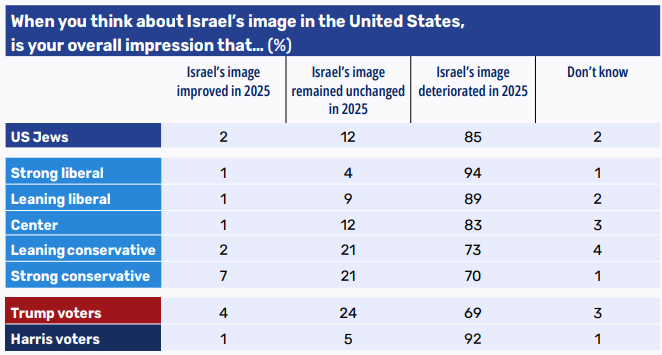
In the final weeks of 2025, we examined how the Voice of the Jewish People respondent panel assesses Israel’s standing and image in the world. Among the US Jews surveyed, there is a broad sense that Israel’s image in the United States eroded in 2025. Eighty-five percent believe Israel’s image deteriorated, while a small 2% minority believe it improved, and 12% think it did not change. This assessment was recorded across all ideological groups, though with different intensities.

Among the strong liberal and leaning liberal cohorts, an overwhelming majority (94% and 89%, respectively) believe Israel’s image suffered damage, with just a few reporting an improvement. A substantial 83% majority also exists in the centrist cohort. Among leaning conservative and strong conservative respondents, the share who perceive damage is lower (73% and 70%, respectively), alongside a higher share who believe there has been no change or even an improvement. Similar gaps appear by voting pattern: Trump voters are less likely to perceive damage (69%) than Harris voters, among whom nearly all (92%) believe Israel’s image was harmed. Overall, there is clear cross‑camp agreement that Israel’s image was damaged in 2025, with liberals tending to perceive the damage as more severe than conservatives.
Among the UK and Canadian Jews surveyed, there is also a clear sense that Israel’s image suffered harm in 2025. In both countries, a majority of respondents believe there was damage to Israel’s image: 85% in the United Kingdom and 87% in Canada, while only a negligible share think it improved (2% in each country). The share believing that there has been no change is also relatively low: 8% in Canada and 12% in the United Kingdom. These findings reinforce the impression that Jewish communities in different countries identify a deterioration in Israel’s international image in 2025.
Closeness to Israel and to Judaism
Among US Jews, there is a general trend of increased closeness to Israel following the events of 2025. Half of respondents (49%) report feeling closer to Israel, compared with a fifth (20%) who report feeling more distant, and a third (30%) who report no change.
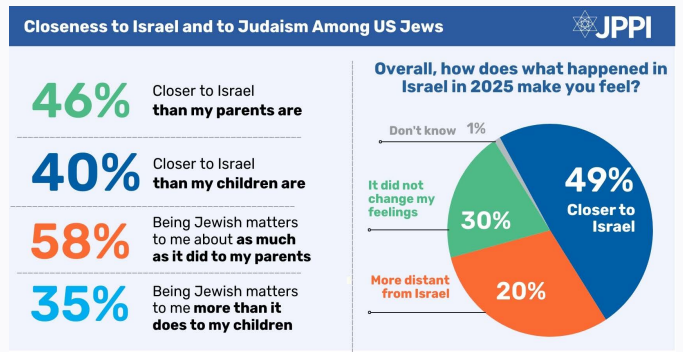
As one moves along the ideological scale from liberal toward conservative, the share of respondents reporting that they feel closer to Israel increases, and the share who feel more distant decreases. Among the strong liberal respondents, half (50%) feel more distant from Israel following the events of 2025, while a quarter (25%) report feeling closer. Among leaning liberal respondents, 37% feel closer to Israel, a similar share (40%) report no change, and a fifth (20%) feel more distant. By contrast, among centrists and the two conservative cohorts, a stronger sense of closeness to Israel is evident. A majority of centrists report increased closeness (59%), and the share reporting increased distance is low (5%). The pattern is even stronger among the leaning conservative and strong conservative cohorts, where about three quarters (77% and 74%, respectively) report feeling closer to Israel. Similarly, a breakdown by voting pattern reveals that most Trump voters express increased closeness to Israel (73%), while Harris voters are divided – one-third (35%) feel closer, one-third (30%) feel more distant, and another third (33%) report no change.

Similar to a parallel examination conducted a year ago, this month we assessed closeness to Israel and Judaism with generational questions. Respondents were asked to indicate their relationship to these identity components relative to their parents and their children (if they have children, and if the children are old enough for the question to be meaningful). The data suggests that connection to Israel does not weaken relative to the parents’ generation and has even strengthened for a considerable share of respondents. Nearly half of respondents (46%) say they are more connected to Israel than their parents, the same share recorded in December 2024. At the same time, the share who believe their level of connection is similar to that of their parents remains high (40% this year, compared with 43% last year). However, there has also been an increase in the share reporting a lower connection to Israel compared with their parents – from 5% last year to 10% this year.
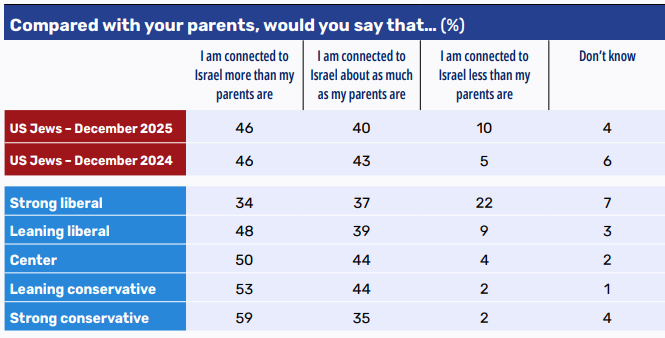
Among those who self-identify as strong liberals, one-fifth (22%) report being less connected to Israel than their parents; one-third (37%) report a similar level of connection; and another third (34%) feel more connected to Israel than their parents. As one moves rightward along the ideological spectrum, the sense of connection to Israel increases: among the leaning conservative and strong conservative cohorts, more than half report feeling more connected to Israel than their parents (53% and 59%, respectively), and a negligible share report feeling less connected.
The sense of connection to Israel, relative to their parents’ generation, is also influenced by denominational affiliation. Among the ultra-Orthodox (Haredim), a stronger connection to Israel particularly stands out, with two-thirds (67%) reporting that they are more connected to Israel than their parents. Among Orthodox and Conservative respondents as well, most report a level of connection that is the same as or stronger than their parents’, and the share who feel less connected is very low. Half of Reform respondents (49%) report being more connected to Israel than their parents; a third (31%) report a similar level; and a sixth (16%) report being less connected than their parents.

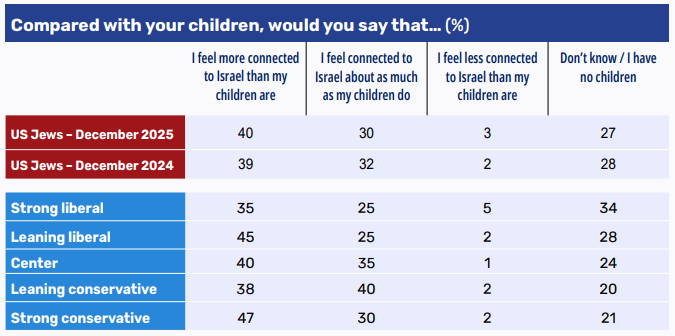
A similar question regarding respondents’ children suggests that the parents’ generation feels connected to Israel to a similar or greater extent than the children’s generation. Two in five (40%) say they are more connected to Israel than their children – the same share as in December 2024. About a third (30%) believe their level of connection is similar to their children’s, and only a small minority (3%) report that their children are more connected to Israel than they are. One quarter of respondents (27%) have no children or reported that they did not know how to answer.
Broken down by ideology, the strong conservative and leaning liberal cohorts comprise the highest share of respondents who say they are more connected to Israel than their children (47% and 45%, respectively). By contrast, among the strong liberal and leaning conservative cohorts the share reporting this is the lowest (35% and 38%, respectively). A breakdown by religiosity shows a clearer pattern: as one moves along the scale from Reform toward Orthodox, the share of respondents reporting that their children’s connection is similar to their own increases, and the share who believe they are more connected to Israel than their children decreases. Half of Reform respondents (51%) believe they are more connected to Israel than their children, compared with one-third (35%) of Modern Orthodox and one-quarter (27%) of Haredi respondents.
Questions in the same format examined respondents’ sense of connection to Judaism relative to that of their parents and their children. On this question, we found stability – and even some strengthening – in the importance respondents ascribe to their Jewish identity relative to their parents’ generation. A majority (58%) of respondents believe they ascribe a similar level of importance to their Jewish identity as their parents do. One-third (33%) say that being Jewish matters more to them than it does/did for their parents, an increase of 5 percentage points relative to December 2024, and only a small minority (5%) report that their Jewish identity is less important to them than it was to their parents. (This figure may, of course, be influenced by the fact that those for whom Jewish identity is not important are less likely to participate in JPPI’s respondent panel.)
A majority across all religious cohorts report that being Jewish matters to them to a similar degree as it did/does to their parents. Among Conservative respondents, two-thirds (67%) indicate a similar level of importance to that of the parents’ generation. Among Haredi, Modern Orthodox, and Reform respondents, slightly more than a third report that Jewish identity is more important to them than it was/is to their parents (40%, 36%, and 36%, respectively).
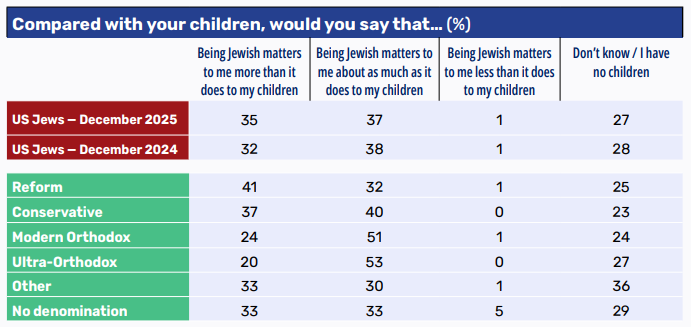
One-third of respondents (35%) report that being Jewish matters more to them than it does to their children, a slight increase relative to 2024. At the same time, a similar share say there is no generational difference between them and their children in the importance attached to Jewish identity (37%), and a negligible share report that it matters more to their children. As in the previous question about children, here too, one-quarter of respondents (27%) report that they have no children or did not know how to answer. A breakdown by denominational affiliation points to differences in perceptions of intergenerational continuity: among Reform and Conservative respondents, the sense that parents are more connected to Jewish identity than their children is more pronounced (41% and 37%, respectively); among Modern Orthodox and Haredi respondents, there is a stronger tendency to perceive a similarity between generations (51% and 53%, respectively).
Hanukkah
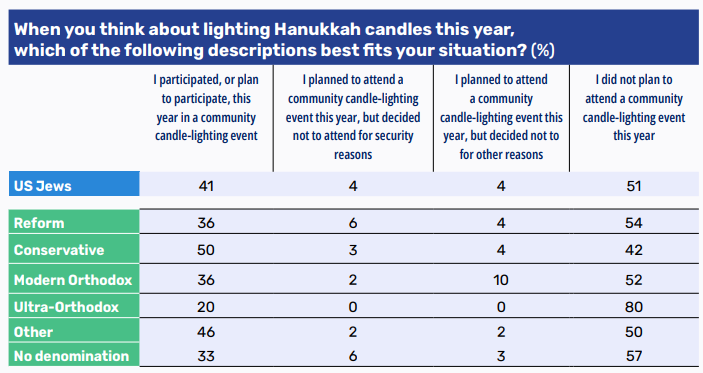
The December survey was conducted during the Hanukkah holiday and against the backdrop of the deadly incident at Bondi Beach in Australia, where 15 Jews were killed at a community candle‑lighting event. Half of respondents (51%) reported that they did not plan to attend a community Hanukkah candle‑lighting event this year, while two in five (41%) said they did plan to participate in such an event. A relatively small share said they had planned to attend a candle-lighting but decided not to, either for security reasons (4%) or for other reasons (4%). Among Conservative respondents, the highest participation rate in community candle‑lighting events was recorded (50%). In the other denominational groups, a majority reported that they did not plan to participate in a community candle‑lighting event.
In the small samples of Jews in Canada and the United Kingdom, a similar intention to participate in community Hanukkah candle‑lighting events was recorded. In Canada, the participation rate was slightly higher (44%) than in the United Kingdom (38%). A possible explanation is that in the UK there was a higher share who had planned to participate but refrained from doing so for security reasons (10% versus 5% in Canada). In both countries, half of respondents said that they did not plan to participate in a community event at all (49% in the UK and 47% in Canada).
Christmas Eve
It is commonly assumed that eating Chinese food on Christmas Eve has become, for many Jewish families, an intergenerational tradition that blends humor, identity, and a sense of cultural belonging. The data indicates that such a family tradition is familiar – and somewhat prevalent – among US Jews, though it is not observed consistently. A majority of respondents (53%) report that they have such a family tradition sometimes or always; most observe it occasionally (40%), and a minority observe it regularly (13%). By contrast, 44% report that they do not have such a family tradition, and only a small number say they are unfamiliar with the phenomenon. Among Reform, Conservative, and non‑denominational respondents, more than half report that the tradition exists in their family at least to some extent. By contrast, most Modern Orthodox and Haredi respondents report that they do not have such a tradition, which is unsurprising given that Chinese cuisine in most cases is not kosher (64% and 67%, respectively).

Survey Data and Implications
This report analyzes a survey conducted among 691 American Jews registered for the JPPI – Voice of the Jewish People Index panel. Generally, the survey tends to reflect the views of “connected” American Jews – that is, individuals with a relatively strong affinity to the Jewish community and/or to Israel and/or to Jewish identity. The survey also included approximately 70 participants from the United Kingdom and about 120 from Canada. The results, unless otherwise noted, reflect the views of US respondents only. The JPPI – Voice of the Jewish People Index survey was conducted by JPPI Fellows Shmuel Rosner and Noah Slepkov, with the assistance of Yael Levinovsky. Prof. David Steinberg serves as statistical consultant.
This table provides data on the December 2025 American survey respondents.
