



War with Iran, Hezbollah, and Hamas; Trust in Prime Minister Netanyahu and President Donald Trump.
Main Finding
Most of the public believes that the emerging agreement to end the war with Iran is not good for Israel.
Additional Findings
- The public is far from feeling that there was a decisive outcome in Iran: only a minority believes that most objectives were achieved.
- There are gaps in assessments of the achievements of the campaign against Iran: a majority on the right believes that the objectives were achieved.
- Nevertheless, a large majority of the Israeli public still supports the decision to go to war with Iran.
- Disappointment in Lebanon: more than half of Israelis assess that Israel is far from achieving its objectives.
- A more positive assessment of the Gaza front: half believe that most or a large share of the objectives have been achieved.
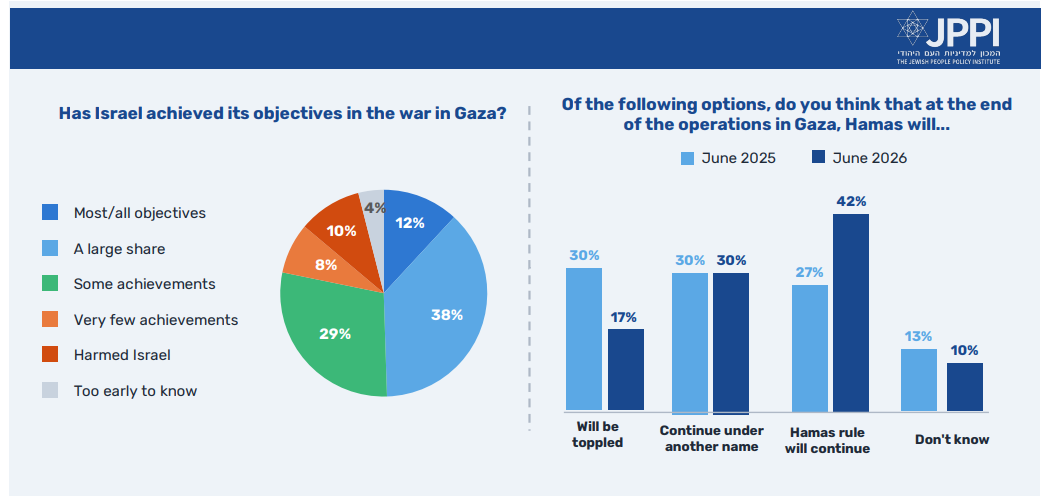
- A significant decline in the share of Israelis who believe Hamas rule in the Gaza Strip will be toppled.
- Two-thirds of Israelis believe Israel will not establish Jewish settlements in Gaza.
- The overall sense of victory in the war is at a low point compared with previous months.
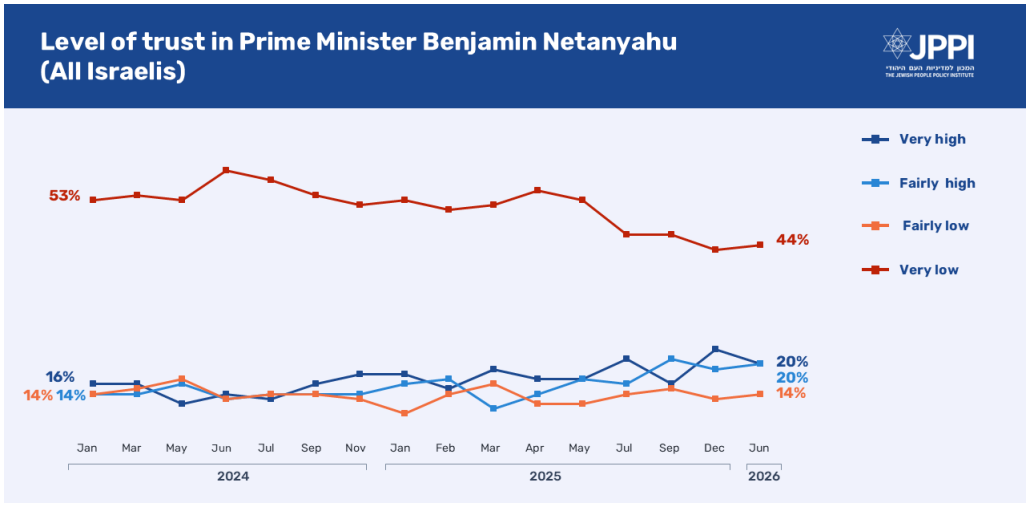
- Six in ten Israelis express distrust of Prime Minister Benjamin Netanyahu.
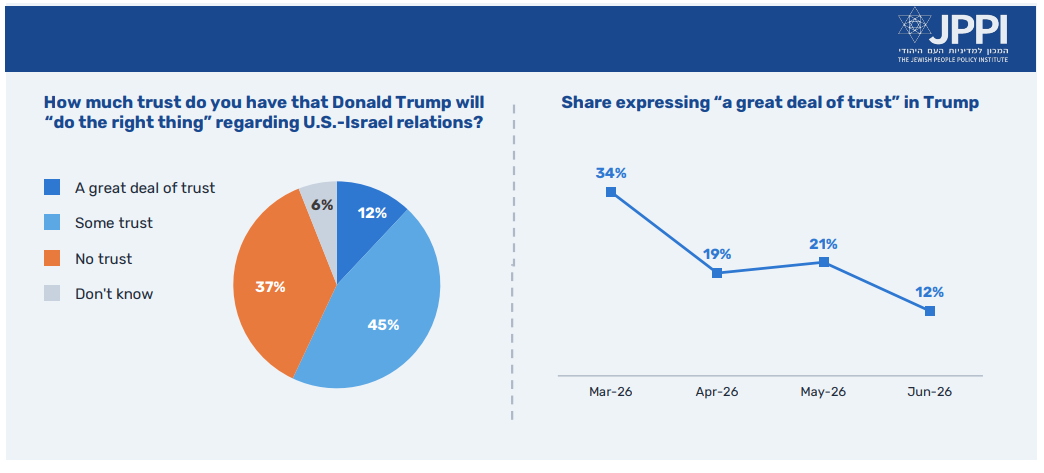
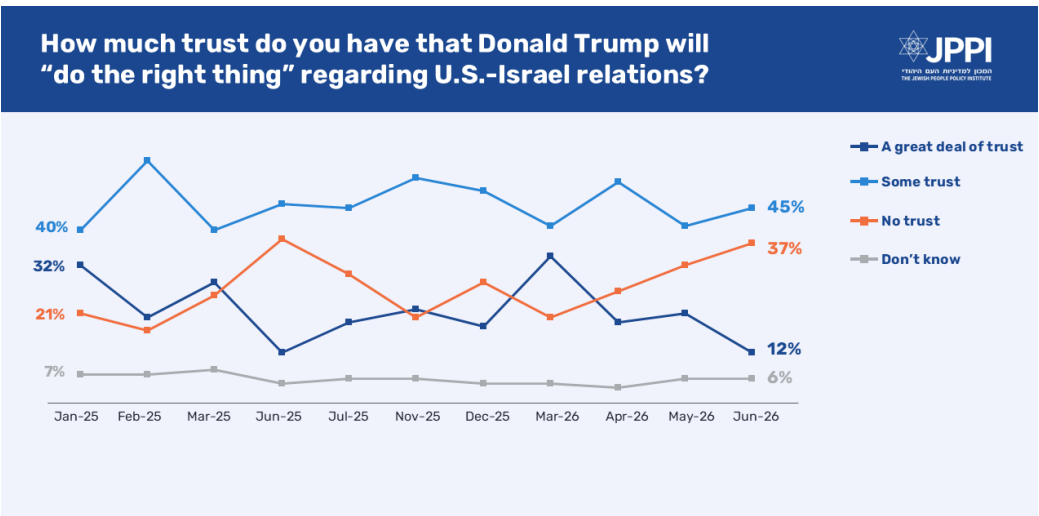
- Trust in President Trump has continued to erode since the peak reached last March.
To download a PDF version, click here.
The Iran War
At the time of this writing, the United States and Iran had already signed a memorandum of understanding (MOU) to end the war. The survey data was collected during the first week of June, when an agreement was emerging but had not yet been signed.
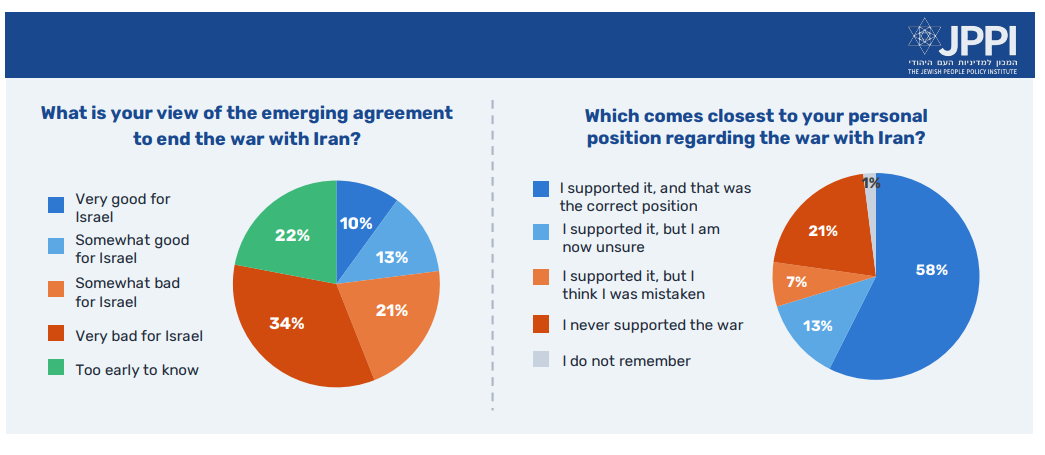
A majority (55%) of the Israeli public expressed concern about the possible implications of the agreement for Israel, compared with 23% who believe it is good for Israel and 22% who, at the time of the survey, had not yet formed a final position. There is a gap between Jewish and Arab Israelis regarding the agreement: a majority (64%) of Jewish respondents believe that the agreement will be bad for the State of Israel. The dominant share within this group (40%) chose the emphatic formulation “very bad,” and 24% assessed it as “somewhat bad.” By contrast, only a small minority (13%) of Jewish respondents see positive potential in the agreement, and 23% believe that it is too early to know. The picture is reversed among Arab respondents, with a 61% majority viewing the agreement as positive (29% very good and 32% somewhat good), compared with 22% who view it negatively.
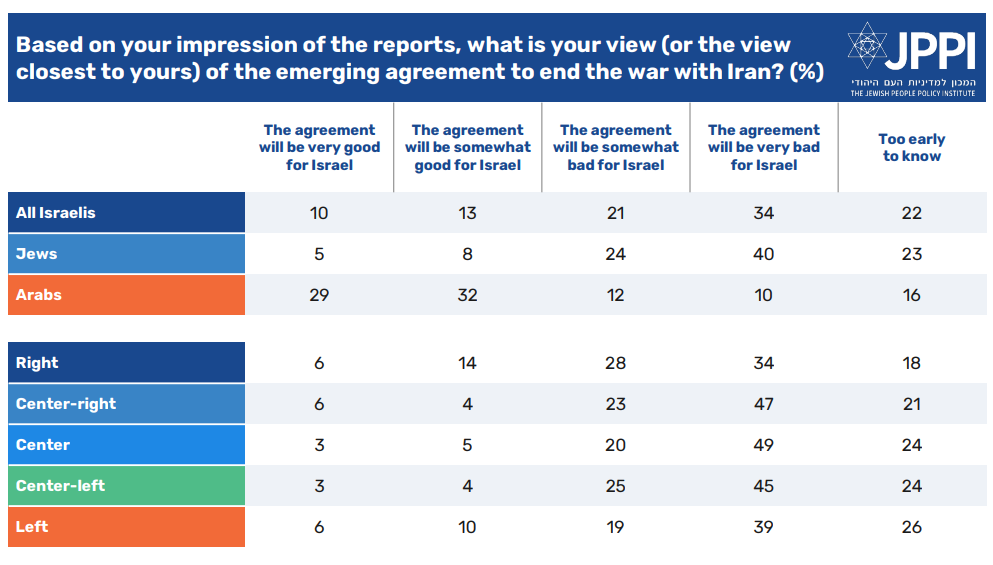
A breakdown by ideological orientation shows that assessment of the agreement as “very bad for Israel” is the leading position across all camps. Similarly, when the negative categories are combined (“somewhat bad” and “very bad”), a majority across ideological cohorts believe the agreement is not good for Israel. This cross-cohort agreement is also reflected in the breakdown by voting patterns in the 2022 elections: majorities who believe that the agreement will be bad for Israel are found among coalition voters (77% of Religious Zionism voters, 54% of Likud voters, 53% of Shas voters, and 50% of United Torah Judaism voters) and opposition voters alike (85% of Yisrael Beiteinu voters, 76% of National Unity voters, 71% of Yesh Atid voters, 66% of Labor voters, and 58% of Meretz voters).
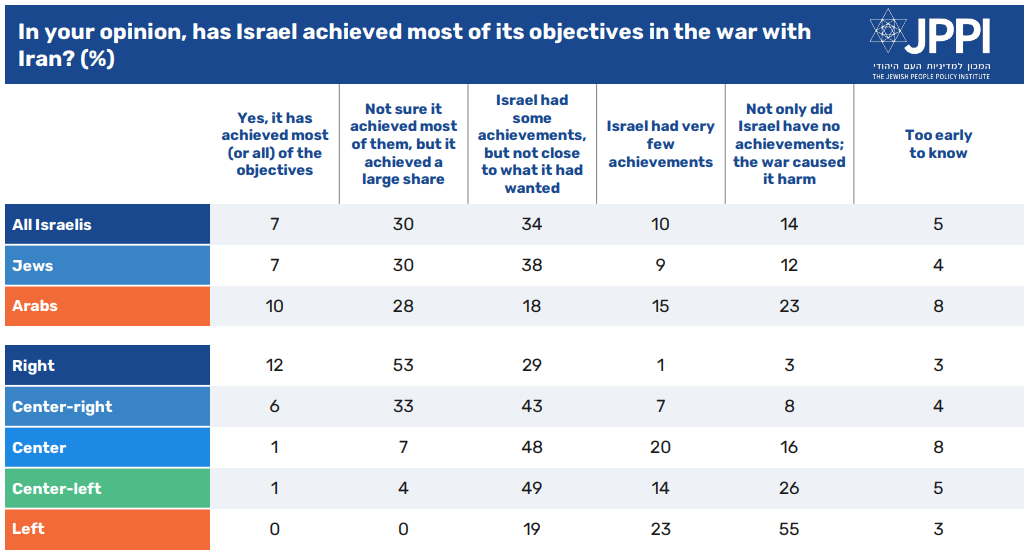
The Israeli public tends toward a skeptical assessment of whether the war objectives were achieved. Among Jewish Israelis, a negligible minority (7%) believes that Israel achieved most or all of its objectives on the Iran front, while the largest group (38%) thinks Israel had some achievements but that the outcome is far from what it had wanted. An additional 30% hold an intermediate position: they are unsure whether most of the objectives were achieved but believe that a large share were achieved. Conversely, one-fifth of the Jewish public say that Israel had very few achievements or that the war actually harmed the country. Arab Israelis take an even more emphatic view: four in ten (38%) say Israel had very few achievements or that the war caused it harm.
A breakdown by ideological orientation shows a consistent correlation: perceptions of success are concentrated on the right, while negative assessments of the campaign’s achievements grow among centrist and left-wing respondents. The highest level of satisfaction was recorded on the right: half of respondents (53%) said that a large share of the objectives were achieved, and an additional 12% believed that Israel achieved most or all of its objectives vis-à-vis Iran. A similar, though weaker, trend was found in the center-right cohort, where 33% said a large share of the war objectives had been achieved and 6% claimed full success. Moving leftward along the ideological spectrum, criticism intensifies: in the centrist and center-left cohorts, half of respondents believed that there were achievements but that the outcome was far from the desired result (48% and 49%, respectively), while the share claiming that the war harmed Israel stands at one-sixth in the centrist cohort and rises to one-quarter in the center-left group. At the leftmost end of the ideological spectrum, the trend reaches its peak. A majority (55%) stated that the fighting harmed the country, and one-quarter identified very few achievements.
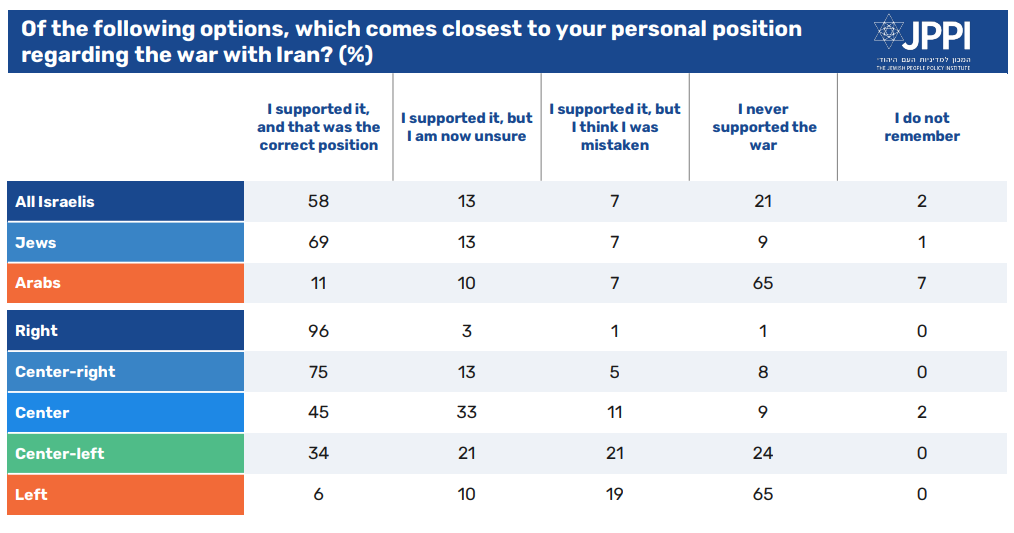
A comparative examination of public attitudes since the start of the war shows that A majority of Israelis (58%) continue to support the decision to enter the war. One-fifth (20%) supported entering the war but now say that it may have been a mistake, and one-fifth (21%) opposed it from the outset. Among Jewish respondents, support for having gone to war remains predominant. A majority (69%) state that they supported going to war with Iran and that this was the correct position, while one-eighth report that they supported it but are now unsure whether the move was justified. Seven percent of Jewish Israelis express some regret, saying that they supported the war but now think they were mistaken, and an additional 9% say they did not support the campaign from the outset. The picture is reversed in the Arab sector, where two-thirds (65%) report that they did not support the war. Among Arab respondents who did support it at the outset, 11% still hold that position, 10% now have doubts about it, and 7% believe they were mistaken.
There is a direct correlation between ideological orientation and the retrospective assessment of support for entering the war. Among those who self-identify as right-wing, there is a consensus: an overwhelming majority (96%) say they supported the war and that it was the correct decision. This trend remains robust among center-right respondents as well, with 75% reporting that they supported the war and still support it today, and 13% saying they supported it at the start but now express some skepticism. Among those who self-identify as centrist, there is a split: 45% hold to their original view that the war was justified, 33% initially supported the war but are now unsure, 11% believe that they erred in supporting it, and 9% did not support the war from the outset. Moving leftward along the ideological spectrum, criticism and opposition intensify: among center-left respondents, 34% still maintain their initial support, 21% consider their initial support a mistake, and 24% state that they never supported the war with Iran.
The War in Lebanon
Over the past month, many attacks have occurred in northern Israel and in the area under IDF control inside Lebanon. These events took place under the formal framework of a ceasefire; in practice, however, fighting continued.
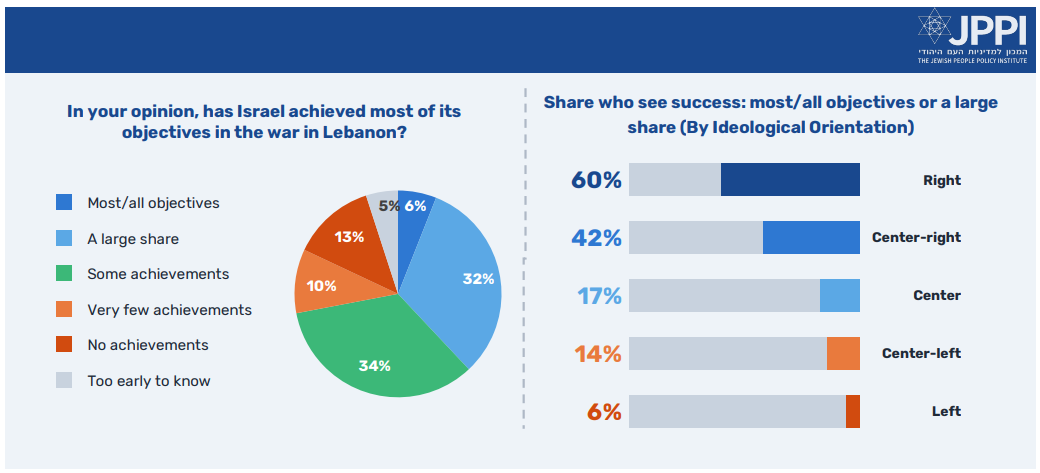
A majority of Israelis (57%) express varying degrees of disappointment with Israel’s achievements on the Lebanon front: 34% assess that there were some achievements but that the situation is far from what the country had wanted, 10% identify very few achievements, and 13% state that the fighting harmed Israel. Conversely, roughly four in ten Israelis identify major success in Lebanon (achievement of most or a large share of the military objectives). Among Jewish Israelis, a negligible share believes that Israel achieved most or all of the objectives, while four in ten (38%) think Israel had some achievements but that the result is far from what it had wanted. One-third of Jewish Israelis (33%) hold an intermediate position: they are not certain that most objectives were achieved but believe many objectives were achieved; one-fifth express a clearly critical position (10% identify very few achievements, and another 10% believe the war produced no achievements and harmed the country). Among Arab Israelis, there is an even greater split: one-quarter (25%) are convinced that the war ended without achievements and harmed Israel, while an identical share (25%) believes that many of the objectives were achieved, alongside 10% who identify complete success.
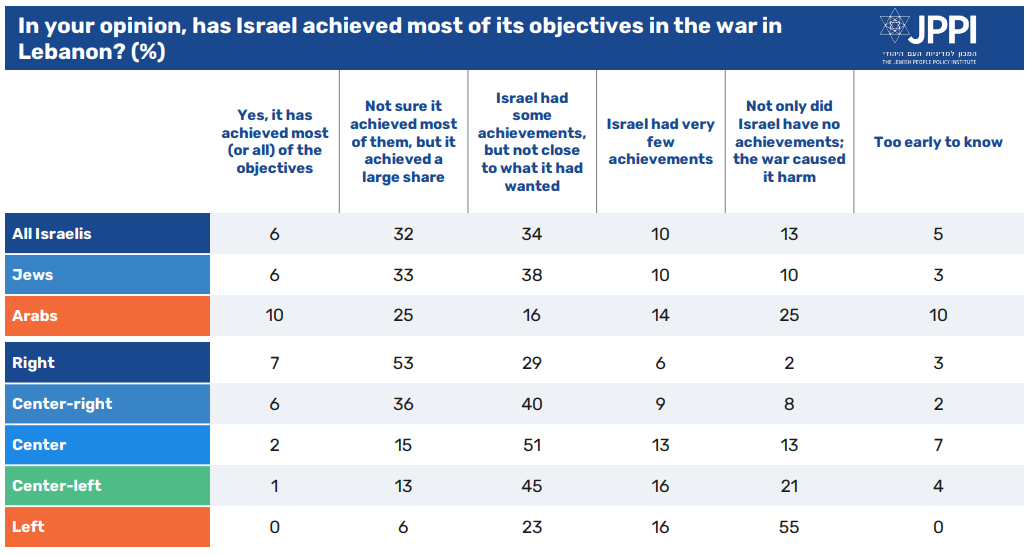
Those who self-identify as right-wing have the highest level of satisfaction with the Lebanon situation: six in ten (60%) believe that most objectives, or many of them, have been achieved. In the center-right cohort, the dominant position tends toward moderate skepticism, with four in ten (40%) identifying some achievements but a result far from the desired one, alongside more than one-third (36%) who believe that many of the objectives were achieved. As one moves leftward along the ideological spectrum, the level of criticism intensifies: in the center and center-left cohorts, a majority of respondents believe that the results are far from what Israel had wanted (51% and 45%, respectively), while the share claiming that the war harmed the country stands at one-eighth in the center cohort and rises to one-fifth in the center-left group. At the left end of the ideological spectrum, a negative consensus prevails: a majority (55%) believes the war has harmed the country.
The War in Gaza
Public sentiment regarding the achievement of the Gaza war objectives is somewhat more positive than on the other fronts. Half of Israelis (50%) see success, three in ten (29%) see some achievements but believe that the outcome is far from what Israel had wanted, and one-fifth (18%) believe that Israel has had very few achievements, or none at all, and that the war caused it harm. Jewish respondents have a higher level of confidence regarding Gaza than their Arab counterparts, with a majority (52%) identifying success, one-third believing that the achievements are far from what Israel had wanted, and 14% saying there were few achievements or that the war caused harm. The Arab public, by contrast, has a wider distribution of views: 40% identify success, 16% identify some achievements, and 34% say there were very few achievements or that the war caused Israel harm.
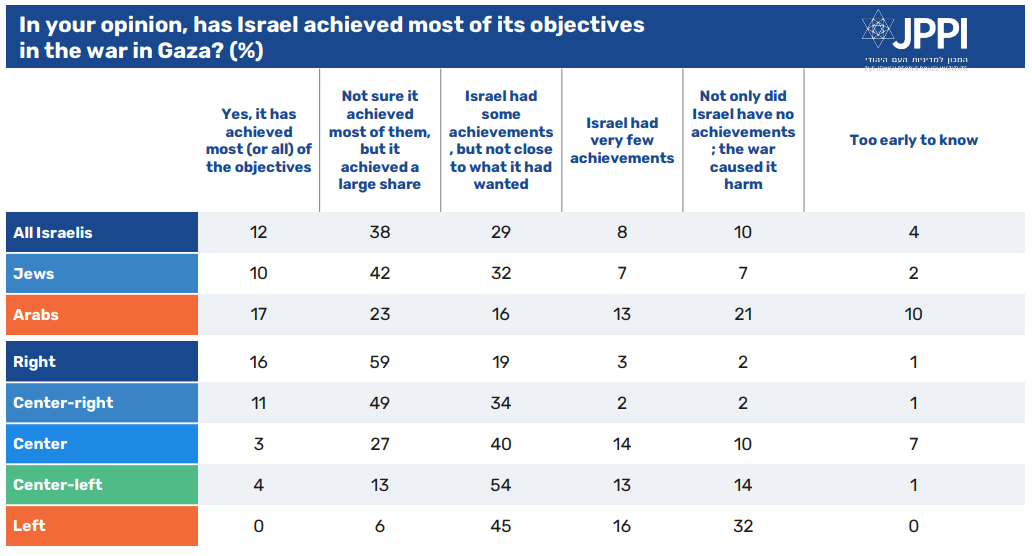
On the ideological right, the sense of achievement is stronger: three-quarters of those who self-identify as right-wing and six in ten of those who self-identify as center-right identify real success in the campaign. Among centrist and center-left respondents, a more skeptical view predominates, with the largest group believing that some achievements were made but that the situation is far from what Israel wanted (40% and 54%, respectively). At the leftmost end of the spectrum, near-total rejection of the achievements of the Gaza war prevails.
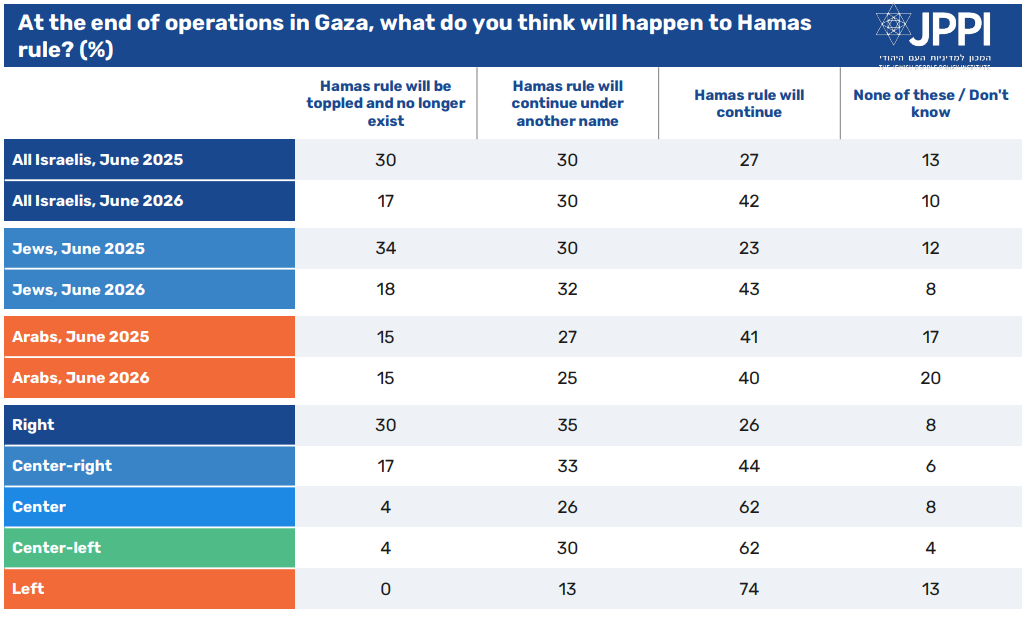
Following the question on achievements in Gaza, we examined what Israelis think will happen to Hamas rule at the end of the Gaza war (which may already have ended). Compared with a year ago, there has been a significant increase in the share who believe that Hamas rule will continue in its current form from 27% in June 2025 to 42% this month. The share who believe that Hamas rule will be toppled was cut by almost half, from 30% to 17% in the same period. As a year ago, one-third (30%) of Israelis continue to think that Hamas rule will continue to exist under another name. Among Jewish respondents in particular, there was a significant increase in the belief that Hamas will maintain its rule (from 23% to 43%), alongside a drop in the belief that it will fall and not re-emerge (from 34% to 18%). Unlike the Jewish public, the Arab public has remained stable over the last year: 40% think that Hamas rule will continue, one-quarter (25%) believe that it will continue under another name, and 15% believe that Hamas will be toppled.
There is a direct correlation between ideological orientation and assessments of the likelihood that Hamas will be ousted, with the perception that it will be completely toppled concentrated almost exclusively on the right. Among the centrist and left-wing cohorts, the assessment is that this Israeli objective will not be achieved. One-third of those self-identifying as right-wing assess that Hamas will be toppled and no longer exist, compared with one-quarter who believe it will continue to exist and one-third who believe it will continue under another name. In the center-right cohort, the level of optimism weakens: only one-fifth believe the Hamas regime will be ousted, one-third expect it to maintain power under another name, and the largest group (44%) believes Hamas will continue to exist in its present form. As one moves further leftward along the ideological spectrum, the expectation that Hamas will be toppled nearly disappears: in the center and center-left cohorts, an identical and negligible 4% believe the Hamas regime will fall, and two-thirds (62%) in both camps are convinced that Hamas will continue to exist. At the leftmost pole, the trend reaches its peak: a negligible share believes that Hamas rule will be toppled, 13% believe it will continue to exist under another name, and three-quarters (74%) believe that Hamas will continue to exist.
Israeli public opinion regarding the establishment of Jewish settlements in the Gaza Strip is largely the same as it was a year ago, and most Israelis continue to view this scenario as unlikely. Two-thirds (65%) of the Israeli public now believes that Israel will not establish Jewish settlements inside the Strip, while one-quarter (25%) foresee the establishment of settlements within two to three years (18% in locations near the border and 7% deep inside the territory). This position is even more predominant among the Jewish public, where a majority (69%) believe that settlements will not be established, 18% foresee settlement near the border, and only 6% believe settlements deep inside the territory will be established. The trend among the Arab public over the last year has also moved toward viewing such a scenario as unlikely: the share assessing that Israel will not establish settlements in the Strip rose from 41% in June 2025 to 48% this month, while the share believing that settlements will be established deep inside the territory fell from 22% to 15%.
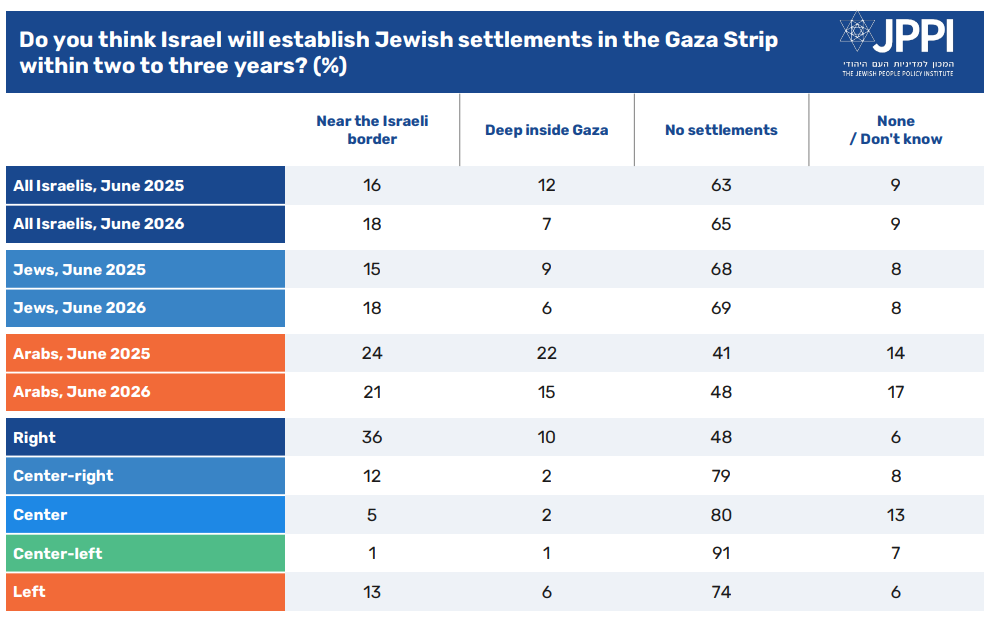
A breakdown by ideological orientation shows a broad consensus in the centrist and left-wing cohorts rejecting the feasibility of such a move, compared with a marked split in the right-wing camp. In the centrist and left-wing cohorts, there are large majorities who believe Israel will not establish settlements in the Strip: 91% in the center-left, 80% in the center, and 74% on the left. There is a similar trend among center-right respondents, with a large majority (79%) believing that Jewish settlements will not be established in Gaza, only 12% expecting settlements near the border, and a negligible share believing that settlements will be established deep inside the territory. By contrast, half of those who self-identify as right-wing share the general belief that Israel will not establish Jewish settlements, but a significant share (46%) believes that the move will indeed occur within two to three years: 36% foresee settlement in locations near the border, and 10% believe that settlements will be established deep inside the territory.
Trust in Leadership and Confidence in Victory
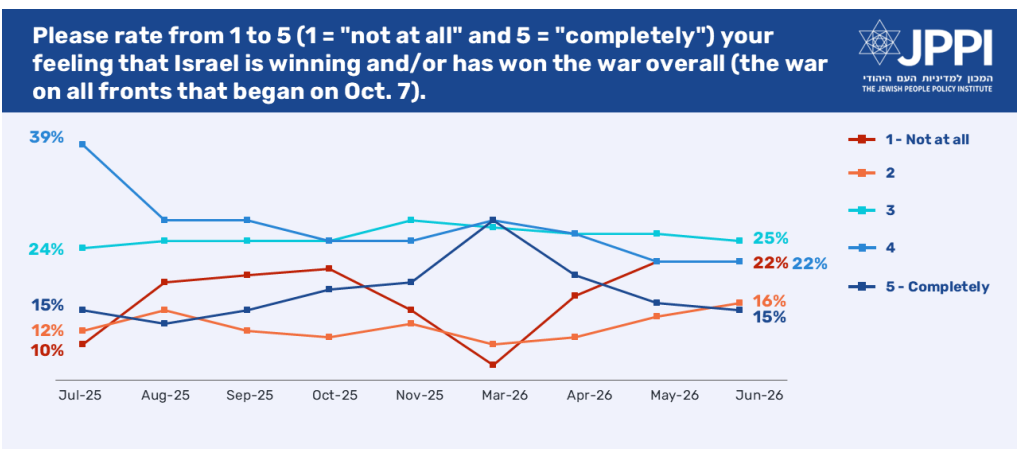
The Israeli public’s sense of victory in the multi-front war indicates that attitudes have stabilized at a relatively low level, continuing the trend found last month (in this context, it should again be noted that the survey was conducted before the final announcement of the U.S.-Iran MOU and the accompanying statements by President Trump). Two-thirds of Israelis do not feel that Israel is winning: more than one-third (38%) express a low sense of victory, while one-quarter holds an intermediate position, and only 37% share a sense of victory – figures almost identical to those in last month’s (May) survey.
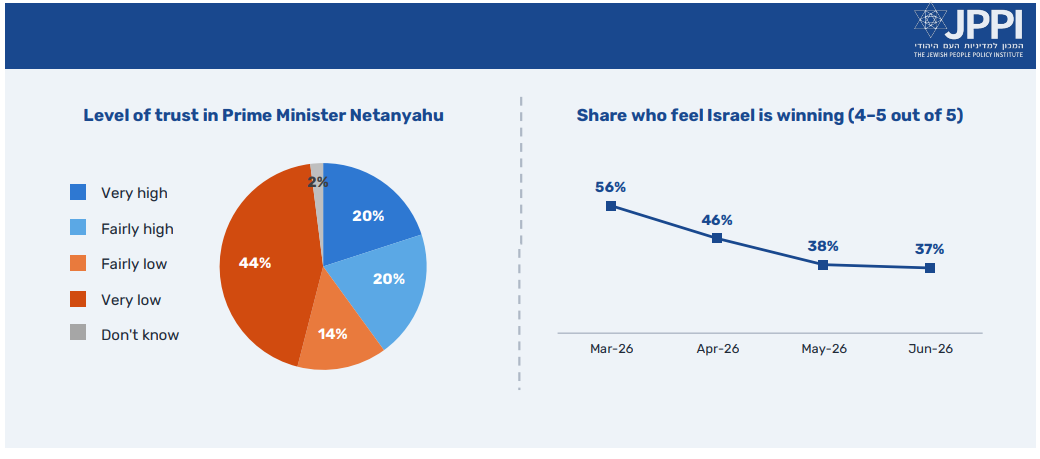
After several months in which Israelis’ trust in Prime Minister Benjamin Netanyahu was not examined, this month’s survey shows stable polarization very much in keeping with the trends documented at the end of 2025. This month, the Israeli public is almost evenly split between those who express trust in the prime minister and those who do not: four in ten Israelis (40%) report a high level of trust, divided evenly between 20% who report very high trust and 20% who report fairly high trust. Conversely, more than half of the public (58%) expresses distrust of Netanyahu, with the overwhelming majority adopting the most critical and emphatic position: 44% report very low trust in the prime minister, while the remaining 14% say their trust is fairly low. A comparison with the data from December 2025 underscores the relative stability of public attitudes, with only minor changes that do not exceed a few percentage points a finding that may indicate that perceptions of Netanyahu’s leadership have become entrenched among the different identity groups in Israel.
U.S.-Israel Relations
An examination of the Israeli public’s level of trust in President Trump reveals a clear decline, characterized by a sharp drop in the maximum score and a rise in negative ratings. This month, just 12% of Israelis report having a great deal of trust in Trump a figure that represents a significant decline compared with the 21% recorded in May and is well below the peak measured last March (34%), a few days after the start of the Iran war. The largest group in the sample continues to be those with some trust, at 45% (a slight increase from 41% in May again, the survey was conducted before the agreement with Iran). Conversely, complete distrust is strengthening: the share of Israelis who state that they have no trust in Trump rose to 37% this month, compared with 32% last month. The data from this month are strikingly similar to the results recorded a year ago (June 2025: 12% great deal of trust, 46% some trust, and 38% no trust), which may indicate cyclical volatility in Israeli public attitudes, which are highly sensitive to political and diplomatic developments.
JPPI’s June Israeli Society Index survey was administered between June 2 and 8, 2026, to 772 respondents. Data was collected by HaMadad.com (547 Jewish-sector respondents, in an online survey) and Afkar Research (225 Arab-sector respondents, approximately half online and half by telephone).
The data was analyzed and weighted by voting pattern and religiosity to represent the views of Israel’s adult population. The Index is compiled by Shmuel Rosner and Noah Slepkov, with research, production, and writing assistance from Yael Levinovsky. Prof. David Steinberg serves as statistical consultant.