


Connected U.S. Jews on Iran Policy, Support for Israel, the Fight against Antisemitism, and Optimism about the Future.
Main Findings:
- Half of the U.S. respondent panel supports using all means, including war, against Iran.
- A majority supports either separation or the establishment of a Palestinian state, a large gap compared to Jewish Israelis.
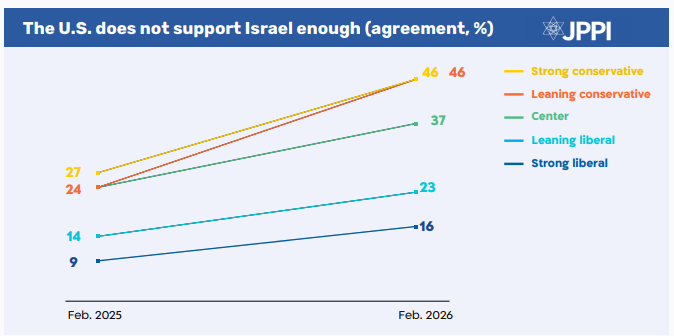
- One-third of respondents think the U.S. does not support Israel enough – an increase compared to a year ago.
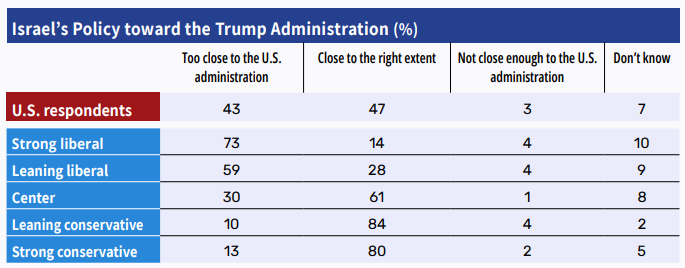
- There is stark ideological polarization regarding the desired level of closeness between the Government of Israel and the U.S. administration.
- There is a broad disagreement with Vice President Vance’s claim that antisemitism is a backlash to U.S. foreign policy.
- Most respondents distrust Vance in combating antisemitism.
- At the same time, most respondents think antisemitism is sometimes used to prevent critical debate about Israel.
- Half of the respondent panel believes that Jews should support Diversity, Equity, and Inclusion (DEI) initiatives in light of Jewish tradition.
- There is growing opposition to Trump’s immigration policy vis-à-vis Jewish tradition.
- Respondents are generally optimistic about Israel’s future, but pessimistic about the U.S. and the Jewish community in the U.S.
To download a PDF version, click here.
Iran Policy
Several developments shaped this month’s survey questions and responses. The centerpiece was the “Board of Peace” summit in Washington, where the United States presented a plan to rehabilitate Gaza, including a multinational force and an American base, alongside major multi-national investment. Meanwhile, tensions with Iran continued to rise amid extensive U.S. military deployment in the region. Diplomatic friction also grew after Trump publicly criticized Israel’s President Isaac Herzog and called for a pardon for Prime Minister Netanyahu.
Methodological note: In recent months, JPPI has begun surveying the views of Jews in Canada and the United Kingdom. In both countries, respondent panels are coalescing. In February, about 50 respondents in the UK and about 100 in Canada were surveyed. Accordingly, data on the views of Jews in these countries should be treated with caution. Where the report shows data by ideology, denominational affiliation, and voting pattern, it refers only to the U.S. Jews surveyed.
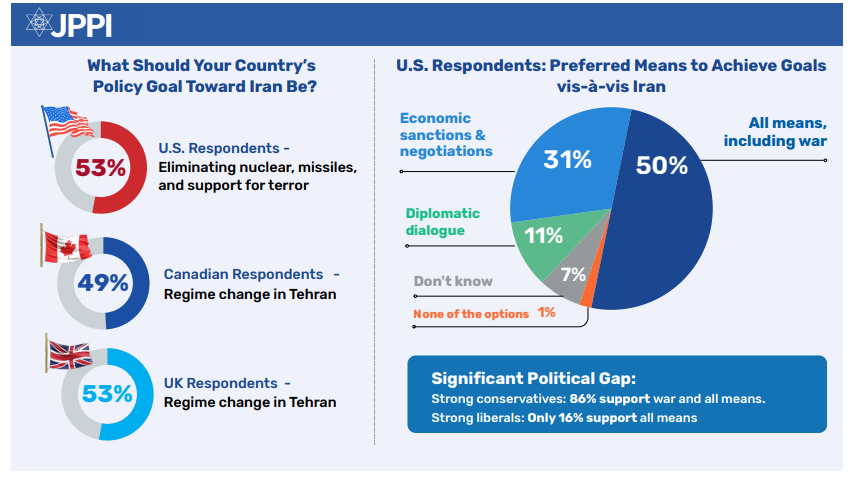
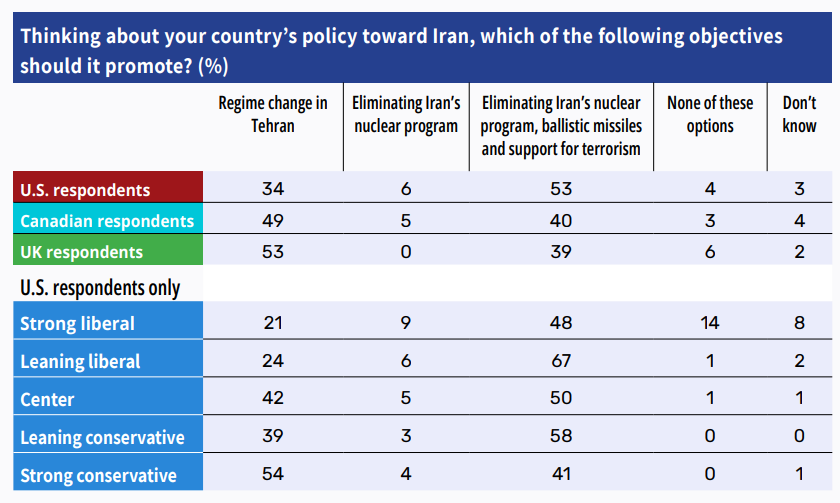
There are differences in how the central objective of policy toward Iran is perceived in the Jewish communities of the United States, Canada, and the United Kingdom. While respondents in the U.S. tend to prefer eliminating Iran’s nuclear program, ballistic missiles, and support for terrorism (53%), Canadian and British respondents chose regime change in Tehran as the preferred objective (49% and 53%, respectively). In other words, Canadian and British respondents preferred a root-cause approach of regime change, while U.S. respondents tend to favor a comprehensive strategic-security solution.
Among U.S. respondents, one can identify a direct link between ideological conservatism and support for regime change. In the strong conservative cohort, regime change is the preferred goal (54%), while only one-fifth (21%) of the strong liberal cohort supports it. Strong liberal respondents mainly support the combined goal of eliminating Iran’s nuclear program, ballistic missiles, and support for terrorism; support for this option among leaning liberal respondents peaks at 67%. The strong liberal cohort is the only one showing significant skepticism toward all the options offered, with 14% choosing “none of the options,” compared to negligible shares in the conservative and centrist groups.
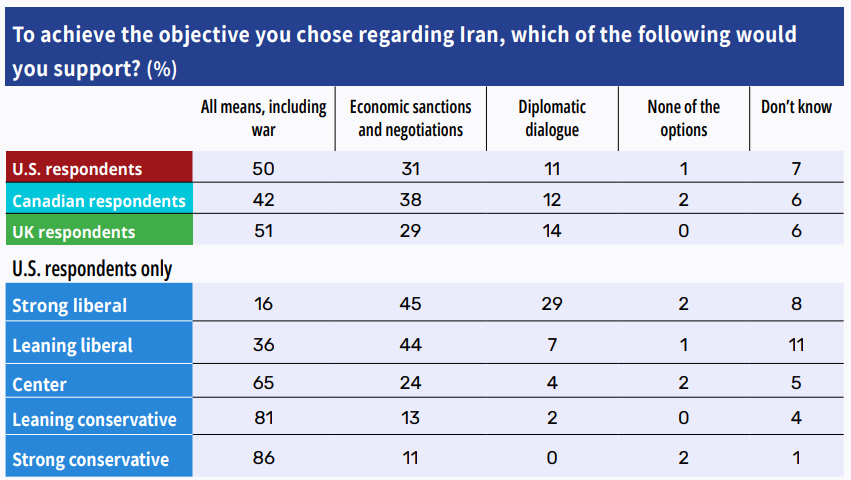
When examining the preferred means of achieving the objectives vis-à-vis Iran, U.S. and UK respondents answered similarly: in both communities, half (51%) support using all available means, including war. Canadian respondents, by contrast, take a more reserved position toward direct military confrontation (42%) and show higher support for economic sanctions and negotiations (38%) than the other groups. Across all ideological groups in the U.S., a similar share – between about one-tenth and one-sixth – support diplomatic talks and dialogue as a means to achieve objectives vis-à-vis Iran.
There is a significant gap between the different ideological cohorts among U.S. respondents regarding the use of military force as a policy tool. There is overwhelming support in the strong conservative cohort (86%) for utilizing all means, including war, while the share supporting this option drops to only 16% in the strong liberal group. Both liberal cohorts (strong liberal + leaning liberal) clearly tend to prefer softer tools: 29% of strong liberal respondents favor diplomatic dialogue (a rate substantially higher than in any other ideological cohort), and 45% support economic sanctions. As ideological orientation becomes more conservative, support for dialogue and diplomacy declines and sometimes disappears altogether, and the focus shifts almost exclusively to force.
Israel and the Palestinians
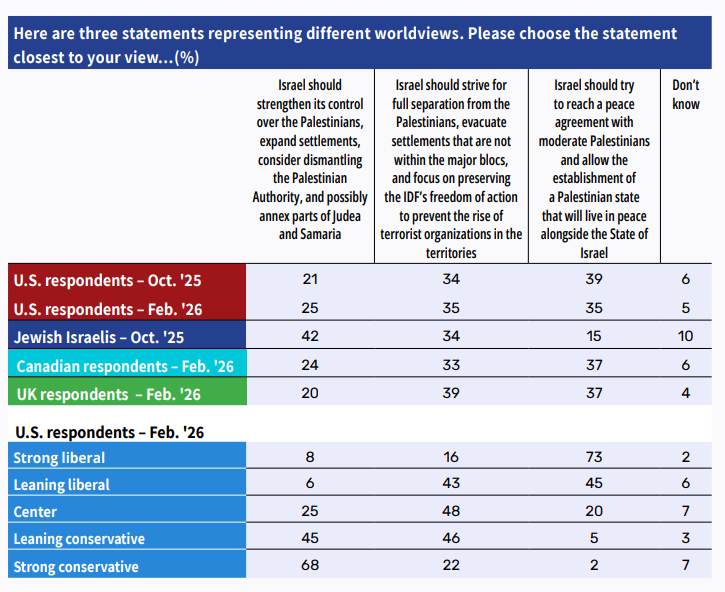
Among U.S., Canadian, and UK respondents, there is a relatively balanced division between support for separation between Israel and the Palestinians and support for a peace agreement and the establishment of a Palestinian state. However, among U.S. respondents, a certain strengthening of the hawkish approach is evident: between October 2025 and February 2026, the share supporting stepping up control and expanding settlements rose slightly, alongside a decline of support for the peace agreement option. Compared to the positions of Jewish Israelis on the same question, as measured in JPPI’s October 2025 Israeli Society Index, it is evident that the share of Jewish Israelis supporting stepped-up control over the Palestinians and settlement expansion is much higher (42%) than that recorded in this month’s Voice of the Jewish People Index. In other words, Jews in Israel have a greater tendency to support expanding control and settlements, while U.S. Jews tend to favor a peace agreement and the possibility of a Palestinian state.
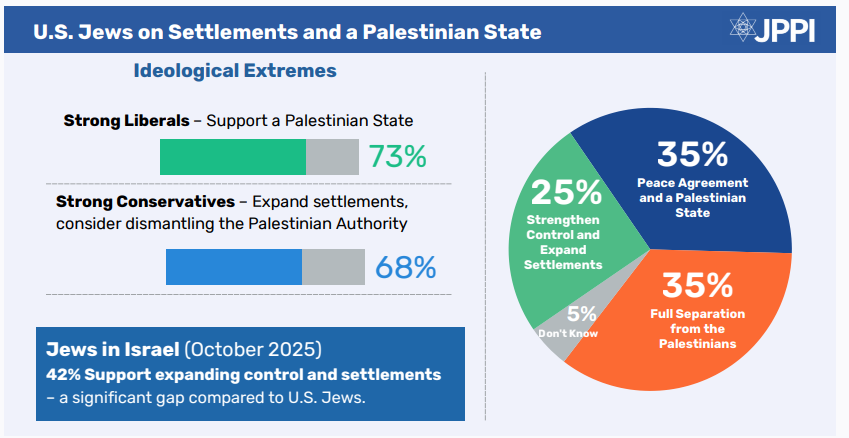
At the ideological extremes, there is broad agreement around opposing narratives: 73% of the strong liberal cohort supports striving to establish a Palestinian state, compared to 68% of the strong conservative cohort who favor strengthening control and expanding settlements. In the centrist and the moderate groups (leaning liberal and leaning conservative), the option of full separation while maintaining IDF freedom of action has the greatest support (43%–48%).
Israel for Support
Nearly half of the respondent panel (48%) thinks the U.S. supports Israel to the right extent; 31% of respondents say it supports Israel too little; and 14% think the U.S. supports Israel too much. This represents a change compared to last year, when most panel members (57%) thought the U.S. supported Israel to the right extent. At the same time, the share who think the U.S. does not support Israel enough rose from one-fifth (18%) to one-third, and the share who think the U.S. supports Israel too much declined slightly.
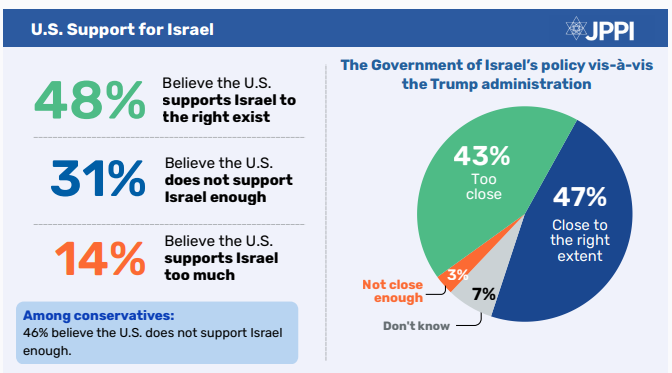
Whereas four in ten respondents in the strong liberal cohort think the U.S. supports Israel too much, as one moves rightward along the ideological spectrum, agreement with this claim almost disappears. At the same time, centrists and conservatives agree with the claim that support is either at the right level or insufficient, with nearly half of conservatives (46%) believing that American support for Israel is insufficient.
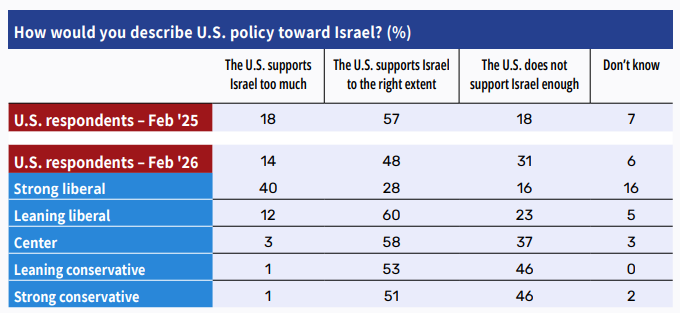
A breakdown examining trends according to ideological orientation shows that among liberals, there was a relatively moderate increase of 7–9 percentage points in support of the claim that the U.S. does not support Israel enough. Among centrists the figure jumped from 24% to 37%, and among conservative cohorts, there was a jump of about 20 percentage points, bringing them to 46% agreement. However, it should be noted that the current level of dissatisfaction is still significantly lower than the peaks of 90% and above recorded throughout 2024, at the height of the Swords of Iron war and during President Joe Biden’s administration.
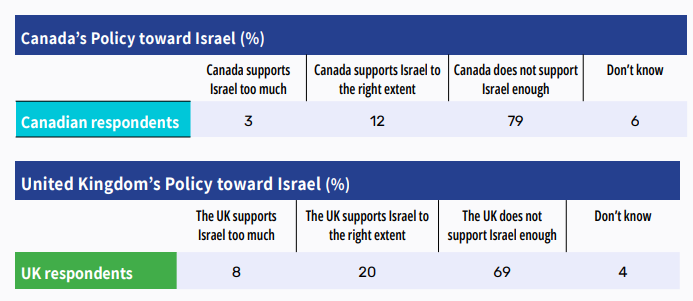
A large majority of Canadian and UK respondents (79% and 69%, respectively) think their countries do not support Israel enough. An eighth (12%) of Canadian respondents think their country supports Israel to the right extent, and a negligible share think it supports Israel too much. Among UK respondents, a fifth (20%) think their country supports Israel to the right extent, and 8% think it supports Israel too much.
U.S. respondents are split between those who think the Government of Israel is too close to the U.S. administration (43%) and those who believe the closeness is to the right extent (47%). A breakdown by ideological orientation reveals significant gaps between groups: most liberals – especially those who self-identify as strong liberals (73%) – think the Government of Israel’s closeness to the Trump administration is undesirable, while conservatives think the level of closeness is correct, by a majority of more than 80%. Across ideological cohorts, only a few percent think the Government of Israel is not close enough to the U.S. administration.
Expressions of Antisemitism
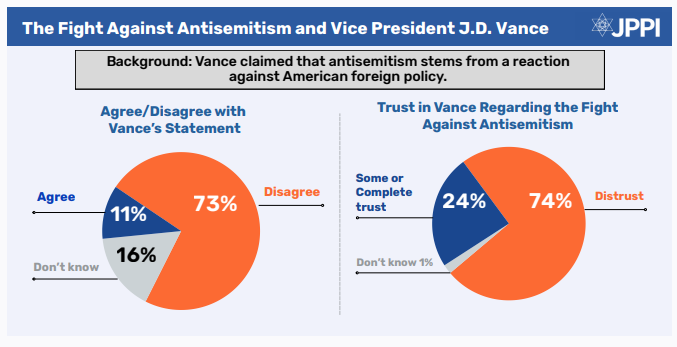
Last month, U.S. Vice President J.D. Vance asserted that certain statements by supporters of the Republican Party – statements some Jews regard as antisemitic – represent a backlash to U.S. foreign policy (which supports Israel), rather than inherent hatred of Jews or Israel. The data shows a sweeping rejection (73%) of this interpretation among U.S. respondents, while 11% agree with it, and 16% did not know. Opposition is not limited to one political camp. Rejection of Vance’s remarks is the Jewish consensus position and, as noted, it cuts across political camps. An ideological breakdown shows that the centrist cohort reports the highest rate of opposition (82%); for the leaning liberal cohort, it is slightly less (79%). Among Trump voters (67%) and those who self-identify as strong conservatives (61%), a significant majority rejects his assertion.
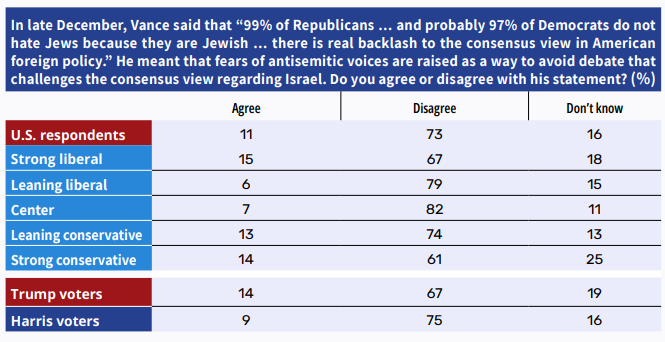
Additional differences are evident in the level of certainty between groups: among strong conservative respondents, the share choosing “don’t know” is the highest, at a quarter (25%), compared to one-tenth (11%) for centrist respondents. This may indicate that conservative respondents feel a tension between political loyalty and perceptions of reality regarding antisemitism.
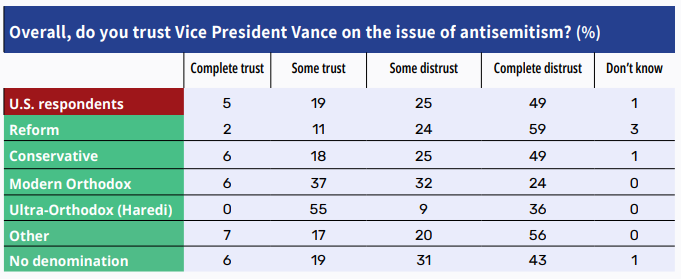
Most U.S. respondents (74%) distrust Vance with respect to antisemitism, with close to half (49%) reporting “complete distrust.” Only a quarter report trusting (some + complete) Vice President Vance in the context of antisemitism. In other words, Vance’s rhetoric – condemning ethnic hatred and antisemitism as “disgusting” and saying it has no place in the conservative movement – does not persuade most of the Jews surveyed. A denominational breakdown shows that distrust is especially acute among Reform and Conservative Jews (83% and 74%, respectively). Among Orthodox respondents (many of whom vote Republican), trust in Vance is higher, though still not a majority position. Among ultra-Orthodox (Haredi) respondents, more than half (55%) report “some trust” in Vance.
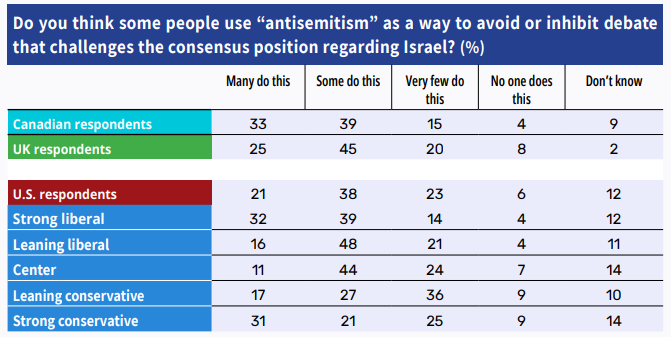
Despite rejecting Vance’s claim, most respondents in the U.S., Canada, and the UK agree that some people use “antisemitism” to avoid debate that challenges the consensus position regarding Israel. Among respondents in Canada and the UK, 72% and 70% (respectively) think that “many” or “some” people do this; the same is true of 59% of U.S. Jewish respondents. Overall, only a small minority in all groups think “no one does this,” indicating broad recognition that such a phenomenon exists.
A political breakdown shows a close link between ideological perceptions and responses, with some similarity between the political extremes. In the strong liberal and strong conservative cohorts, the share believing that “many” people use “antisemitism” to prevent debate about Israel is highest (32% and 31%, respectively). In the other cohorts, there is a tendency to choose “some” or “very few” in response to this question.
Support for Diversity, Equity, and Inclusion (DEI) Initiatives
In recent years, many U.S. legislative and regulatory initiatives have emerged under the rubric of Diversity, Equity, and Inclusion (DEI). In the U.S. conservative camp, there has been sharp criticism of this trend, and the Trump administration has been working vigorously to repeal such initiatives, arguing that they lead to “reverse discrimination,” prioritize one demographic group over another, and reinforce radical progressive positions. Among Jews, criticism has also been voiced regarding these initiatives’ neglect of antisemitism and the exclusion of Jewish populations, particularly since the outbreak of the Israel-Hamas war. This month we examined how the respondent panel regards DEI initiatives and their connection to Jewish tradition.
The most common view among U.S. respondents (44%) is that Jewish tradition obligates Jews to support DEI initiatives. A quarter (25%) think tradition has no relevance to this topic, and a fifth (21%) interpret tradition as a basis for opposing these initiatives. Compared to a year ago, there has been a modest increase in the share supporting a link between Jewish tradition and DEI initiatives (from 41% to 44%), while the share rejecting the claim has remained stable. There has also been a decline in the share who do not know (from 14% to 10%), which may indicate that public debate around DEI has crystallized for much of the U.S. Jewish community. Canadian respondents express similar positions, but for UK respondents, the picture is more diffuse, with one-third (31%) viewing Jewish tradition as a basis for supporting such progressive initiatives, and an equal share contending that Jewish tradition bears no connection to them (the highest among the communities surveyed).
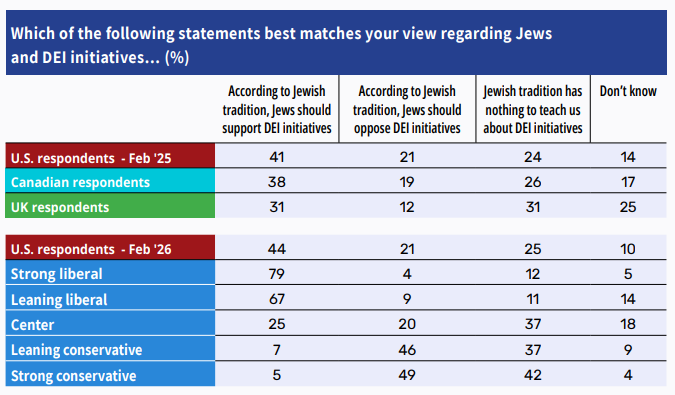
Among strong liberal U.S. respondents, a broad majority (79%) interpret Jewish tradition as a call to support DEI initiatives. By contrast, at the conservative end of the ideological spectrum, nearly half (49%) think tradition requires opposing DEI initiatives. Among centrists, the largest group (37%) thinks Jewish tradition has nothing to teach on the issue.
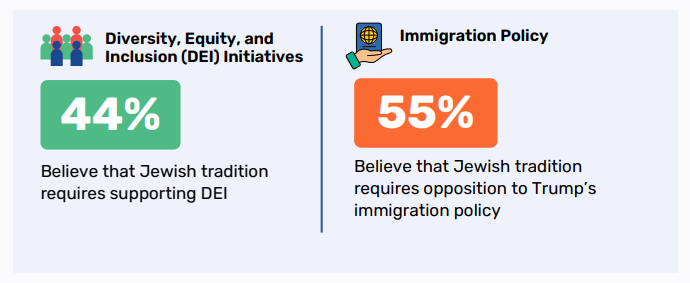
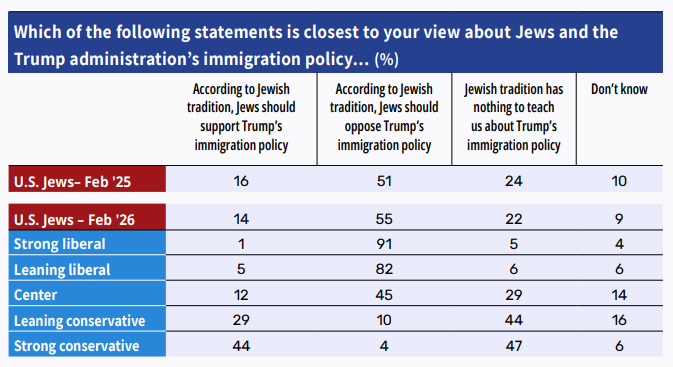
The February survey also included a question about the relationship between Jewish tradition and the Trump administration’s immigration policy. Most of the respondent panel (55%) thinks Jews should oppose the Trump administration’s immigration policy on the basis of Jewish tradition. A fifth (22%) think Jewish tradition has nothing to teach about this policy, and an additional 14% think that based on Jewish tradition, Jews should support the Trump administration’s immigration policy. Over the past year there was a slight increase in those who think tradition implies opposition to the President’s policy (from 51% to 55%). While among the strong liberal there is near-complete unanimity (91%) that tradition requires opposing Trump’s immigration policy, among the “strong conservative” the picture is completely reversed: only 4% see tradition as a reason to oppose it, 44% see it as a reason to support it, and a similar share (47%) think Jewish tradition is irrelevant to the issue.
Most of the respondent panel (57%) thinks Jewish tradition has nothing to teach about the Trump administration’s tariff policy, which the U.S. Supreme Court struck down just after the survey data was collected. A quarter (24%) think that in light of Jewish tradition’s lessons, Jews should oppose this policy, and 6% believe Jews should support Trump’s tariff policy. Responses to this question were consistent with those of a year ago.
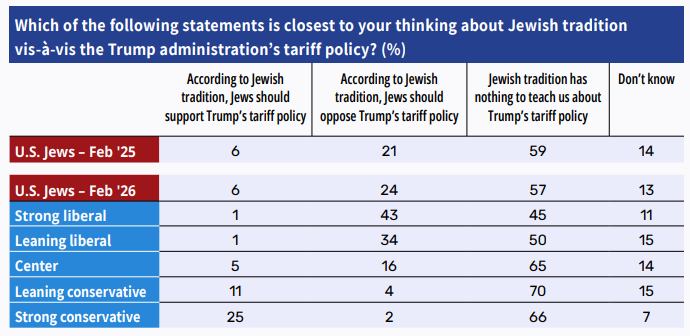
A breakdown by ideological orientation shows that 43% of strong liberal respondents think tradition implies opposition to tariffs, while 25% of strong conservative respondents see it as a basis for support. Notably, among conservatives and centrists alike, the share saying tradition “has nothing to teach us” vis-à-vis tariffs is highest (between 65% and 70%). This suggests that in this context, liberals tend to mobilize Jewish values as a tool for political struggle, while conservatives and centrists prefer to separate the religious sphere from government decisions.
Optimism about the Future
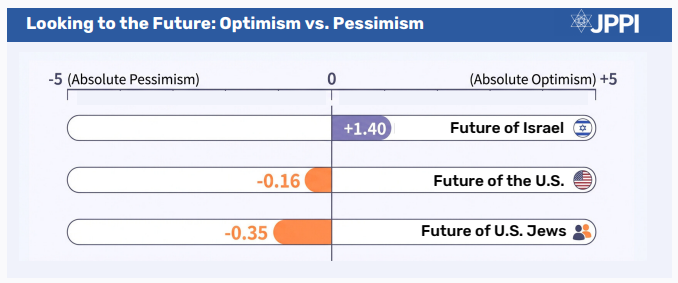
As we do from time to time, this month we examined the respondent panel’s level of optimism about the future of Israel, the future of the U.S. and its Jewish community, the future of Canada and its Jewish community, and the future of the UK and its Jewish community. In general, Diaspora Jews share a positive view regarding the future of the State of Israel. Among the groups we surveyed, Canadian respondents have the highest level of optimism, with an average of 1.68, followed by U.S. respondents (1.40) and UK respondents (1.37).
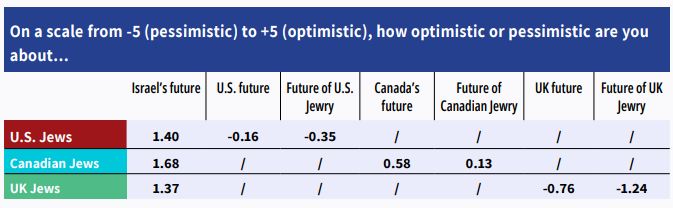
The picture is more complex and pessimistic when respondents consider their countries of residence and the future of their local Jewish communities. While respondents in Canada maintain cautious optimism (0.58 for the country’s future and 0.13 for the community’s future), pessimism prevails in the other communities. U.S. respondents express moderate concern about the country’s future (-0.16) and their community’s future (-0.35). The most pessimistic ratings are those of the (relatively few) UK respondents, who indicate deep pessimism, especially regarding the future of British Jewry (-1.24).
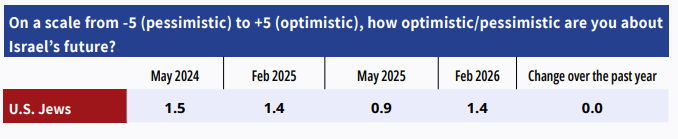
A longitudinal examination shows cautious and relatively stable optimism among U.S. Jewish respondents regarding the future of the State of Israel. Despite fluctuations over the past two years, the mood remains positive, with a relatively small ratings range (between 0.9 and 1.5). This month, the index returned to the same level as last year (1.4), indicating a year-over-year change of 0.0.
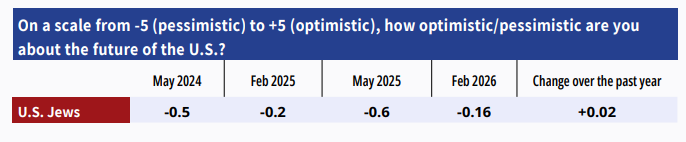
While U.S. respondents remain optimistic about Israel, they show consistent pessimism regarding the future of their own country. Across the entire time series, the index remains in negative territory. Looking at the annual change, it is a tiny 0.02. At bottom, the U.S. Jews surveyed consistently view Israel’s future more positively than the future of the United States.
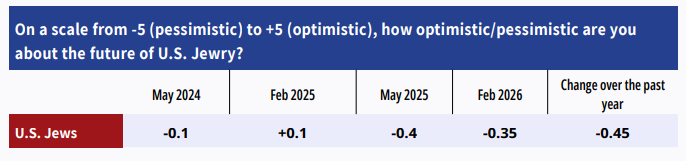
While U.S. respondents have maintained stable optimism levels toward Israel and the U.S., they have become increasingly pessimistic about their own future as a community within the United States. This month, the index stands at -0.35, indicating pessimism. This is a slight improvement compared to May 2025, but year over year, it reflects a significant decline in optimism regarding the future of U.S. Jewry.
Survey Data and its Implications
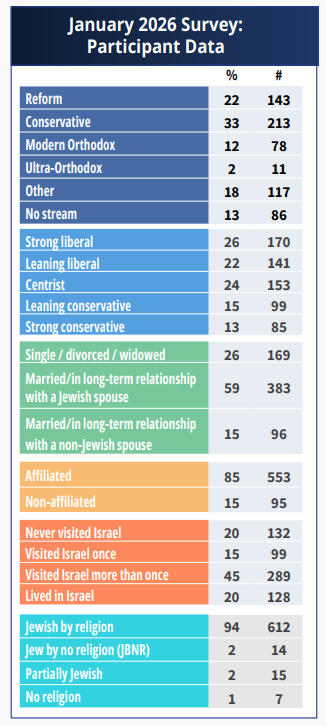
This report is an analysis of a survey administered to 807 Jews registered in JPPI’s Voice of the Jewish People respondent panel. In general, the survey tends to reflect the positions of “connected” American Jews – those with a relatively strong connection to the Jewish community and/or to Israel and/or to Jewish identity. The survey also included 50 respondents in the UK and 100 in Canada. Unless otherwise noted, the findings reflect the positions of U.S. respondents only. JPPI’s Voice of the Jewish People Index survey was conducted by JPPI fellows Shmuel Rosner and Noah Slepkov, with assistance from Yael Levinovsky. Prof. David Steinberg served as statistical consultant.
This table includes data on the February 2026 American survey participants.