
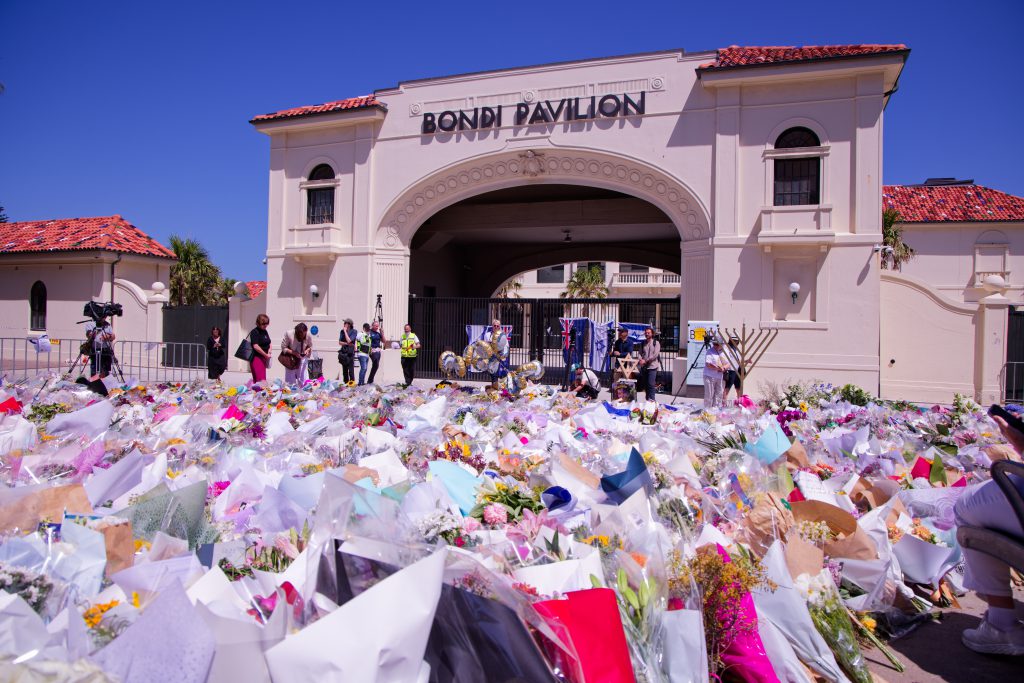


Condolences after terror attacks are not enough; the government should remove the obstacles that prevent Jews in the West from making aliyah
Antisemitic attacks from Boulder to Manchester to Sydney are no longer isolated incidents but part of a global pattern. While investigating terror networks and possible Iranian involvement is essential, the deeper Jewish response must be strategic and historic: Israel must actively promote aliyah from the West.
The massacre at Sydney’s Bondi Beach, which left 15 people dead and dozens injured, did not happen in a vacuum. Nor was it an isolated tragedy. It joins a growing chain of antisemitic and anti-Jewish attacks that now spans continents and Jewish holidays alike: Boulder, Colorado; Washington; Manchester on Yom Kippur; and now Sydney on Hanukkah. The pattern has become impossible to ignore.
Behind the slogan “globalize the intifada” lies a deadly ideological equation that is steadily gaining legitimacy in parts of the West. Jews are reduced to Zionists, Zionists are labeled genociders, genociders are framed as enemies of humanity, and enemies of humanity become legitimate targets. What once belonged to the extremist margins now circulates freely in universities, demonstrations, media discourse, and social networks. Violence is no longer perceived as a deviation, but as a logical conclusion.
Most Diaspora Jews already sense this shift. Those who still doubt it will likely come to the same realization in the months ahead. Antisemitic violence today is not sporadic; it is structural. It is embedded in a global ecosystem that fuses radical Islamist narratives with progressive anti-Zionism and amplified online at a speed no police force or intelligence agency can realistically contain.
Western governments are not blind to this reality, but they are constrained by it. In many countries, Jewish communities are outnumbered tenfold or twentyfold by Muslim populations that are larger, younger, and more politically mobilized. Leaders hesitate to inflame the street. Law enforcement reacts after the fact. Political language becomes evasive. Jews are reassured symbolically, while being advised practically to lower their profile, remove visible signs of identity, avoid gatherings, and accept permanent protection as a way of life. This is not safety. It is organized vulnerability.
Investigating possible Iranian or proxy involvement in such attacks is necessary and legitimate. Iran has a long record of exporting terror and encouraging violence against Jewish targets worldwide, directly or through ideological and operational networks. Pursuing accountability on that front matters. But it cannot be the core Jewish response.
Israel was founded as the sovereign answer to the structural insecurity of Jewish existence in exile. If the Jewish state responds to Bondi only with condolences, statements, and reinforced embassy security, it will miss the deeper meaning of the moment. The ultimate Jewish response to Bondi is not another psychic bunker abroad, but a strategic decision to come home: aliyah.
Not aliyah by panic or despair, but aliyah by design.
Israel must move from rhetoric to policy and establish a dedicated national authority whose sole mission is to promote and enable aliyah from developed Western countries. The current absorption system was built for waves of distress aliyah. It is bureaucratic, slow, and poorly adapted to professionals, entrepreneurs, academics, and families who are not fleeing poverty, but who are losing their future.
Such an authority must be executive, focused, and empowered, operating across ministries rather than alongside them. Its role would be to remove the concrete obstacles that prevent Western Jews from translating moral clarity into physical return: accelerated recognition of academic degrees and professional licenses, temporary work permits allowing skilled immigrants gainful employment immediately while completing local requirements, and intensive Hebrew and professional retraining programs designed for adults with families.
Aliyah must also become employment-driven rather than assistance-driven, with job placement prepared before arrival rather than improvised months later. Housing and community frameworks must ensure that families arrive into functioning social ecosystems rather than isolation. Education for children must be treated as a strategic priority, with reinforced Hebrew acquisition and academic continuity that reassures parents that their sacrifice will not come at the expense of their children’s future.
This is not an act of charity; it is one of national investment.
Western Jews bring with them human capital, civic culture, economic capacity, and a deep attachment to Jewish continuity. Their aliyah can strengthen Israel economically, socially, and morally, just as previous waves once did. The tragedy of Bondi should not be remembered only as another name added to a growing list of Jewish bloodshed abroad. It should be remembered as the moment Israel chose to respond not only with empathy, but with vision.
History rarely announces itself politely. Sometimes it knocks violently. The question is whether we are prepared to answer.