
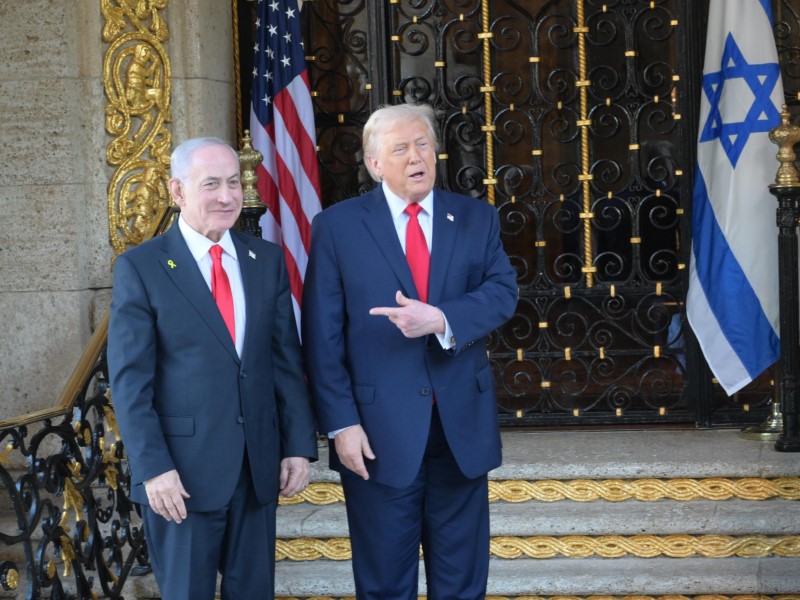


The Jewish People Policy Institute (JPPI) Israeli Society Index for February examined how the Trump presidency is evaluated from an Israeli perspective.
The findings indicate an exceptionally high level of public approval of Trump’s performance in relation to Israel.
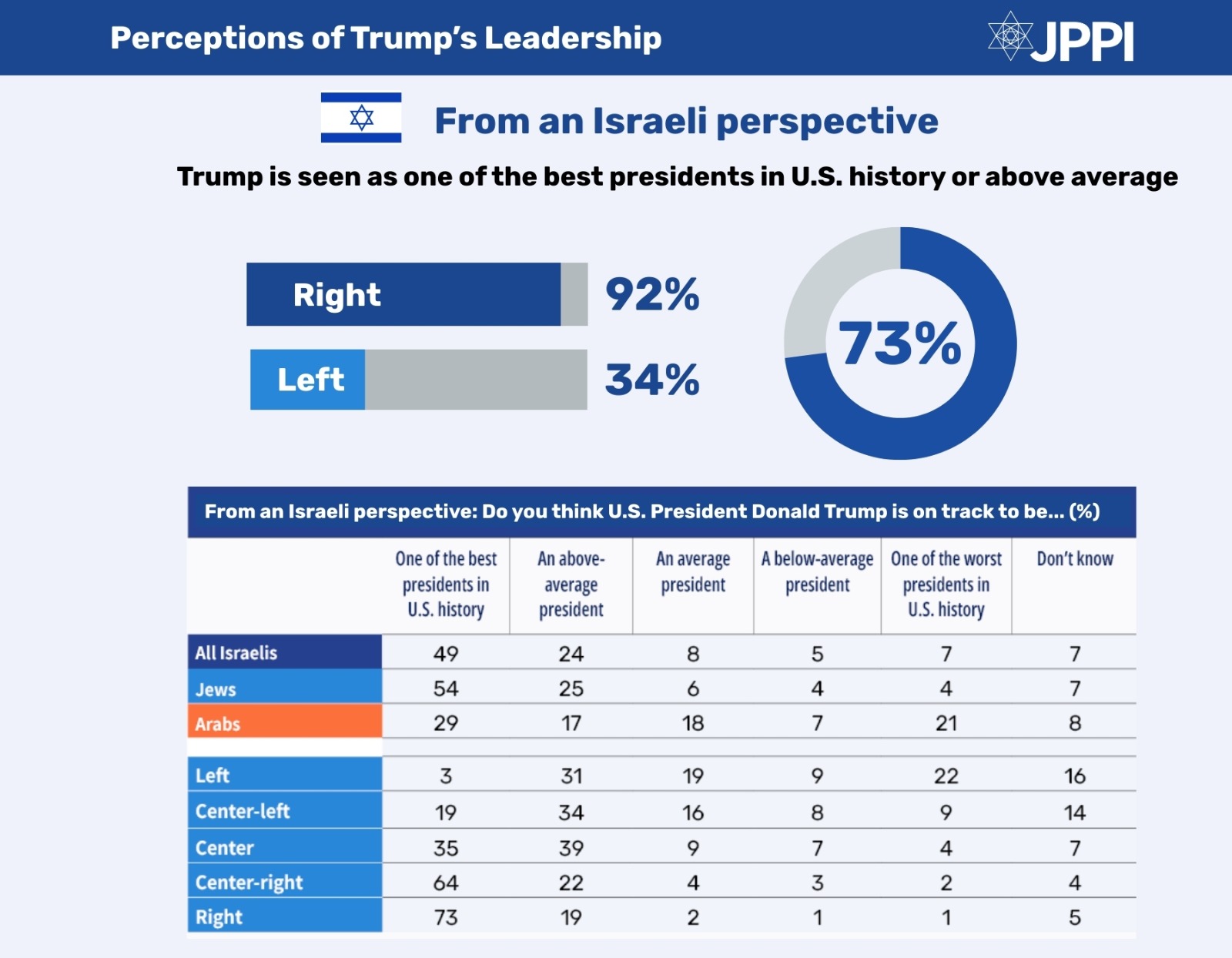
The findings show that 73 percent of Israelis rate Trump as a better-than-average U.S. president for Israel’s interests. Of these, 49 percent say that from Israel’s point of view Trump is one of the best presidents in U.S. history, while another 24 percent describe him as above average.
To read the full index, click here.
Among Jewish Israelis, 54 percent say Trump is one of the best presidents in U.S. history in the Israeli context, with an additional 25 percent describing him as above average, for a total of 79 percent.
Support for Trump on the Israeli right is almost unanimous. Seventy-three percent view him as one of the best presidents, and another 19 percent see him as above average from an Israeli perspective, totaling 92 percent. On the Israeli left, by contrast, only 34 percent hold a positive view of Trump.
The survey also asked of Israelis to perceive Trump’s performance from an American perspective (insofar as Israelis can assess it). The responses pertaining to the American perspective are compared with an identical question from a Siena College/New York Times poll published last month.
From an American perspective, as assessed by Israelis, 28 percent believe Trump will be remembered as one of the best presidents in U.S. history, while an additional 20 percent describe him as an above-average president. In total, nearly half of Israelis believe that even from the viewpoint of American voters, Trump’s presidency will ultimately be regarded as positive. At the same time, Israeli opinion is divided. One-fifth of respondents, 20 percent, believe Trump will be remembered as one of the worst presidents in U.S. history, while another 20 percent think he will be judged as average or below average. Twelve percent said they did not know or did not respond.
Clear differences emerge between population groups. Among Jewish Israelis, assessments are more favorable, with 31 percent viewing Trump as one of the best presidents in U.S. history. Among Arab Israelis, attitudes are more negative, with 38 percent describing him as one of the worst presidents in U.S. history.
A comparison with American public opinion highlights a notable gap. A Siena College and New York Times poll of American voters conducted last month found that only 19 percent of Americans believe Trump will be remembered as one of the best presidents in U.S. history, compared to 28 percent of Israelis who hold that view. Conversely, 42 percent of Americans believe Trump will be remembered as one of the worst presidents, more than double the share of Israelis who think so.
Ideological divisions within Israel further shape these assessments. On the right, belief in Trump’s positive historical legacy is especially strong, with more than half of respondents viewing him as one of the best presidents in U.S. history. Among center-right Israelis, a majority rate Trump as an above-average president. In contrast, most center-left and left-wing Israelis view Trump negatively, describing him as a below-average president or one of the worst presidents in U.S. history.
Perceptions of the War: Victory, with Reservations
Against the backdrop of relative calm on the ground and uncertainty surrounding the implementation of the second phase of the agreement, which includes Hamas’s disarmament and the reconstruction of the Gaza Strip, 54 percent of Israelis believe that Israel won the war. Among them, 36 percent say the victory was insufficient, while 18 percent believe it was a full victory.
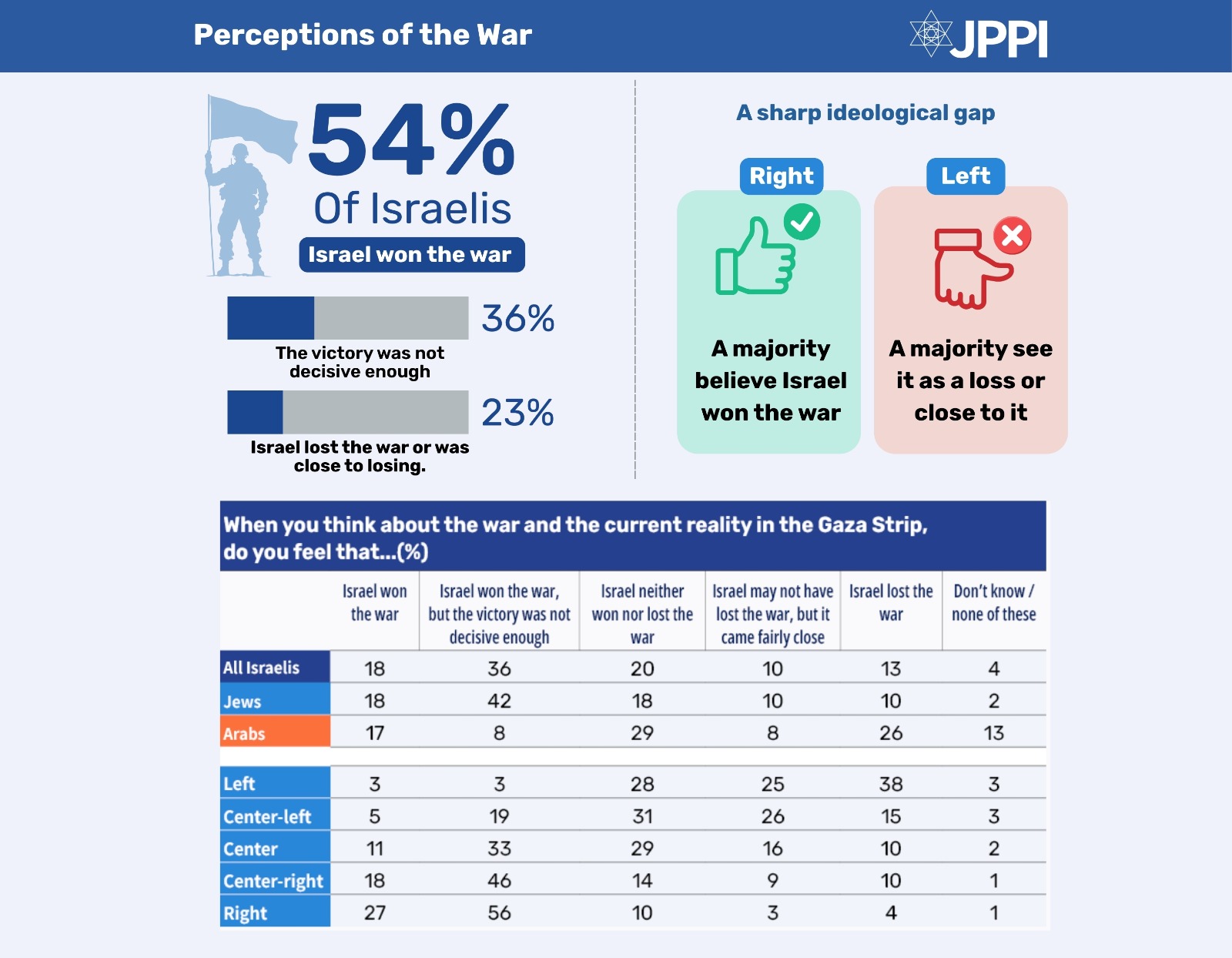
By contrast, 20 percent of the public believe that Israel neither won nor lost the war, while 23 percent assess that Israel lost the war or came close to losing it. Among Jewish respondents, 60 percent believe Israel won the war. Among Arab respondents, only 25 percent share that view.
The ideological divide sharpens the picture. The further right respondents place themselves politically, the stronger the perception that Israel defeated Hamas, with 83 percent on the right expressing this view. On the left and center-left, there is a clear tendency to see the outcome of the war as a failure or, at best, an incomplete achievement, a view held by 63 percent of those on the left.
A particularly notable finding emerges among coalition voters. Even there, a sense of unfinished business prevails. A majority of Likud voters, 51 percent, and an even larger majority of Religious Zionism voters, 69 percent, believe that although a victory was achieved, it was not sufficient. The only party whose voters mostly believe that Israel lost the war or came close to losing it is the Democrats Party, where 52 percent hold that view.
Survey Data and Methodology
Data for JPPI’s February 2026 Israeli Society Index was collected February 1–4, 2026. Data collection was conducted via the “the Madad” website panel (588 Jewish respondents in an online survey) and Afkar Research (207 Arab respondents, roughly half online and half by telephone). The data was analyzed and weighted by voting pattern and religiosity to represent the views of the adult population in Israel. The JPPI Israeli Society Index is compiled by Shmuel Rosner and Noah Slepkov with research, production, and writing assistance by Yael Levinovsky. Prof. David Steinberg serves as statistical consultant.