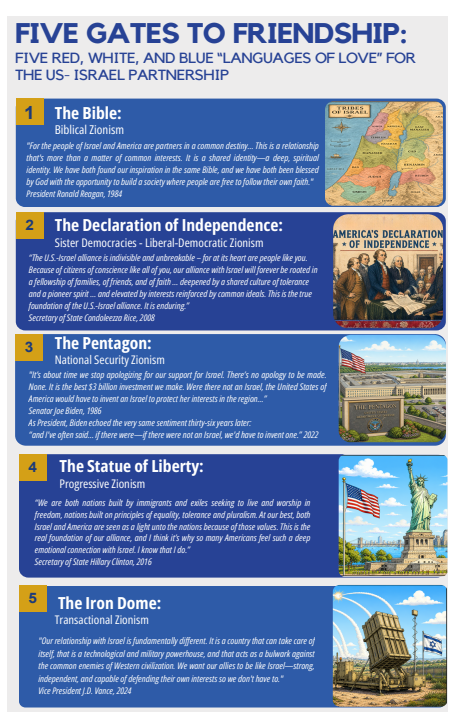
The 250th Anniversary Edition
By: Prof. Gil Troy
To download the full guide, click here.

ASSESSING THE U.S.-ISRAEL SPECIAL RELATIONSHIP – WHAT BINDS THE TWO COUNTRIES TOGETHER?
On June 22, 2025, America’s Secretary of Defense Pete Hegseth described America’s “precision strike in the middle of the night against three nuclear facilities in Iran.” Hegseth praised “the level of joint and allied integration that speak to the strength of our alliance and our joint forces.”
It was a fraught moment. Israel had long avoided joint military operations, not wanting one American life to be risked in defending the Jewish state. Donald Trump ran for president vowing “NO MORE FOREIGN WARS.” Some MAGA supporters opposed American intervention in “Israel’s war.” The headlines predicted MAGA’s fragmentation, as the “horseshoe alliance” united Tucker Carlson, Marjorie Taylor Greene, and other right-wingers with left-wing anti-Zionists, including Bernie Sanders and Ilhan Omar. As the conflict dragged on to Spring 2026, American Jews soured on the war, while a Pew Study estimated that 60 percent of Americans had soured on Israel.
Still, deeper forces triumphed. Most Americans supported specific war aims, even if the coverage and Democrats’ disdain for President Trump had them doubting the war. Fifty-seven percent supported Israel’s attack on Iran’s nuclear infrastructure. Eighty percent wanted Iran’s nuclear weapons program stopped – because it threatened America too. And defying the MAGA rebels, 83 percent of Trump voters supported Israel’s airstrikes. Most Americans agreed with General Michael Kurilla, CENTCOM’s commander, who declared: “There has rarely been a time with greater opportunity to protect [our] national interests” in the Middle East.
AIPAC, the American Israel Public Affairs Committee, celebrates both countries’ “shared values” and “shared interests.” That still holds. The rhetoric of two of Israel’s closest friends, Ambassador Mike Huckabee and Representative Ritchie Torres, captures many
Americans’ love for Israel, offering a rare bipartisan rallying point in a divided America.
Ambassador Huckabee articulates the traditionalists’ “red state” sensibility, celebrating Israel as “a very special place on Earth.” Recognizing Jews’ “connection to this land that goes back 3,800 years,” he declares: “America has friends. It has allies. It only has one partner. And by partner, I mean the relationship is like a marriage. It is so tight. And that’s Israel.”
Congressman Torres roots Israel in “blue state” values, insisting: “None of us is free until all of us are free. And so I see my freedom as a Black Latino from the Bronx as inextricably bound to the freedom of the Jewish people. I see the security of my own nation and home, the United States of America, as inextricably bound to the security of the Jewish homeland. And I’m here to affirm that I am pro-Israel, not despite my progressive values, but because of my progressive values.”
Huckabee and Torres reflect a remarkable right-to-left coalition. Evangelical Christians and liberal Jews clash over abortion – but most jointly support Israel. Security-minded nationalist Republicans and stability-oriented globalist Democrats clash over Trump – but both support Israel. Healthy democracies need some issues over which left and right can agree. For decades, Israel gave America that balm. Today, with bipartisanship increasingly rejected, Israel risks becoming yet another partisan flashpoint.
Nevertheless, both Democrats and Republicans had come a long way during a seven-decade friendship with Israel, that formally began minutes after Israel’s establishment as a modern democratic-Jewish state.
A ROOTED FRIENDSHIP
America and Israel belong to an exclusive international club of liberal democracies. The two constitute a smaller minority of catalytic “Over the Rainbow” democracies. Both are founded on a dynamic idea generating a volcanic, world-changing, energy. For America, it’s “life, liberty, and the pursuit of happiness.” For Israel, it’s “to be a free people in our homeland.”
Both countries are rooted in biblical values and images providing a common language and many overlapping aspirations. In 1963, Martin Luther King, Jr., quoted the Prophets while proclaiming “I have a Dream!” And Israel’s Declaration of Independence begins:
“ERETZ-ISRAEL [the Land of Israel] was the birthplace of the Jewish people. Here their spiritual, religious, and political identity was shaped. Here they first attained to statehood, created cultural values of national and universal significance, and gave to the world the eternal Book of Books,” the Bible.
Signing the Declaration marking Israel’s rebirth in May 1948, Golda Meir cried. Born in Kiev in 1898, she moved to Milwaukee in 1906 and to Palestine in 1921. “When I studied American history as a schoolgirl and read about those who signed the United States Declaration of Independence,” she recalled, “I couldn’t imagine these were real people doing something real. And there I was sitting down and signing the Declaration.”
Longer books like Michael Oren’s majestic Power, Faith and Fantasy: America in the Middle East, 1776 to the Present (2008), detail Americans’ historic support for Jews and the Zionist dream. The Pilgrims’ “New Zion” resonated with the Jews’ altneu, old-new, restored Zion. Whether you believe their founding covenant is consecrated by God or by the sweat of the pioneers’ brow – or both – America’s and Israel’s stories, values, visions, and aspirations, rhyme much more than they clash.
Today, George Washington’s 1796 Farewell Address is remembered for its isolationist sentiment, urging “neutrality.” But his Address was also idealistic and interventionist, imagining America as a “blessing” to all nations, offering “the magnanimous and too novel example of a people always guided by an exalted justice and benevolence.” Since then, American foreign policy wavers between dodging the world – and saving it. Especially since World War II, America is interventionist, usually benefitting others and America too. But many Americans share Washington’s fantasy of enjoying “our detached and distant situation.”
The Bible references “the Promised Land” at least 170 times. Christians often quote Joel 2:18: “Then the LORD will be jealous for His land, the Land of Israel, and will have compassion on His people,” the Jewish people. That explains why religious Republicans and Democrats usually support the Jewish State – and why America’s growing secularization may weaken the alliance. Long before Theodor Herzl founded the formal Zionist movement in 1897, many presidents affirmed, as Abraham Lincoln did, that restoring the Jewish national home in Palestine was “a noble dream and one shared by Americans.” Since Zionism fulfilled that dream in 1948, the existential and practical ties keep spiraling higher, benefiting Americans and Israelis.
That ideological stance broadens the understanding of that foundational story in U.S.-Israel relations, describing how one brave Jew saved the Jewish people. Despite the Holocaust, the legendary general and Secretary of State, George C. Marshall, warned an untested President Harry Truman that supporting a Jewish state would alienate millions of oil-rich Arabs. Nevertheless, Eddie Jacobson of Kansas City pressed his army buddy, Harry Truman, to meet with the Zionist leader Chaim Weizmann. Then, America recognized Israel 11 minutes after its establishment in May 1948.
Although true, the story doesn’t tell the whole truth. 1948 was an election year. The influential Jewish communities in Los Angeles, Philadelphia, Chicago, Boston, and New York would support Truman’s pro-Zionist stance. Moreover, 59 percent of Americans favored establishing a Jewish state in Palestine.
This poll found 57 percent believing the Jews had “too much power” in America – but it didn’t diminish Americans’ defense of the Jews, especially after the Holocaust. America was already competing with the Soviet Union. Both rivals supported UN Resolution 181 of November 29, 1947, recognizing the Jews’ right to a Jewish state in Palestine.
Beyond his sentimental, political, and geopolitical motivations, Truman believed Deuteronomy 1:8, telling the Israelites to “take possession of the land God promised your ancestors.” Truman embraced his historic opportunity to resettle the Jews, just as the Babylonia’s Persian conqueror, Cyrus the Great, had restored the Jews to Zion in 539 BCE.
After Truman’s presidency, when Eddie Jacobson introduced his friend at New York’s Jewish Theological Seminary as the man who helped establish Israel, Truman shouted: “What do you mean, ‘helped to create?’ I am Cyrus. I am Cyrus.”
Nevertheles, American support for Israel was initially wary. Most generals and diplomats doubted its viability amid so many hostile Arabs. They feared alienating the Arab masses and oil sheikhs. They wondered: “How many oil wells does Israel have?” Moreover, many antisemites in America’s leadership class disdained Zionism and the Jews.
A story, perhaps apocryphal, captures these dynamics. In 1954, Secretary of State John Foster Dulles, noting how Jews came from many lands, confronted Prime Minister David Ben-Gurion: “After 2,000 years of exile, can you honestly speak about a single nation, a single culture?”
Echoing his 1947 UN speech, Ben-Gurion noted that America’s “first settlers” came on the Mayflower, “approximately 300 years ago.” He doubted any “ten American children” knew who captained the ship, how many days they sailed, and what they ate on the Mayflower. “Now in contrast,” Ben Gurion continued, “not 300 but more than 3,000 years ago, the Jews left the land of Egypt. I would kindly request from you, Mr. Secretary, that on one of your trips around the world, try and meet ten Jewish children in different countries.” And ask them: who led the Jews out of Egypt, how long they wandered, and what they ate in the desert. “Once you get the answers to these questions, please carefully reconsider the question that you have just asked me.”
Ben-Gurion understood what America’s best leaders have, that their diverse, continent-wide nation is an idea, forged in a shared story, values, identity, fate, not just geography and ethnicity. Ben-Gurion spoke the transcendent language that continues to bond America and Israel. It surpasses fleeting headlines, personality clashes, or policy differences. It provides the foundation for this mutually beneficial relationship.
Seven decades later, during the 2008 presidential campaign, an interviewer asked Barack Obama how he understood America’s relationship with the Jewish state. In this informal exchange – not an AIPAC speech – Obama saluted Zionism, passionately, empathetically. He recalled a Jewish camp counselor who “shared with me the idea of returning to a homeland and what that meant for people who had suffered from the Holocaust, and he talked about the idea of preserving a culture when a people had been uprooted with the view of eventually returning home.”
Half-Black, half-White, half-Kansan, half-African, perennially searching for his father, Obama found that “so powerful and compelling.” He proclaimed: “My starting point when I think about the Middle East is this enormous emotional attachment and sympathy for Israel, mindful of its history, mindful of the hardship and pain and suffering that the Jewish people have undergone, but also mindful of the incredible opportunity that is presented when people finally return to a land and are able to try to excavate their best traditions and their best selves. And obviously it’s something that has great resonance with the African American experience.”
More practically, as Israel’s ambassador to the U.S. from 2009 to 2013, Michael Oren often reassured Americans: “My friends, you don’t need to do nation building in Israel. We’re already built. You don’t need to export democracy to Israel. We’ve already got it. And you don’t need to send American troops to Israel. We defend ourselves.” In 2023, President Isaac Herzog told Congress: “When the United States is strong, Israel is stronger. And when Israel is strong, the United States is more secure.”
Most succinctly, President Donald Trump Tweeted in 2018: “We have no better friends anywhere.”
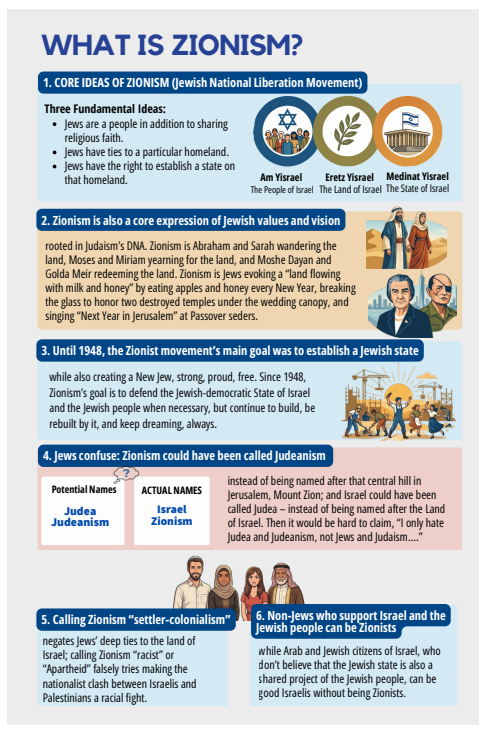
Today, America and Israel are each divided internally. Some believe Israel is becoming more conservative “red,” alienating liberal “blue” Americans. The Gaza War intensified the polarization. In April 2026, 58 percent of Republicans viewed Israelis favorably – 80 percent of Democrats didn’t. Forty-seven percent of Republicans trusted Israel’s prime minister, 76 percent of Democrats didn’t. Some progressives put Israel on probation, with its acceptance contingent on good behavior. Anti-Zionists repudiate Israel as “settler-colonialist.”
The polarizations echo one another. Israelis fear “Jerusalem” or the traditionalist state of “Judea,” clashing with “Tel Aviv,” the ever-modernizing “Start Up Nation.” Meanwhile, “red state” Americans, traditionally oriented toward family, faith, and flag, delight in Jerusalem’s 3,000-year-history, the Promised Land’s allure, and Israel’s patriotic, family-centered, culture. Politically, most applaud Israel’s long-serving Prime Minister, Benjamin Netanyahu. “Blue state” Americans prefer the bustle of Tel Aviv’s gay-friendly, high-tech, party-hearty world.
Actually, both countries are more “purple.” Israelis particularly blur the lines. Israel’s army has long outpaced America’s army in integrating women and gay men into combat. Similarly, many Tel Aviv hipsters who protest vocally and look “blue” – usually serve in the army, marry, raise families, wave the flag on Independence Day, and celebrate the Jewish holidays that many American Jews overlook.
This analysis highlights two other keys to the U.S.-Israel bond. Both countries share a common reservoir of images, values, ideals, aspirations, and lifestyles.
Israel is more Americanized than the primitive, proto-socialist young nation of David Ben-Gurion and Golda Meir. As both countries navigate these confusing times, there’s much each could learn from the other – starting with Israelis explaining to Americans how, despite so much war, their sense of identity, community, and purpose propels them to rank in the top ten of the World Happiness Index, well ahead of Americans.
This cultural resonance has only grown along with the geopolitical alliance.