


And I served as a lieutenant colonel in military intelligence in the Israel Defense Forces.
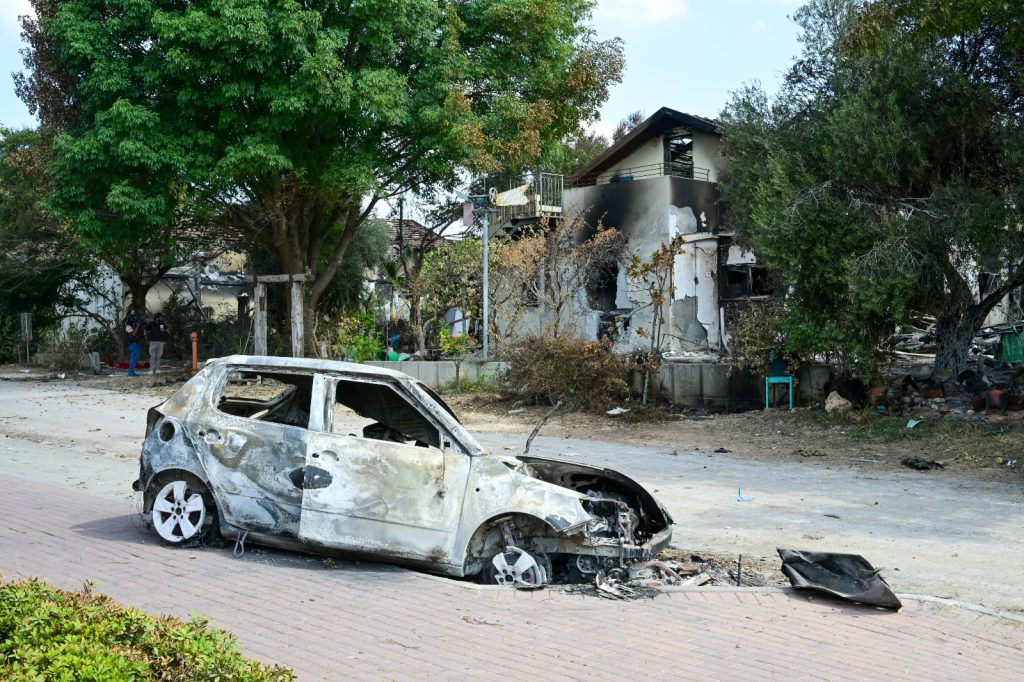
I, too, was caught by surprise when rockets began flying from the Gaza Strip toward Israel at 6:29 a.m. on Oct. 7, even though I was then serving as a lieutenant colonel in the Israel Defense Forces’ Military Intelligence Directorate and commanding the branch responsible for strategic analysis of Hezbollah and Lebanon. Only hours later did the scale of the catastrophe inside Israel become clear: 1,200 people had been murdered, more than 250 abducted, and scenes of unimaginable destruction had unfolded in communities across southern Israel. Hamas had launched a brutal surprise attack, and Israel had not seen it coming. The IDF and the entire Israeli security establishment had failed in their most basic mission: protecting the country’s citizens.
Hamas inflicted on Israel the greatest disaster the Jewish people had suffered since the Holocaust. And the State of Israel—the start-up nation, home to the strongest military in the Middle East and one of the world’s most highly regarded intelligence communities—had neglected to prevent it. The gulf between Israel’s perceived strength and the magnitude of its failure was incomprehensible to me. Yet I devoted the first hours, days and months of the war to understanding Hezbollah—making sure that a strategic surprise would not come from that front as well—stabilizing our analytical work, and restoring confidence among the intelligence officers after the failure in Gaza had shaken the entire system.
Only months later was I able to turn to the causes of the failure. After I retired from military service in early 2026, the subject became an obsession: I needed to understand what had happened to Israeli intelligence and explain it to the Israeli public. I believed then, as I do today, that this was my responsibility as someone who had served for 18 years in the Military Intelligence Directorate and witnessed its inner workings firsthand.
To confront the challenge, I returned to two lessons from aviation. The first came from the commission that investigated Israel’s 1997 helicopter disaster, which stressed that “accidents do not simply happen; they are caused.” The second came from the study of aviation accidents, which shows that disasters usually result not from a single failure but from a chain of failures that compound one another until they produce a catastrophe. The parallel to Oct. 7 was unmistakable: This was the result of a preventable chain of failures.
At the heart of the disaster were three cumulative failures—intelligence, military and political—that reinforced one another. The military and political failures will be discussed elsewhere, one hopes by an independent state commission of inquiry. Here, I will focus on the realm in which I worked for years: intelligence.
The Military Intelligence Directorate, Israeli Security Agency (Shin Bet) and Mossad all failed to grasp Hamas’s strategy; the concrete preparations that preceded the attack; the organization’s military capacity to carry out a large-scale ground assault; its perception of its own strength relative to Israel; and the lessons it had drawn from previous rounds of fighting—foremost among them, that a deliberately initiated surprise attack was a prerequisite for any future campaign.
How did the intelligence community come to understand events in Gaza so differently from reality itself?
First, it refused to learn from the past in the way Hamas had. Had it done so, it would have learned that surprise attacks can happen to anyone, even great powers, and can confound even the brightest and most capable people. It would have learned that no defensive line is impenetrable, along with a lesson or two in humility about the imbalance of power between Israel and its enemies. History, as the saying often attributed to Mark Twain goes, does not repeat itself, but it does rhyme. Israeli intelligence, however, looked only forward, never backward.
The failure also reflected a fundamental misunderstanding of Hamas’s nature. Over the years, the intelligence community convinced itself that Hamas, while a despicable terrorist organization, cared above all about preserving its rule and was prepared to make significant compromises to maintain its standing in Palestinian society. It later became clear that governing the Gaza Strip was secondary to the ideological, murderous and antisemitic worldview that shaped the organization—and its leader, Yahya Sinwar, in particular.
To realize his messianic vision, Sinwar was prepared to sacrifice tens of thousands of Palestinians and even Hamas’s own rule in Gaza. Intelligence analysts struggled to understand a leader and a movement operating according to a radically different set of values and priorities. Within the prevailing framework, increasing the number of Gazans allowed to work in Israel was therefore seen as a restraining influence, while Hamas’s decision to sit out rounds of fighting between Israel and Palestinian Islamic Jihad was treated as evidence that it had been deterred.
At the same time, a collective attitude of contempt took hold in Israel, leading officials to underestimate Hamas’s capabilities in a way they did not underestimate Hezbollah’s or Iran’s. On several occasions, I personally heard Hamas dismissed as “stupid Palestinians” distracting Israel from what truly mattered—the Shi’ite axis. Sinwar recognized this perception and worked hard to reinforce Israel’s belief that Gaza posed no real threat.
Even the security establishment, which warned the prime minister several times before Oct. 7 of the growing potential for war, believed that trouble would come from the north—from Hezbollah or Iran—and did not view the Palestinian arena as an immediate danger.
This contempt also affected the security and intelligence resources Israel devoted to Gaza before Oct. 7. The Lebanon arena was covered by a stable and sophisticated network of analysts and collection specialists who challenged one another’s assessments. The Gaza arena was entrusted to a small group of people on whom Israel depended for its understanding of Hamas and its intentions.
The system was also dominated by a deeply rooted strategic assumption: that Israel’s enemies were highly unlikely to launch a deliberate attack because they understood both the vast imbalance of power and the strength of Israeli deterrence. Across every arena, the prevailing belief was that war could erupt because of a miscalculation, an escalatory dynamic or even greater risk-taking by an adversary; however, not as the result of a large-scale offensive resembling the Yom Kippur War or, in a very different context, the attack on Pearl Harbor.
That helps explain why Hamas’s plan to seize the communities surrounding Gaza was dismissed as fantastical. What enemy would dare attempt such an operation against mighty Israel?
Meanwhile, the intelligence community turned inward. It refused to allow outside voices to influence its thinking. In a closed system with little room for unconventional thought, challenging an entrenched conception becomes exceedingly difficult. When everyone thinks alike, no one thinks as they should.
The Military Intelligence Directorate—and with it the broader intelligence community—excelled at recruiting outstanding people, but of a very particular kind. The door was thus closed to those who thought differently, and on the eve of Oct. 7, the intelligence community had become hierarchical, formulaic and one-dimensional.
Too often, voices that challenged the dominant view were immediately dismissed as irrelevant, tedious, unprofessional or insufficiently experienced. The intelligence community also openly discounted dissenting views from outside the system, whether they came from government ministers, academics or foreign intelligence services. The unspoken message was clear: What could they possibly understand? They’re not experts like us.
Information overload
This problem was compounded by a distinctly modern challenge: information overload. Before the Yom Kippur War, the intelligence community received a limited number of warning indicators pointing to an intention to go to war.
Today, the volume of information flowing into the Military Intelligence Directorate is almost unimaginable. This offers many advantages, but its most serious drawback is that anyone already captive to a false conception can easily find information that confirms it. In a world in which billions of pieces of information enter the intelligence community’s systems every day, how can analysts filter out the noise, determine what is credible, and decide what is more or less alarming?
So it was in the period before Oct. 7: The warning signs were swallowed by a mass of other information that appeared to contradict them. Confronted by such a powerful conception, those signals struggled to command enough attention to influence decision-makers, especially when other indicators seemed to reinforce the prevailing view.
Professional safeguards were supposed to address precisely this problem, but they, too, had eroded across the intelligence community over the years. In a gradual process, the fundamentals of the profession—the insurance policy meant to protect against catastrophes such as Oct. 7—were neglected. The system elevated speed and efficiency over professional rigor and thoroughness, and basic principles of intelligence work fell away because they were deemed “too time-consuming.” The essential mechanisms for preserving institutional knowledge and learning lessons also deteriorated. As long as there was no unmistakable and glaring failure, there was little incentive to “return to basics.”
The relentless pursuit of efficiency also displaced efforts to look beyond the horizon and identify potential dangers. The Military Intelligence Directorate was so confident in its assessments that it saw too little need to adhere to practices that had served intelligence professionals for generations. The intelligence community should have operated like the aviation industry, with multiple layers of redundancy reflecting the severity of the risk.
Instead, it operated like a publicly traded company determined to cut costs. The Military Intelligence Directorate behaved as if the danger were a bad quarterly report, not a strategic catastrophe.
The entire intelligence community also depended to an astonishing degree on a very small number of intelligence sources in the Gaza Strip. As a result, it viewed the arena through a narrow lens that produced the false conviction that Hamas was restrained and did not want war.
This was partly connected to the dominant status of Unit 8200 and the belief that Israel’s technological superiority allowed it to understand every move its enemies made. These technological capabilities have made an enormous contribution to Israel’s security, but they are not sufficient on their own.
Diversify your investments
The Military Intelligence Directorate failed to follow the most basic rule taught in any introductory lesson on financial markets: Diversify your investments. Instead of combining a broad range of collection capabilities, the intelligence community became addicted to a particular kind of source and assumed it offered a complete picture of reality. This helps explain why the reports of the female surveillance soldiers stationed along the Gaza border were given so little weight: Why take them seriously when Israel possessed extraordinary technological capabilities that appeared to contradict them?
The failure was especially conspicuous in the realm of open-source intelligence.
On Sept. 12, 2023, Hamas itself released a propaganda video showing a large-scale exercise in Gaza, including a seaborne raid toward the coast, militants breaching the border fence in white pickup trucks and simulated abductions. I first encountered the video only a few months ago and quickly skipped past it because I assumed it was yet another clip from Oct. 7. It is difficult to convey my shock when I realized it had been published less than a month before the massacre.
Hamas had handed Israel a gift—a glimpse of how it would attack just weeks later—and Israel had buried its head in the sand. The intelligence community had no systematic mechanism for monitoring publicly available information and integrating it into intelligence assessments.
Hatzav, the unit responsible for open-source intelligence, had been shut down in 2021, reflecting the attitude then prevalent in the Military Intelligence Directorate: If it isn’t Unit 8200, then it isn’t interesting.
The role of intelligence in national decision-making also demands examination. In a properly functioning system, intelligence is not supposed to predict the future or give senior leaders a false sense of certainty. Its role—ironically displayed in enormous letters at the Military Intelligence Directorate’s headquarters in Tel Aviv—is to help decision-makers think about the future.
Yet over the years, and because of its immense power and prestige, intelligence became a kind of crystal ball that instilled confidence in policymakers. The political leadership demanded answers, and intelligence supplied them: confident judgments, complete certainty and categorical assertions, both about what was happening and what would happen next—the very opposite of the humility required of every intelligence analyst.
This created an informal bargain between intelligence professionals and decision-makers: reality was whatever the intelligence community presented, and anything absent from its assessments did not exist. Under this unwritten agreement, intelligence could not be wrong about the fundamental questions.
And perhaps this was the gravest weakness of all: the fervent belief that Israel’s intelligence community was the best in the world and that its people were the most talented. I remember well the slogan of Havatzalot, the flagship program for training intelligence officers where I trained: “Making the best even better.” Intelligence officers learned to operate much like their counterparts in Israel’s start-up community: to believe in their ability to succeed beyond all imagination.
That quality is immensely valuable in many fields. But in intelligence analysis, excessive self-confidence impairs the ability to listen to other views and adopt them when warranted. The Military Intelligence Directorate should instead have sanctified humility, doubt and the asking of difficult questions—and promoted people who embodied those qualities. It did precisely the opposite.
During my visits to schools and pre-military academies, I often hear the word “conspiracy.” But there was no conspiracy. Many people also point, with justification, to negligence by some military intelligence officers on that night, and during the weeks and months that preceded it.
Expression of the system
Yet neither conspiracy nor negligence can explain the depth of this systemic failure. The disaster resulted from fundamental shortcomings that accumulated over years until they reached a breaking point.
It would be comforting if the gulf between perception and reality could be explained by a conspiracy or the negligence of a few individuals. The truth is far more disturbing: The failure was embedded deep in the culture, structure and working methods of Israel’s intelligence community. It was the direct result of profound problems left unaddressed for years. This was not an isolated bug in the system; it was an expression of the system itself, and of the way it had learned to think and operate.
Still, Israel must not throw out the baby with the bathwater. It has no other intelligence community, and these are the same organizations that achieved extraordinary intelligence successes against Hezbollah, Iran and Syria. Israel’s intelligence community is a national asset, but it must undergo fundamental change if it is to become more resilient to future surprises.
That is a responsibility it owes to itself, but above all, to Israel’s citizens and to those who sacrificed everything in this war. The path forward must include an independent state commission of inquiry that examines the full range of failures—intelligence, military and political—and formulates the necessary recommendations.
Israel has no alternative, and its enemies will not wait. Now is the time to ensure that the lessons of Oct. 7 are learned and that the risk of the next strategic surprise is reduced as much as possible. Our enemies are already learning the lessons of Oct. 7. The question is whether we are, too.