

If it passes, it will fortify the camp that rejects core civic values, magnify the burden on the military and the economy, and put the country’s very survival in jeopardy.
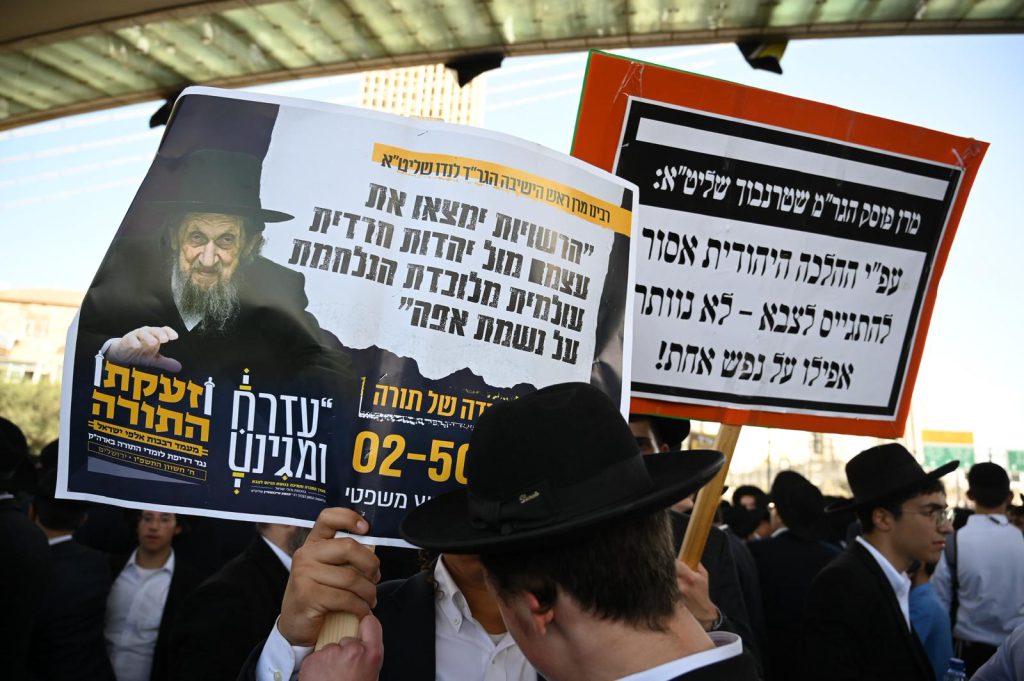
The draft law promoted by MK Boaz Bismuth and the ultra-Orthodox (Haredi) parties is, in essence, a bill to entrench draft evasion and increase subsidies to the Haredi sector. Introducing a full-scale draft-exemption law during wartime is not only a moral disgrace but a knife in the back of those who serve. If the proposed legislation passes, the consequences will be far more disastrous than merely perpetuating the unbearable burden on Israel’s reservists. Israel stands at a historic crossroads: a choice between restoring the Zionist project or continuing to capitulate to the Haredi political leadership – leading, in the not-too-distant future, to Israel’s decline into a third-world state with questionable long-term viability.
Already today, nearly one in three children in Israel’s Hebrew-language public school system is Haredi. In other words, roughly a third of Jewish students in Israel are ultra-Orthodox. Demographic projections indicate that within four decades, a third of all Israelis will be Haredi –without even accounting for the rising number of mostly secular Israelis who are emigrating.
At present, the Haredi community’s economic contribution is negative: the participation of Haredi men in the workforce is low, and the salaries of those who do work are, on average, just 57 percent of what non-Haredi Jewish men earn. They pay significantly lower taxes while receiving far more welfare benefits and subsidies. In economic terms, the monthly fiscal gap between a Haredi household and the average Israeli household amounts to roughly NIS 6,114 ($1,890). The equation is simple: as the relative size of the Haredi population grows, the financial burden it places on the country will increase — until the system collapses under its own weight.
But the economic dimension is only part of the picture. There is also an ideological and civic dimension. The Haredi community lives in a fortified cultural ghetto, detached from – and often hostile to – the core civic values of the Zionist state. Many do not view themselves as part of the collective or as sharing any responsibility for sustaining it. As several Haredi rabbis and political leaders have made clear in recent months, they would prefer to leave the country than shoulder their fair share of the national burden.
But when it comes to political attitudes, the Haredi public is the most hardline in Israel, especially on questions of war, minorities, and national policy – positions that lock Israel into an endless conflict, for which others pay the price in blood. There is also a fundamental security dimension. The debate over Haredi IDF service is no longer just about equality. The war has placed an immense and prolonged strain on Israel’s military manpower. The coming years will require a larger standing army and a much larger reserve force. This will likely mean extending mandatory service for those who already serve, alongside annual reserve duties that routinely exceed 100 days a year. This is an impossible burden – one that fewer and fewer Israelis are willing to bear, especially in light of wholesale Haredi non-service.
The current draft bill does not even pretend to solve this national crisis.
Zionist Israel was built on a shared ethos: participation in the economic, civic, and security burden. A sober look at demographic and social trends shows that unless current patterns change drastically, the number of Israelis carrying that burden will shrink as the burden itself grows. As surveys already show, the willingness of secular, middle-class Israelis – the backbone of Israel’s military and economy – to continue carrying the weight of Haredi non-service is eroding. Many are already contemplating leaving the country.
Zionist Israel will not disappear overnight. In the short term, we will witness a deterioration in public services, a shift in the character of the public sphere, and profound changes in the fabric of Israeli society. But in the longer term, the result may be a fundamental transformation of the state’s identity: no longer a liberal, modern Jewish nation-state, but a more religious and less democratic polity. In the face of constant existential threats that require Israel to maintain close alignment with the West and technological superiority, it is far from clear that such a state could remain viable.
The debate over Haredi conscription has long since ceased to be about fairness or shared sacrifice. It has become a historic moment of reckoning over the very identity of the State of Israel. If the current exemption bill becomes law, it will fortify the Haredi enclave and send Israel hurtling down a steep and dangerous slope – toward the unraveling of the Zionist enterprise as we have known it, and place Israel’s long-term survival in jeopardy.