

Connected U.S. Jews on the War with Iran, Confidence in World Leaders, U.S.-Israel Relations, the Congressional Midterms, and Interpersonal Trust.
Main Findings
- The Iran campaign has lost its aura of success: The share who view it as successful has fallen from two-thirds to one-third.
- Trump’s rating on Iran: The share rating his leadership as good fell to one-fifth in June before rebounding to one-third in July.
- Confidence in Netanyahu: A large majority of conservatives view his leadership as good, while most liberals rate it negatively.
- Most say the action against Iran did not go far enough — a view that strengthens as respondents move to the right.
- The United States as Israel’s “true friend”: One-fifth say it is a better friend than before, while one-third are unsure whether it is a true friend or say it definitely is not.
- More respondents than a year ago view Zohran Mamdani as both anti-Israel and antisemitic.
- Three-quarters of the respondent panel say Israel has not committed genocide in Gaza.
- In the midterms, 46% of the respondent panel plan to vote mostly Democratic, compared with 29% who plan to vote mostly Republican.
- Only 55% of the connected U.S. Jews surveyed say their religious leadership handles Israel-related issues well.
- The Interpersonal Trust Index rose, with a larger share agreeing that most people can be trusted.
To download a PDF version, click here.
The Iran War: From Perceived Success to a Sense of Failure
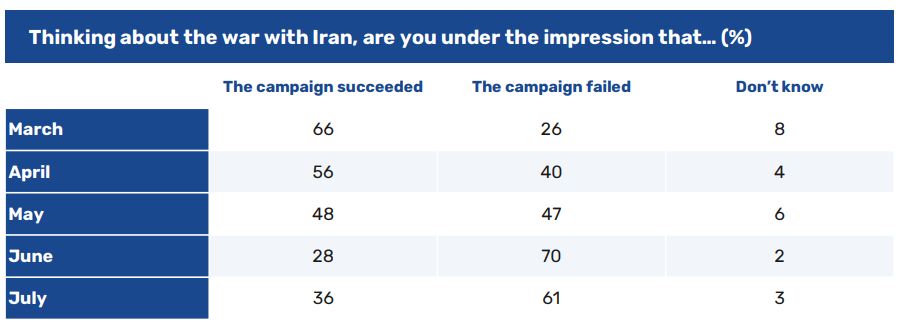
Iran has dominated the survey waves of recent months, and the trend is clear: The further the operation recedes, the less successful respondents believe it was. In March 2026, at its height, two-thirds (66%) of respondents viewed the campaign as a success. That share fell to 56% in April, 48% in May, and just 28% in June, when 70% viewed it as a failure. The results stabilized somewhat this month: 36% now consider the campaign a success, but a clear majority (61%) still view it negatively. In just four months, the overall picture has reversed.
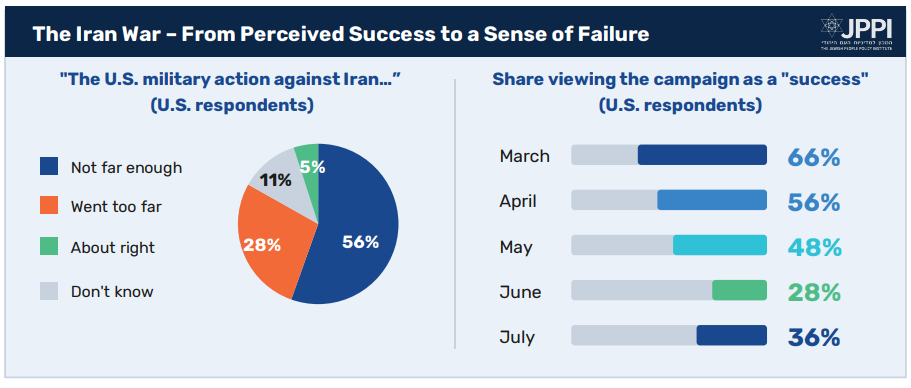
The trend is evident in all three communities sampled, although its strength varies. Among Canadian respondents, the share viewing the campaign as a success fell from 70% in March to 40% in July; among UK respondents, it fell from 75% to 47%. The U.S. average the survey’s primary focus – masks one of the sample’s deepest divides, with political affiliation emerging as the key factor. Among strong liberals, 90% view the campaign as a failure, while three-quarters (76%) of strong conservatives still view it as a success. The divide is even sharper by 2024 vote: 71% of Trump voters see the campaign as a success, while 82% of Harris voters see it as a failure.
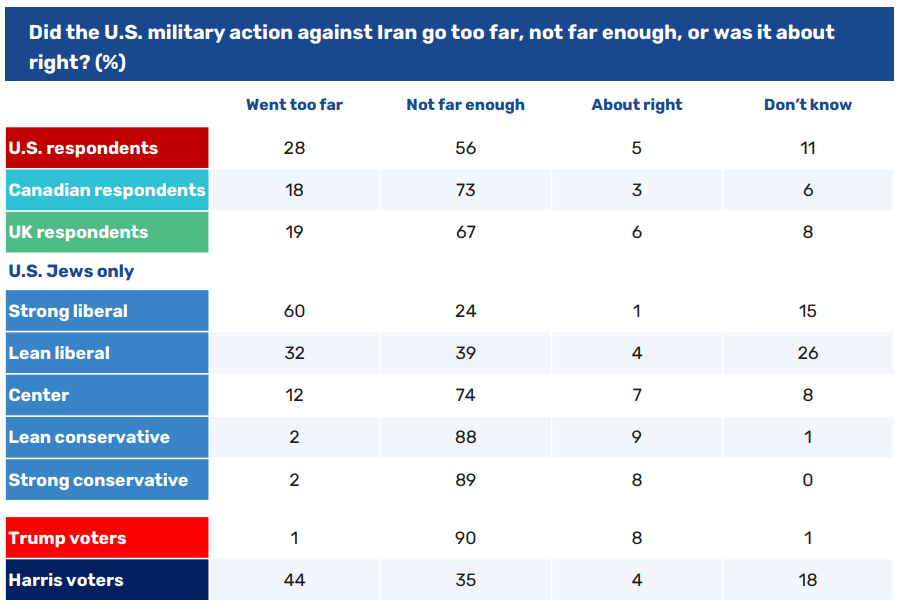
Although assessments of the war’s outcome have deteriorated, the majority’s view of the military action itself remains clearly positive. Among the connected U.S. Jews surveyed, 56% say the U.S. action against Iran “did not go far enough,” compared with 28% who say it “went too far” and just 5% who say it was “about right.” For many respondents, then, criticism of the campaign reflects not opposition to the use of force, but a belief that the force used was insufficiently decisive. This view is also pronounced in Canada (73%) and the UK (67%).
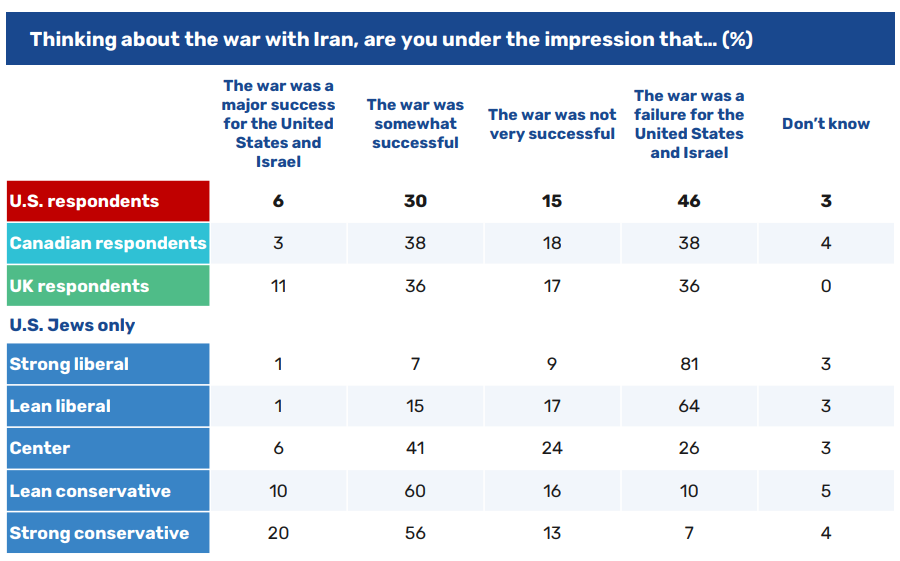
A breakdown by ideological orientation shows that 89% of strong conservative respondents and 88% of those who lean conservative favor a tougher approach toward Iran, while 60% of strong liberal respondents say the action went too far. When examined by voting pattern in the 2024 presidential election, the gap is even wider – 90% of Trump voters say the military action did not go far enough; by contrast, 44% of Harris voters say it went too far. Thus, the hawkish view shared by most respondents coexists with disappointment over the campaign’s results.
Confidence in Leaders
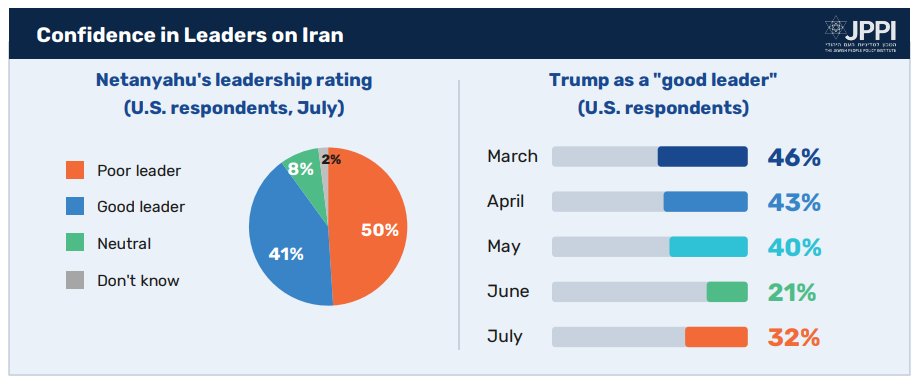
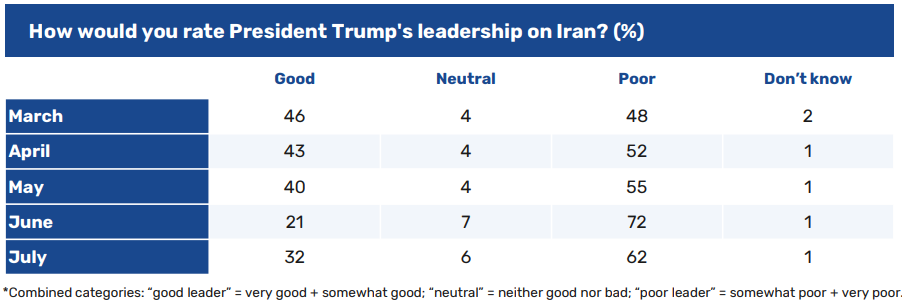
As assessments of the campaign declined, so did evaluations of President Trump’s leadership. Iran has become a major test of Trump’s leadership among connected U.S. Jews, and his standing on this issue fell rapidly. The share rating his leadership on Iran as “good” (very or somewhat good) declined from 46% in March to 40% in May and then to 21% in June. July brought a partial rebound to 32%, but a stable majority (62%) still regard his leadership in the Iran arena as poor. The decline is substantial: His positive rating fell by 14 percentage points over four months, and July recovered only part of that loss.
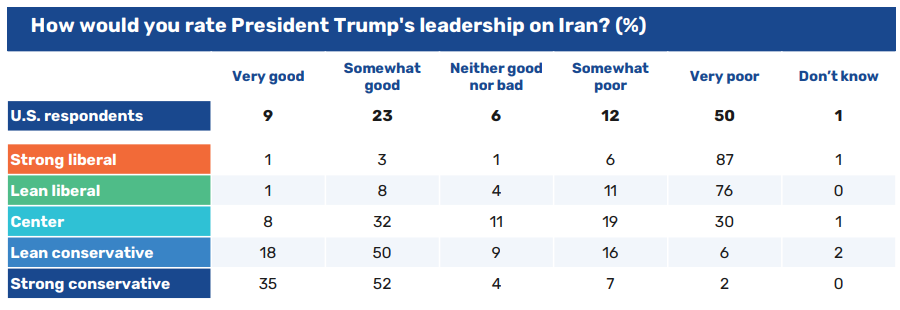
Political affiliation accounts for most of the variation in assessments of Trump’s leadership, underscoring how strongly views of the president track with partisan identity. Among strong conservative respondents, 87% rate him positively, as do 68% of those who lean conservative. Among strong liberal respondents, however, 87% rate his leadership as “very poor” and another 6% “somewhat poor.” Centrist respondents are split (40% good, 49% poor). The divide by 2024 vote is similarly stark: 80% of Trump voters rate his leadership positively, while 77% of Harris voters regard it as very poor.
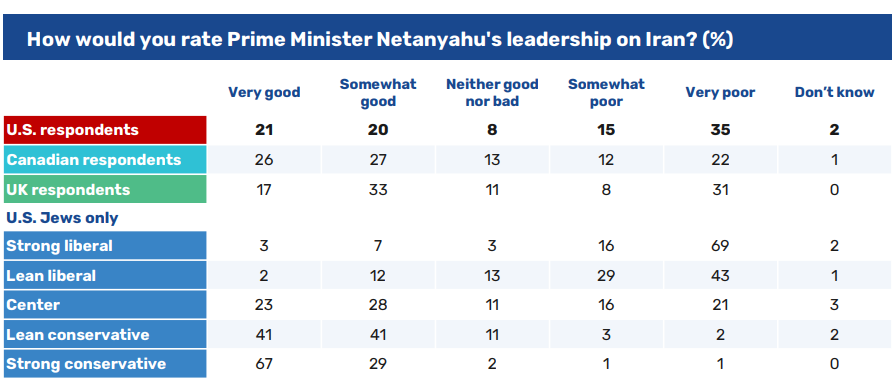
Prime Minister Netanyahu’s leadership rating vis-à-vis Iran declined moderately but steadily throughout the survey period: The share rating his leadership as good fell from 53% in March to 41% in July, while 50% now rate his leadership as poor. Unlike Trump, Netanyahu did not experience a sudden collapse around the campaign; instead, his rating eroded gradually. Yet the overall average masks polarization even deeper than that surrounding Trump. Among the strong conservative cohort, two-thirds (67%) rate Netanyahu’s leadership as very good and 96% rate him positively overall, while 69% of the strong liberal cohort rate it as very poor.
The connected Canadian Jews surveyed rate Netanyahu’s leadership on Iran somewhat more positively than their U.S. counterparts (53% good), while the UK Jews surveyed more closely resemble U.S. respondents (50% positive). Over time, however, Netanyahu’s leadership rating has declined more sharply among Canadian Jews than among U.S. Jews.
The United States as a “True Friend”: Growing Ambivalence
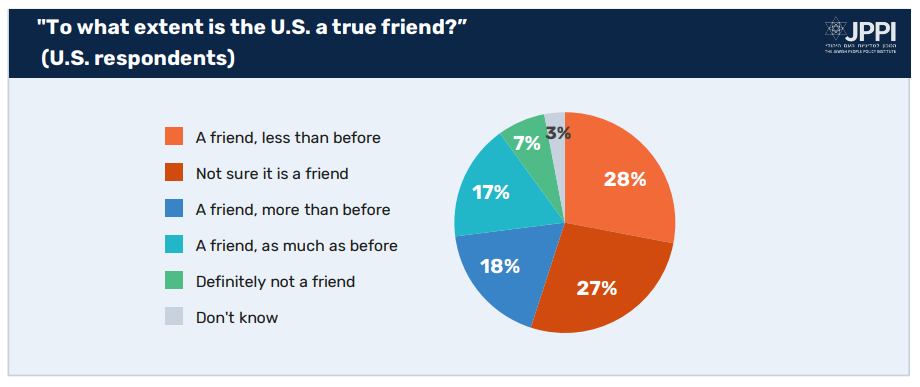
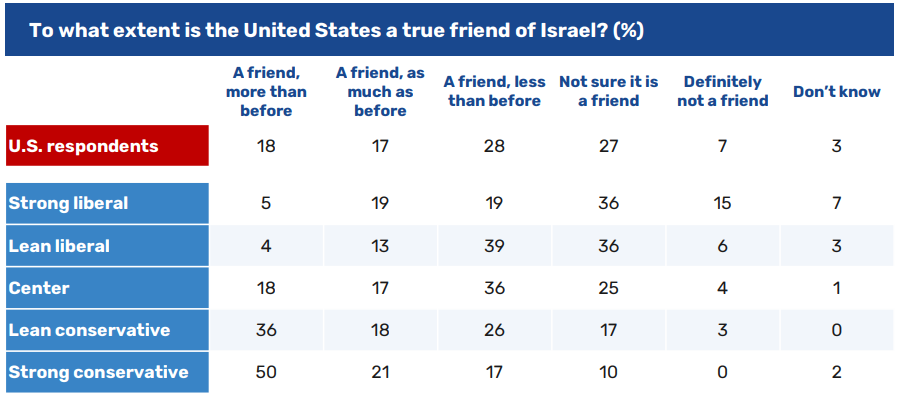
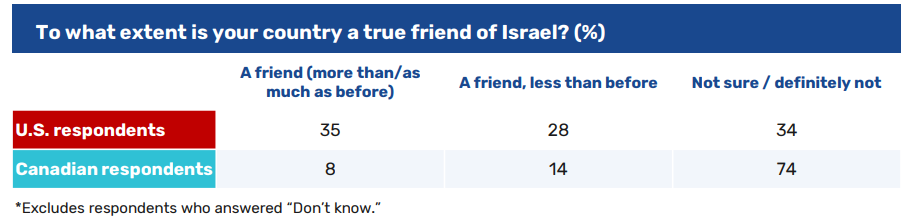
Against the backdrop of tensions over Iran and the Trump administration’s policies, connected U.S. Jews are divided over the depth of the U.S. commitment to Israel. Nearly one-fifth (18%) say the United States is more of a true friend than it was in the past, and another 17% say it is as much a friend as before. By contrast, 28% say it is less of a friend than before, 27% are unsure it is a friend at all, and 7% say it is definitely not a friend. Taken together, 35% say the United States is either less of a friend than before or definitely not a friend. Here, too, ideological orientation is decisive: Half (50%) of the strong conservative cohort says the United States is a better friend than before, compared with just 5% in the strong liberal group.
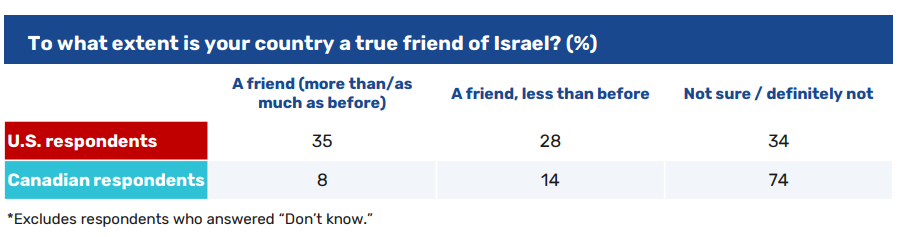
A comparison between the Canadian and U.S. Jews surveyed reveals a striking gap: Canadian Jews are far more skeptical than their U.S. counterparts about their country’s commitment to Israel. Only 8% view Canada as a true friend (either more than before or as much as before), while a significant majority (74%) are unsure it is a friend or say it is definitely not one. Thus, while the U.S. debate centers on whether the United States is less friendly than before, the Canadian debate has shifted to whether Canada is a friend at all.
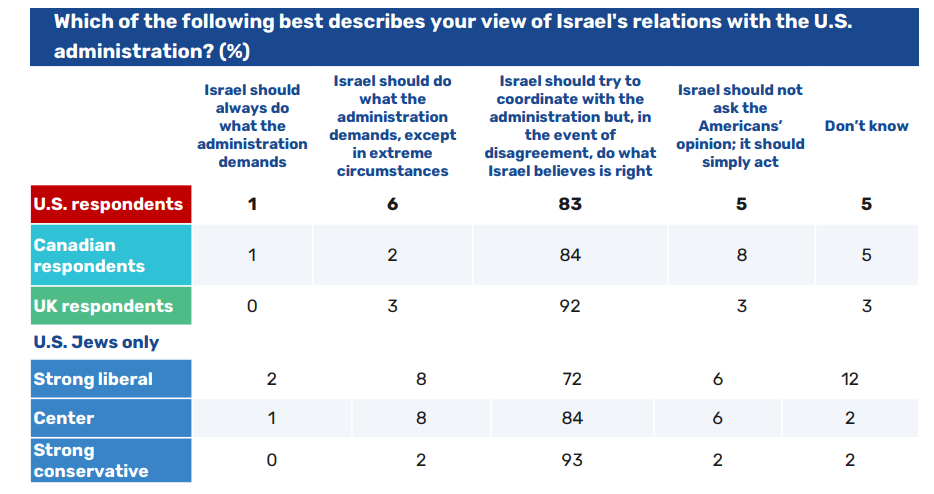
Despite disagreements over Trump’s leadership and the strength of the U.S.-Israel friendship, respondents show unusually broad agreement across ideological, denominational, and geographic cohorts on how Israel should manage relations with the U.S. administration. Large majorities (83% in the United States, 84% in Canada, and 92% in the UK) say Israel should seek to coordinate its policies with the administration but, when the two disagree, act according to what Israel believes is right. Only 6% support near-total compliance with the administration’s demands except in extreme circumstances, 5% say Israel needn’t ask the Americans’ opinion at all, and just 1% say Israel should always do as the administration wishes. This is a rare consensus in a survey otherwise marked by sharp divisions.
Zohran Mamdani
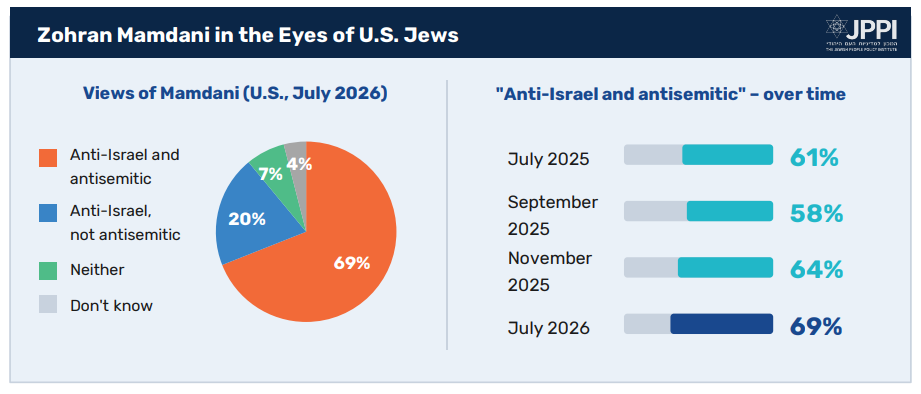
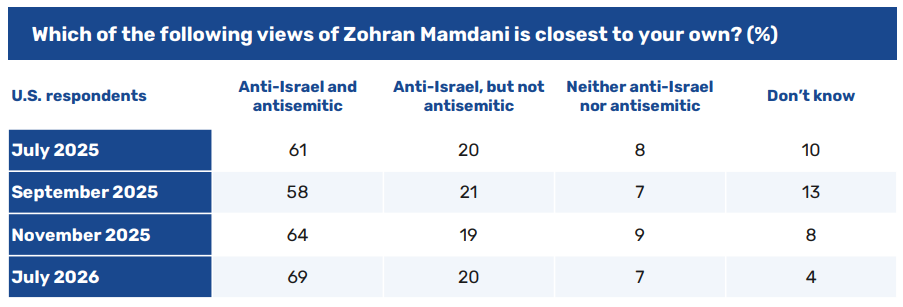
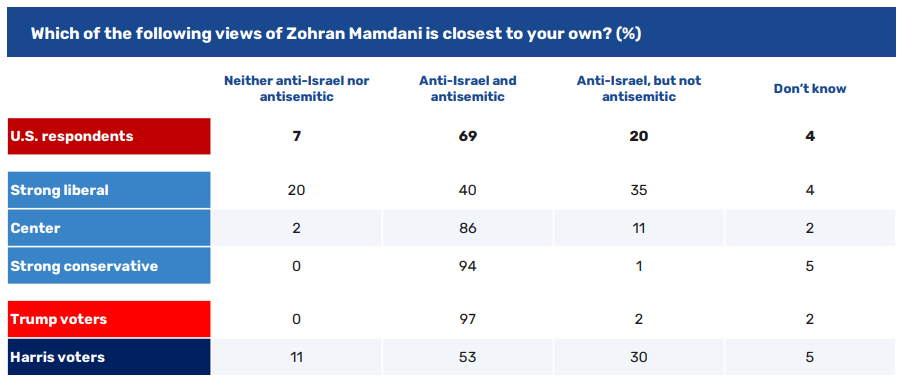
Zohran Mamdani’s tenure as mayor of New York City continues to command the attention of the U.S. Jewish community, and negative views of him have hardened over time. This month, 69% of U.S. respondents say he is both anti-Israel and antisemitic, up from 61% last July. Another 20% see him as anti-Israel but not antisemitic, while only 7% say he is neither. Meanwhile, the share unable to answer fell from 10% a year ago to just 4%, suggesting that Mamdani has become a familiar figure about whom respondents have formed a view.
Negative views span the political spectrum but intensify as respondents move toward the conservative end of the ideological spectrum: 94% of strong conservatives and 97% of Trump voters describe Mamdani as both antisemitic and anti-Israel, compared with 40% of strong liberals and 53% of Harris voters. Among strong liberals, 35% describe him as “anti-Israel but not antisemitic.”
Genocide Allegations in Gaza
Allegations of genocide against Israel in the Gaza war continue to appear in international media and on social media platforms. An AP-NORC survey published earlier this month found that 31% of all Americans and a nearly identical share of American Jews (30%) believe Israel committed genocide in Gaza. That survey examined American Jews as a whole, unlike the present survey of connected Jews. Just under half (49%) said Israel had not committed genocide in Gaza, while 21% said they did not know.
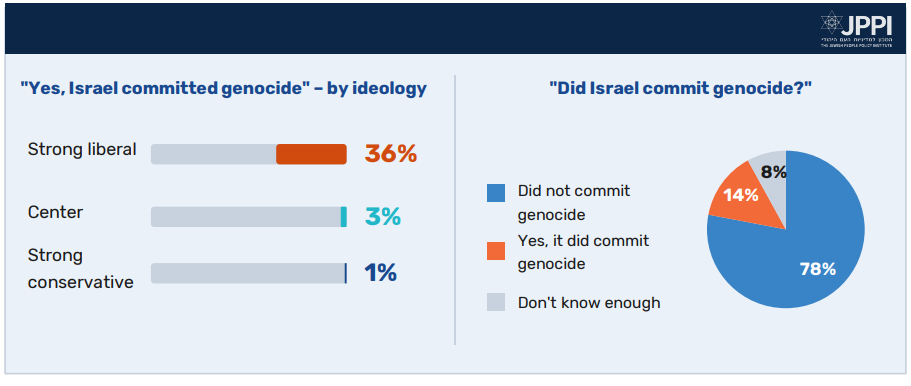
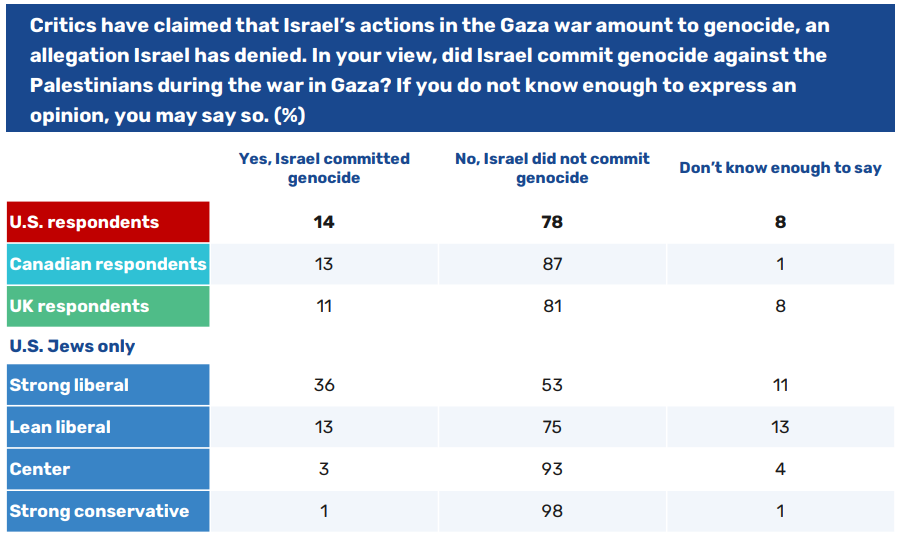
The overwhelming majority of connected U.S. Jews participating in JPPI’s Voice of the Jewish People respondent panel reject the genocide allegation: 78% say Israel did not commit genocide, 14% say it did, and 8% say they do not know enough to express an opinion. The lower “don’t know” rate, compared with that in the representative AP-NORC sample, may also suggest greater familiarity with the issue among connected Jews. Here, too, a sharp ideological divide is evident – 36% of strong liberal respondents agree with the allegation, and only 53% reject it, compared with virtually no strong conservative respondents who agree. A similar divide appears by 2024 voting pattern: 22% of Harris voters agree, compared with virtually no Trump voters. Agreement is slightly lower in Canada and the United Kingdom than in the United States (13% and 11%, respectively).
Congressional Midterm Elections
Ahead of the fall midterm elections, 46% of the connected U.S. Jews surveyed intend to vote mostly for Democratic candidates, compared with 29% who intend to vote mostly for Republican candidates. Another 9% plan to split their vote, 14% remain undecided, and 2% do not intend to vote. The Democratic plurality reflects the American Jewish community’s historical voting pattern, but the overall figure masks a deep divide among religious denominations. While 67% of Reform respondents and 43% of Conservative respondents lean Democratic, 53% of Modern Orthodox Jews and 75% of Haredi Jews lean Republican. The gap underscores the close relationship between denominational affiliation and political orientation within the American Jewish community.
Religious Leadership in the United States
Building on the AP-NORC survey, this month we examined how connected Jews assess their religious leadership’s handling of Israel-related issues. The picture is mixed: 55% rate the performance positively (14% extremely well, 20% very well, and 21% somewhat well), while 22% rate it negatively. Particularly notable is the high “don’t know” share 23% suggesting that many respondents are unfamiliar with their religious leadership’s position on Israel or do not have such leadership. By comparison, only a small share of respondents in AP-NORC’s representative sample of U.S. Jews answered “don’t know.”
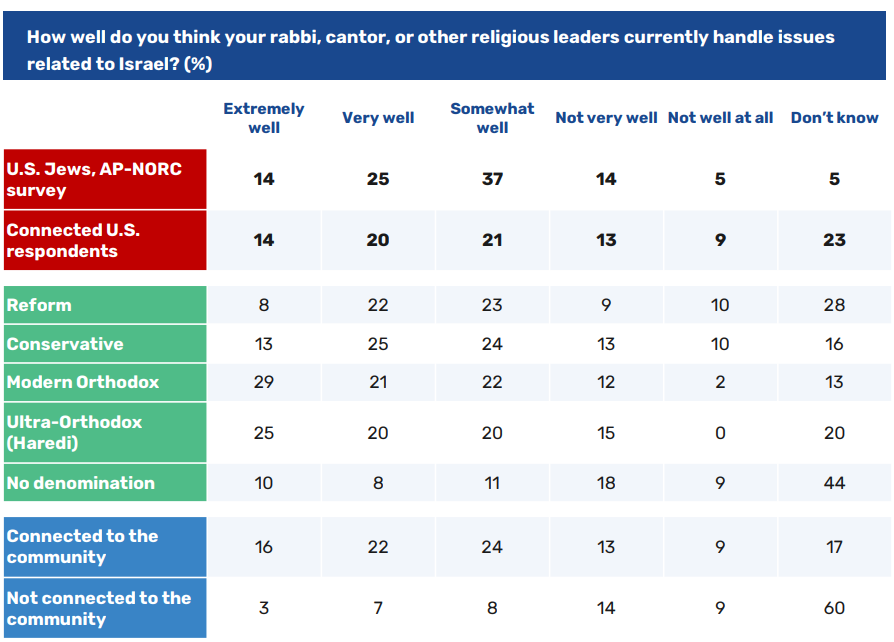
Satisfaction with religious leaders is highest among Modern Orthodox Jews (50% “extremely well” or “very well”) and lowest among those with no denominational affiliation, 44% of whom answered “don’t know.” An even sharper divide emerges by communal connection: Only 17% of respondents connected to the community answered “don’t know,” compared with 60% of those who are not connected. In other words, religious leadership shapes perceptions largely within the connected core and has little reach in the community’s more distant periphery.
The United Kingdom and France
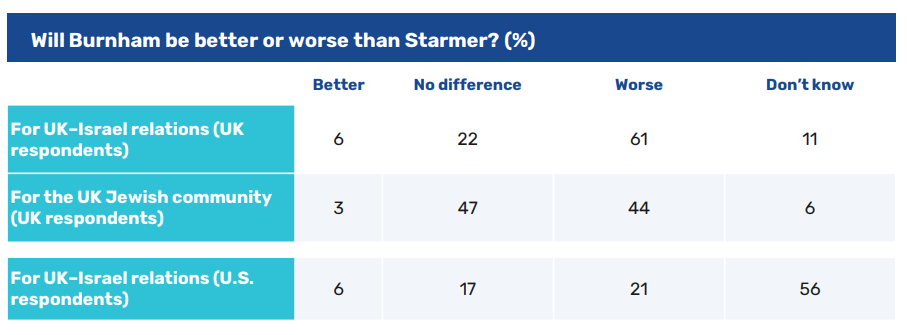
The survey also examined developments in the UK and France. In the UK, amid expectations of a Labour leadership change, respondents were asked how the then-presumptive prime minister Andy Burnham would compare with his predecessor, Keir Starmer. The UK respondents surveyed are largely pessimistic: 61% expect Burnham to be worse than Starmer for UK-Israel relations, and 44% fear he would also be worse for Britain’s Jewish community. Among the U.S. respondents, by contrast, 56% did not know how to answer, indicating limited familiarity with Burnham. Among those who did express an opinion, concern outweighed optimism: 21% said he would be worse for relations with Israel, compared with 6% who said he would be better.
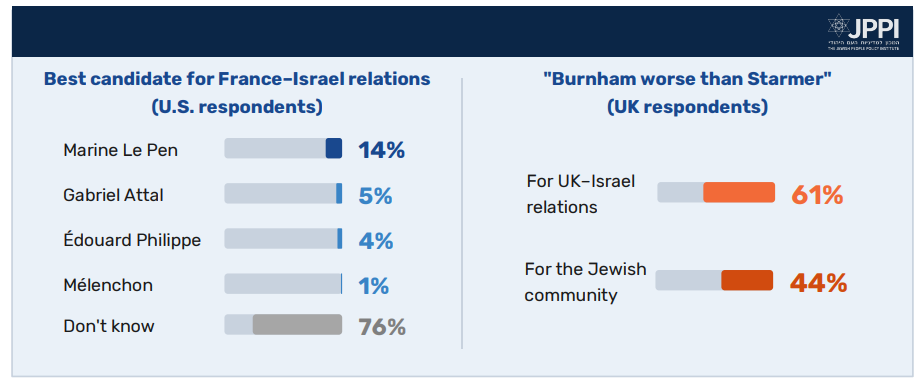
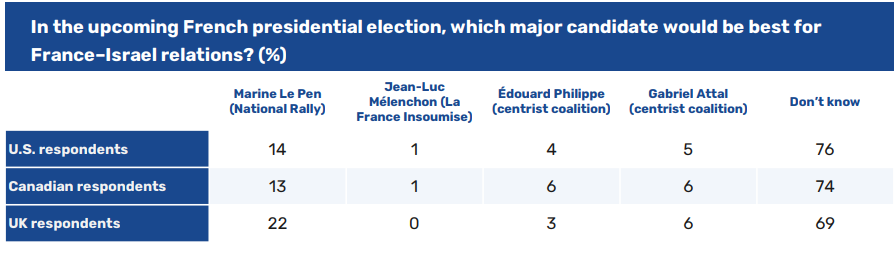
With the French presidential race already taking shape (the election is slated for April 18, 2027), three-quarters of respondents do not know which candidate would be best for France-Israel relations further evidence of limited familiarity with French politics. Overall, Marine Le Pen of the right-wing National Rally is the clear preference: 14% say she would be best for relations with Israel, compared with single-digit shares for every other likely candidate. This view is concentrated among conservatives (35% of the strong conservative cohort) and Trump voters (38%) and is nearly absent among the two liberal cohorts.
Interpersonal Trust
In 1972, nearly half of Americans (46%) said that, in general, “most people” could be trusted. Five decades later, the question is the same, but trust has eroded from nearly one-half to roughly one-third. Pew researchers describe “social trust” as partly rooted in personal experience: People learn whether to trust others through the course of their lives. Negative experiences, such as losing a job or facing discrimination, can erode this trust, producing gaps by income and education. Against this backdrop of broad decline, it is particularly useful to examine where connected Jews stand and how their views change from year to year.
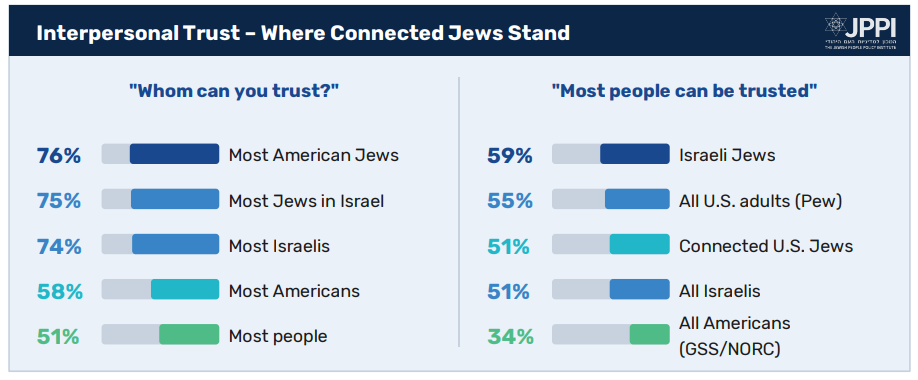
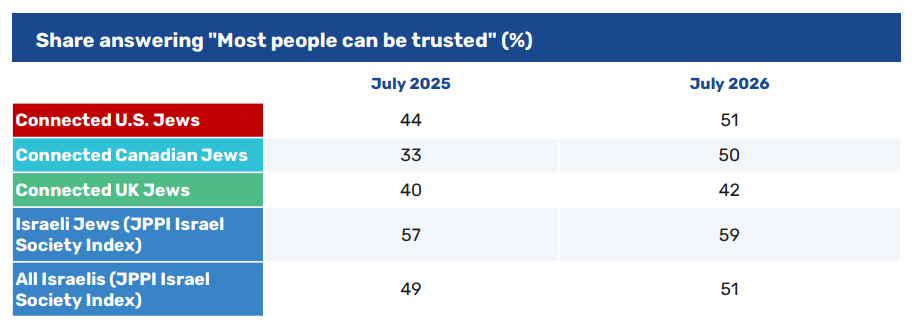
JPPI’s Interpersonal Trust Index focuses on connected U.S. Jews participants in the Voice of the Jewish People panel whose ties to the Jewish community, Israel, and Jewish identity are stronger than the average for all U.S. Jews. Among them, the share agreeing that “most people can be trusted” rose from 44% in July 2025 to 51% in July 2026, a gain of seven percentage points. To interpret this figure properly, it should be compared with two distinct reference groups: all U.S. adults and Israeli Jews, who are asked the identical question in JPPI’s Israeli Society Index. This comparison qualifies last year’s conclusion: The connected Jewish core in the United States does not exhibit exceptionally high trust. At 51%, it stands slightly below all U.S. adults (55% in Pew’s identically worded measure) and below Israeli Jews (59%), although the seven-point increase narrows both gaps.
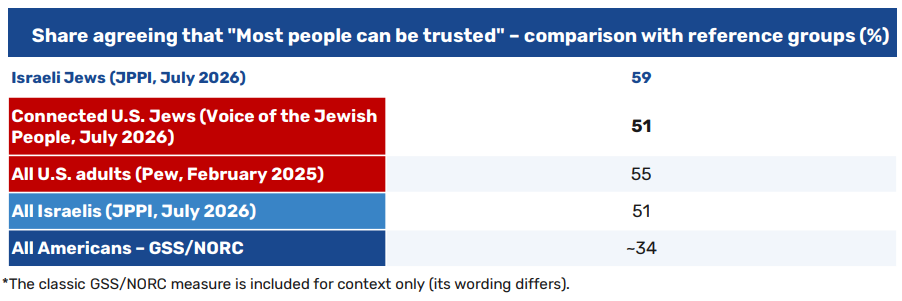
Two caveats are important. The first concerns wording, which has a decisive effect. The comparison figure of 55% among all U.S. adults comes from a 2025 Pew Research Center survey whose binary wording (“can be trusted” versus “cannot be trusted”) matches ours. By contrast, the historical GSS/NORC measure uses different wording (“can be trusted … or you can’t be too careful”) and yields much lower rates – reflecting a decline from 46% in 1972 to about 34% today. Using that measure for comparison purposes last year made the connected Jewish core appear more trusting than average; the like-for-like comparison now yields the opposite picture. The second caveat is that our sample consists of connected Jews, not a representative sample of all U.S. Jews. A representative survey could produce a different result, so the 51% should be understood as applying to the connected Jews JPPI surveys, not to American Jewry as a whole.
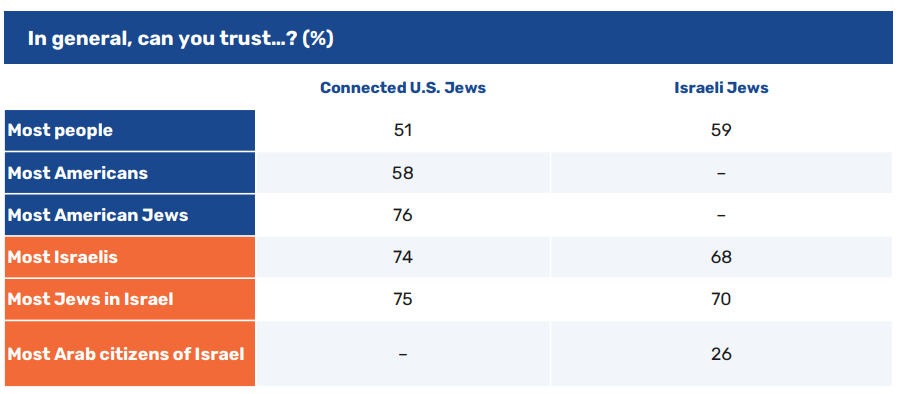
A direct comparison between connected U.S. Jews and Israeli Jews, based on identical questions, reveals a surprising pattern. Although Israeli Jews are more likely to trust most people (59% compared with 51%), connected U.S. Jews are more likely than Israeli Jews themselves to trust Israelis and Israeli Jews: 74% trust “most Israelis” and 75% trust “most Jews in Israel,” compared with 68% and 70%, respectively, among Israeli Jews. In other words, distance may enhance trust Diaspora Jews’ attachment to Israel is accompanied by greater trust than that expressed by those living there.
The pattern of Jewish in-group affinity – substantially greater trust in Jews than in people generally – also extends beyond the United States. Eighty-three percent of Canadian Jews trust most Canadian Jews, and a similar pattern appears in Britain, suggesting that the collective sense of belonging among connected Jews transcends national boundaries. The same pattern appears in Israel, where the share expressing trust rises from 59% for “most people” to 70% for “most Jews in Israel.” There, however, it is accompanied by a stark external divide: Only 26% of Israeli Jews trust most Arab citizens of Israel, one of the lowest figures in the index.
Survey Data and Implications
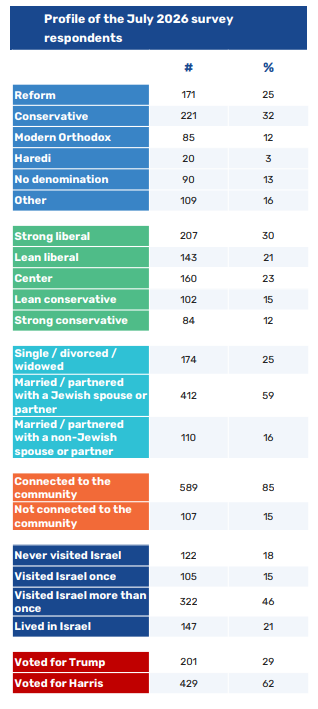
This report is based on a survey of 696 U.S. Jews registered for JPPI’s Voice of the Jewish People respondent panel, conducted July 15-19, 2026. The survey primarily reflects the views of “connected” Jews those with relatively strong ties to the Jewish community, Israel, and/or Jewish identity. The survey also included 112 Canadian respondents and 36 UK respondents. Unless otherwise noted, the results reflect U.S. respondents only; the UK findings should be interpreted with caution due to the small sample. JPPI’s Voice of the Jewish People Index surveys are conducted by JPPI fellows Shmuel Rosner and Noah Slepkov, with assistance from Yael Levinovsky and statistical oversight by Prof. David Steinberg.