

Connected U.S. Jews on the Upheaval in Iran, U.S. Engagement in World Affairs, Trust in Leaders, and Immigration to Israel (Aliyah).
Main Findings
- U.S. Jews support American engagement in world affairs at a higher rate than the U.S. public overall.
- Broad consensus: the United States should officially call for regime change in Iran.
- Half of the Jews surveyed oppose U.S. military intervention in Iran; one‑third support it.
- Trust in Trump regarding the Iranian threat is lower than trust in him on U.S.–Israel relations and antisemitism.
- Jewish respondents in Canada and the United Kingdom also expect their governments to call for regime change in Iran.
- Half of U.S. respondents oppose U.S. action to topple the regime in Venezuela.
- Half believe U.S. military interventions in foreign countries generally make the situation worse.
- Respondents in Canada and the United Kingdom do not trust their prime ministers to manage relations with Israel.
- Half of those surveyed express a complete lack of trust in Netanyahu regarding his handling of the Palestinian arena.
- More agree with the statement that Israel is a safer place for Jews than the United States.
- There has been an increase in the share of respondents who believe Israel is the safest place for Jews.
- About one‑fifth of respondents are considering, or might consider, Aliyah; a large majority are not considering such a move.
- Antisemitism is the main driver leading Diaspora Jews to consider moving to Israel.
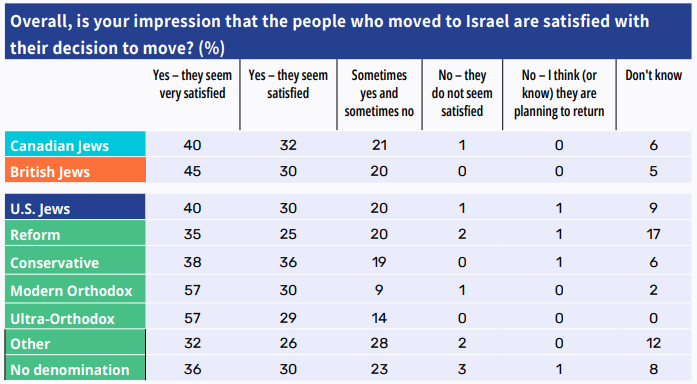
- Most participants believe that their relatives/acquaintances who moved to Israel are satisfied with their decision.
To download a PDF version, click here.
Survey Background: Data for this month’s Voice of the Jewish People Index was collected between January 15 and 20. Several developments over the past month shaped the choice of survey questions and the attitudes reflected in its findings. Earlier in the month, the United States launched a large‑scale military operation in Venezuela, culminating in the capture and arrest of President Nicolás Maduro. At the same time, anti-regime protests in Iran intensified and spread to dozens of cities; the demonstrations were quelled with devastating brutality. The United States threatened to intervene, and President Trump encouraged the protesters, telling them that help was on the way. As this report is published, U.S. forces have been fortified in proximity to Iran, and it remains uncertain whether the administration intends to take kinetic action there. Also, in the Middle East arena this month, President Trump officially announced the establishment of a “Board of Peace” and held a ceremony at the World Economic Forum in Davos, Switzerland, where international leaders were invited to sign its charter. The original role of the Board of Peace was to oversee the ceasefire in Gaza, but Trump decided that it would also monitor additional conflicts.
Methodological note: In recent months, we have also begun surveying Jews in Canada and the United Kingdom. Panels in both countries are works in progress, growing over time. In January, approximately 50 participants in the UK and about 130 in Canada were surveyed. Accordingly, findings for Jews in these countries should be treated with caution; their reliability is lower than that of the U.S. Jewish panel, which includes hundreds of participants each month and whose composition is known and kept broadly consistent over time. Where this report presents breakdowns by ideology, denominational affiliation, or vote choice, the data refers to U.S. respondents only.
Protests in Iran
Over the past month, Iran has experienced one of the deepest and most violent internal upheavals in the history of the Islamic Republic – evolving from an economically driven wave of protests into a mass uprising with revolutionary characteristics. The protest movement, which began in late December 2025 following the collapse of the local currency (rial) and a sharp rise in the cost of living, rapidly spread across Iran and a wide range of social sectors. Peak events – when millions of citizens took to the streets calling for the overthrow of the regime – were met with a hard‑line response by security forces and the Revolutionary Guards. This response included an internet blackout and extensive use of live fire, reportedly resulting in thousands of deaths and tens of thousands of arrests.

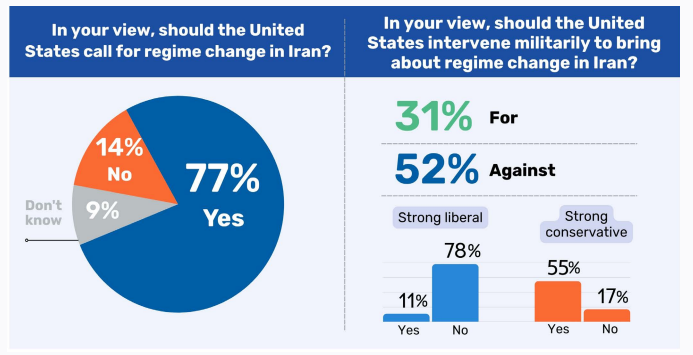
A large majority of the U.S. Jews surveyed by JPPI’s Voice of the Jewish People Index (77%) believe that the United States should, at present, call for regime change in Iran, compared with one‑eighth (14%) who oppose such an appeal. Broken down by ideological orientation, support rises gradually as respondents’ self‑identification becomes more conservative: among “strong liberal” Jews, support is lower yet still a majority (60% in favor vs. 25% opposed). Among those “leaning liberal,” support increases to 74%, while opposition falls to 15%. Among centrists, support is especially high at 82%, with only 8% opposed. Among those identifying as “leaning conservative” and “strong conservative,” support is nearly unanimous – 94% and 93%, respectively – favoring a U.S. call for regime change in Iran.
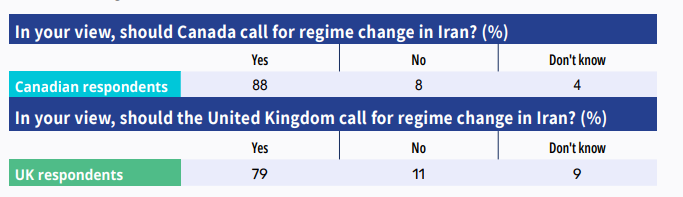
This month, we asked the same question of the still‑coalescing respondent panels of Jews in Canada and the United Kingdom regarding their respective governments’ policy. Among Canadian Jews, agreement was even higher than among U.S. respondents (88%) that their country should call for regime change in Iran. Among British Jewish respondents (a relatively small sample), a similar level (79%) was recorded as measured among U.S. Jews.

Following the question about regime change, we examined whether respondents think their respective countries should intervene militarily to effect regime change in Iran. Half of U.S. Jews surveyed (52%) think the United States should not intervene militarily in Iran for this purpose, while one‑third (31%) believe it should intervene, and one‑fifth (18%) do not know.
As respondents move rightward along the ideological spectrum from liberal to conservative, the share who support U.S. military intervention in Iran increases. While most liberals believe the U.S. should not intervene, most conservatives believe it should. This pattern also appears by voting pattern (in the 2024 U.S. presidential elections): a majority of Trump voters (59%) think the U.S. should intervene militarily in Iran, compared with a majority of Harris voters (70%) who oppose such intervention.
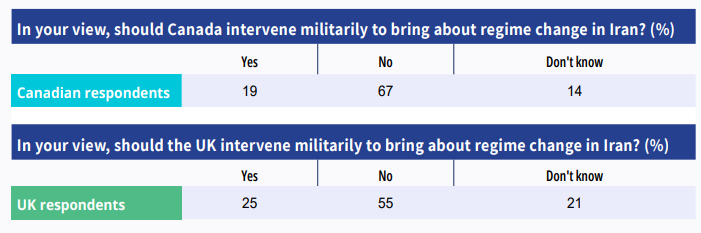
A higher share of Canadian Jews (67%) than U.S. Jews believe that their country (Canada) should not intervene militarily to effect regime change in Iran. One‑fifth (20%) of the Canadian Jews surveyed support such a move, and one‑eighth did not know how to answer. Among British Jews, a similar share to that in the U.S. (55%) think their country should not intervene, while a lower share (25%) think it should. In other words, among Jews in the U.S., Canada, and the UK, a majority think their respective countries should call for regime change in Iran; at the same time, a majority believe it would not be right for their countries to intervene militarily there.
Iran: Trust in Leadership
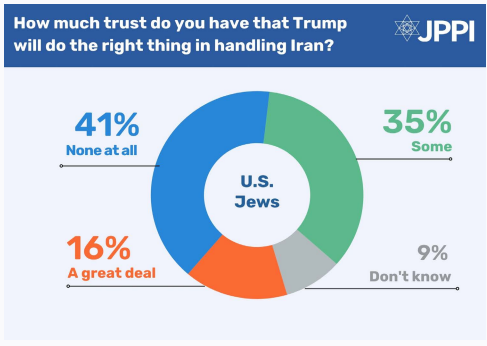
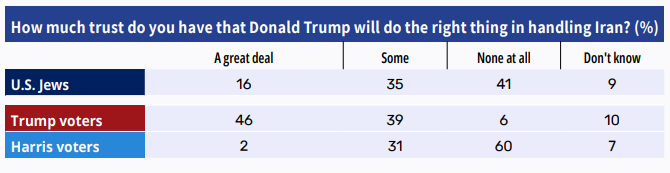
The trust respondents place in Trump to do “the right thing” regarding Iran is lower than their trust in him in several other areas examined this month (see below). Only about one‑sixth of respondents have a great deal of trust in him on the Iran issue. One‑third express some trust, while four in ten have no trust at all in Trump on this matter. Fewer than half of Jewish Trump voters express a great deal of trust in him in the Iranian context, and four in ten of his voters report only limited trust. By contrast, most Harris voters do not trust him at all to act appropriately with respect to Iran.
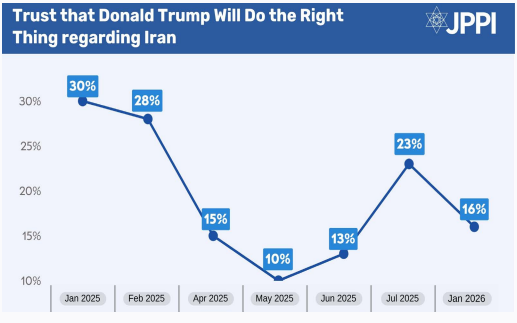
Trust that Trump will do the right thing regarding Iran has fluctuated substantially since the start of his term in January 2025. While in January and February 2025, the share reporting high trust stood at 30% and 28%, respectively, a sharp decline was recorded in April and May, reaching a low of 10%. In June and July, trust rose again – likely attributable to U.S. action in the 12-day campaign against Iran – to 13% and then 23%. This month, however, trust in him vis-à-vis Iran has decreased again to 16%. Overall, the trend points to instability and relatively low trust throughout Trump’s current term. Of course, the relatively low level of trust may reflect two opposing Jewish concerns: those who fear Trump will be too aggressive toward Iran, and those who think he will not be aggressive enough.
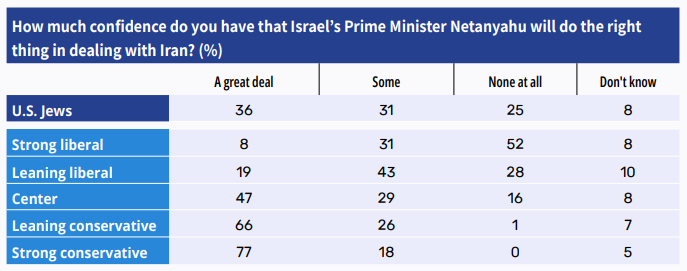
One‑third of the U.S. Jews surveyed express high confidence in Israel’s Prime Minister Benjamin Netanyahu regarding his handling of the Iran issue, compared with one‑third who express limited confidence in him and one‑quarter who have no confidence in Netanyahu at all. In Canada and the United Kingdom, confidence in Netanyahu is higher: more than half of respondents in both countries reported high confidence in him on this issue (54% in Canada and 51% in the UK). In a breakdown by ideological orientation, sizable gaps emerge: most respondents identifying as strong liberals report no confidence in Netanyahu, compared with about half of those identifying as centrists and a majority among the two conservative cohorts, who report high confidence in him in this context.
The Venezuela Operation
In recent months, U.S. foreign policy in Latin America has shifted from diplomatic pressure and economic sanctions to direct military intervention aimed at replacing the government in Venezuela. The U.S. operation combined air power, technologies to disrupt infrastructure, and ground raids by special forces. It reached its peak with the capture of Venezuela’s president, Nicolás Maduro, and his wife, and their transfer to the United States to stand trial on charges of narco-terrorism and drug trafficking. Along with deposing the regime’s leadership, the operation was also intended to neutralize the influence of rival powers in South America.
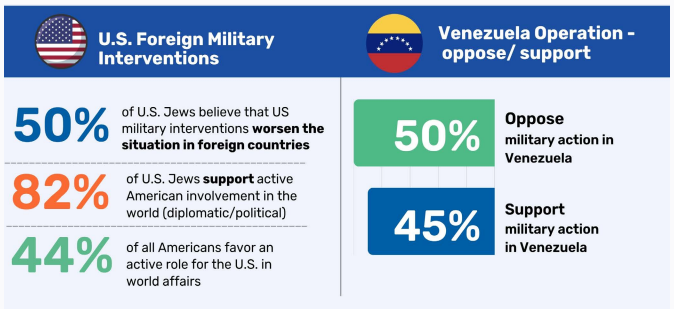
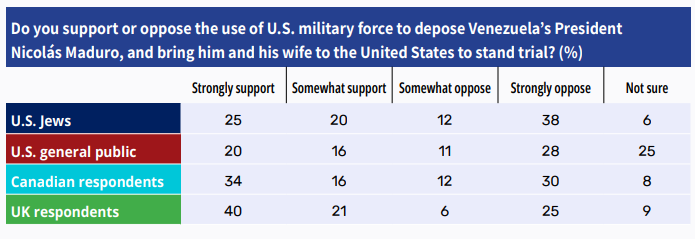
We examined whether Jews in the United States, Canada, and the United Kingdom support or oppose this U.S. move, and compared the results with findings from an identically worded YouGov survey of the U.S. general public. Half of U.S. Jews oppose (strongly oppose + somewhat oppose) the use of U.S. military force to remove Venezuela’s president and bring him to trial. By contrast, 45% support (strongly support + somewhat support) this move. Among Canadian Jews, a similar pattern emerges: half support the move and 42% oppose it. In the relatively small UK sample, support for the military operation is higher: a majority (61%) support it, while about one‑third oppose it. Compared with the YouGov survey of the U.S. public, both support and opposition are lower – driven by the fact that one‑quarter (25%) of Americans are unsure of their position on this issue.
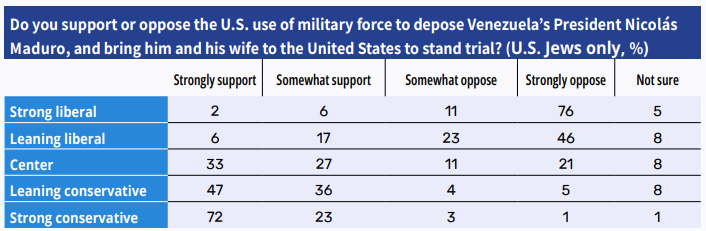
Support for – or opposition to – the use of U.S. military force to depose the Venezuelan president is strongly influenced by respondents’ ideological orientations. While majorities of those identifying as strong conservative (95%), leaning conservative (83%), and centrist (60%) support this action, a majority of liberals (leaning liberal + strong liberal) oppose it. By voting pattern, an overwhelming majority of Jewish Trump voters (90%) support military intervention in Venezuela, whereas three‑quarters of Jewish Harris supporters (74%) oppose it. These patterns are similar to polling among the U.S. public overall, where 66% of Republicans support the U.S. military move in Venezuela, and 63% of Democrats oppose it.
Following the Venezuela question, we asked a broader question about U.S. military interventions abroad. Half of the U.S. Jews surveyed (50%) believe such interventions “make the situation worse” in most cases, while about one‑fifth (22%) think they “improve it,” and one‑tenth (10%) think they have no clear effect one way or the other. A similar pattern appears among the Canadian Jews surveyed, with 45% believing that U.S. military intervention makes the situation worse. In the United Kingdom, the gap is smaller: 38% think U.S. intervention generally makes the situation worse, 28% think it improves it, and 17% believe it neither improves nor worsens conditions. In an identically worded survey of the U.S. public overall, 37% say military interventions make the situation worse, 29% think they improve it, and 15% identify no clear effect. In all groups, the share saying intervention worsens the situation is higher than – or similar to – the share saying it improves it, with skepticism particularly pronounced among U.S. and Canadian Jews.
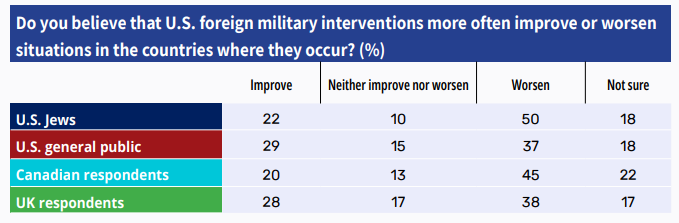
In breakdowns by ideological orientation and denominational affiliation, as respondents move along the spectrum from liberal to conservative, the share who believe U.S. military interventions in foreign countries improve the situation increases. While among the strong liberal respondents, a large majority believe such intervention is harmful (81%), among the strong conservative respondents, a majority believe it is helpful (65%). A similar pattern emerges in a January 2026 YouGov survey of the U.S. public: a majority of Democrats (55%) think military intervention makes the situation worse, while a majority of Republicans (57%) think it improves it.
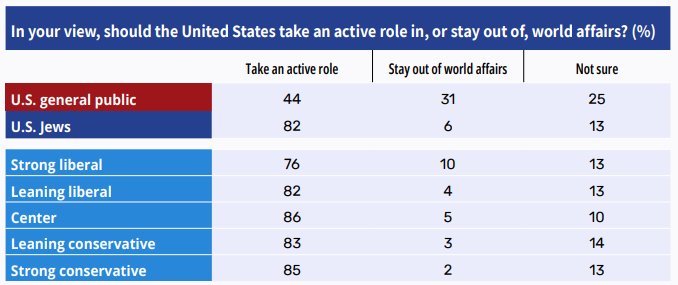
When we asked about general involvement in world affairs – rather than military intervention explicitly – responses differed. A large majority of the JPPI Voice of the Jewish People respondent panel (82%) believes the United States should take an active role in world affairs, and only a very small share (6%) thinks it should avoid such involvement. Here, the gap between U.S. Jews and the general U.S. public is striking, reflecting the latter’s more isolationist orientation. While 44% of Americans believe the United States should take an active role in world affairs, 31% think it should not get involved, and one‑quarter do not know.
This question differs from the military‑intervention question in another respect: there are almost no differences across ideological cohorts. There is an across-the-board consensus that the United States should take an active role in world affairs, with fewer than 10% in each group endorsing an isolationist stance. The same pattern appears by voting pattern: 86% of Trump voters and 80% of Harris voters think the U.S. should take an active role in what happens in the rest of the world.
Leaders and U.S. – Israel Relations
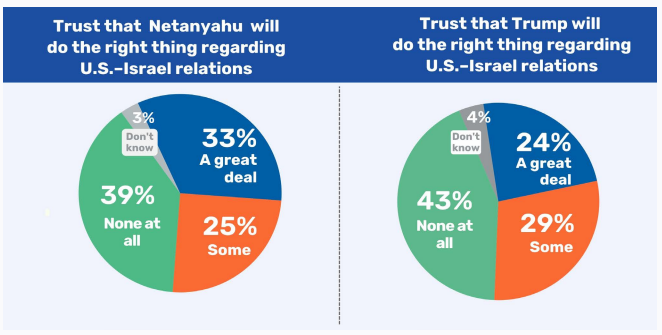
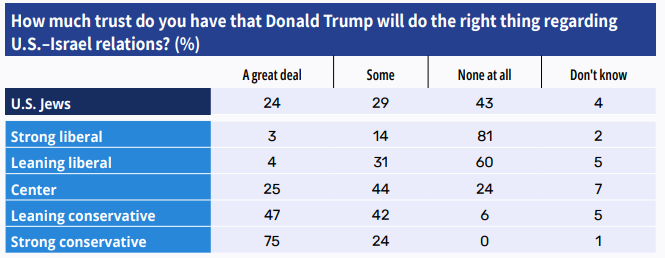
This month as well, U.S. Jews report relatively low trust that President Trump will do “the right thing” regarding U.S.–Israel relations. Twenty‑four percent express a great deal of trust in him in this context, compared with 29% who have some trust in him, and 43% who have no trust in him at all. Broken down by ideological orientation, substantial gaps emerge: among the two liberal cohorts, a majority report no trust in Trump regarding U.S.–Israel relations. The picture is more mixed for the centrist cohort: one‑quarter report high trust, about half report some trust, and another quarter report none at all. Among the leaning conservative group, trust is markedly higher, with about half reporting high trust; among the strong conservative cohort, trust is almost absolute (75%).
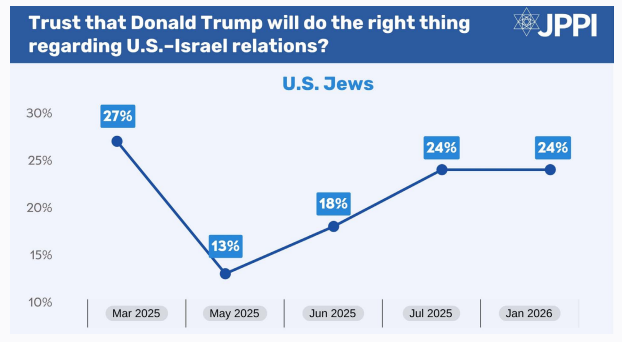
JPPI has asked this question several times over the past year since Trump took office. In March 2025, the share reporting high trust stood at about one‑quarter (27%), but in May it fell to one‑eighth (13%), likely due to a perception of insufficient support in relation to the fighting in Gaza. Thereafter, trust in Trump on U.S.–Israel relations recovered gradually: in June it rose to 18% and in July to 24%, a rise that may be attributed to U.S. support for Israel in the confrontation with Iran. This month, the level of trust is identical to that recorded six months ago. Overall, following the decline recorded in May, the pattern indicates a return to a moderate but stable level of trust, slightly lower than at the start of Trump’s term.
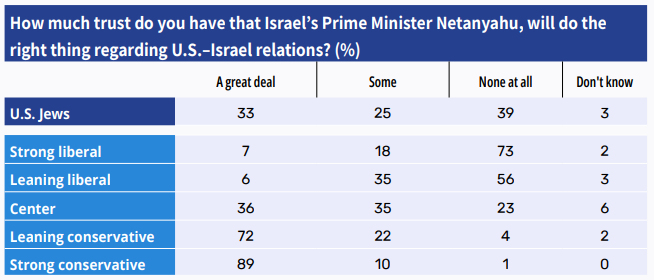
One‑third of U.S. Jews report high trust that Israel’s Prime Minister Netanyahu will do the right thing regarding U.S.–Israel relations. One‑quarter report some trust, and four in ten say they have no trust at all in Netanyahu in this area. Trust in Netanyahu among British Jewish respondents is slightly higher than among Americans (38% report high trust), and among Canadian Jews it is higher still (43% report high trust). Broken down by ideological orientation, majorities in the two conservative cohorts report high trust in Netanyahu, whereas majorities in the two liberal groups report no trust that he will do the right thing regarding relations between the two countries. The same pattern emerges by presidential vote: while most Trump voters (81%) trust Netanyahu, most Harris voters (60%) do not trust him at all.
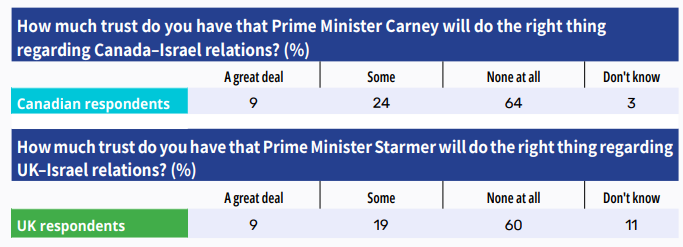
This month, for the first time, we also examined the level of trust Canadian and British Jews have that their own prime ministers will do the right thing regarding relations with Israel. In both cases, a majority reported having no trust at all in the prime minister in this context. In other words, in both Canada and the UK, the level of trust in their respective prime ministers is lower than the trust U.S. Jews have that Trump will do the right thing in relation to relations with Israel.
Leadership and the Palestinian Issue
January was marked by the United States’ transition to “Phase II” of the Gaza reconstruction plan. Trump announced the establishment of the Board of Peace, and in Israel, a public debate ensued over government policy in relation to these developments. It was also evident that Hamas still retains weapons in Gaza, with no indication that it intends to disarm. At the same time, the United States introduced representatives from Turkey and Qatar into some of the bodies involved in Gaza reconstruction – a move Israel opposed and protested.
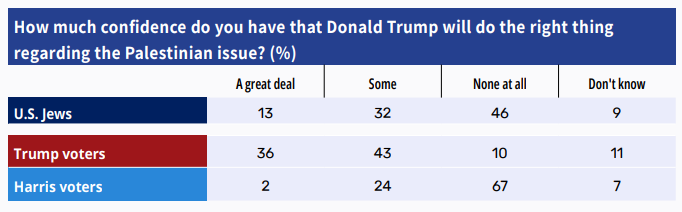
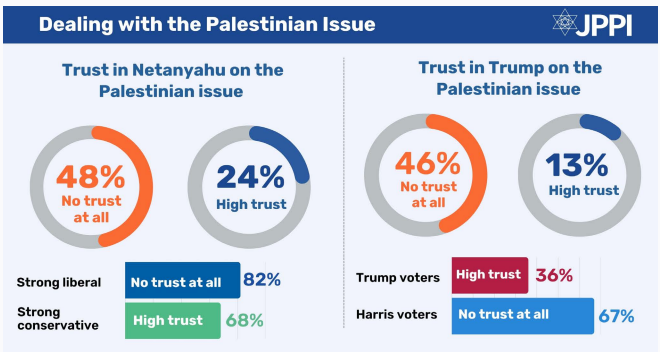
With respect to the Palestinian issue, this month we asked about trust in leaders – Trump and Netanyahu – and also the prime ministers of Canada and the UK. Trust in Trump vis-à-vis the Palestinian issue is lower than with respect to Iran. About half of the U.S. respondents report no trust at all in President Trump on this issue; one‑third report limited trust, and one‑eighth have high trust that he will act appropriately regarding the Palestinian issue. Broken down by voting choice in the 2024 presidential elections, only one‑third of Trump voters fully trust him in this context; four in ten report low trust, and an additional one‑tenth report no trust. It is reasonable to assume that this relatively low trust reflects dissatisfaction among conservative Jews with moves Trump has made in recent weeks (including bringing Turkey and Qatar onto the team dealing with Gaza reconstruction). Among Harris voters, a majority report no trust at all that the president will act appropriately on this issue.
Compared to a year ago, there has been a 10‑percentage‑point decline in the share of U.S. Jews reporting high trust in the president on the Palestinian issue – whereas in February 2025, nearly one‑quarter of panel participants (23%) reported high trust in Trump, this month only about one‑eighth (13%) do so.
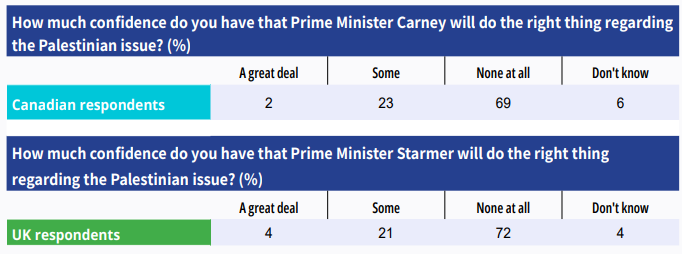
Among Canadian and British Jews, trust is lower than among U.S. Jews that their prime ministers – Mark Carney and Keir Starmer, respectively – will do the right thing regarding the Palestinian issue. In Canada, a 69% majority report having no confidence at all that Carney will do the right thing. In the UK, a large majority (72%) report no trust at all that Starmer will do the right thing vis-à-vis the Palestinian issue.
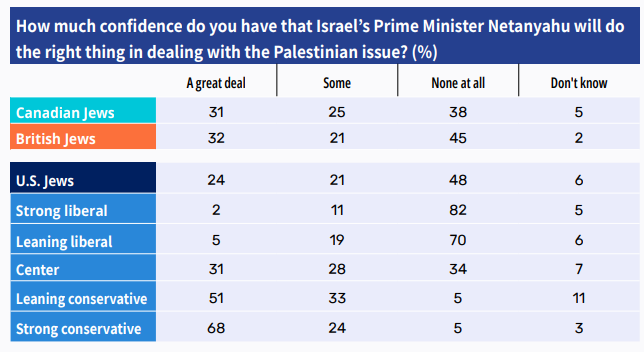
Nearly half of the U.S. Jews surveyed (48%) report having no confidence at all that Netanyahu will handle the Palestinian issue appropriately; one‑quarter (24%) express high confidence in him, and one‑fifth (21%) have limited confidence. In Canada and the UK, trust in Netanyahu is higher, with about one‑third of respondents in both countries (31% and 32%, respectively) reporting high trust in him. At the same time, the share reporting no trust at all remains substantial: 45% in the UK and 38% in Canada. In other words, there is skepticism among English‑speaking Jews worldwide regarding Netanyahu’s approach to the Palestinian issue. As respondents move rightward along the ideological spectrum from liberal to conservative, the share reporting high confidence that Netanyahu will act appropriately on the Palestinian issue rises. While a majority in liberal groups report no trust at all in Netanyahu on this issue, a majority of respondents in the two conservative cohorts trust him in the Palestinian context.
Antisemitism and Perceived Personal Security

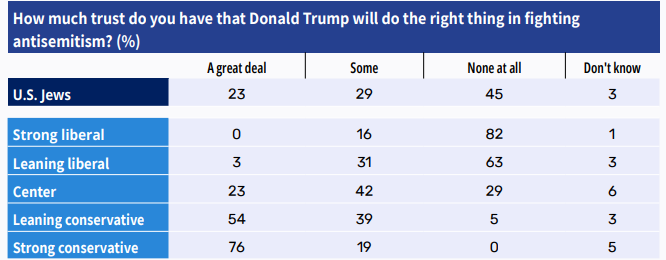
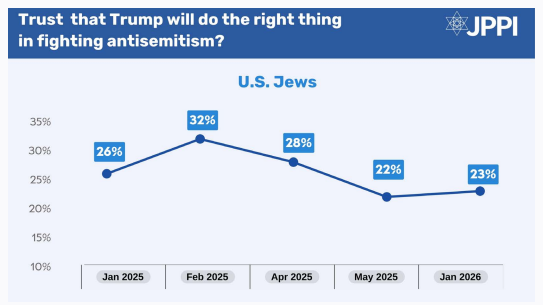
Nearly half of the respondent panel (45%) report that they do not trust Trump to do the right thing in fighting antisemitism. Twenty‑nine percent report limited trust, and an additional 23% report high trust. Responses to this question are also strongly influenced by respondents’ ideological positions: most conservatives express high trust that Trump will act appropriately on antisemitism, while most liberals are not confident that he will.
Since Trump entered the White House a year ago, there have been fluctuations in U.S. Jews’ trust in how he is addressing antisemitism. While trust increased at the start of his term, since last April, there has been a slow but persistent decline, and over the past six months, it has stabilized with roughly one‑quarter of U.S. Jews reporting high trust in this area.
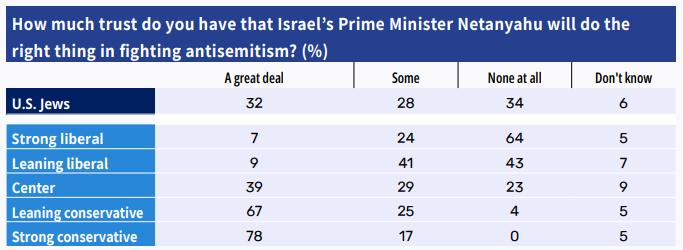
The respondent panel’s trust that Netanyahu will do the right thing in combating antisemitism is higher than their trust in Trump on this issue. One‑third report high trust in Netanyahu, one‑quarter report limited trust, and another third report no trust at all that Israel’s prime minister will act appropriately in fighting antisemitism. In keeping with their assessment of Trump’s handling of antisemitism, most conservatives express high trust in Netanyahu, while most strong liberals express no trust in him at all. Notably, within the leaning liberal cohort – where a majority do not trust Trump at all on this issue – trust in Netanyahu is much higher. Overall, the higher trust in Netanyahu relative to Trump regarding antisemitism appears to be driven mainly by differences among respondents in the political center – leaning liberal, center, and leaning conservative.
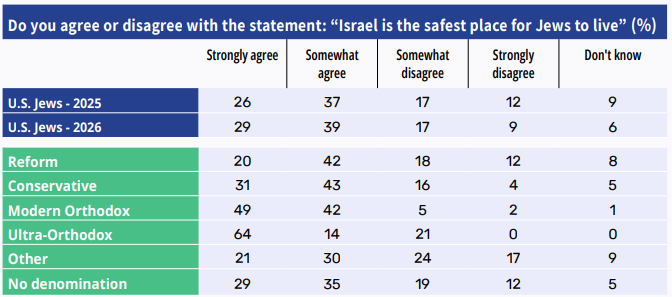
A majority of the U.S. Jews surveyed (68%) agree with the statement, “Israel is the safest place for Jews to live,” while one‑quarter (26%) disagree. Compared with a year ago, there has been a slight increase (5 percentage points) in the share who view Israel as the safest place for Jews. This increase may be attributed to both the end of the war in Gaza and to rising antisemitism worldwide. Broken down by denominational affiliation, agreement is especially high among Modern Orthodox and ultra-Orthodox (Haredi) respondents, whereas among Reform Jews, those with no denominational affiliation, and those self-identifying as belonging to another denominational group, agreement is lower and uncertainty/opposition is relatively higher. Simply put, the more observant the religious group, the higher the share believing that Israel is the safest place for Jews.
Alongside the respondent panel’s majority view that Israel is the safest place for Jews to live, most also believe that the statement “the United States is the safest place for Jews to live” is true. Each statement – about Israel and about the United States – was presented separately, such that respondents could agree with both (we did not ask for a comparison). Nonetheless, agreement with the statement regarding the United States is substantially lower than agreement with the statement regarding Israel. Regarding the United States, half of the respondents somewhat agree that it is the safest place for Jews, and fewer than one‑tenth strongly agree. Regarding Israel, one‑quarter of respondents strongly agree that it is the safest place for Jews.
Broken down by denominational affiliation, a majority across all cohorts – except the Modern Orthodox – agree that the United States is the safest place for Jews to live. Among Modern Orthodox respondents, a majority do not agree with this statement. Compared with a year ago, responses to this question have not changed.

Aliyah
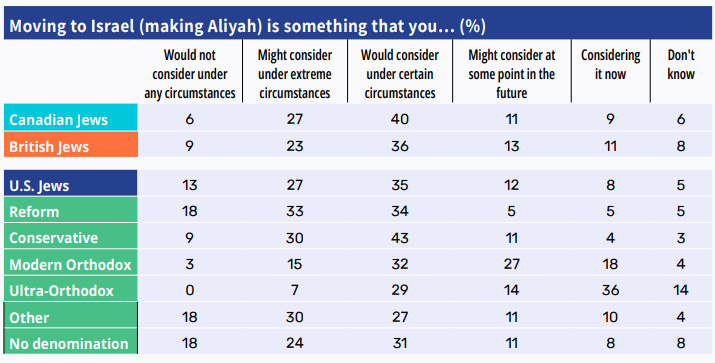
One‑eighth of U.S. Jews say they would not consider Aliyah under any circumstances; one‑quarter say they might consider it under extreme circumstances; one‑third say they would consider it under certain circumstances; and one‑eighth say they might consider it at some point in the future. Fewer than one‑tenth report that they are currently considering Aliyah. Similar patterns were recorded among respondents in Canada and the UK. Broken down by denominational affiliation, as one moves from the Reform cohort toward the Orthodox groups, the share considering Aliyah increases.
When we examined what might lead panel participants to consider moving to Israel, antisemitism emerged as the primary reason: four in ten U.S. Jews selected this option, as did nearly half of respondents in Canada and the UK. The next most influential reason among the options presented was close family members moving to Israel. Options that received little endorsement were peace in the Middle East and economic reasons that would make Israel more attractive. At the same time, one‑fifth of U.S. panel participants indicated that other reasons (not listed) could lead them to consider moving, and one‑tenth said that no reason would lead them to consider moving to Israel. By religiosity, in all groups except Haredim, antisemitism can be a central factor that might lead Jews to consider moving to Israel. Among Haredim, the leading reason is close family members deciding to move, or other reasons.
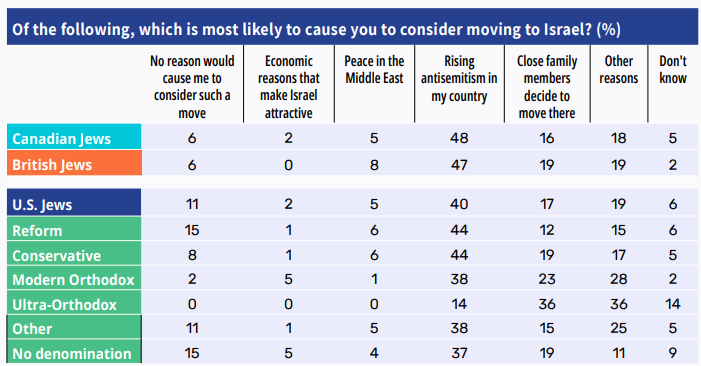
When respondents were asked to indicate a “second reason” that might lead them to consider moving to Israel, one‑quarter of U.S. respondents identified antisemitism, followed by close family members moving to Israel. In many cases, those who cited antisemitism as their first reason cited close relatives as their second, and those who cited relatives first cited antisemitism second.
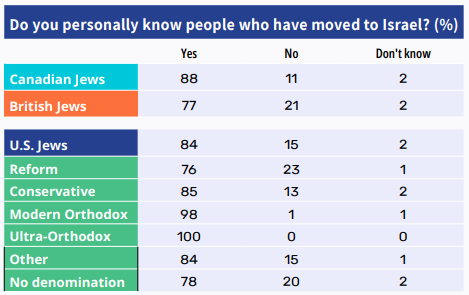
We then asked respondents whether they personally know Jews who have moved to Israel. A large majority – 84% in the United States, 88% in Canada, and 77% in the United Kingdom – report that they personally know people who have moved to Israel. A breakdown by denominational affiliation shows that the more observant groups have higher shares of respondents who know Jews who have made Aliyah. While three in four Reform respondents said they know such people, all Orthodox respondents said they do.
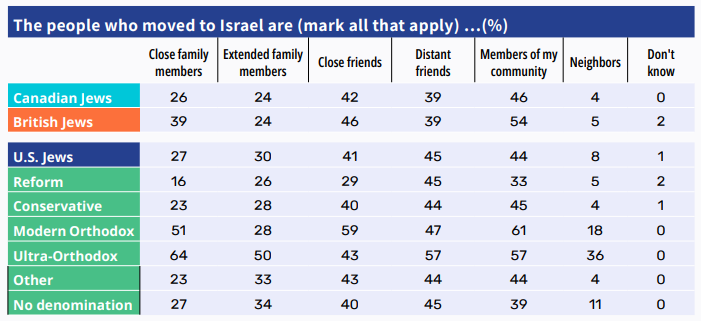
A significant share of respondents indicated that they know distant friends, community members, and close friends who have moved to Israel; in the UK, community ties are particularly prominent (54%). A breakdown by denominational affiliation indicate that among Orthodox and Haredi respondents, this is a widespread phenomenon that includes close family members and neighbors, whereas among Reform respondents and those with no denominational affiliation, knowing people.
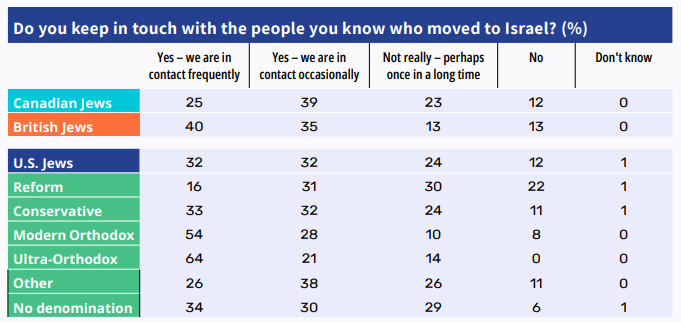
Respondents report that they remain in contact with those who have moved to Israel, though to varying degrees. Among U.S. and Canadian Jews, about two‑thirds say they maintain frequent or occasional contact; in the UK the share is even higher, with three‑quarters (75%) reporting ongoing contact. By denominational affiliation, contact is especially close among Modern Orthodox and Haredi respondents, most of whom report frequent contact, while among Reform respondents, there is greater distance, with a notable share reporting rare contact or no contact at all. Obviously, the degree of contact can be expected to differ depending on the type of relationship one has with the people who made Aliyah.
Most of the respondent panel believes that the people close to them who moved to Israel are very satisfied or satisfied with their decision to make Aliyah, while only a negligible share perceive dissatisfaction among those who moved or plan to return to their country of origin. Among Modern Orthodox and ultra-Orthodox (Haredi) respondents, reports of satisfaction are especially high, with a clear majority indicating very high satisfaction. Among other denominational groups as well, the overall impression is positive, though there is a higher share of more qualified responses.
Survey Data and Implications
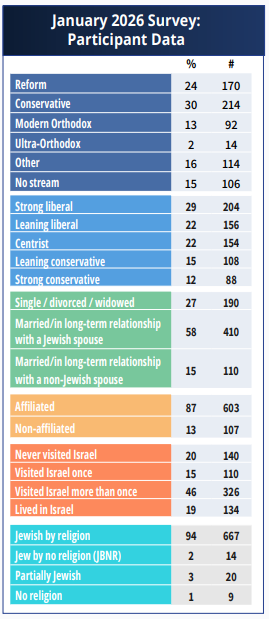
This report is based on a survey of 710 American Jews registered for the JPPI – Voice of the Jewish People Index panel. Generally, the survey tends to reflect the views of “connected” American Jews – i.e., individuals with a relatively strong attachment to the Jewish community, and/or to Israel, and/or to Jewish identity. The survey also included 50 participants from the United Kingdom and 130 from Canada. Unless otherwise noted, the findings reflect the views of U.S. respondents only. The JPPI – Voice of the Jewish People Index survey was conducted by JPPI fellows Shmuel Rosner and Noah Slepkov, with the assistance of Yael Levinovsky. Prof. David Steinberg serves as statistical consultant.
This table provides data on the January 2026 American survey respondents.