

An overwhelming majority of Israelis denounce vandalizing religious symbols: Nine in ten think the soldier who smashed the crucifix in Lebanon was wrong.
Additional Findings:
- There has been a decline in the share of Israelis who think launching the Iran war (Operation Roaring Lion) was justified, but a majority still think it was.
- A similar decline was found in the share of Israelis who expect a positive long-term outcome of the Iran war.
- A majority of the public believes that Prime Minister Netanyahu’s depictions of the war’s results are inaccurate.
- Trust in the IDF senior command has eroded after peaking during Operation Roaring Lion.
- Trust that President Trump will act appropriately in the context of U.S.-Israel relations has continued to decline.
- Israelis are divided over why American support for Israel is eroding.
- Most of the Israeli public supports establishing a commission of inquiry into the war as soon as possible. Still, it is split over the preferred type: a state commission of inquiry or a commission based on “broad consensus.”
- An overwhelming majority of Israelis denounce vandalizing religious symbols: Nine in ten think the soldier who smashed the crucifix in Lebanon was wrong.
- Defeat in the upcoming elections would be seen as regrettable by right-wing Israelis and “intolerable” by their left-wing counterparts.
- Most of the public supports civil marriage, but many oppose intermarriage between Jews and non-Jews.
- What most endangers the future of humanity? Nuclear weapons rank first, followed by social media, global warming, and artificial intelligence.
Click here to download the PDF version.
The Iran War

After a month and a half of fighting, a Pakistan-brokered ceasefire took effect on April 8. The calm was extended several times during April and in early May and has held despite tensions on the ground. As of this writing, efforts are underway to negotiate an end to the crisis, while Israel maintains military readiness out of concern that the confrontation may resume.
Six in ten Israelis (59%) believe that the decision to launch Operation Roaring Lion was the right one, while 22% believe it was wrong and 19% say it is too early to determine. This is a sharp decline from the 72% who supported the decision to strike in March at the start of the campaign. Among Jewish Israelis, broad support (70%) remains, with only 10% opposing the move. Still, this represents a significant decline relative to the 85% majority who supported the decision to strike at the war’s onset (March 2026 survey).
There is a direct correlation between respondents’ position along the ideological spectrum and the degree to which they think the operation was justified. On the right, there is almost complete support for the move (96%), and substantial (73%) support among the center-right. As one moves leftward along the spectrum, support declines and ambivalence rises: in the centrist and center-left cohorts, more than one-third (36% and 37%, respectively) say it is too early to tell whether the decision was correct. Among the left-wing cohort, 50% think it was the wrong decision. In other words, the right views the attack as a necessary step, while the center and the left exhibit uncertainty and even opposition to the move.

As in the previous two months (March and April), the May Israeli Society Index survey again examined whether Israelis think the war with Iran will or will not change the situation in the Middle East over the long term. This month, there was some stabilization in the level of optimism on this question. After the sharp decline recorded between March (65% optimistic) and April (53%), the share of those who believe the situation will change for the better in the long term still stands at about half (52%). At the same time, the share of Israelis who are unsure about the campaign’s outcomes remains high (26% of respondents).
Broken down by ideological orientation, the right-wing cohort exhibits almost complete belief in positive long-term change (92%), with half of respondents (52%) saying they are “certain” of it. The opposite picture appears on the left, where virtually no respondents expect positive change and half (50%) expect the situation to worsen over the long term. Both the center and center-left cohorts include a high share of respondents who are unsure whether the war will have a positive or negative long-term effect (44% and 53%, respectively). This indicates that respondents outside the right and center-right cohorts still find it difficult to view the war’s achievements as a regional paradigm shift.

An examination of the level of credibility the public attributes to the prime minister’s reports on the outcomes of the “Rising Lion” (June 2025) and “Roaring Lion” (2026) campaigns reveals a crisis of trust. Six in ten Israelis (60%) believe Netanyahu’s descriptions of the campaigns’ achievements are inaccurate (20% “not very accurate” and 40% “very inaccurate”), compared with just over a third (38%) who believe he describes the reality correctly. More than half (56%) of Jewish Israelis question the accuracy of his depictions, and a large majority (76%) of Arab Israelis say that Netanyahu’s depictions are inaccurate.
Whereas in the right-wing cohort, a majority (77%) believes Netanyahu’s descriptions are accurate, the opposite perception holds among the center-right, where slightly more than half (53%) believe his reports are inaccurate. As one moves further leftward on the ideological spectrum, trust in the prime minister’s words almost entirely evaporates: in the center, 89% of respondents do not believe his depictions of the outcomes have been accurate, and in the center-left and left-wing cohorts, the figure reaches 96% and 100%, respectively. Perceptions of the security reality and assessments of the military’s achievements are mediated through the political prism, with declarations about the campaigns’ success by the political echelon received with deep skepticism by more than half of the Israeli public.


Trust in Leadership and in Victory
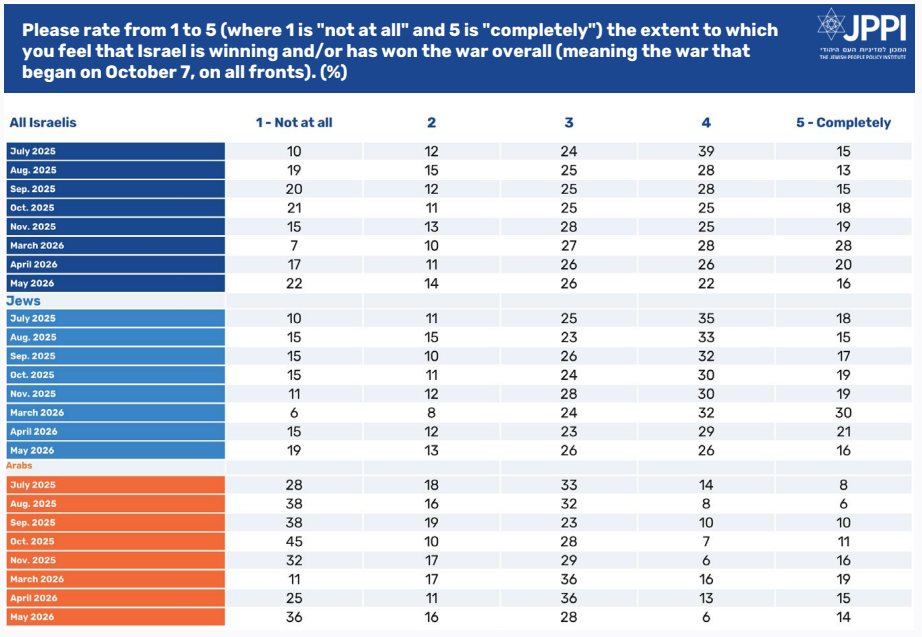
Recent months have seen a sharp and continuing decline in the Israeli public’s general sense of victory in the war across all fronts. At the height of “Operation Roaring Lion” in March, a majority of Israelis (56%) reported a strong sense of victory (ratings of 4 and 5), but this figure has eroded this month to 38%. Among Jewish Israelis, the decline was even more dramatic: from a peak of 62% in March to 42% in May. At the same time, there has been a significant rise in the share of Israelis who report that they do not feel Israel is winning at all, a figure that tripled within two months – from 7% in March to 22% in May. Among the Arab public, pessimism is even deeper: half of respondents (52%) believe Israel is not winning the war (1 or 2), and only a fifth (20%) feel that Israel is winning.
We identified very large gender gaps with respect to this question. Fifty-seven percent of men said Israel is winning, compared with 25% of women. This is a gap of 32 percentage points between men and women, reflecting entirely different readings of reality. Even after analysis controlling for political views, religiosity, age, income, and education, the differences remain large. Not only does a gender-based gap remain, but it is growing from month to month. Incidentally, the group in which the sharpest decline during these months can be identified is Likud-supporting women aged 25 to 45. Among them, the sense that Israel is winning fell from 84% in March to 52% in May.

Erosion of public trust in the government also continued this month, a trend that began immediately after the peak of “Operation Roaring Lion.” In March, trust in the government reached 45%, its highest level in the past two years. However, in the two months since, the figure has gradually declined – to 42% in April and to 41% in May.

Among Jewish Israelis, trust in the IDF senior command has also gradually eroded since the peak recorded at the start of the campaign against Iran. In March, trust in the IDF senior command reached its highest level in the past two years (82%); it declined to 75% in May. Especially notable is the erosion in the share of respondents expressing “very high” trust, which has almost been cut in half over the last two months.
An examination of the data by sector (Jewish and Arab) reveals deep gaps in perceptions of the senior military echelon. Among the Jewish public, a three-quarters majority (75%) expresses trust in the command; among the Arab public, the picture is reversed, with only 42% expressing any degree of trust in the IDF senior command, and half (51%) saying they do not trust the senior command (including 27% who “do not trust it at all”). The weighted trust rate among all Israelis this month stands at 68%.

U.S.-Israel Relations
This month, there was a decline in Israelis’ confidence that President Trump will “do the right thing” in the context of U.S.-Israel relations. Whereas at the height of “Operation Roaring Lion” trust in the U.S. president in this context stood at 75%, this month the figure is 62%. This trend is accompanied by a significant rise in the share of respondents who say they have no trust at all in the president, from 20% in March to 32% today – a level approaching the nadir recorded in June 2025, just before “Operation Rising Lion.” Overall, trust in Trump has been highly unstable over the past year and a half, with positive spikes around the hostage-release deal in January 2025 and around the military operations against Iran in July 2025 and March 2026.


Among those who self-identify as right-wing, 85% have trust in Trump (39% a great deal of trust and 46% some trust); among those self-identifying as center-right, the level of trust stands at 78%. As one moves leftward along the ideological spectrum, trust diminishes: among the center cohort, a majority (58%) still expresses some trust, but in the center-left and left-wing cohorts the opposite picture emerges – a majority of these respondents (55% and 75%, respectively) say they have no trust in the U.S. president in the context of U.S.-Israel relations.

Recent surveys on Israel’s standing in the United States by the Pew Research Center and Gallup have found a significant erosion in its image across almost all demographics. Israelis explain this erosion in different ways. The most common explanation among the options offered in JPPI’s May Israeli Society Index survey (28%) attributes the erosion to Israel’s foreign and security policy, but similar shares of Israelis attribute it to the ideological “craziness” of Americans (27%) or to poor Israeli public diplomacy (24%). Among the Arab public, there is broad agreement that Israeli policy is the decisive factor in the erosion of its standing in the U.S. (51%), while the Jewish public assigns greater weight to external or image-related factors, with the leading explanation being internal ideological changes in the U.S. (32%), followed by the quality of Israeli public diplomacy (27%).
Among Jewish Israelis, just over half of those who self-identify as right-wing (53%) absolve Israel of primary responsibility for the erosion of its standing and instead blame ideological dynamics within the U.S., while only 5% attribute the erosion to Israeli government policy. By contrast, the centrist and left cohorts tend to place responsibility on Israel itself: centrists primarily focus on failures in Israel’s public-diplomacy apparatus (40%), while center-left and left-wing respondents primarily say that Israeli policy is mostly to blame for the erosion (57% and 78%, respectively). Notably, Israel’s identification with Donald Trump is perceived as a secondary factor across all groups.


The Sense of Security in Israel’s North and South
A State Comptroller’s report published just a few days before this writing pointed to serious failures in the handling of the rehabilitation of communities in Israel’s north and south that were damaged during the war. The sense of uncertainty about the future of the regions in question is directly expressed in public attitudes: a 60% majority of Israelis believe that, under the current circumstances, residents of the north will not be able to return to living in peace; just 33% express optimism. Deep pessimism was registered among the Arab public, with 75% doubting the possibility that residents of the north will be able to feel secure where they live, compared with half (56%) of the Jewish public who hold this view.
Here, too, a breakdown of the data by ideological orientation highlights gaps in perceptions of security and rehabilitation: among those who identify as right-wing, a majority (61%) believe that residents of the north will be able to return to living calmly. However, the right-wing camp is the exception: among the center-right, center, center-left, and left cohorts, pessimism prevails. Three-quarters (76%) of centrists do not believe it will be possible to restore a sense of security to residents of the north; among the center-left and left-wing cohorts, the figure rises to 92% and 91%, respectively.
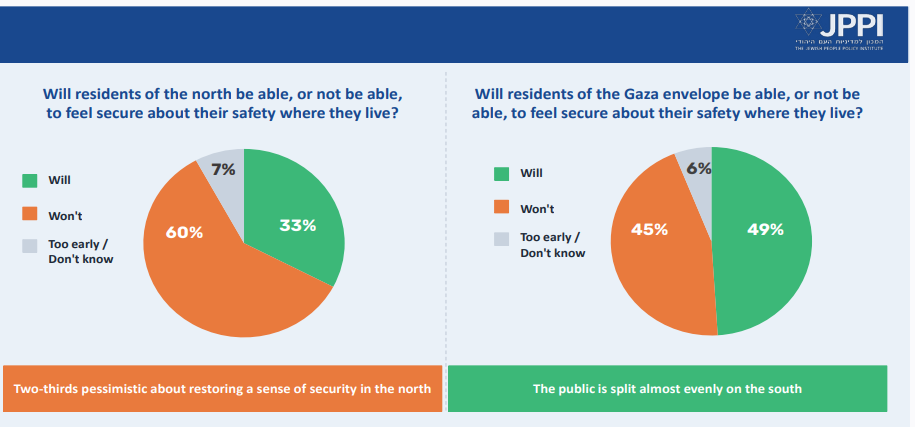

Unlike public attitudes regarding restoring a sense of security on the northern border, nearly half of Israelis (49%) think that residents of the Gaza envelope communities will be able to feel secure where they live; a similar share (45%) holds the opposite view.
Regarding the Gaza envelope communities in southern Israel, there is also a correlation between a right-wing ideological position and optimism that a sense of security will be restored there. Among right-wing respondents, a particularly high level of confidence was recorded, with eight in ten (80%) believing that residents of the Gaza border area will be able to feel secure. The picture reverses as one moves leftward along the ideological spectrum: while an optimistic majority remains among center-right respondents (57%), pessimism prevails in the center and left cohorts. Majorities in the center (64%), center-left (73%), and left (75%) cohorts believe that, under the emerging circumstances, it will not be possible to ensure that the region’s residents feel secure.

Commission of Inquiry
This month, Israel’s High Court of Justice held a hearing on petitions demanding an orderly investigation of the war through a state commission of inquiry. Nearly two-thirds (63%) of the Israeli public believes that a commission of inquiry into the events of October 7 and the war that followed should be established as soon as possible. This position is shared by a majority of respondents in both the Jewish sector (62%) and the Arab sector (67%). Fifteen percent of Israelis believe that establishing the commission should wait until the war has fully ended, and 11% believe that the decision on when to establish it should be left to the government’s discretion.
In the left (100%), center-left (99%), and center (87%) cohorts, there is nearly total support for the immediate establishment of a commission of inquiry. A 68% majority of center-right respondents also support an immediate inquiry. A different picture emerges in the right-wing cohort: only 34% support establishing a commission as soon as possible, while a majority prefers to postpone the move; 30% want to wait until the war is over, and another 26% believe that the government should determine the timing. Among Likud voters (2022 elections), positions are split: just over one-third (38%) support establishing an immediate commission of inquiry, while the majority (58%) prefer to wait until the war ends or to leave the timing to the government to determine.


The Israeli public is almost evenly divided over the structure of the commission that would investigate the events of October 7 and the war that followed, with a slight advantage for a state commission of inquiry headed by a Supreme Court justice (46%) over a national commission of inquiry composed of broadly agreed-upon public figures (40%). Only a negligible share of Israelis (5%) supports a government commission of inquiry, and a similar share (4%) believes there is no need for a commission of inquiry at all beyond the professional reviews conducted by the security agencies. Among Jewish Israelis, there is a slight preference for a “broad consensus” commission (48%) over a state commission (42%). Among Arab Israelis, there is a clear demand for a state commission headed by a Supreme Court justice (62%).
A breakdown by ideological orientation reveals that the involvement of the judicial system in the inquiry is the principal point of contention between ideological groups. Among right-wing respondents, there is almost complete opposition to a commission headed by a Supreme Court justice (6% support), with the majority (80%) preferring a national commission of inquiry composed of figures acceptable to broad segments of the population. The opposite picture appears among center, center-left, and left-wing respondents: in the center (78%), center-left (93%), and left (94%) cohorts, there is a broad consensus demanding a state commission of inquiry headed by a Supreme Court justice.

Vandalism of Religious Symbols
The international press widely covered two recent incidents in which IDF soldiers damaged Christian religious symbols in villages in southern Lebanon. In this month’s survey, we asked about the first incident, which involved the smashing of a crucifix; the second involved the desecration of a statue of Mary. These incidents, which generated international attention and criticism, met with a forceful institutional response in Israel. The command echelon, including the chief of staff, condemned the acts, characterizing them as a moral failure contrary to the IDF Code of Ethics. Disciplinary measures were taken against the soldiers involved.
An overwhelming majority of the Israeli public (90%) believes that the soldier who smashed the crucifix statue in southern Lebanon was wrong, on ethical and moral grounds: 65% of Israelis believe that it is forbidden to smash symbols of other religions. Among the Arab public, this position is even more pronounced, at 71% compared with 63% among the Jewish public. Alongside this moral rationale, a significant share of respondents believe that the soldier’s action was improper because it caused reputational damage to Israel (13%) or because it violated army orders (12%).
A breakdown by religious identity groups shows that the strongest opposition to the act based on respect for other religions was recorded among the secular public (80%). However, as the level of religious observance rises, this share decreases, reaching 39% among the ultra-Orthodox public. At the same time, higher levels of support for the act itself were recorded among the religious (Dati) and ultra-Orthodox (Haredi) groups: 20% of the religious and 21% of the ultra-Orthodox believe that the soldier did the “right thing,” with most of them objecting mainly to the fact that it was photographed and disseminated (12% and 15%, respectively).


2026 Elections
Ahead of the elections expected in late October, we once again examined how Israelis anticipate feeling in the event that the side they support is not victorious at the ballot box. This month, there was a slight uptick in the share of Israelis who say they will respect any decision the public delivers (from 23% in March to 27% this month). An examination of the right-wing and center-right camps reveals a relatively pragmatic approach: nearly half (47%) of the respondents in these cohorts characterize a possible loss as “regrettable, but that is life,” and about another third (30%) declare full respect for the decision of the majority. Forty percent of Arab respondents selected the option of respecting the public’s decision, a figure that stands out compared with the share among their Jewish counterparts (24%).
As in the findings recorded in the March 2026 Israeli Society Index, this month, too, there are differences among ideological groups in their understanding of the meaning of the results of the upcoming elections. As one moves from right to left along the ideological spectrum, the sense that an electoral defeat would be “intolerable” becomes more acute. In the left-wing camp, a majority (81%) gave this response, while a negligible share responded that they would respect “any decision” of the public. This feeling is also dominant in the center-left (62%) and center (49%) cohorts. This contrasts with the right-wing cohort, where only 20% of respondents attach such severe significance to defeat.


Civil Marriage
The question of civil marriage in Israel came onto the public agenda this month following remarks by Naftali Bennett indicating a willingness to establish such an option in Israel. The data shows that, in general, a majority of Jewish Israelis (59%) support the option of civil marriage, with nearly half (46%) saying they “strongly support” it. By contrast, the Arab public shows substantial opposition: 46% oppose the introduction of a civil marriage option, compared with 39% who support it, and a relatively high share of respondents (15%) who do not hold a consolidated position. Weighted across all Israelis, there is a 55% majority in support of changing the status quo on this issue.
A breakdown by religiosity shows that at the secular end of the spectrum, there is near-complete consensus (91%) in favor of civil marriage. Among traditionalist respondents, there is a division: most “traditionalist, not religious” respondents support the move (54%), but among the “traditionalist, religious” group, the picture reverses, and a majority (60%) oppose it. Opposition reaches its peak among the religious (77%) and Haredi (85%) groups, for whom religious marriage is perceived as a critical component of the state’s identity and of preserving the unity of the Jewish people.


Responses to the civil-marriage question change somewhat when the question includes qualifying details. We examined two such qualifications: one clarifying that civil marriage would also include marriages between Jews and non-Jews, and one clarifying that it would include same-sex marriages.
Adding the possibility of intermarriage (between Jews and non-Jews) to the civil marriage equation affects public support. While the general question on civil marriage garnered 59% support among Jewish Israelis, support fell to less than half (46%) in a follow-up question that explicitly included intermarriage between Jews and non-Jews. Among all Israelis, half of the public (50%) opposes civil marriage when it includes the possibility of interreligious marriage, and 44% support it. Among Arab Israelis, too, opposition (48%) is higher than support (37%) for this model. The data shows that for a significant share of the public, opposition to interreligious marriage is a central barrier to their support for civil marriage more broadly.
A breakdown by Jewish religiosity shows that interreligious marriage generates opposition not only among the religious (Dati) and ultra-Orthodox (Haredi) cohorts, but also among the traditionalist (Masorti) groups. Although most “traditionalist, not religious” respondents support civil marriage in principle, their view changes when interreligious marriage is included, with a 59% majority opposing the move. Among the religious (87%) and Haredi (94%) publics, opposition is nearly complete. Even among the secular public, which supports civil marriage at high levels, support drops when the model includes intermarriage – from 91% to 75%.

Opposition to civil marriage that would also permit same-sex unions is lower: the Israeli public is divided almost evenly between support and opposition, with a slight advantage for supporters (49%) over opponents (45%). We found a large gap between Jewish and Arab respondents: whereas a 59% majority of Jewish Israelis support a move that would permit same-sex marriages, a 75% majority of Arab Israeli respondents are opposed, most of whom (62%) are “strongly opposed.”
Among Jewish Israelis, religiosity is a predictor of attitudes toward same-sex marriage. Among secular respondents, support was sweeping at 86%, and a 60% majority was recorded among traditionalist, not religious respondents. The shift to groups with a stronger religious affiliation marks the ideological turning point: among traditionalist, religious respondents, a 57% majority opposes recognition of same-sex civil marriages, and among the religious and Haredi groups, opposition is overwhelming (86% and 82%, respectively).

Attachment to Jewishness and Israeliness
This month’s survey repeated a question asked annually on the sense of “Jewishness” among Jews in Israel – that is, the extent to which they “feel Jewish” on a scale from 0 (not at all) to 10 (the maximum possible). The data shows a consistent upward trend in the sense of Jewish identity among Jewish Israelis, with the overall average rising to 9.11, compared with 9.05 last year and 9.02 two years ago. Among the religious and traditionalist cohorts, the sense of Jewishness is close to the maximum score; among the secular public as well, a high and stable level of identification is recorded.
At the same time, we examined the extent to which Arab Israeli respondents feel “Israeli” on a scale from 0 (not at all) to 10 (the maximum possible). Here, too, the data reveals a clear upward trend, with the overall average crossing the midpoint of the scale, having risen from 4.31 to 5.07. The trend is especially evident among the Muslim public, where a significant one-point jump was recorded, and among the Druze public, which continues to report a particularly high level of identification with “Israeliness.” The Christian public, however, is an exception to this trend, with a slight decline in the sense of “Israeliness.”


Threats to the Future of Humanity
This month, we asked respondents to rate several issues often regarded as dangerous to the future of humanity in recent years on a scale from 1 (not a threat at all) to 5 (a very severe threat). Among the four domains examined – global warming, artificial intelligence (AI), the influence of social media, and nuclear-weapons proliferation – the Israeli public ranks the proliferation of nuclear weapons as the most significant threat to humanity (84%). The influence of social media ranks second (56%), perceived as more dangerous than global warming (49%), while the development of artificial intelligence elicits the lowest level of concern (38%) among the issues examined.
Forty-nine percent of Israelis view global warming as a significant threat to the future of humanity (ratings of 4 and 5), but this figure conceals a sectoral gap. Among the Arab public, a majority (72%) characterizes the problem as dangerous. By contrast, among the Jewish public, the perception of threat is relatively low: 43% assign the issue a high danger rating, while 31% attribute a low level of danger to it (ratings of 1 and 2).
Ideological orientation emerges as a predictor of public attitudes regarding climate change, with perceived threat severity increasing as one moves leftward along the ideological spectrum. Among those who self-identify as right-wing, 21% view global warming as a major threat, compared with 49% who characterize it as a low-level threat. This picture reverses in the center cohort, where a 56% majority expresses significant concern, and reaches its peak in the left-wing cohort, where a consensus (88%) views the crisis as a severe threat, with 66% of the left-wing cohort characterizing it as “very dangerous.”


The Israeli public expresses concern about the development of artificial intelligence, with nearly four in ten (38%) viewing it as a significant threat to the future of humanity (ratings of 4 and 5). While only 32% of the Jewish public expresses serious concern, a 57% majority of the Arab public does so. However, the largest group among all respondents (34%) chooses the midpoint rating of 3, indicating an ambivalent or cautious position regarding the long-term implications of artificial intelligence.
Here, too, concern about artificial intelligence tends to rise as one moves leftward along the ideological spectrum, though to a limited extent. Whereas the lowest level of concern was recorded on the right (26% in ratings 4 and 5), among center-left respondents, the share reaches a peak of 41%.

Israelis identify the influence of social media as a greater threat to the future of humanity than artificial intelligence, with 56% assigning the issue a high danger rating. Among Arab Israelis, the concern is deeper, with nearly half (46%) characterizing the influence of social media as “very dangerous,” compared with less than a quarter of Jewish Israelis (23%). In terms of ideological orientation, concern about the consequences of social media appears to cut across camps, but it strengthens as one moves leftward along the ideological spectrum: from 45% high perceived risk on the right to 59% on the left.

Of the four issues examined, Israelis view the threat of nuclear proliferation as the most severe. More than eight in ten Israelis (84%) assign the issue a high danger rating, with 65% of all Israelis characterizing the phenomenon as “very dangerous to the future of humanity.” This perception cuts across sectors: among the Jewish public, the share of those who are very concerned is nearly two-thirds (64%), and is slightly higher among the Arab public, reaching 68%.
Unlike the other issues, the question of nuclear-weapons garnered a similar severity assessment across the ideological map. In the right-wing, center-right, and center cohorts, intense and similar levels of concern were recorded, with about two-thirds of respondents choosing the maximum risk rating. In the center-left and left cohorts, the share of respondents defining the situation as “very dangerous” was slightly lower (58% and 50%, respectively), but these groups balance this with a higher share of respondents assigning the issue a rating of 4.

JPPI’s May Israeli Society Index survey was administered between April 30 and May 4, 2026, to 749 respondents. Data was collected by HaMadad.com (547 Jewish sector respondents, in an online survey), and Afkar Research (202 Arab sector respondents, approximately half online and half by telephone). The data was analyzed and weighted by voting pattern and religiosity to represent the views of Israel’s adult population. The Index is compiled by Shmuel Rosner and Noah Slepkov with research, production, and writing assistance from Yael Levinovsky. Prof. David Steinberg serves as statistical consultant.