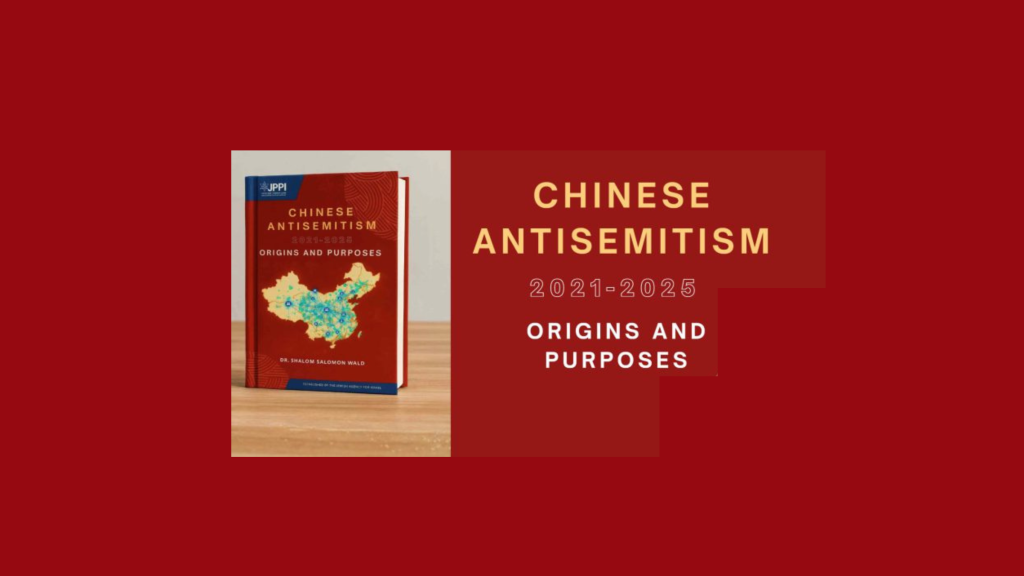
Required reading for anyone who wants to ensure that the oldest hatred in the world does not become a new norm in the civilization that claims to be the oldest in the world.
BY: DR. SHALOM SALOMON WALD
BY: DR. SHALOM SALOMON WALD
Salient Cases of Antisemitism in China
Antisemitic ideas were occasionally expressed in the People’s Republic of China even in the years before the current antisemitic wave. Song Hongbing, in his 2017 book Currency Wars, asserted that Jews controlled global finance. The book became a best seller, perhaps because many Chinese hoped to learn how to get rich quickly rather than out of any preoccupation with the Jewish question. Yet there were also signs that the public atmosphere in regard to Israel and Jews was beginning to deteriorate. On August 19, 2020, the Jerusalem Post published an unfriendly editorial: “China has proven to be a bad actor – we owe them nothing.”¹⁷ By then the Chinese should have become used to unfriendly headlines in Western newspapers, but this one, translated into Chinese, triggered a flood of unexpected antisemitic attacks by Chinese netizens that discomfited scholars of Judaism in China.
An unprecedented antisemitic media wave started with the Gaza war in 2021. It was reinforced since the Hamas attack of October 7, 2023.¹⁸ Chinese media began spreading antisemitic tropes under the cover of criticism of Israel’s military actions. While similar denunciations conflating Israel, Zionists, and Jews occurred in other countries too, in China all political speech is tightly monitored and censored if it is not in line with official positions. If antisemitism was spreading on China’s media, it meant that it was officially sanctioned. It appeared in government sources and public media, in social media, and in universities.
Government Sources And Public Media: Since October 7, 2023, antisemitism has surged on media platforms controlled by the Chinese government. The Vice President of China’s Foreign Ministry think tank, China Institute for International Studies (CIIS) alleged that “the foundation for political survival in the U.S. is parasitically attached to Israel’s powerful Jewish forces.”¹⁹ On October 10, when Israel had barely regained control over its territory after the Hamas onslaught, the governmental China Internet Information Center (CIIC) alleged that Israel had used white phosphorus bombs. This was a lie that prompted Chinese netizens to compare Israel to the Nazis.²⁰ Chinese officials decided to eradicate some memories of Jewish history and culture in China. In 2024, Beijing canceled a non-political musical about the Jewish refugees in Shanghai, a prohibition which contradicted the regular official celebrations of Shanghai’s offering refuge to fleeing Jews. Already earlier, the city of Harbin removed the memorial tags affixed to buildings once belonging to a Jewish community, such as the former synagogue, and the city’s small Jewish museum was shuttered.²¹ Inevitably, the Nazi practice of eliminating all traces of Jewish contributions to Germany comes to mind. Also, state publishers canceled the publication of several books on Jewish history.
Social Media: The Chinese internet is the chief conveyor of antisemitic and anti-Israeli opinions. This had already started before 2021. Hostile bloggers argued with internet users who defended Israel. What had been a trickle before 2021 became a flood after. But even during Israel’s war with Iran in 2025, some bloggers applauded Iran’s defeat, whether because they loathed Iran or liked Israel is not known.²² After 2021 and again following 2023, cyber nationalists and Marxists, internet pundits, and “influencers” were free to defame Israel and the Jews because the internet antisemites were protected by official approval. The news excoriating Israel and Jews on social media are often translations of foreign, mainly English-language sources. It is not known who provides and pays for the translations. It would be no surprise if Israel’s wealthiest enemies help fund such activities. The best known among them is involved quite openly. The only foreign news provider operating from inside China is Qatar. Its Al Jazeera was allowed to open a news channel in 2002, but this is now blocked. Instead, Al Jazeera launched in 2018 a Mandarin-language news website, the first website from the Middle East addressing the Chinese audience directly. Needless to say, the Chinese version of the news is as hostile to Israel as the Arab and English versions. Al Jazeera is widely followed in China. Chinese students who have to write papers on the Middle East have quoted Al Jazeera as a serious professional source.²³ There are also domestic Muslim news sources in China. Already decades ago, Muslim websites blamed the Jews for Britain’s Opium Wars against 19th-century China, imitating antisemitic slanders in the West that are blaming the Jews for all wars.²⁴ Inside China, Israel cannot defend itself against hostile Arab and domestic Muslim propaganda.
Repeated hostile depictions of the United States and Israel as “brothers” are conjuring up the vision of a post-Western global governance, with the United States isolated as a puppet of Israel and world Jewry. One of the more important bloggers is Lu Kewen, a former worker who claims to have 15 million followers. He defames the Jews with quotes from Hitler’s Mein Kampf and the Protocols of the Elders of Zion, pre-dating Israel by a century or more. Lu Kewen published photos of a foreign women to enable his Chinese readers to identify any Jew by their long noses (considered ugly in popular Chinese tradition).²⁵ Similar racist pictures could be found in Nazi publications more than eighty years earlier. Another media influencer, Su Lin expressed his murderous hostility openly. After the October 7 attack, he stated that “Hamas went too soft on Israel.”²⁶ A preferred target of China’s internet warriors is “the Jew George Soros.” Although Soros has no public Jewish connections and is funding organizations critical of Israel, his characteristics fulfill the criteria most relevant for Chinese polemicists: he is a Jew, very rich, American, politically influential, and an enemy of China. Hence, China’s internet antisemites accuse him of representing the Jews’ alleged international financial power and of conspiring to control the world for Jewish benefit. “The Jew” Soros had once criticized President Xi Jinping, which made it mandatory to lash out at him.²⁷
Universities: Official animosity to Israel and its Jewish supporters encouraged an atmosphere of hostility that is said to have existed in some Chinese universities before 2023. As all universities are government-financed, their policies follow government directions. Visitors and colleagues report that some teaching staff and students are openly expressing antisemitic, including pro-Nazi, and anti-Israeli views. This is how prestigious universities became critical nodes for the spread of antisemitism.
Objective research and unbiased publications on Israel, Zionism or Judaism have become difficult, unpopular and in some cases impossible. Fewer academics teach and do research on Jewish culture and history than in the past. Similar trends have been reported from Western countries as well. But in contrast to the West, where publicly defending Jews and Israel, fighting antisemitism and objective scholarly research is possible, it is not in China, or only at great risk to the defenders. In 2024, China closed down the first Chinese university in Israel, a branch of Beijing’s University of International Business and Economics (UIBE) after three years of operation. The Chinese professors and students returned home. The reasons were said to be practical and not antisemitic or anti-Israeli, but the closure still sent a message.
There are also professors who have become not conveyors, but targets and victims of antisemitism and anti-Zionism. Germany, after 1933 when the Nazis came to power, had already demonstrated the lead role of universities in spreading antisemitism and excluding Jews. In fact, it was a double role: many in academia were persecutors and some were persecuted.²⁷ In some universities and institutes the atmosphere has turned ugly. When late Prof. Yin Gang, a nonconformist scholar criticized Hamas’ violence, he was called a “Judeo-Nazi.” Though many respected him for his vast knowledge of the Middle East, he faced a flood of internet insults.²⁹ Other professors report getting written death threats from students who blame them for not condemning Israel. Suddenly, shadows from China’s dark past are re-emerging: during the Cultural Revolution (1966-1976), students who became Red Guards mistreated teachers whom they accused of “counterrevolutionary” thoughts.
There are a few positive signs as well, but they do not weigh heavily. Some students do not trust the one-sided official presentation of the war between Israel and Hamas and want to know how it really started. Occasional public university lectures on Jewish issues are attended by large numbers of students, and in 2025 Chinese Ph.D. theses on Jewish history and culture could still be written. But Judaic researchers are pessimistic about the long-term future of their research in China. One of them predicted that in 20 years, teaching and research on Judaism will have disappeared from Chinese universities, not only due to hostility, but because Israel and Jews would be regarded as increasingly irrelevant in a world where the Global South, guided by China, is expected to be dominant. The slow death of teaching and research on Jews and Israel could be a long-term consequence of the current antisemitic wave.
Prof. Yin Zhiguang: Yin is a young professor of international relations at the prestigious Fudan University in Shanghai. His views are examined here because he is a well-known academic antisemite. His Marxist-Leninist rhetoric and Maoist appeal to the Global South align closely with President Xi Jinping’s political and ideological agenda.³⁰ Yin advocates global “cultural decolonization” and strengthening the China-led Global South. While he consistently denounces the United States, the only other nation facing his permanent wrath is Israel. The Gaza wars of 2021 and 2023-25 offered him many occasions to lash out at Israel. His reaction to Israel’s September 2024 pager attack against Hezbollah terrorists was an eye-opener. “How dare the West speak of civilization? Israel’s atrocities reveal that Western civilization has never had a moral bottom line.” This statement reflects a broader conflation in the Chinese imagination between the West and the Jews. Two decades ago, young Chinese generally admired Western, and particularly American, civilization, and often associated it with Jewish achievements. However, the “Trade War” starting in 2018 and the subsequent, growing tensions between China and the United States eroded the latter’s image in China and by extension, that of the Jews as well. Yin describes the Israelis as “armed guards of Gaza’s open-air concentration camp.”³¹ He almost certainly was never in Gaza and wrote this before Israel occupied most of the Gaza Strip. Did his comment emerge from long-suppressed collective memories of China’s own “open-air concentration camps,” a taboo issue, where millions suffered during Mao’s Cultural Revolution?³² Or is this a reaction to the American and Western charge that China keeps Uyghurs in concentration camps, a charge that China resents and rejects?
Yin’s accusations are at times exaggerated and unsubstantiated, such as asserting that “Israel has deliberately assassinated countless Palestinian poets.” He investigates the roots of the current violence: “Israel’s colonial rule over Palestine has lasted 77 years.” This means that Israel’s creation in 1948 was inherently illegitimate, and logically it should still be illegitimate. Yin explains further that “Israel’s regime is both an outpost of a contemporary capitalist global empire and a time-capsule of the 19th-century capitalist colonial empires.” These accusations are identical to those of the West’s radical leftists. Yin’s most surreal claim is that the West cannot even speak about Israel’s alleged crimes because all public voices “are strictly controlled by financial capitalists…a shadow empire that controls media, politics, finance” – obviously the Jews.³³ A secret conspiracy of Jewish capitalists controlling the world is one of the oldest antisemitic canards. Yin now also blames this invented Jewish conspiracy for the imaginary prohibition of free speech in the West. This is quite ironic as he identifies with the policies of the People’s Republic of China, which has never allowed free speech. Yin conveniently ignored the fact that Israel is under continuous attack by Western media and popular demonstrations.
It is unclear whether Yin influenced Chinese government positions or the antisemitism in China’s social media. He does not disclose how he discovered the assumed wrongdoings of the Jews. He refers neither to a Chinese tradition nor to old Soviet antisemitism. Yin obtained his Ph.D. in 2011 from the University of Cambridge where a few years later, students demonstrated for Hamas, called for “intifada until victory” and threatened their Jewish classmates. Probably this was the link. Antisemitism has become a bond uniting students and professors at many universities across national borders.
Censorship: China’s censorship is involved in the antisemitism question, both in social media and in academia. Chinese experts argue that their country’s ubiquitous media censorship ignores antisemitism on social media because it triggers no domestic social tensions. There are very few Jews in China. By contrast, there are many Chinese Muslims. This is said to be the reason why media censorship is suppressing anti-Islamic but not anti-Jewish sentiment. It is a true, but only partial explanation. It ignores the official permission, if not encouragement of media antisemitism.
Censorship is obvious at the higher education level. The authorities warned professors to keep away from “political” issues. The safest way for a professor to follow this advice is to limit his field to ancient Bible studies, which at least one is doing. Some academics were forbidden to visit Israel, and others had their Weibo and WeChat accounts suspended as punishment for voicing support for Israel. Some professors avoid communicating in writing with Jewish or Israeli colleagues. They maintain contact through personal visitors. An annual conference of Judaic studies in China had to be postponed. Publishing peer-reviewed articles in key journals has become difficult when the author portrays Jews or Israel in a positive light. A publication stop can jeopardize an author’s academic career. A special case are foreign professors invited to give a lecture in China. The Chinese edition of the books of the Hebrew University professor Yuval Noah Harari, such as Sapiens, remain best sellers, but when Harari was invited to give a lecture at the University of Peking about a philosophical issue, not the Middle East (July 10, 2025), he was introduced to the audience as a professor from Cambridge. When he spoke about his younger years as a schoolboy in “the country,” he never mentioned which country.³⁴ “Israel” and “Jerusalem” are apparently forbidden words. These can be signs of a disorganized censorship bureaucracy, or of a political decision to wipe out any neutral public mention of Jews, Judaism, and Israel, a symptom of incipient Orwellian totalitarianism.
Censorship decisions on books about Jewish themes are unpredictable. Some books are allowed, but others are forbidden, which can look absurd to outsiders. For example, prohibiting the Chinese edition of a biography of an early 18th-century founder of a Jewish sect in Eastern Europe does not seem to make sense. Did the censors fear a resurgence of religious sects in China itself, like those that created so much havoc in the past?