

New research by Dr. Kobby Barda exposes the cracks in the “green-red alliance” in the United States and demonstrates that a coalition of minority groups cannot permanently override deeply held religious and moral beliefs.
American presidential politics has long relied on the concept of the “big tent”—a broad coalition uniting diverse and sometimes ideologically contradictory voting blocs under a single party umbrella. For decades, the Democratic Party successfully maintained this structure. However, a compelling new academic study published in the journal Israel Affairs examines one of the deepest fractures within this tent: the collapse of the “green-red alliance” between traditionalist Muslim communities and progressive actors.
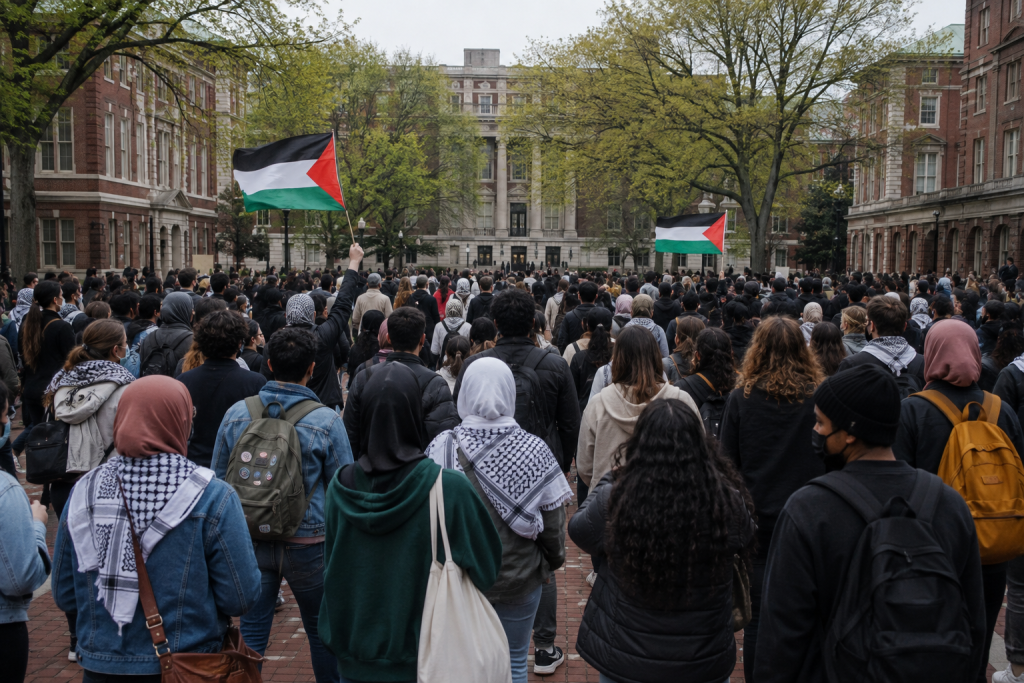
The research illuminates this dynamic through the work of Dr. Kobby Barda, a Senior Researcher at the Jewish People Policy Institute (JPPI) and a lecturer at the Holon Institute of Technology (HIT). Barda focuses on Metro Detroit, Michigan, where municipalities like Hamtramck and Dearborn have become fascinating political laboratories. In Hamtramck, which elected an entirely Muslim city council, the local government passed a resolution in 2023 restricting Pride and group flags on public property to maintain official “neutrality”. Concurrently, Dearborn witnessed intense grassroots mobilizations and school board controversies over the inclusion of LGBTQ-themed materials in public school curricula.
Barda’s analysis demonstrates that these local clashes expose the inherent limits of intersectional politics. At the elite federal level, progressive actors and Muslim political figures managed to paper over deep ideological differences by relying on shared platforms, with anti-Zionism serving as a geopolitical “glue” that united them against a common external enemy. Yet, when those abstract ideas translated into immediate, localized moral conflicts over child protection, public symbolism, and family structures, the alliance buckled under the strain.
To rigorously decode voter behavior, the study integrates sociological frameworks, specifically applying Albert O. Hirschman’s “Exit, Voice, and Loyalty” model. Barda shows how Muslim voters signaled a structural de-alignment from the Democratic consensus through distinct behavioral pathways: “exit” via switching to Republican candidates, and “voice” via protest voting for third-party alternatives.
The study’s empirical data highlights the staggering magnitude of this shift. In Hamtramck, support for the Democratic presidential nominee plummeted from 85.4% in 2020 to 46.2% in 2024, while Donald Trump surged to 42.7% and the Green Party’s Jill Stein captured 9.0%. Similarly, in Dearborn, the Democratic vote share dropped from 68.7% to 36.3%, with Trump leading at 42.5% and Stein securing a remarkable 18.4%. These figures, derived from a strict triangulation of official precinct-level returns and targeted voter surveys (such as CAIR and ISPU), underscore the severe electoral cost of the coalition’s collapse.
The broader implication of this study is striking: the assumption that shared minority status and progressive identity politics can indefinitely override deep-seated religious and moral convictions has been empirically challenged. When traditionalist Muslim voters felt their domestic and familial norms were threatened by progressive educational and cultural mandates, they chose to prioritize moral boundary-making over historical partisan loyalty. By dissecting these local institutional battlegrounds through a sophisticated sociological lens, Dr. Barda’s research offers a sharp, objective perspective on the shifting architecture of American coalition politics and the unprecedented challenges facing the traditional progressive “big tent”.
For the full article in the journal Israel Affairs, click here.