
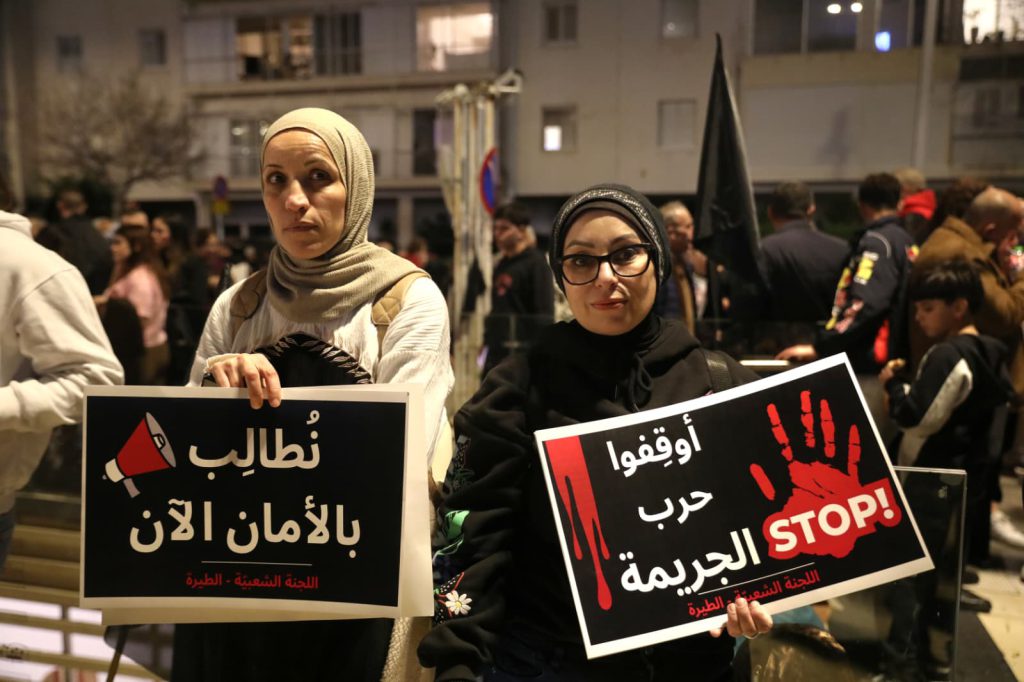


Indifference to the shocking rise in murders of Arab citizens is not only a strategic error, but a moral stain on Israeli society.
We are only at the beginning of February 2026, one month into the year, and the numbers are horrific. Just yesterday, three more young men were murdered in cold blood, and since the start of the year, 31 people have been killed in Israel’s Arab society. Nearly one murder a day. 2025 was the deadliest in the country’s history, with 252 murders – an unimaginable figure that places Israel’s Arab community alongside countries such as Mexico and Colombia in homicide rates.
But in Israel, these statistics hit a wall of indifference. For many Israelis, this is “an Arab problem” that might also be of interest to a few “leftists.” This indifference is a strategic and first-order moral mistake, and it is even more dangerous when it comes from those who constantly preach “governance” and “sovereignty.” Anyone who thinks the rampant violence in Arab towns is “their problem” is, in effect, abandoning Israeli sovereignty in significant parts of the country. You cannot sustain a “state within a state.” We cannot have a Wild West in the Galilee (where about 42 percent of last year’s murders occurred) and expect the rest of Israel to remain safe and law-abiding. A vacuum of governance cannot be contained within Kafr Qasim’s municipal border.
This approach poses a direct security threat to all Israeli citizens. The illegal weapons used today to settle scores between clans could tomorrow be turned against security forces or civilians in mixed cities. Worse still, the crime organizations that have flourished under this neglect no longer limit themselves to “internal debt collection.” They take over state tenders, extort Jewish contractors and farmers in the Negev and the north through protection rackets, and affect both public security and the cost of living for all of us. When the Israel Police only manages to solve about 15% of the murder cases in Arab society, they project weakness – and in the Middle East, weakness is an invitation to attack. Deterrence eroded in the face of crime families in Jaljulia will not be magically restored when confronting crime in Netanya or nationalist terror in Jerusalem. Sovereignty is not a buffet. You cannot choose to enforce it only where it is convenient and pleasant. Policing vacuums are ultimately filled by lawless militias.
Beyond the clear security and governance interest, there is also a Jewish moral issue that cannot be ignored. A Jewish state cannot accept a reality in which blood is spilled like water in its streets, even when that blood is not Jewish. The data also shows a shocking rise in the murder of innocent women and children. Indifference in the face of this daily screaming is a moral stain on Israeli society as a whole. A posture of “sitting idly by” in the face of this horror does not reflect national strength, but a collapse of values. Some blame this reality on “Arab culture.” Indeed, according to the JPPI Israeli Society Index, 33% of Israelis believe the main reason for the scourge of Arab-on-Arab violence is “a cultural matter.” But that is beside the point. As long as this is the reality, confronting violence in Arab society is the responsibility of the state and the police – and it is a supreme national interest. The reason is simple: you cannot maintain a strong army, a thriving economy, and a healthy society while parts of the country are run by criminal gangs.
It is time to change the paradigm: an iron fist against crime, aggressive confiscation of illegal weapons, and meaningful cooperation with leaders of the Arab sector. This must go hand in hand with addressing the root causes – neglect and resource gaps – that worsen the situation and serve criminals rather than the State of Israel. Arabs who want to live have a clear interest in this, but first and foremost, it is an existential interest of Israel as a sovereign state governed by the rule of law. Whoever gives up on enforcing the law in Taybeh will eventually forfeit governance in Tel Aviv.