

More than Half Say U.S. Action in Iran Did Not Go Far Enough.
Main Findings
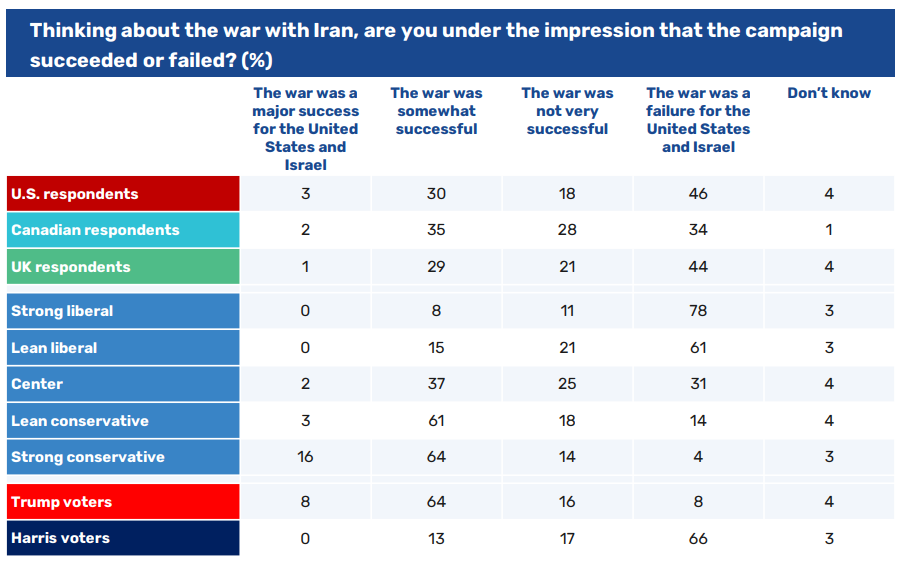
- Views of the Iran campaign: A large majority of Harris voters see it as a failure, while a large majority of Trump voters see it as a success.
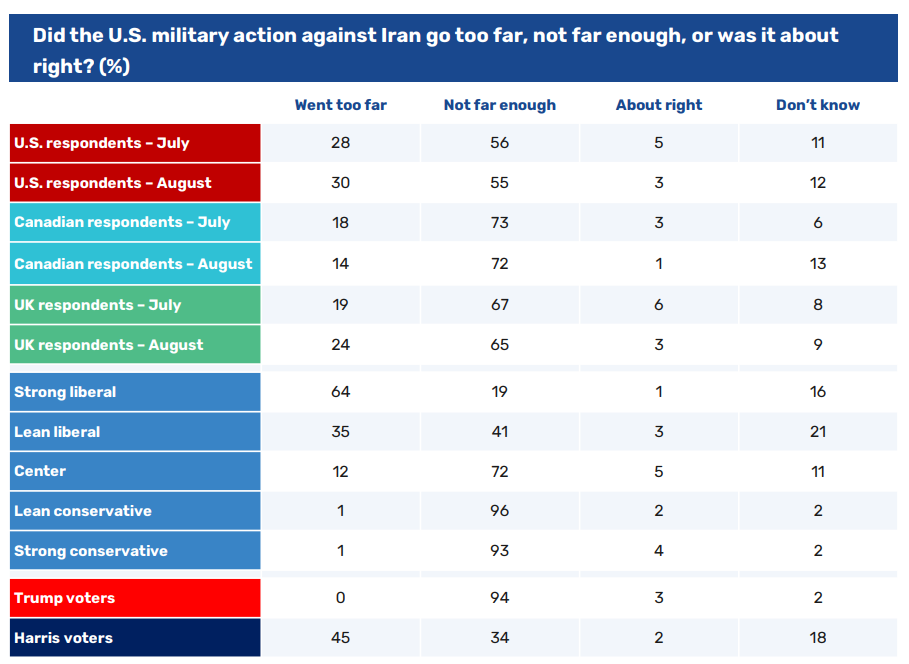
- A consistently hawkish stance: More than half of respondents say the U.S. action against Iran “did not go far enough,” compared with nearly one-third who say it “went too far.”
- Netanyahu’s leadership on Iran: His leadership rating continues to erode moderately, with a sharp political divide – an overwhelming majority of strong conservatives rate his leadership positively, while an overwhelming majority of strong liberals rate it negatively.
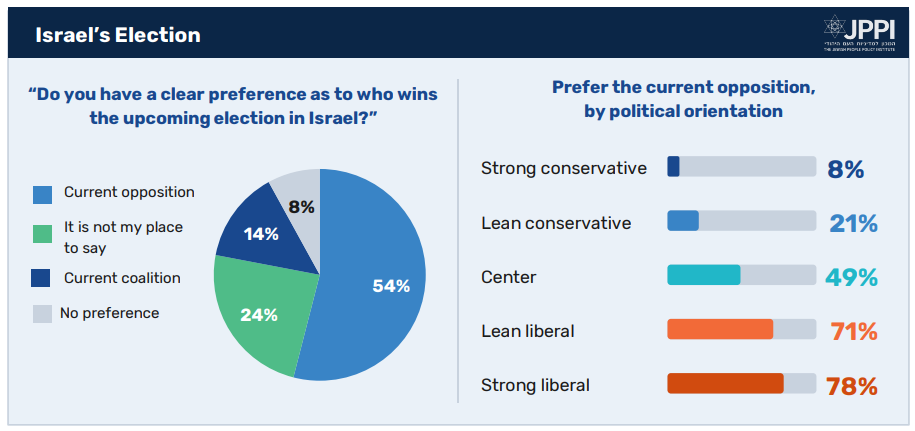
- Israel’s election: A majority of respondents prefer an opposition victory, compared with roughly one in seven who prefer the current coalition.
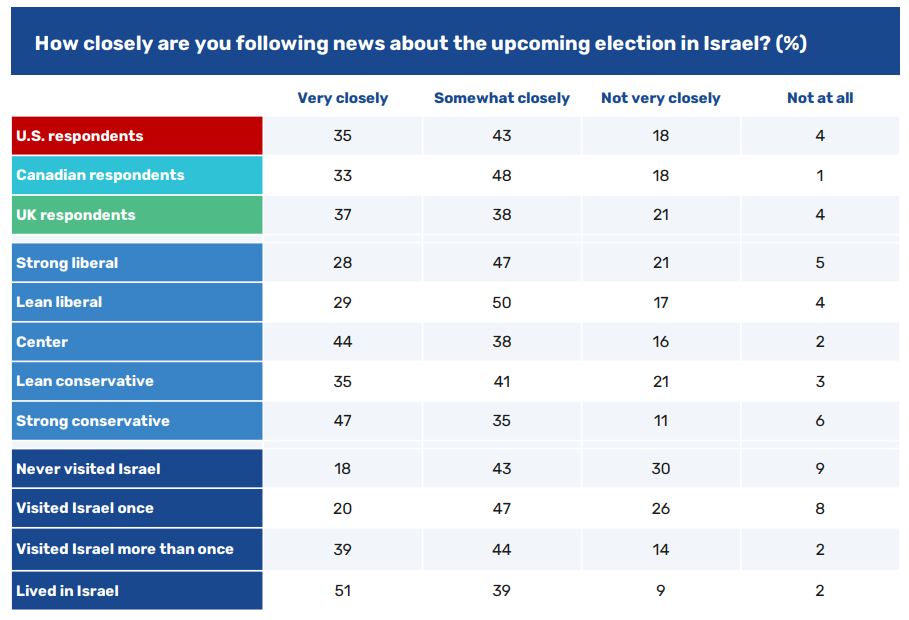
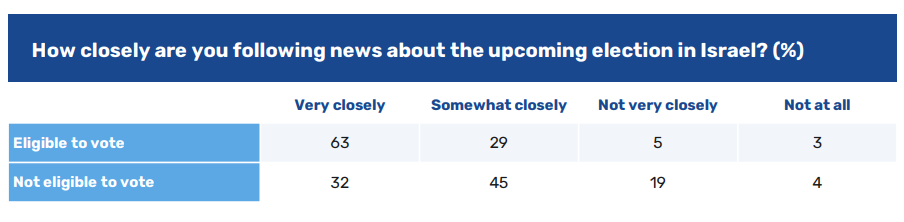
- Following but not voting: Three-quarters follow the Israeli election, but only about one in ten respondents are eligible to vote.
- Two-thirds view votes cast by Israelis living abroad as legitimate. Relatively few know Israelis who plan to travel to Israel to vote.
- Future of Judea and Samaria (the West Bank): Connected U.S. Jews lean toward establishing a Palestinian state, in contrast to Israeli Jews, among whom annexation is the most widely supported option.
- Moral map: The connected U.S. Jews surveyed are considerably more permissive than Israeli Jews on most issues, but less supportive of the death penalty.
- Jewish identity in the Diaspora: Nearly half conceal their Jewish identity while traveling at least sometimes.
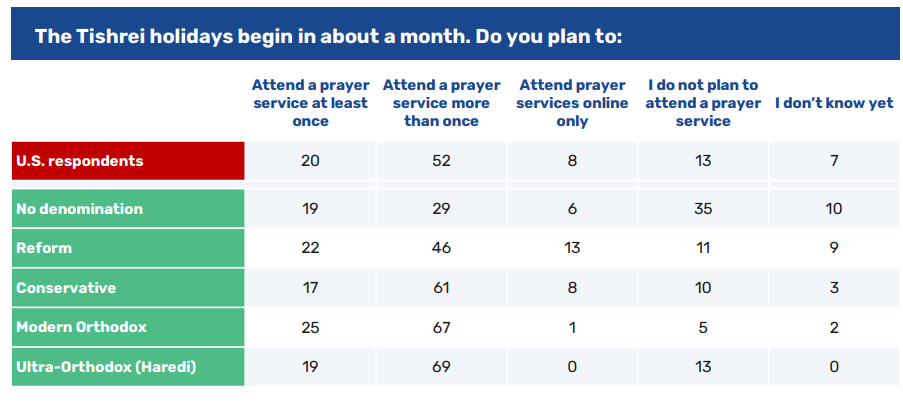
- Ahead of the holidays, three in four respondents intend to attend prayer services in person (not remotely).
To download a PDF file, click here.
Survey Context and Methodological Note
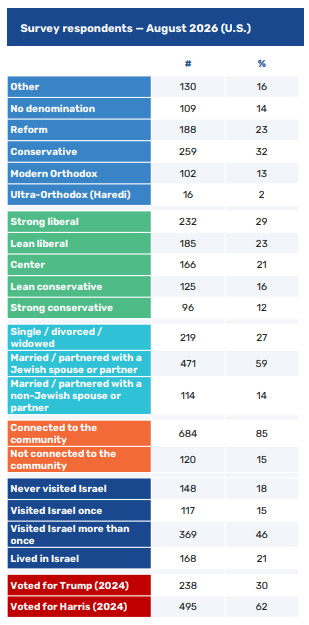
Survey context: August data was collected about a month after the signing of the agreement that brought the campaign against Iran to an end, as public debate continued over its results and the leadership that conducted it. At the same time, President Trump’s initiative to disarm Hamas in Gaza occupied a prominent place in public discourse, alongside preparations for the congressional midterm elections and Israel’s election, expected in the fall. Methodological note: In recent months, we have also been surveying Jews in Canada and the United Kingdom. In August, 136 respondents participated from Canada and 68 from the UK. These findings should be interpreted with caution because of the small sample sizes. All breakdowns by ideology, denomination, or vote refer to U.S. Jews only.
The Iran War: Disillusionment Continues
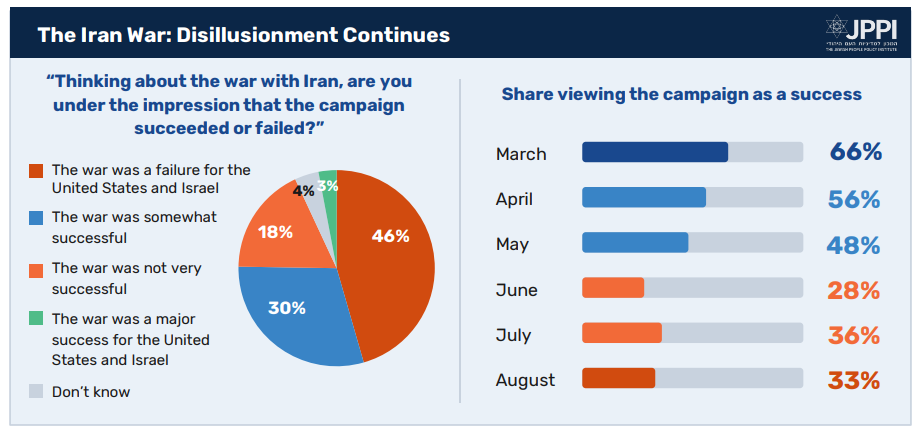
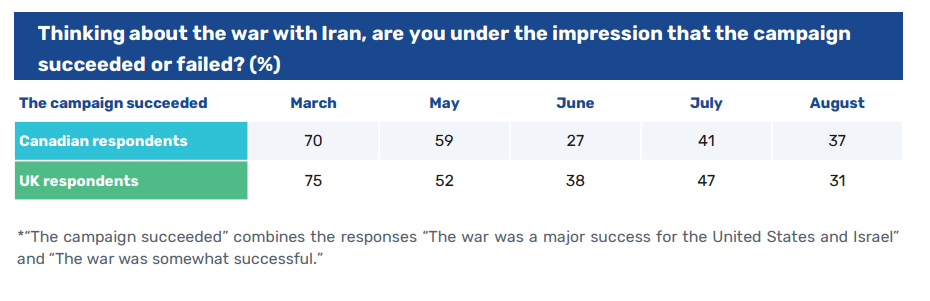
As Operation Roaring Lion recedes, connected U.S. Jews’ assessment of the campaign’s success continues to erode. In March 2026, two-thirds (66%) viewed it as successful. Since then, the figure has declined almost steadily – to 56% in April, 48% in May, a low of 28% in June, and 36% in July. In August, just one-third (33%) view it as successful, while nearly two-thirds (64%) view it as a failure. Among strong liberals, an overwhelming 89% view the campaign as a failure, while four in five strong conservatives (80%) still view it as a success. The divide is even sharper by 2024 presidential vote: 73% of Trump voters view the campaign as successful, while 84% of Harris voters see it as a failure. The trend is evident across all three communities: in Canada, the share viewing the campaign as a success fell from 70% in March to 37% in August; in the UK, from 75% to 31%.
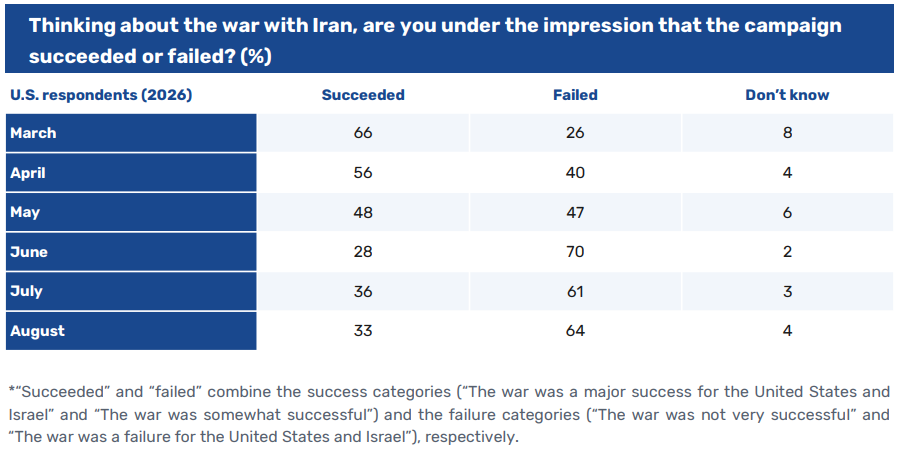
The same substantial decline is evident in Canada and the UK. In Canada, the share viewing the campaign as successful fell from 70% in March to a low of 27% in June, before rising slightly to 37% in August. In the UK, it declined from 75% in March to 31% in August. The pattern thus extends across all three communities, although the degree of erosion varies. Despite the erosion in assessments of the campaign’s outcome, the majority’s view of the military action itself remains positive and stable compared with last month. Among connected U.S. Jews, 55% say the U.S. action against Iran “did not go far enough,” compared with 30% who say it “went too far” and just 3% who say it was “about right.” Thus, criticism of the campaign does not reflect opposition to the use of force; for many, it reflects a belief that the force employed was not decisive enough.
A breakdown by political orientation shows that nearly two-thirds (64%) of strong liberals say the action went too far, while overwhelming majorities of both lean conservatives and strong conservatives (93%-96%) favor a tougher approach. The voting divide is similarly pronounced: 94% of Trump voters say the action did not go far enough, compared with 45% of Harris voters who say it went too far. The hawkish view is also prominent in Canada (72%) and the UK (65%).
Leadership Ratings on Iran
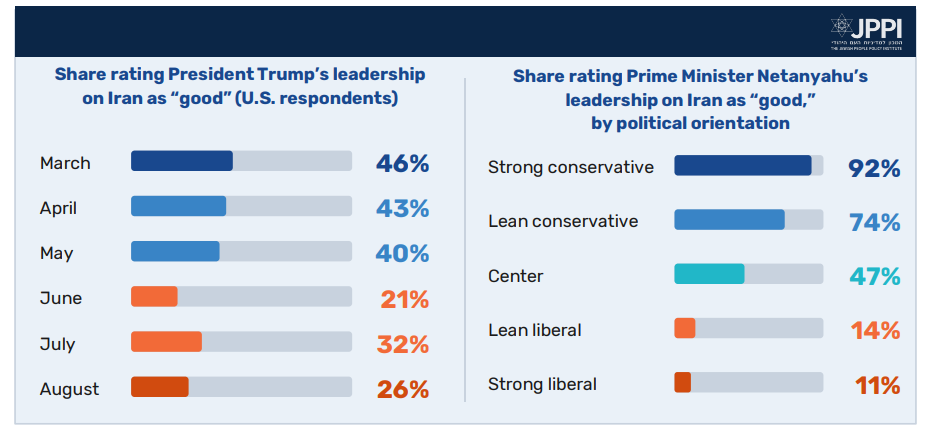
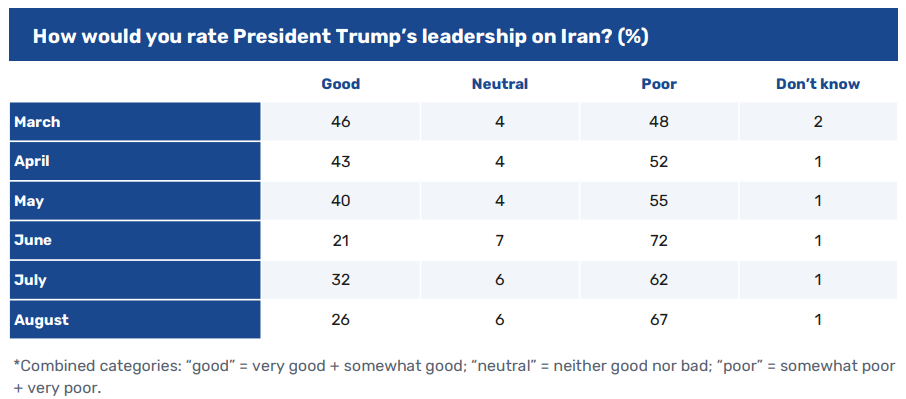
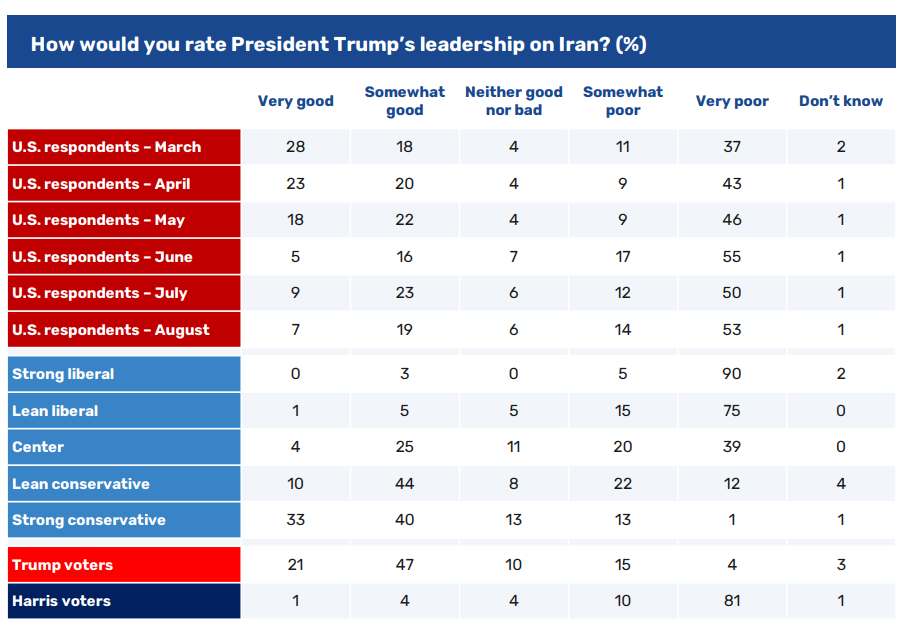
As assessments of the campaign’s success eroded, so too did evaluations of the leaders who conducted it. President Trump’s leadership rating on Iran fell from 46% “good” in March to a low of 21% in June, partially recovered to 32% in July, and declined again this month to 26%. Two-thirds (67%) rate his leadership as “poor,” with a majority rating it “very poor.” July’s rebound, in other words, did not hold. Political orientation explains most of the variation: among strong conservatives, nearly three-quarters (73%) rate him positively, as do just over half (54%) of lean conservatives. Among strong liberals, by contrast, 90% rate his leadership as “very poor.” Among centrists, 39% rate his leadership as “very poor,” compared with 29% who rate it positively. The divide by 2024 vote is also sharp: 68% of Trump voters rate his leadership positively, while 81% of Harris voters rate Trump’s leadership on Iran as “very poor.”
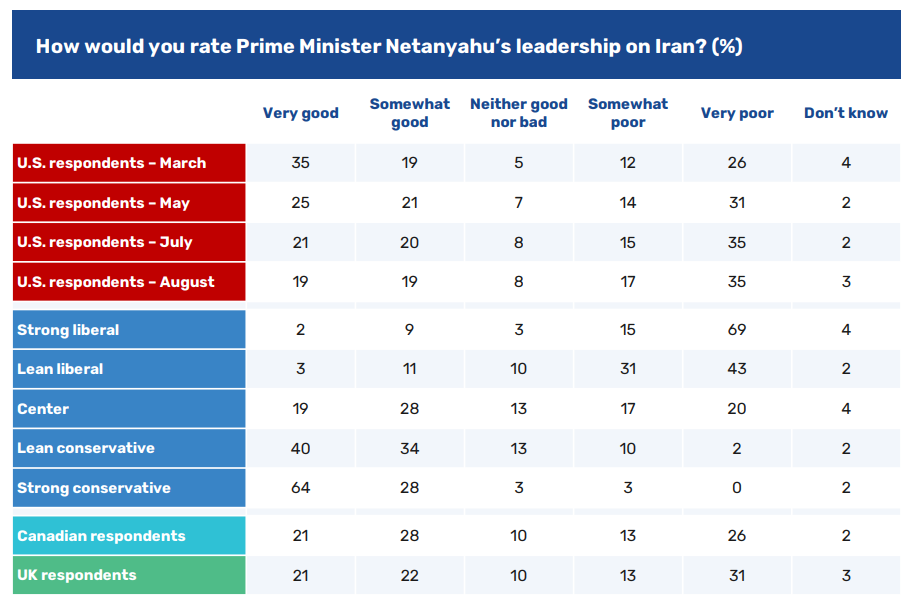
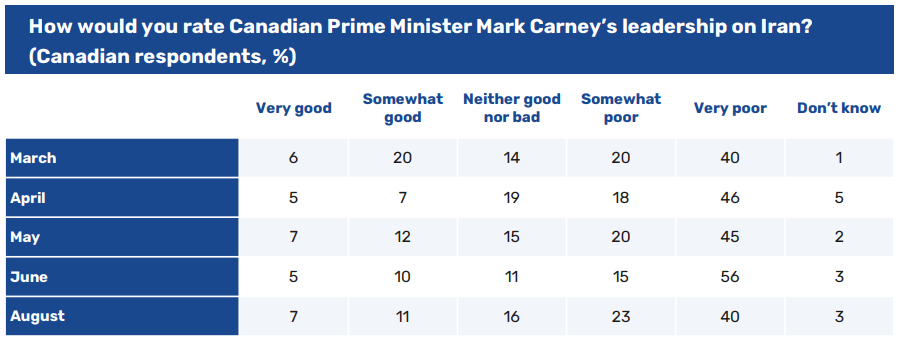
Prime Minister Netanyahu’s leadership rating on Iran has eroded slowly but steadily from 53% rating his leadership as “good” in March to just 38% this month, while 52% now rate his leadership as “poor.” Unlike Trump, Netanyahu did not experience a sudden collapse; rather, his rating has eroded gradually. The overall figure masks polarization even sharper than that surrounding Trump: 92% of strong conservatives rate Netanyahu positively, while 84% of strong liberals rate him negatively. Centrist respondents lean slightly positive (47% good versus 37% poor). Canadian Jews rate Netanyahu somewhat more positively than their U.S. counterparts, with half rating his leadership as “good”; the UK picture is similar to the U.S., with four in ten rating him positively. In Canada and the UK, local leaders receive low ratings on Iran: in Canada, Prime Minister Mark Carney’s rating remains low and stable (18% “good”, 63% “poor”), while in the UK, Andy Burnham receives 16% positive, 28% middle category, and half negative.
Israel’s Election
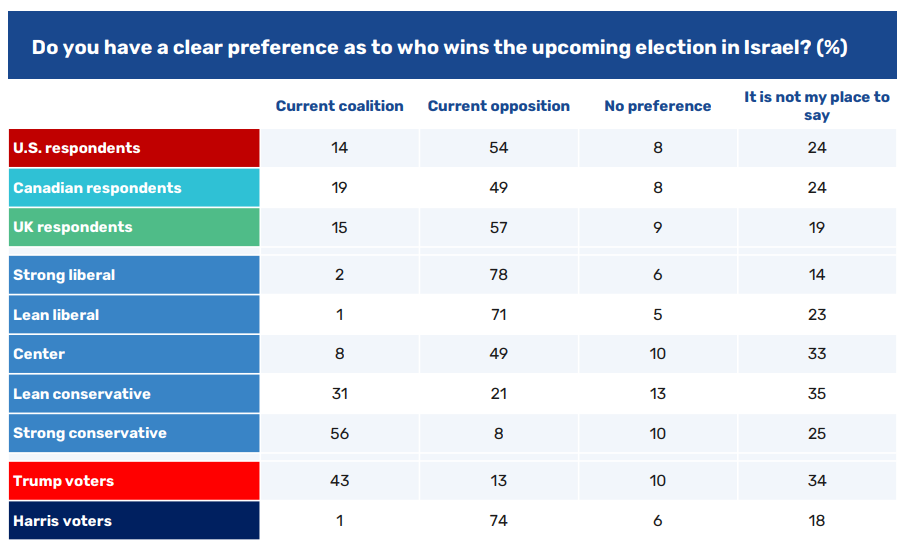
With Israel’s election expected in two months, this month we examined how connected U.S. Jews view it. Attention is high: 78% follow election news very or somewhat closely, although only 8% hold Israeli citizenship and are eligible to vote. When asked whom they would prefer to win, respondents lean toward a change of government: a majority (54%) prefer the current opposition, compared with 14% who prefer the current coalition; 8% have no preference, and 24% say it is not their place to say. Preference largely mirrors ideological orientation and the composition of the panel, which has a Democratic majority. Among strong liberals, 78% support the opposition in Israel, as do 74% of Harris voters in the 2024 election. At the other end of the ideological spectrum, 56% of strong conservatives and 43% of Trump voters prefer the coalition. Even among them, however, the preference is not overwhelming, and a sizable 34% of Trump voters decline to take a position. Canadian (49%) and UK (57%) respondents resemble their U.S. counterparts in their support for a change of government.
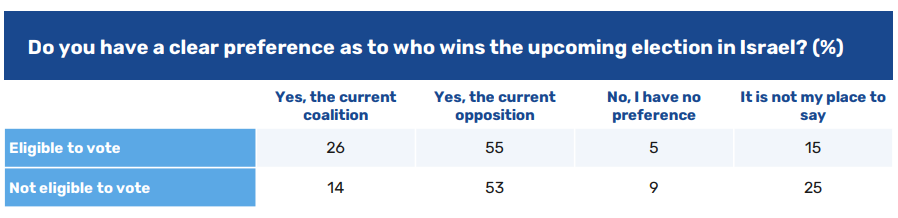
Breaking respondents down by eligibility to vote in the upcoming Israeli election sharpens the picture. Support for the current opposition remains stable and dominant in both groups: similar majorities of eligible voters (55%) and those not eligible to vote (53%) prefer an opposition victory. Differences emerge, however, in support for the coalition and in reluctance to express a view. Among eligible voters, support for the current coalition is nearly twice as high as among those who are ineligible (26% versus 14%). By contrast, those who are not eligible to vote are considerably more likely to refrain from taking a position: one-quarter (25%) say “it is not my place to say,” and the share with no preference is almost twice as high. In other words, eligibility to vote sharpens preferences and strengthens support for the coalition somewhat, without eroding the opposition’s advantage.
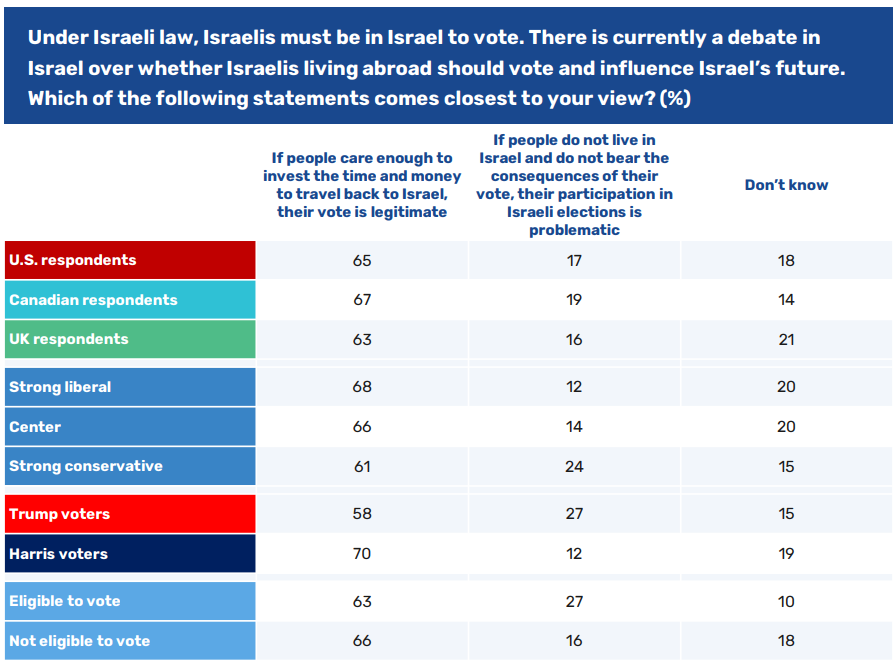
In a follow-up question, we examined connected U.S. Jews’ views of Israelis living abroad who plan to travel to Israel to vote. The subject has generated lively debate in Israel in recent months over the legitimacy of such voting, and initiatives such as “Vote&Fly” have emerged to encourage Israelis abroad to travel to Israel to cast ballots and thereby broaden participation in the election. Nearly two-thirds (65%) of respondents say that if Israelis care enough to invest the time and money required to travel to Israel and vote, their vote is legitimate, compared with 17% who say that voting by people who do not live in Israel and do not bear the consequences of their vote is problematic. Another 18% answer “don’t know.” Majorities of both Trump voters (58%) and Harris voters (70%) regard voting by Israelis living abroad as legitimate. However, 27% of Trump voters see such voting as problematic, more than twice the share among Harris voters (12%). Notably, panel participants who are eligible to vote in Israel are more likely than those who are not eligible to view such voting as potentially problematic.
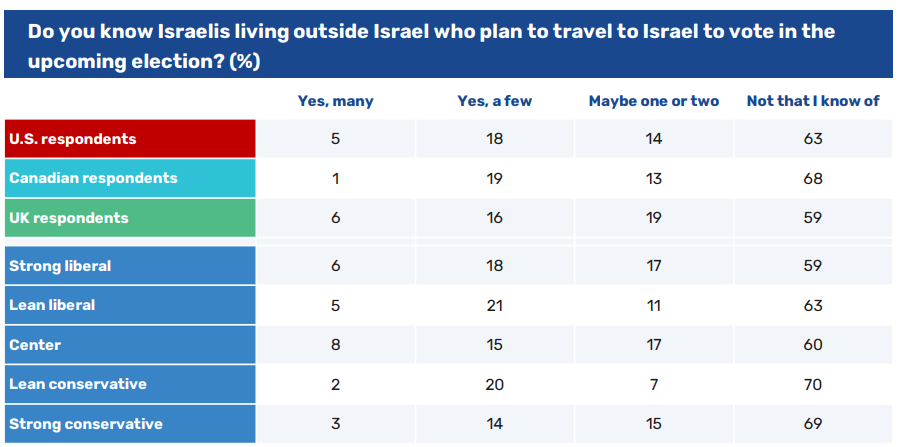
Most panel participants say they do not know Israelis living outside Israel who plan to travel to Israel to vote in the upcoming election (63% in the United States, 68% in Canada, and 59% in the UK). Only a few percent of respondents say they know “many” Israelis planning to come vote. Looking at all forms of acquaintance (“a few,” “one or two,” and “many”), just over one-third of respondents (37% in the United States, 33% in Canada, and 41% in the UK) know Israelis who plan to travel to Israel to vote. A breakdown by political orientation shows broadly similar patterns across the ideological spectrum, with only modest differences in familiarity with the phenomenon. In every political camp, a majority say they do not know Israelis planning to travel to Israel to vote, with unfamiliarity somewhat more pronounced among conservatives. The combined share who know Israelis planning to travel reaches a high of 41% among strong liberals, suggesting that discussion of traveling to vote is somewhat more common in center-left circles, but remains limited overall.
Respondents’ interest in the upcoming election reflects broad and sustained attention to Israeli politics. Nearly eight in ten (78%) say they follow news about the election – 35% “very closely” and 43% “somewhat closely.” By contrast, only 18% say they do not follow it very closely, while the share who do not follow it at all remains marginal. A breakdown by political orientation reveals meaningful differences in the intensity of attention, with respondents in the center and on the conservative right following the election more closely than those on the liberal wing. Strong conservatives are the most likely to follow the election “very closely” (47%), followed by centrists (44%) and lean conservatives (35%). Among liberals, the share following very closely is substantially lower – 28% among strong liberals and 29% among lean liberals – with the largest shares instead following “somewhat closely” (47% and 50%, respectively). Even so, when “very closely” and “somewhat closely” are combined, interest remains high (above 75%) across the ideological spectrum, and disinterest is minimal in every group.
A breakdown by respondents’ direct ties to Israel shows a clear relationship between those ties and the intensity with which they follow the election. Among respondents who previously lived in Israel, 51% follow the election “very closely,” and the combined share following it reaches 90%. A similar pattern appears among those who have visited Israel more than once: 39% follow very closely and another 44% somewhat closely. As direct ties weaken, intensive attention declines. Among those who have visited Israel only once and those who have never visited, the share following “very closely” falls to about half that level (20% and 18%, respectively), alongside higher shares who do not follow very closely (26% and 30%) or do not follow at all (8% and 9%). The data also reveals a clear gap between panel participants who are eligible to vote (92% follow, 63% “very closely”) and those who are not (77% follow, 32% “very closely”).
The Future of Judea and Samaria (the West Bank)
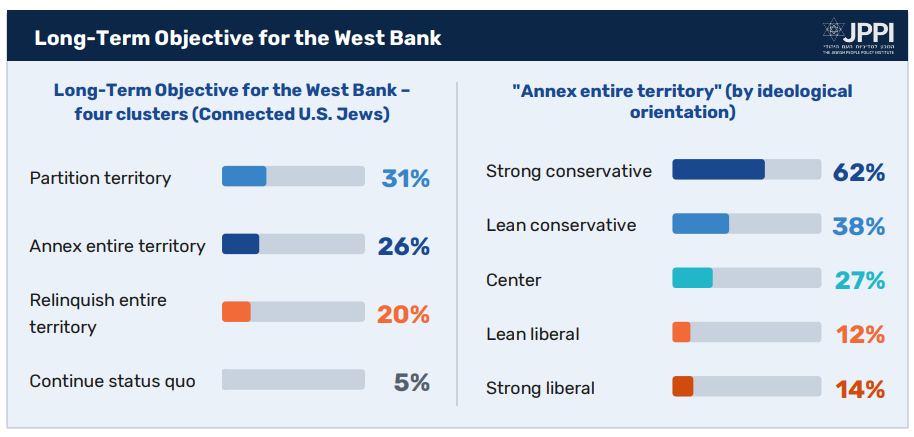
This month, panel participants were asked the same question presented in JPPI’s Israeli Society Index about what they view as the realistic long-term objective for the future of Judea and Samaria (the West Bank) and the settlements there. The wording asked respondents to choose an outcome that is “both feasible and preferable, even if it can only be achieved many years from now.” Respondents were presented with ten options, condensed from proposals voiced by different Israeli public figures. These can be grouped into four clusters: annexation of the entire territory (three variants differing in the status of the Arab population); partition of the territory (between Israel and Jordan or a Palestinian state); transfer of the entire territory to another entity; and continuation of the status quo. Comparing connected U.S. Jews with Israeli Jews reveals a clear difference: among Israeli Jews, the balance of opinion tilts toward annexation (38%), while among connected U.S. Jews it tilts toward partition (31%) or relinquishing the entire territory (20%).
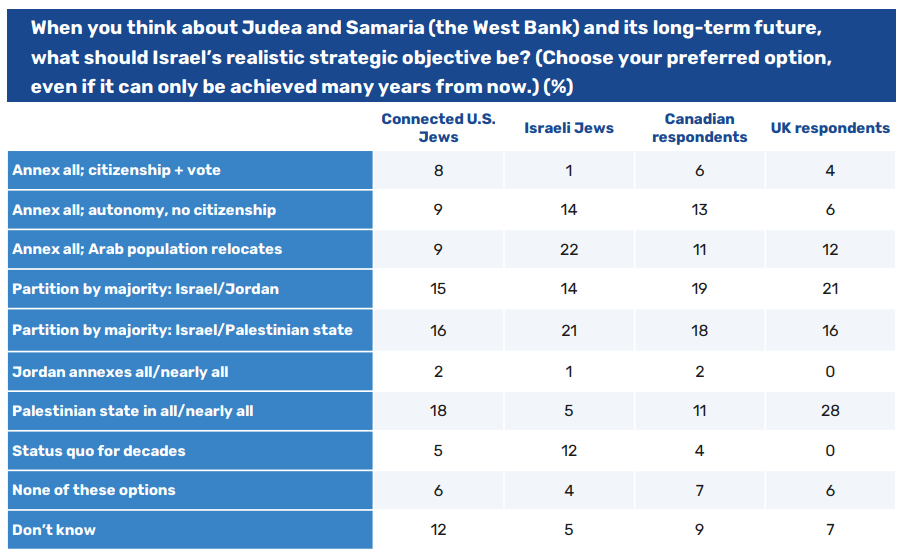
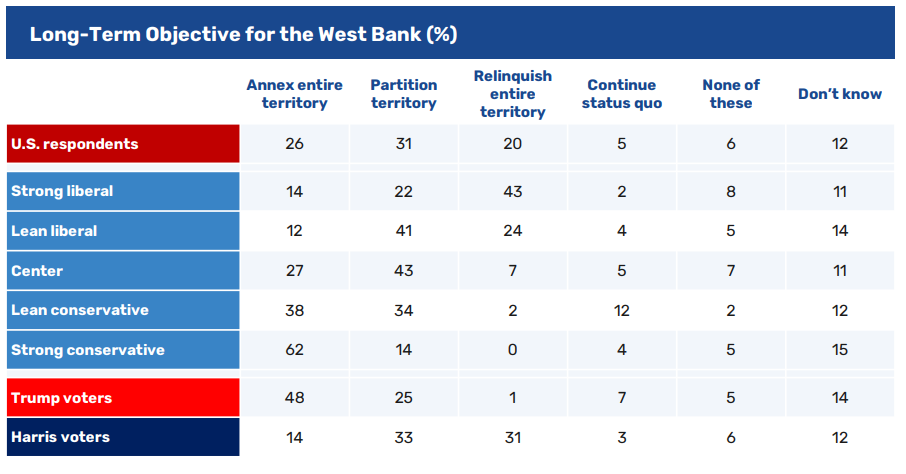
The gap concerns not only overall support for annexation (26% among connected U.S. Jews versus 38% among Israeli Jews), but also the form annexation takes. Among Israeli supporters of annexation, the most common version is one in which “the Arab population moves to other countries” (22%). Among connected U.S. Jews, only 9% choose this option. Conversely, the single most common option among connected U.S. Jews is establishing a Palestinian state throughout the entire territory (18%), compared with only 5% among Israeli Jews. The ideological divide in the U.S. panel is stark: among strong liberals, 43% choose an outcome in which Israel relinquishes the territory (most support a Palestinian state throughout it), while 62% of strong conservatives choose annexation of the entire territory. The difference is also evident by vote: 48% of Trump voters choose annexation, compared with 31% of Harris voters who choose relinquishment. Connected Canadian Jews lean somewhat more toward annexation than their U.S. counterparts, while UK Jews are the most dovish – 28% choose a Palestinian state throughout the entire territory.
Moral Map: Connected U.S. Jews and Israeli Jews
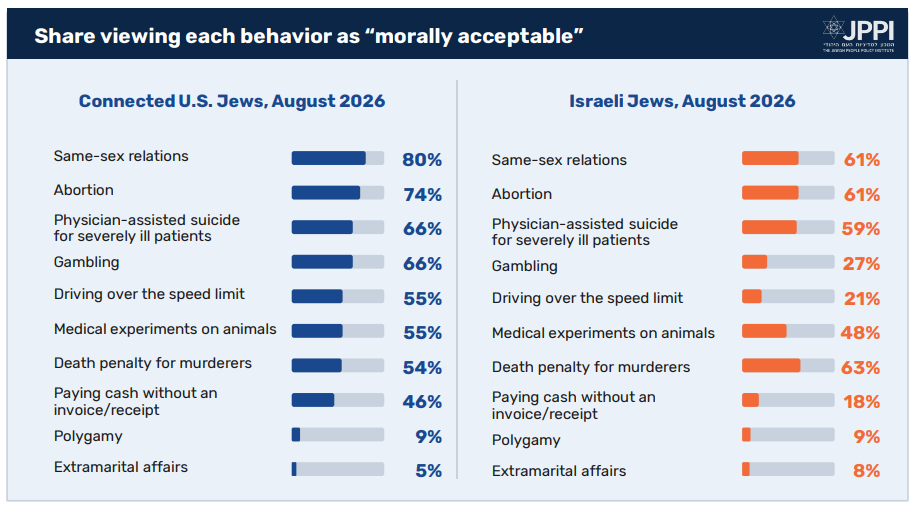
Once a year, we present respondents with a series of ten behaviors and ask them, independently of what is legal or illegal, whether they consider each behavior or activity “morally acceptable” or “morally unacceptable” according to their own worldview. The series is based on a similar questionnaire used by Gallup in the United States, enabling three comparisons: with Israeli Jews, with the U.S. public as a whole, and with connected U.S. Jews surveyed last year. A comparison of moral attitudes among connected U.S. Jews and Israeli Jews shows substantial stability over time alongside cultural and structural differences between the two communities. The connected U.S. Jews surveyed express clearly more liberal and permissive attitudes on social and personal issues: 80% regard same-sex relations as morally acceptable (compared with 61% of Israeli Jews), and 74% say the same of abortion (compared with 61%).
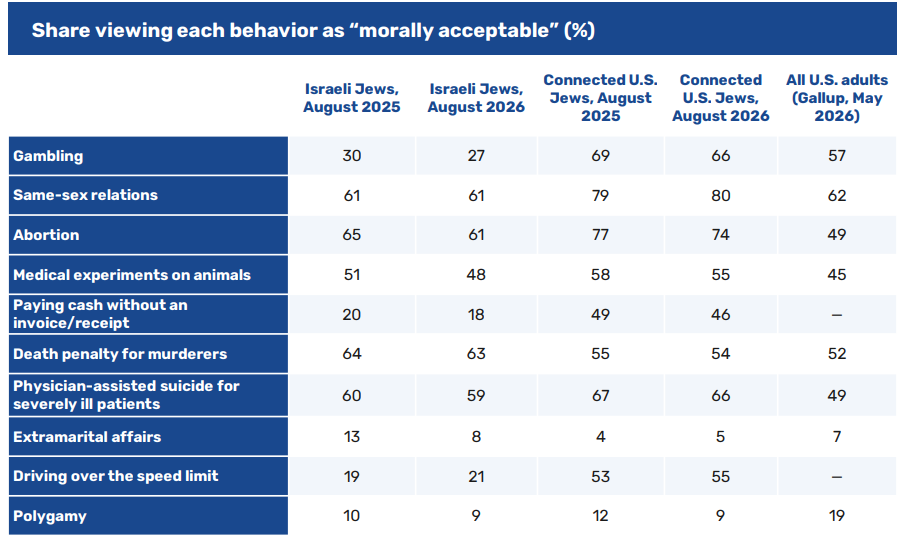
Even larger gaps appear in everyday and civic behaviors: 66% of the connected U.S. Jews surveyed regard gambling as morally acceptable and 55% say the same of driving over the speed limit, compared with 27% and 21%, respectively, of Israeli Jews. Similarly, 46% of the connected U.S. Jews surveyed regard paying cash without an invoice or receipt as morally acceptable, compared with just 18% of Israeli Jews. The only issue on which Israeli Jews express substantially greater acceptance is the death penalty for murderers, regarded as morally acceptable by 63% of Israeli Jews compared with 54% of the connected U.S. Jews surveyed.
Comparing the connected U.S. Jews surveyed with the U.S. public as a whole in the Gallup survey shows that the connected Jewish sample is consistently more liberal than the general public, especially on questions of individual liberty and end-of-life decisions. Abortion is regarded as morally acceptable by a much larger share of the connected U.S. Jews surveyed than of the general public (74% versus 49%), as is physician-assisted suicide for severely ill patients (66% versus 49%) and same-sex relations (80% versus 62%). On some issues, however, there is broad cross-community consensus: extramarital affairs are viewed as morally unacceptable by all groups, with only negligible shares considering them acceptable. Polygamy is also broadly rejected (9% among both Israeli Jews and the connected U.S. Jews surveyed), although acceptance among the U.S. public as a whole is twice as high (19%).
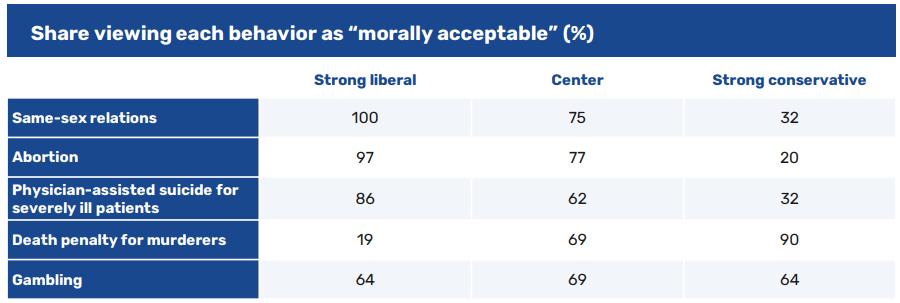
As expected, moral judgments vary with ideology. On issues commonly associated with liberal values, the gap between the poles is very wide: same-sex relations are regarded as morally acceptable by all strong liberals (100%) compared with one-third (32%) of strong conservatives; on abortion, the figures are 97% and 20%, respectively. The death penalty reverses the pattern: 90% of strong conservatives regard it as morally acceptable, compared with just 19% of strong liberals. By contrast, on less ideologically polarized issues, such as gambling and driving over the speed limit, the gap nearly disappears.
Jewish Identity
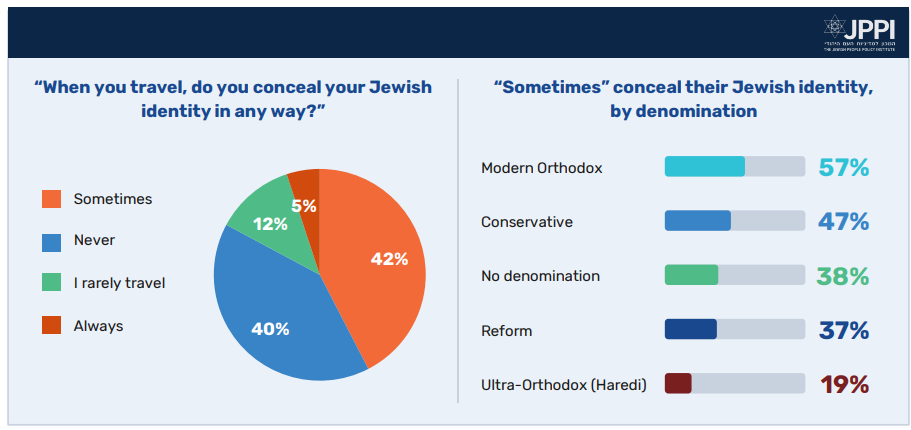
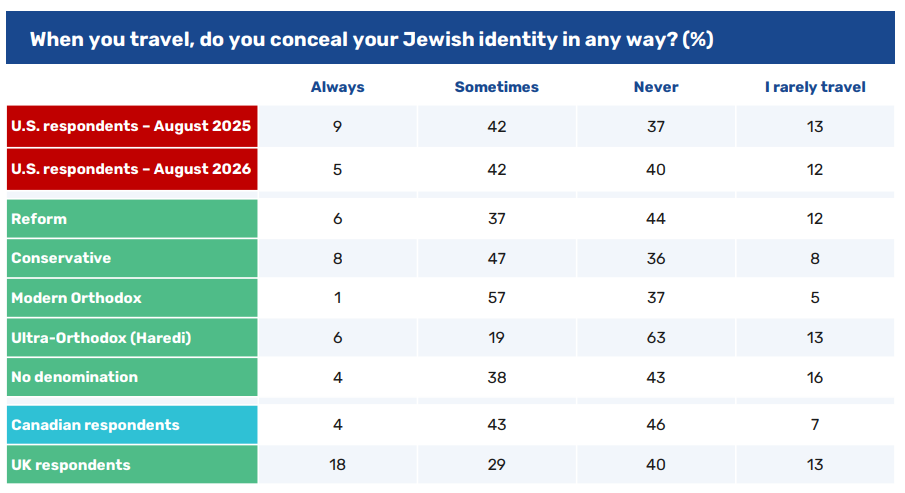
As we did during last summer’s travel season, this month we examined whether panel participants conceal their Jewish identity when traveling. Nearly half (47%) do so at least sometimes – 5% “always” and 42% “sometimes” – while 40% never conceal their Jewish identity. The year-over-year comparison suggests a modest decline in concealment: the share who “always” conceal their identity fell from 9% in August 2025 to 5%, while the share who “never” do so rose slightly. By denomination, Modern Orthodox respondents stand out for the highest share answering “sometimes” (57%). UK respondents are the clearest outlier, with a much higher share than the other groups answering “always” (18%).
Ahead of the Holidays
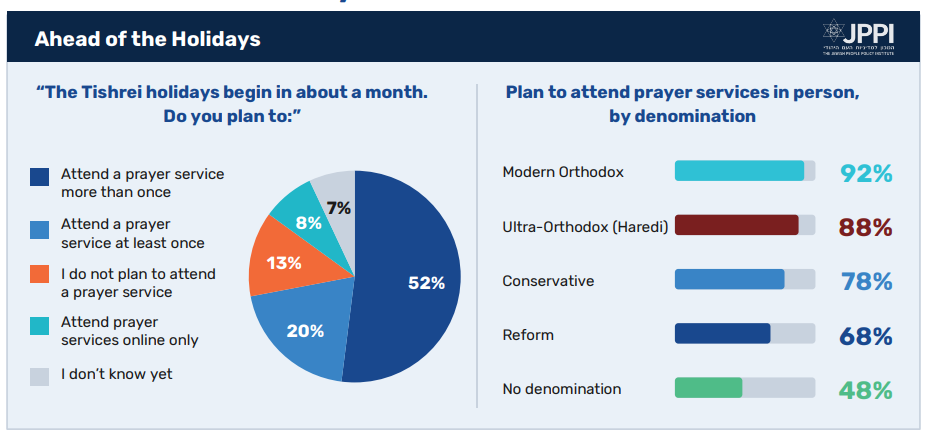
Ahead of the High Holidays, which begin roughly a month after the survey was conducted, 72% of respondents plan to attend prayer services in person (20% at least once and 52% more than once), a rate essentially unchanged from last year. As expected, denominational differences are pronounced: 92% of Modern Orthodox respondents and 88% of Haredi respondents plan to attend in person, compared with just 48% of those with no denominational affiliation. Respondents with no denominational affiliation also have the highest share who do not plan to attend prayer services at all (35%).
Survey Data and Implications
This report is based on a survey of participants in JPPI’s Voice of the Jewish People respondent panel, conducted August 15-20, 2026. The survey primarily reflects the views of “connected” Jews – those with relatively strong ties to the Jewish community, Israel, and/or Jewish identity. The sample is not representative of all U.S. Jews. The survey included 804 U.S. respondents, 136 Canadian respondents, and 68 UK respondents. Unless otherwise noted, the results reflect U.S. respondents only; Canadian and UK findings are presented as indicative trends because of the small sample sizes. Comparisons with Israeli Jews are based on JPPI’s August 2026 Israeli Society Index. JPPI’s Voice of the Jewish People Index survey was conducted by JPPI fellows Shmuel Rosner and Noah Slepkov, with research and writing assistance from Yael Levinovsky. Prof. David Steinberg provided statistical oversight.