

Connected U.S.Jews on the War with Iran, Trust in World Leaders, Antisemitism, the Relationship between Israel and the Diaspora, and Threats to Humanity’s Future.
Main Findings
- Half of the respondent panel characterizes the war with Iran as a failure.
- Perceptual gap: Jews in Israel are more confident than U.S. Jews regarding the war’s achievements. § Erosion of confidence in Trump deepens: most rate his performance on Iran negatively.
- Consensus in the Diaspora: antisemitism in the West is becoming a “normal” routine.
- Changing patterns of daily life: most report concealing Jewish markers and heightened vigilance.
- Most respondents believe that Israel bears substantial responsibility for the continued existence of the Jewish people in the Diaspora.
- There is broad support for investing Israeli resources in education and the strengthening of Jewish identity in the Diaspora.
- Israel as a refuge: Most respondents view Israel as a safe haven forJews.
- Most respondents feel a personal responsibility for the fate of Israeli Jews and feel that they share a common destiny.
- Like Israelis, U.S.Jews perceive nuclear weapons as the gravest threat to humanity.
- Climate-crisis perception gap: deep concern in the United States, relative indifference in Israel.
- Perceptual gap: U.S. Jews view social media as a much more serious threat than Jewish Israelis do.
To download the PDF file, click here.
Survey Background: Data for this month’s Voice of the Jewish People Index survey was collected May 14-20. Several key events over the past month shaped the survey questions and the attitudes reflected in the Index. Central among them was the extension of the ceasefire with Iran, which first took effect at the beginning of April. The continuing diplomatic pressure exerted by the U.S. administration to extend the pause and shift the center of gravity to the diplomatic arena prompted an active public discussion about the degree of trust in American and Israeli leadership and in the outcome of the campaign. At the same time, in the U.S. domestic arena, the political system accelerated its preparations for the congressional midterm elections, with U.S. involvement in the Middle East and its economic implications occupying a central place in the public discourse.
Methodological Note: In recent months, we have also begun surveying the views of Jews in Canada and the United Kingdom. In both countries, panels are being assembled and are growing, albeit slowly. In May, approximately 70 participants from the UK and approximately 130 from Canada responded to the survey. Accordingly, the data on Jewish views in these countries should be interpreted with caution. When the report presents data broken down by ideological orientation, denominational affiliation, or voting pattern, it refers only to U.S. respondents.
Support for the War with Iran
This month’s Voice of the Jewish People Index survey was conducted about a month after the ceasefire among Iran, the United States, and Israel came into effect. Shortly before the ceasefire was set to expire, President Trump announced its extension. This was the situation at the time of this writing, and it is the central context for assessing public opinion.
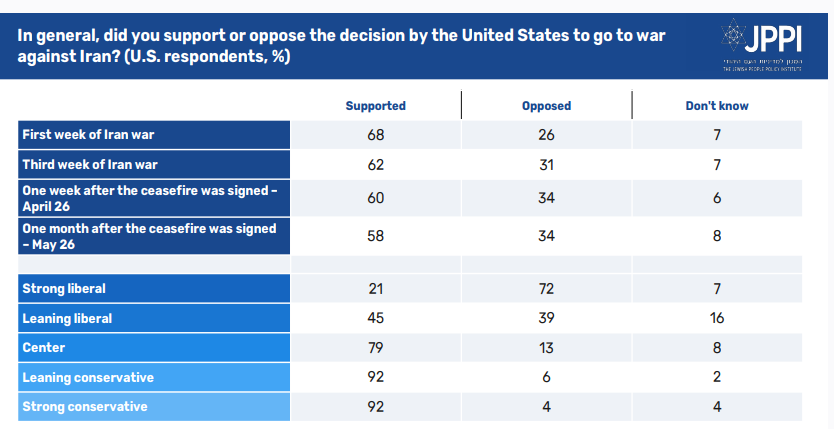
An examination of the respondent panel’s support for the war with Iran over recent months indicates relative stabilization compared with the beginning of the campaign. This month, the share of panel respondents who support the war still constitutes a 58% majority, only a slight decline from the 60% recorded last month and a cumulative decrease of 10 percentage points since the first week of the war (68%). The share opposing the campaign also remained stable, at 34%. These figures suggest that the prolongation of the ceasefire did not generate dramatic shifts in respondents’ opinions.
A breakdown by ideological orientation shows deeply polarized opinions of the war. Consensus exists at the conservative end of the ideological spectrum: both strong-conservative and leaning-conservative respondents support the move overwhelmingly (92%). Support is also high among the centrist cohort (79%), whereas the opposite picture emerges at the liberal pole, where close to three-quarters of the strong liberal cohort (72%) report having opposed the war. The leaning-liberal cohort is the most divided, with slightly more supporters (45%) than opponents (39%); 16% have not yet formed a final position on the issue.
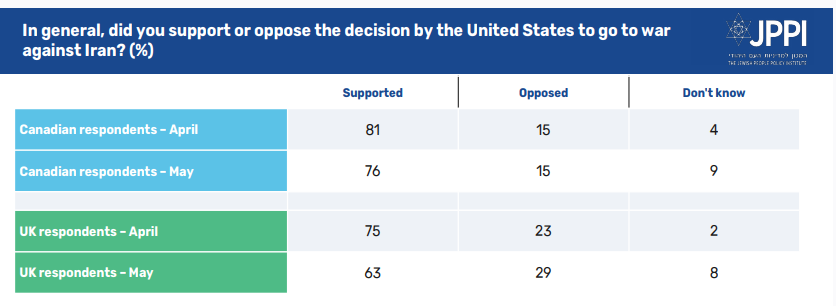
Similar to the U.S.Jews surveyed, in recent months, there has also been an erosion of support for the war among Canadian and UK respondents, against the backdrop of the extended ceasefire. Among Canadian respondents, there has been a relatively moderate five-point decline in support (from 81% to 76%), while the share of those opposed to the war remained stable (15%). Among UK respondents, support for the war fell by 12 percentage points and now stands at 63%, alongside an increase in the share who oppose it (to 29%). Despite the downward trend in both countries, a majority of respondents continue to support the decision to go to war against Iran, with Canadian respondents continuing to display the strongest support.
Success in the War with Iran
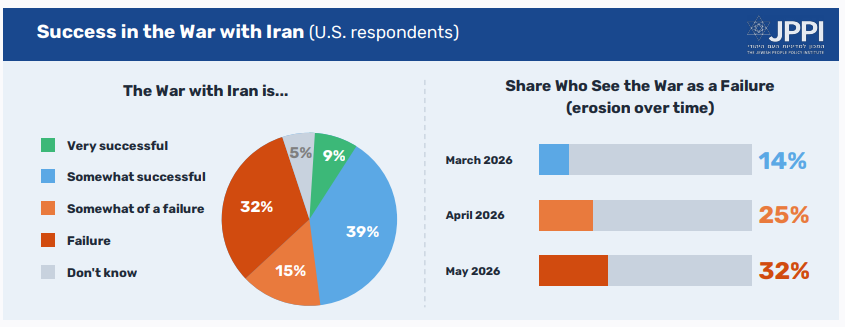
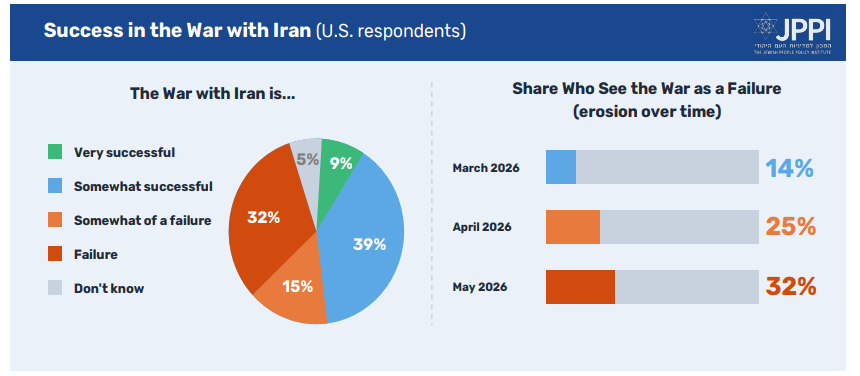
One month into the ceasefire, the respondent panel’s assessment of the war’s achievements is marked by disappointment and skepticism, with only 9% regarding its results as very successful. Conversely, close to half of the respondents (47%) view the war as either a failure or somewhat of a failure. The middle group, which regards the war’s results as a “partial success,” constitutes a substantial share, four in ten respondents (39%). This data reflects a significant gap among the U.S. Jews surveyed between the war’s stated objectives and their achievement.
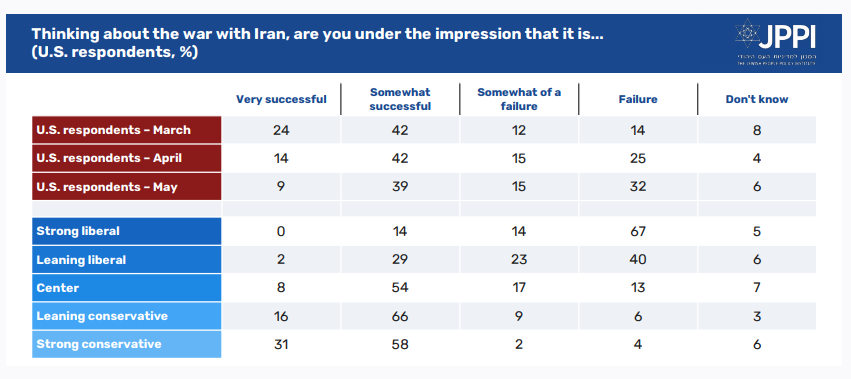
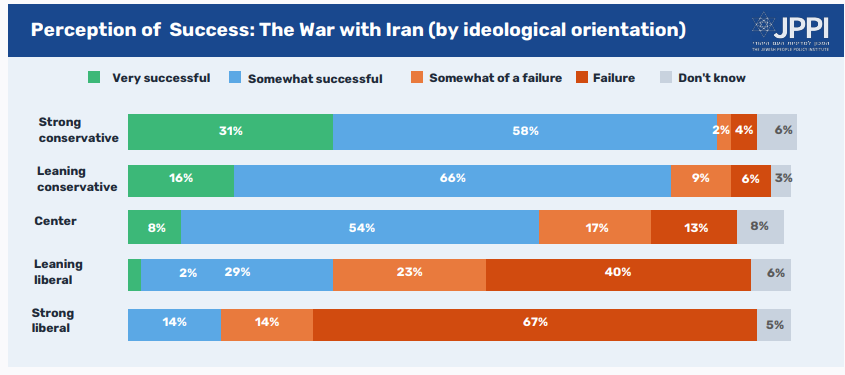
A breakdown by ideological orientation reveals a clear correlation between political outlook and the level of criticism regarding the results of the fighting. At the liberal end of the ideological spectrum, the war is regarded as a failure: three-quarters (78%) of the strong liberal cohort and half(51%) of the leaning-liberal cohort characterize it as such. Among the centrist and the two conservative cohorts, the dominant position is more moderate and tends to regard the outcomes so far as representing some degree of success. Still, it is worth noting that even in the strong conservative cohort, the share identifying the outcome as very successful is only a third (31%). This seems to reflect a general dissatisfaction with the framework under which the fighting was halted.
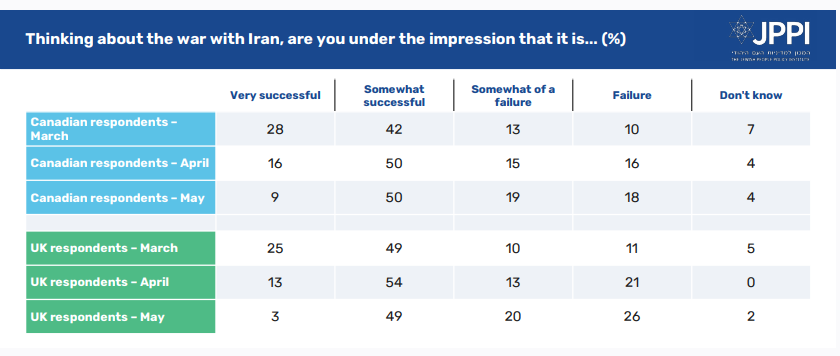
The erosion in the assessment of the war’s achievements is also clearly evident among Canadian and UK respondents. In Canada, the share of respondents who see the campaign as very successful fell to just 9%, while the total share assessing the results negatively rose to 37%. In the UK, the retreat is even sharper: the share characterizing the war as very successful dropped to a negligible 3%, while almost half of respondents (46%) see the results as negative: 26% view it as a failure, 20% as somewhat of a failure. Nevertheless, in both countries, most respondents still tend toward a moderate assessment, characterizing the war as somewhat successful.
An examination of the sense of victory in the multi-front war that began after the October 7 Hamas massacre shows stability in the views of the U.S. respondent panel over the past year, alongside a small gap compared with Jewish Israelis. This month, one-third of the U.S. Jews surveyed (30%) believe that Israel has won or is winning (ratings of 4 or 5), a figure very similar to those recorded in July and August 2025. By contrast, more than a third (38%) feel that Israel is not winning (ratings of 1 and 2); 33% hold an intermediate position. A somewhat different picture appears among Jewish Israelis this month (as per the May 2026 JPPI Israeli Society Index). Jews in Israel show greater confidence in the achievements of the campaign: four in ten (42%) feel that Israel is winning or has won, including 16% who feel this completely (compared with only 4% of the U.S. respondent panel), while only 32% share the sense that Israel is not winning.
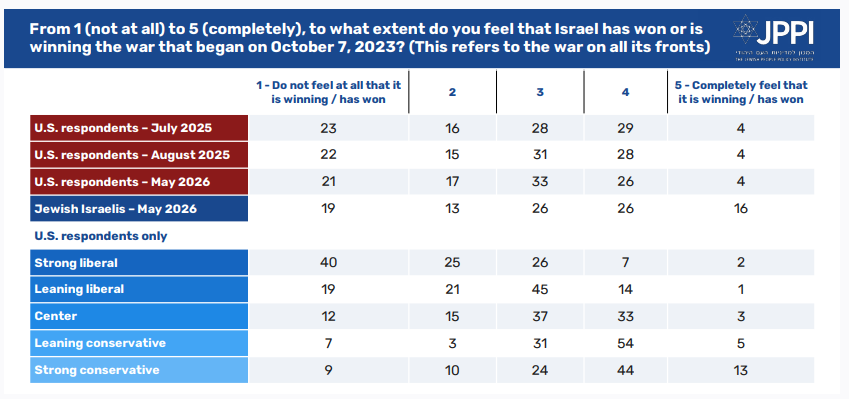
Assessment of the war’s outcome correlates directly with ideological orientation. At the conservative end of the ideological spectrum, majorities among the strong conservative and leaning-conservative cohorts believe Israel has won or is winning (57% and 59%, respectively). This position weakens among centrist respondents and weakens further among the leaning-liberal cohort, where only 15% perceive that Israel has won or is winning in the multi-front campaign. Among those who self-identify as strong liberals, 65% assert that Israel is not winning the war, with only 9% believing it is.
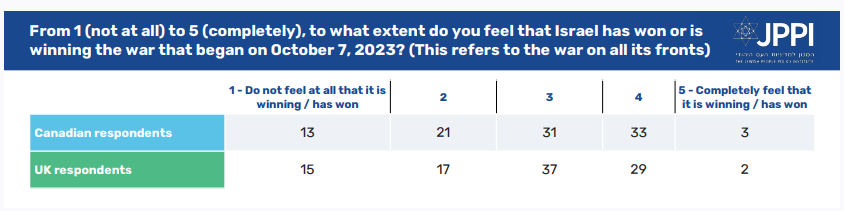
Among Canadian and UK respondents, too, the sense of victory remains qualified, although they display slightly greater confidence than U.S.Jews. A third of Canadian respondents (36%) feel that Israel is winning/ has won the war, compared with another third (34%) who believe that Israel has not won or is not winning. Similarly, among UK respondents, the share identifying an Israeli victor stands at one-third (31%), as does the share rejecting that view (32%). In both countries, as in the U.S., the share of respondents who feel that Israel is completely winning remains negligible.
Trust in Leaders
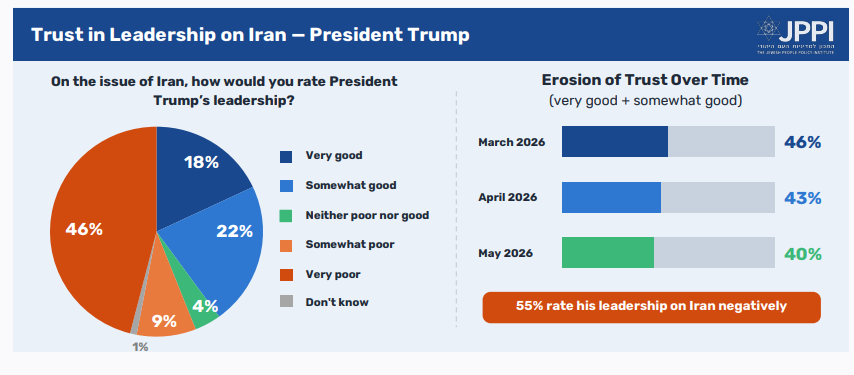
The erosion of respondents’ confidence in President Trump’s handling of Iran deepened over the past month. The data shows that the share of respondents giving Trump’s leadership the maximum rating, “very good,” has been in consistent decline, falling from 28% in March to 23% in April and to only 18% this month. At the same time, criticism of the president is intensifying: the share rating his leadership as “very poor” in the Iranian context has risen consistently in recent months. Overall, a majority (55%) of the respondent panel now assesses Trump’s leadership on Iran negatively.
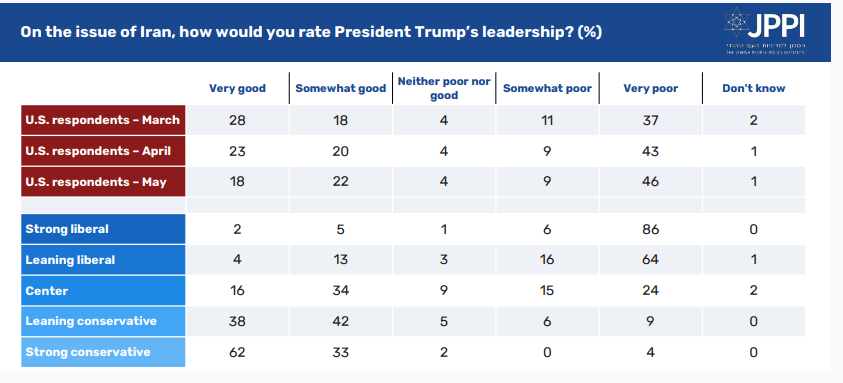
Assessment of the president’s leadership also correlates with ideological orientation. At the conservative end of the ideological spectrum, support forTrump is nearly sweeping (95% amongthe strongconservative cohort and 80% among the leaning conservative group). The opposite picture emerges in the liberal camp,
where an overwhelming majority of the strong liberal (92%) and leaning liberal (80%) cohorts view Trump’s leadership as poor, with 86% of the strong liberal cohort rating it as very poor.
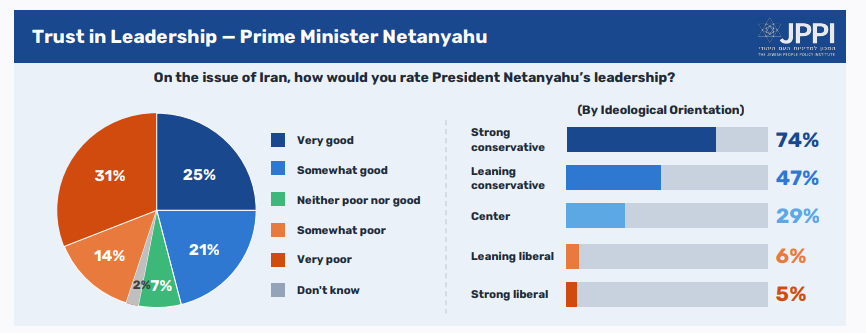
The data show that U.S. respondents’ confidence in Prime Minister Netanyahu’s leadership in the context of Iran is low. Three in ten (31%) respondents characterize Netanyahu’s leadership as very poor. Overall, 45% assess the prime minister’s leadership negatively. Conversely, the core of positive support for Netanyahu’s leadership remains limited but stable, with 25% giving his leadership a positive assessment.
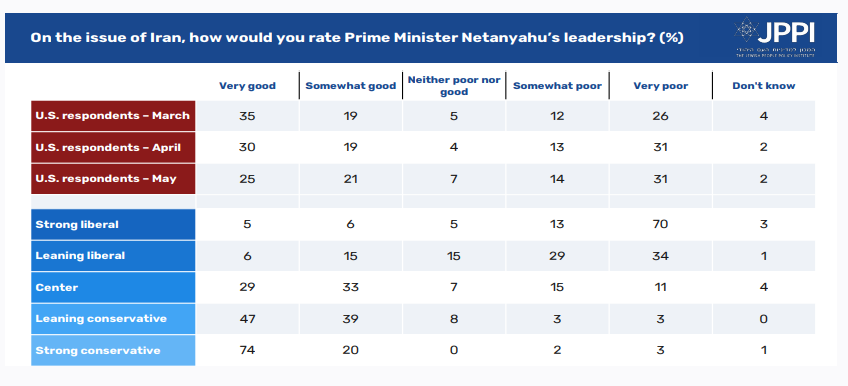
At the conservative end of the ideological spectrum, there is a near-consensus positive assessment of the prime minister: nine in ten (94%) strong conservative respondents and eight in ten (86%) leaning- conservative respondents characterize his leadership in the Iranian context as good. An opposite picture emerges in the two liberal cohorts: an overwhelming majority of strong liberals (83%) and leaning liberals (63%) reject his leadership. The centrist group presents a nuanced position but skews negative.
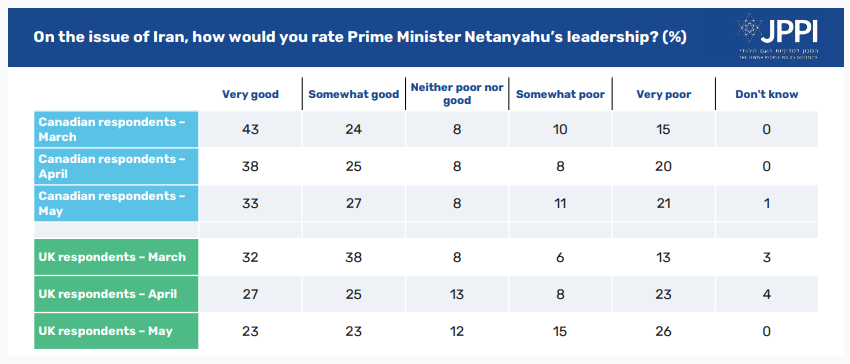
This month, a continued erosion in assessments of Netanyahu’s leadership on Iran was also recorded among Canadian and UK respondents. The share viewing his leadership as poor reached 32% in Canada and 41% in the UK. Despite this trend, Netanyahu’s overall rating remains higher among Canadian respondents than among U.S. respondents; the figures for UK and U.S. respondents are almost identical.
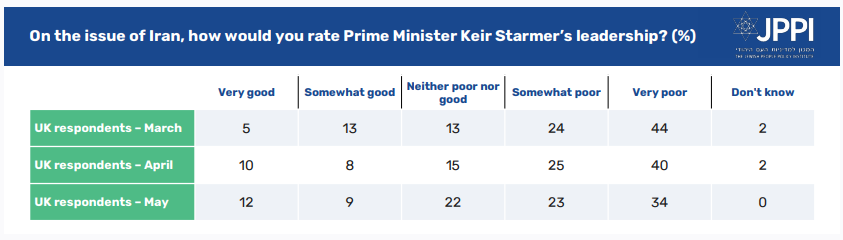
Assessments of British Prime Minister Keir Starmer’s leadership in the Iranian context indicate a gradual improvement among UK respondents overthe past month, despite an overall negative position. The share of UK respondents characterizing his leadership as very poor fell by 10 points compared with March.
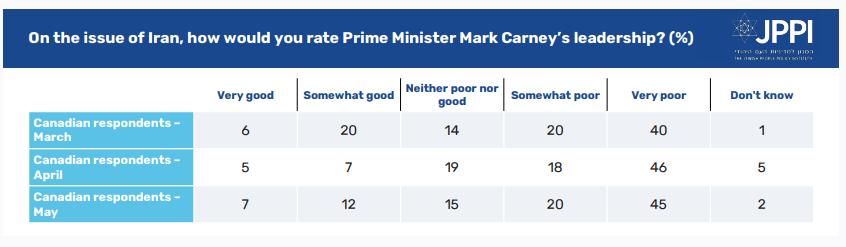
Assessments of Canadian Prime Minister Mark Carney’s leadership regarding Iran stabilized after the decline in confidence recorded in April, but remain largely negative. Positive assessments of his performance are at 19% this month, compared with 12% last month. Conversely, criticism of Carney remains broad, with two-thirds of Canadian respondents (65%) rating his leadership negatively.
Antisemitism
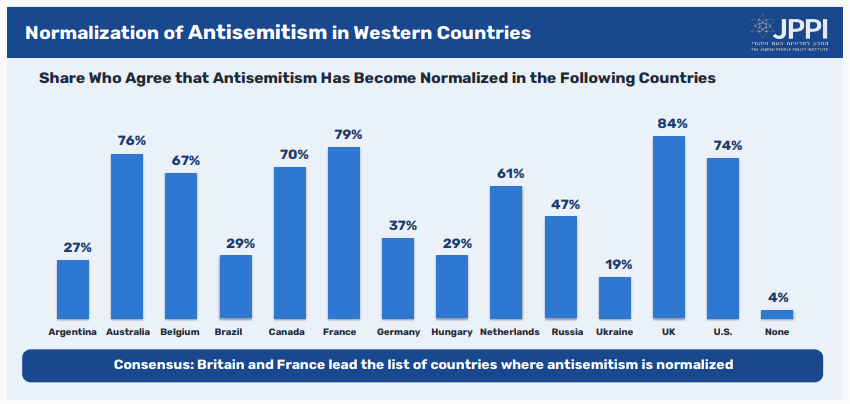
This month, we examined whether respondents feel that antisemitism is becoming normalized and is not being treated with sufficient seriousness. This followed a series of attacks onJews in London that attracted considerable attention and led to an unusual public response from Britain’s chief rabbi.
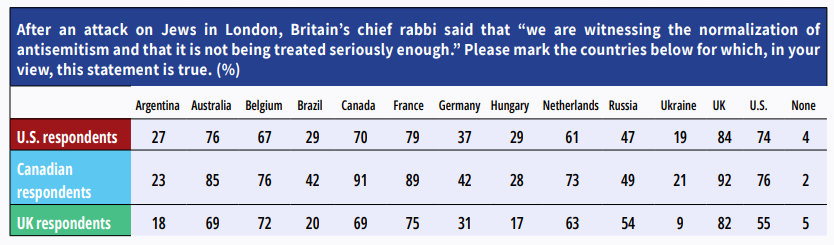
The data indicate broad, cross-community agreement that antisemitism is becoming normalized in Western countries, with Britain, France, Canada, and Australia perceived as the principal centers of risk. Britain leads the list of countries in which the phenomenon is perceived as most severe, with sweeping levels of agreement ranging from 82% among UK respondents themselves to 92% among their Canadian counterparts. Canada is also rated highly, peakingat 91% among local respondents. Canadian respondents express the most critical and concerned stance toward most of the countries examined, including Australia (85%) and the United States (76%). By contrast, UK respondents take a relatively moderate stance in their assessment of the overall situation, expressing less concern with respect to the United States (55%) and Germany (31%), but sharing the general concern about developments in France (75%) and Belgium (72%). Only a negligible share rejects the claim entirely.
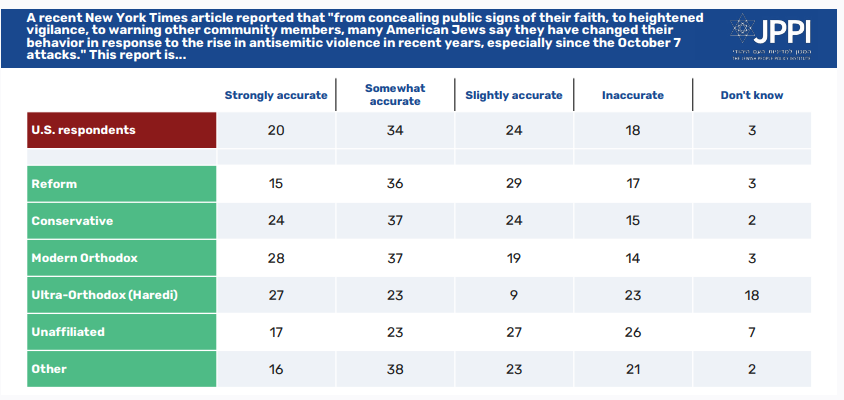
At the beginning of this month, The New York Times reported that many American Jews have changed their behavior in response to the surge in antisemitic incidents in recent years, and especially since the October 7 attack. According to the report, the change is reflected in the concealment of public expressions of worship and identity, increased vigilance in public spaces, and the circulation of warnings and alerts within the community.
The survey data indicate that the rise in antisemitism has had a significant effect on the lives of respondents, with a majority (54%) reporting concealing Jewish markers and increased vigilance. This sentiment crosses political camps and illustrates that security and social anxiety among most of the U.S. Jewish community is front and center. Just one-fifth of respondents (18%) report that the characterization does not correspond at all to their situation.
Examining the findings by religious stream shows that the sense of vulnerability and the need to change behavior are felt particularly strongly among those affiliated with institutional streams, especially those who tend to wear public religious markers or frequently attend communal institutions. Agreement peaks among Orthodox (65%) and Conservative respondents (61%). Half of Reform respondents (51%) also report a broad effect of antisemitism on their conduct.
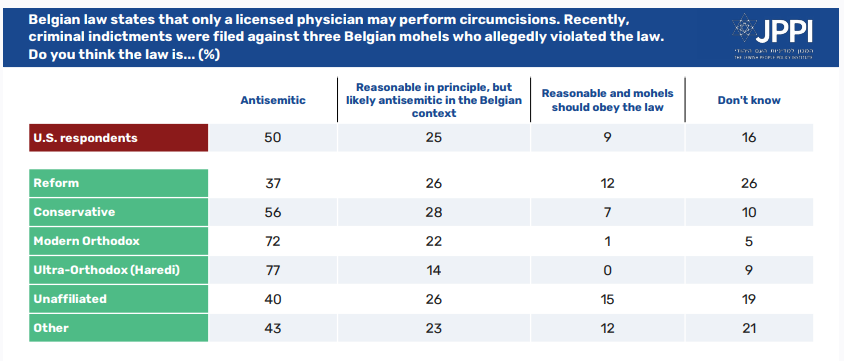
The question of circumcision in Belgium reached a legal crisis point in recent weeks, when authorities filed criminal indictments against three Belgian mohels (circumcizers) who allegedly performed the procedure contrary to guidelines and in violation of the law, which requires physician-performed circumcisions. Most respondents believe that this has antisemitic undertones that restrict the Jewish community’s freedom of action in the country.
Half (50%) of all U.S. respondents believe the physician-only Belgian circumcision law is antisemitic. An additional quarter (25%) believe that although the law may be reasonable in itself, in the specific case of Belgium, it takes on an antisemitic character, bringing the total share identifying intentional harm to the Jewish community to a 75% majority. By contrast, the minority who believe there is no problem with the Belgian law and that local mohels should comply with it remains negligible, at 9% ofthe total sample; 16% of respondents did not know how to answer this question.
A breakdown by denominational affiliation reveals a direct correlation between religiosity and the severity of the interpretation of the Belgian case. Among Haredi and Modern Orthodox respondents, there is sweeping rejection of the law: three-quarters (77% of Haredim and 72% of Orthodox respondents) consider it antisemitic, and support for the Belgian state authorities is effectively nonexistent. This position moderates gradually as one moves along the denominational spectrum toward the liberal end: 56% of Conservative respondents view the law as antisemitic, while 37% of Reform respondents do so.
Special National Shabbat
As part of Jewish American Heritage Month (JAHM), President Trump declared the weekend of May 15- 16 a “special national Shabbat” marking 250 years of American independence. The move sets a historic precedent in which the White House officially calls for a distinctly religious act of Shabbat observance, while integrating the initiative into conservative prayer events. While the Orthodox U.S. Jewish community supported the initiative and held official events in cooperation with the administration, Reform and Conservative Jewish organizations condemned the move, arguing that it violates the principle of separation of religion and state and erodes governmental neutrality.
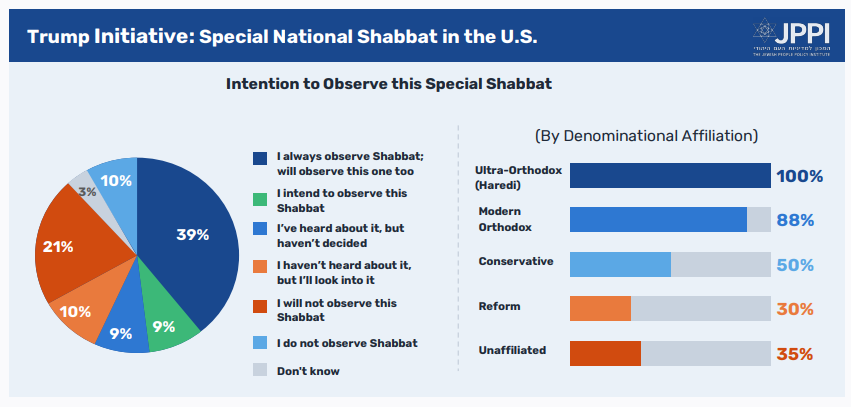
The willingness to take part in the initiative was high among the Voice of the Jewish People respondent panel, though mostly among those who already observe Shabbat. Half of the connected U.S.Jews surveyed (48%) said they intended to observe this special Shabbat. Conversely, a substantial 21% explicitly stated that they would not observe this special Shabbat, and a similar share of respondents (19%) said that they had heard of the initiative but had not yet decided what to do or had not heard of it at all.
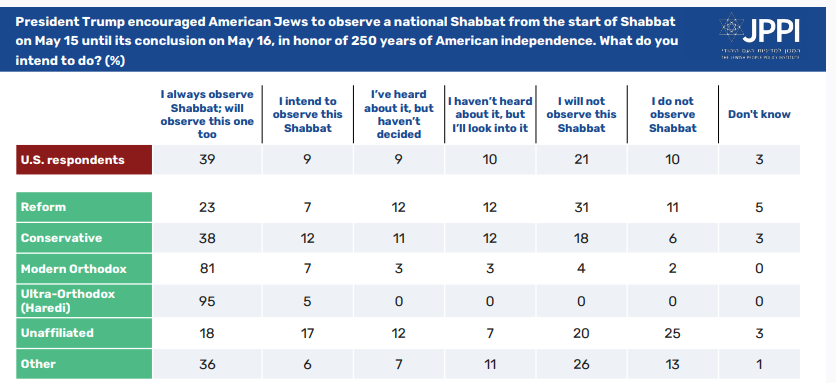
Among Modern Orthodox and Haredi religious respondents, there was near-complete consensus, with the share of those who routinely observe Shabbat ranging from 81% to 95%, alongside a small percentage who honored the specific initiative. A more varied picture emerges as one moves toward the liberal end of the religious axis: in the Conservative cohort, the response was moderate, with four in ten (38%) observing Shabbat regularly and an additional 12% mobilized by the president’s initiative. Among Reform respondents, reservations about the initiative are evident: only 7% chose to join the initiative specifically, alongside one-quarter who observe Shabbat as a matter of routine. The largest group in this stream (31%) stated that they did not intend to participate in Trump’s special Shabbat initiative.
Threats to Humanity’s Future
This month, we asked respondents to rate, on a scale from 1 (not a threat at all) to 5 (a very serious threat), several issues that some have asserted over the past decade constitute “threats to humanity’s future.” This examination is designed to compare attitudes amongJews surveyed in the United States and among Jewish Israelis, who were asked the same questions at the beginning of the month.
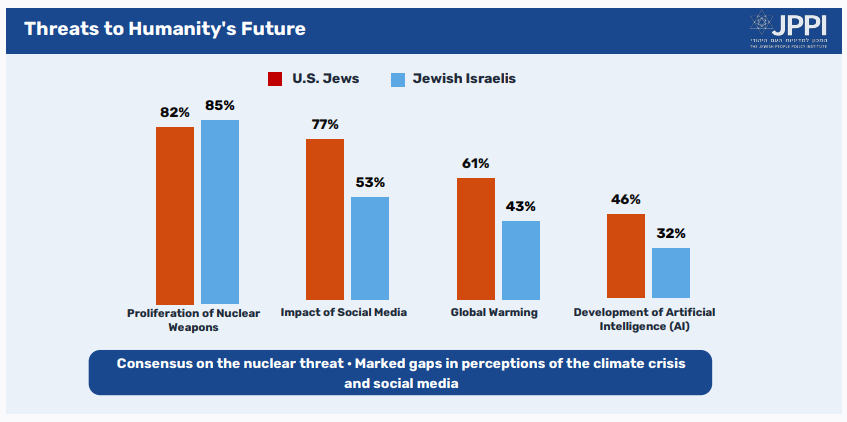
Across the four risk domains presented, Jewish Israelis and connected U.S. Jews like to identify the proliferation of nuclear weapons as the most serious existential threat to humanity. A majority of respondents in both places gave this issue the highest score (a very serious threat): 64% amongJewish Israelis and 58% among U.S. respondents. When the two highest-risk levels (scores of 4 and 5 combined) are combined, the figure rises to more than 80% in both samples. This broad consensus highlights that despite rapid technological change, the nuclear threat remains the central and most consistent concern, crossing geographic boundaries.
In contrast to the agreement on the nuclear issue, a significant gap appears in perceptions of global warming as a threat, reflecting substantial differences between the two communities. While the U.S. Jews surveyed view the climate crisis as a serious and immediate threat, with 61% rating the issue at 4 or 5 (including 43% as a very serious threat), Jewish Israelis display relative indifference, with a different distribution of responses. Forty-three percent of Jewish Israelis placed the risk in the high-threat categories, and only 21% gave it the maximum score. Similar but more moderate gaps were also recorded regarding the impact of social media, which is perceived as far more of a threat by the U.S Jews surveyed77%) compared with 53% in Israel, and regarding the development of artificial intelligence (AI), which in both.
This month, we asked respondents to rate, on a scale from 1 (not a threat at all) to 5 (a very serious threat), several issues that some have asserted over the past decade constitute “threats to humanity’s future.” This examination is designed to compare attitudes amongJews surveyed in the United States and among Jewish Israelis, who were asked the same questions at the beginning of the month.
Across the four risk domains presented, Jewish Israelis and connected U.S. Jews like to identify the proliferation of nuclear weapons as the most serious existential threat to humanity. A majority of respondents in both places gave this issue the highest score (a very serious threat): 64% amongJewish Israelis and 58% among U.S. respondents. When the two highest-risk levels (scores of 4 and 5 combined) are combined, the figure rises to more than 80% in both samples. This broad consensus highlights that despite rapid technological change, the nuclear threat remains the central and most consistent concern, crossing geographic boundaries.
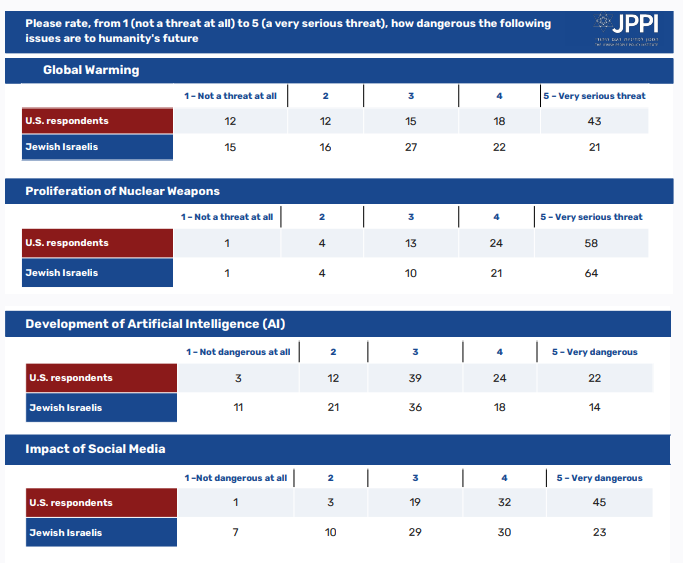
In contrast to the agreement on the nuclear issue, a significant gap appears in perceptions of global warming as a threat, reflecting substantial differences between the two communities. While the U.S. Jews surveyed view the climate crisis as a serious and immediate threat, with 61% rating the issue at 4 or 5 (including 43% as a very serious threat), Jewish Israelis display relative indifference, with a different distribution of responses. Forty-three percent of Jewish Israelis placed the risk in the high-threat categories, and only 21% gave it the maximum score. Similar but more moderate gaps were also recorded regarding the impact of social media, which is perceived as far more of a threat by the U.S Jews surveyed77%) compared with 53% in Israel, and regarding the development of artificial intelligence (AI), which in both
The samples were rated as the least serious of the four threats, with a large share of respondents in both Israel and the United States ranking it a 3.
Content Consumption: Israel and Judaism
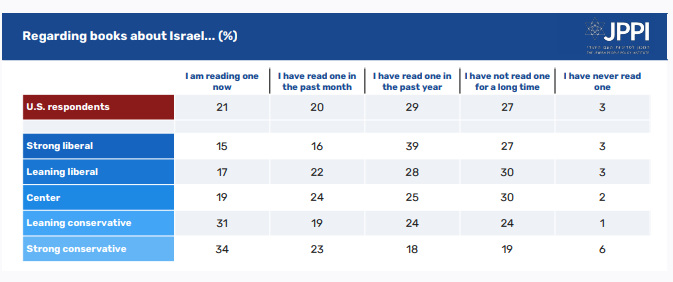
Patterns of consumption of literature about Israel among the connected U.S. Jews surveyed point to a sustained and active intellectual interest, with a majority (70%) of respondents reporting that they had read a book on this topic in the past year. The distribution of responses indicates an active and dynamic readership: one-fifth of the connected U.S. Jews surveyed (21%) say they are currently reading a book about Israel, alongside another fifth (20%) who have read such a book in the past month. Conversely, a quarter of respondents (27%) report not having read a book on Israel for a long time, while only a negligible share (3%) states that they have never read an Israel-related book.
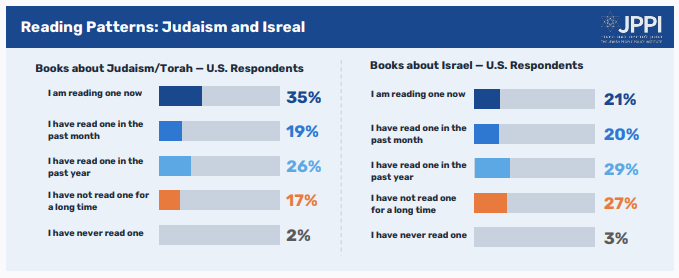
There is a clear and consistent correlation between ideological orientation and the frequency of reading about Israel, with the conservative cohorts showing the highest level of engagement. A majority (57%) of respondents in the strong conservative cohort have read a book about Israel in the past month or are currently reading one. Thirty-one percent of the leaning-conservative cohort, too, are currently reading an Israel-related book. As one moves along the ideological spectrum toward the liberal end, the frequency of reading about Israel declines gradually: among centrist respondents, the share currently reading stands at one-fifth (19%), and in the liberal cohorts it falls slightly to 17% among leaning-liberal respondents and 15% among those in the strong liberal group. Notably, even at the strong liberal pole, most respondents (55%) have read an Israel-related book in the past year.
The data indicate a very high incidence of reading books dealing with Judaism, including Torah texts, among respondents. An 80% majority reported having read a book on Jewish subjects in the past year. One-third (35%) report that they are currently reading a book about Judaism or Torah, compared with 21% who reported currently reading a book about Israel. An additional 19% report having read such a book in the past month, and 26% said they have done so in the past year. Just 17% reported not having read a Jewish book for a long time, and a negligible share (2%) reported having never read a book dealing with these topics.
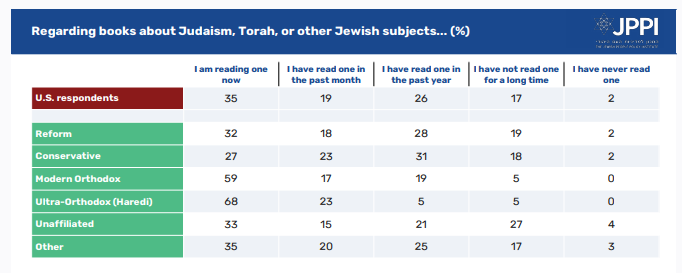
A breakdown by denominational affiliation reveals a direct association between the level of conservatism and reading habits. Currently-reading rates among Haredi and Modern Orthodox respondents are the highest, reaching 68% and 59%, respectively, with only a negligible 5% sayingthey have not read a book on the subject for a long time and none reporting that they have never read such a book. This trend moderates gradually as one moves toward the liberal end of the denominational spectrum but remains substantial: among Reform and Conservative respondents, close to one-third are currently reading a Jewish or Torah book (32% and 27%, respectively), and most have read such a book in the past year.
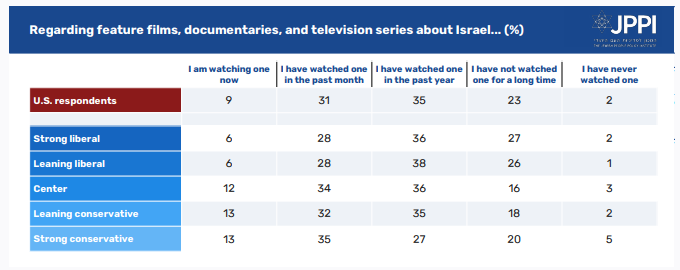
Consumption of Israel-related films and television series is also high. Three-quarters (75%) of respondents reported having watched content of this kind in the past year, a figure slightly higher than the share that has read books about Israel (70%). However, a closer examination of consumption dynamics shows that while books have a higher share ofactive readers at any given moment (21% reported that they are currently reading a book), visual media are characterized by concentrated periodic consumption: only 9% of respondents said they were currently watching an Israel-related television series or film, but 31% have watched such content in the past month, and an additional 35% have consumed such content in the past 12 months. Conversely, 23% noted that they had not watched television or film concerning Israel for a long time.
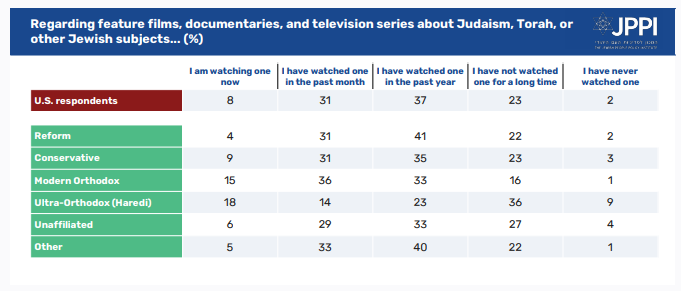
Three-quarters (76%) of the respondent panel reported watching films or television series about Judaism, the Torah, or other Jewish topics in the past year. Ongoing consumption is characterized by a periodic dynamic: only an 8% minority of respondents report currently watching such content, but close to a third (31%) have watched Judaism-related content in the past month, and an additional third (37%) have consumed it over the past year. Conversely, one-quarter (23%) said they had not watched Judaism-related media for a long time, and just 2% reported never having consumed such content.
The Modern Orthodox cohort shows the highest level of engagement in regular viewing of Jewish content, with half of this group (51%) having watched a Jewish film or series in the past month or watching one now. Notable activity is also found among Haredi respondents, with 18% reporting current viewing, although 36% report little interest in such media. In the liberal cohorts, viewing patterns are broad and stable over time: 76% of Reform respondents and 75% of Conservative respondents have consumed Jewish-related media in the past year, with a third in both streams (31%) having watched such content in the past month.
Survey Data and Implications
This report is based on a survey of 989 Jews registered for JPPI’s Voice of the Jewish People respondent panel. Broadly speaking, the survey reflects the views of connected American Jews – that is, those with a relatively strong connection to the Jewish community, and/or Israel, and/ or Jewish identity. The survey included 65 respondents in the United Kingdom and 131 in Canada. Unless otherwise noted, the results reflect the views of U.S. respondents only. JPPI’s Voice of the Jewish People Index survey was conducted by JPPI fellows Shmuel Rosner and Noah Slepkov, with assistance from Yael Levinovsky. Prof. David Steinberg provided
statistical supervision.
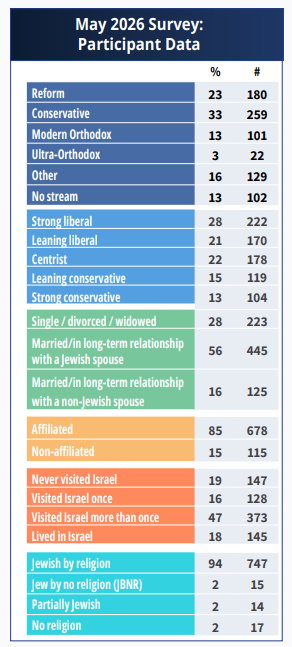
This table includes data on the U.S. survey respondents for May 2026.