

Connected U.S. Jews on Iran, trust in world leaders, Jewish and Israeli attachment, and Zionist identity.
Main Findings
- Skepticism regarding Iran: almost half of respondents think the U.S.-Iran MOU is bad for the U.S.
- A larger majority thinks the MOU is bad for Israel.
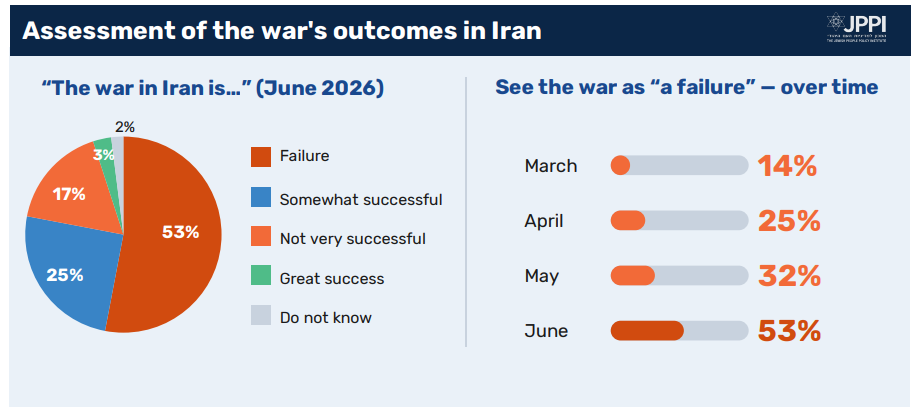
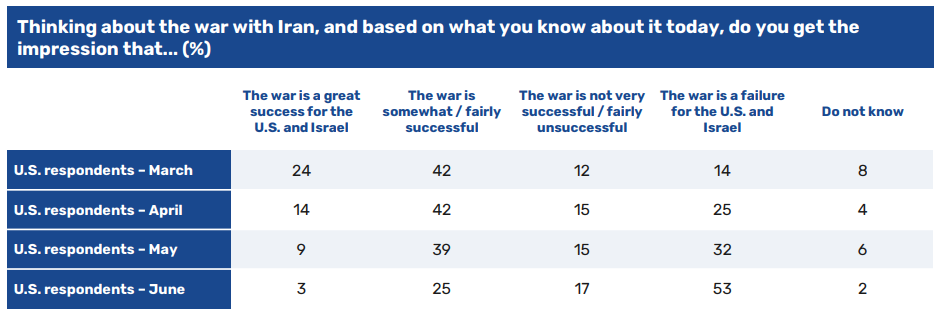
- A low point: for the first time, a majority characterizes the war with Iran as a failure.
- Erosion: the share of respondents who assess the overall multifront campaign as an Israeli victory has declined.
- Deepening erosion in confidence in Trump: three-quarters assess his leadership on Iran negatively.
- Erosion also in the assessment of Netanyahu: half give him a negative rating on Iran.
- Ahead of the 2028 election: preference for the Republican camp when it comes to attitudes toward Israel.
- One-third say that “the situation” increases the likelihood that they will participate in Israel-related events.
- One-quarter say that “the situation” decreases the likelihood that they will participate in Israel-related events.
- Habits becoming entrenched: four in ten wear or display a Jewish symbol as part of their routine.
- A slow and consistent decline in the share who define themselves as “Zionists” (still very high).
- A parallel decline in the share of respondents saying that most of their Jewish friends are “Zionists.”
To download a PDF version, click here.
Survey Background: Data for this month’s JPPI Voice of the Jewish People Index was collected June 15-18. During this period, several diplomatic and security developments unfolded that influenced the attitudes reflected in the survey. At the center was the signing of the “Islamabad Memorandum of Understanding,” a move intended to bring to an end the war between Iran, the United States, and Israel. This diplomatic dynamic, which emerged alongside brief direct exchanges of blows, intensified public engagement with confidence in the American administration and the U.S. president, as well as with perceptions of Israel’s achievements across the various fronts. In the U.S. domestic arena, the political system continued to gather steam ahead of the November midterm congressional elections, with discussion of American foreign policy, pressure to achieve international agreements, and the domestic and foreign-policy implications featuring prominently in public discourse.
Methodological note: In recent months, we have also begun surveying the attitudes of Jews in Canada and the United Kingdom. In both countries, panels are being assembled and are growing, albeit slowly. In June, approximately 40 UK participants and approximately 100 Canadian participants responded to the survey. Accordingly, the data on Jewish views in these countries should be treated with caution. When the report presents data broken down by ideological orientation, denominational affiliation, or voting pattern, it refers to U.S. respondents only.
MOU with Iran
The memorandum of understanding (MOU) intended to end the Iran war was signed against the backdrop of domestic and international pressure on the Trump administration. The document was designed to ensure temporary quiet during a 60-day period in which the United States and Iran would conduct negotiations toward a final agreement. It includes provisions stipulating that Iran, the United States, and their allies commit to halt the war on all fronts, and that the United States would lift the naval blockade immediately upon the MOU’s signing. The agreement also includes economic relief for Tehran, a reiteration that it will not develop nuclear weapons, and clauses relating to the opening of the Strait of Hormuz to international shipping. The survey was conducted in the days immediately following the MOU’s signing.
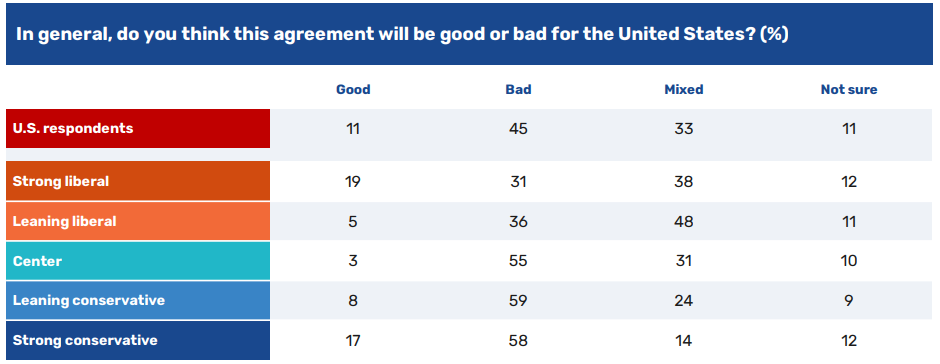
The assessment of U.S. respondents Jews with a connection to Jewish institutions, Jewish identity, and/or Israel reveals a skeptical and critical stance toward the agreement with Iran: 45% say that the agreement will be bad for the U.S.; 11% view it favorably; 33% hold mixed opinions; and 11% are unsure what to think. A breakdown by ideological orientation shows that most respondents in the conservative cohorts have a negative view of the MOU with respect to the U.S. (58% of strong conservative respondents and 59% of leaning conservative respondents). There is also a 55% majority among centrist respondents who think the agreement does not bode well for the U.S. Among strong liberal respondents, 31% consider the MOU a negative move, while 19% – the largest share across cohorts – think it will be good for the U.S.
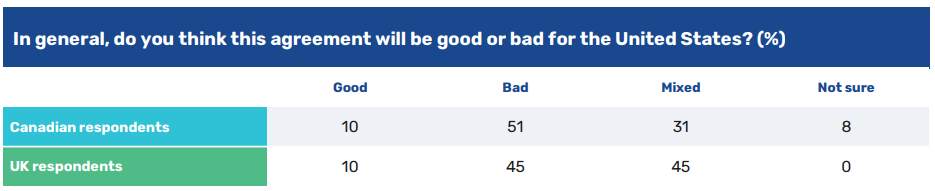
Among Canadian respondents (51%) and UK respondents (45%), the tendency is likewise either to view the agreement as bad for the U.S. or to hold mixed views. As is the case among U.S. respondents, in both countries only a very small share – about 10% – believes the agreement is good for the U.S.
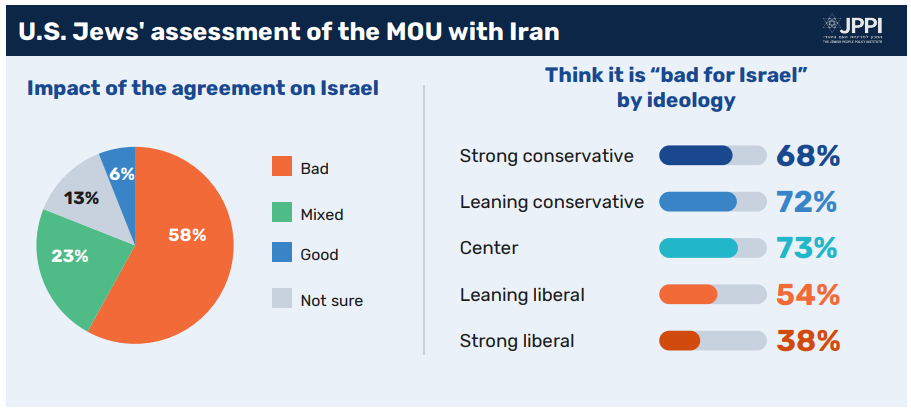
Pessimism is even sharper regarding the agreement’s impact on Israel. A 58% majority of the respondent panel thinks the agreement will be bad for Israel, while just 6% believe that the MOU is good for Israel and 23% hold mixed views. A negative assessment of the MOU is the majority view across all ideological cohorts except the strong liberal group (38%).
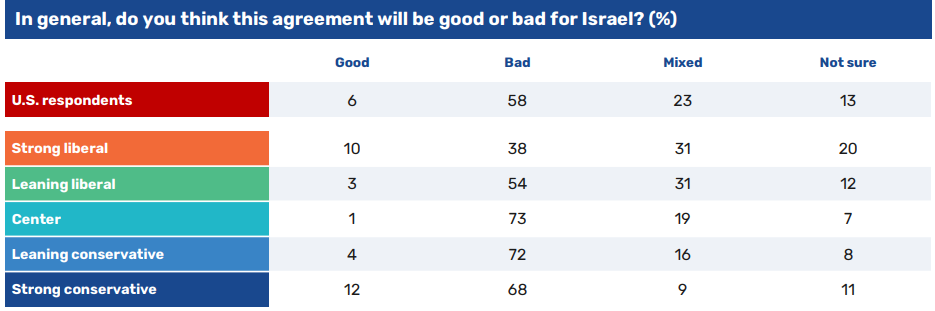
A comparison between assessments of the agreement’s impact on Israel and on the U.S. shows that respondents perceive the agreement as more dangerous for Israel than for the U.S. Whereas 45% assess the agreement negatively with respect to the U.S., the share rises to 58% with respect to Israel. This gap is especially pronounced among the centrist and conservative cohorts: among centrist respondents, the share characterizing the agreement as “bad” jumps from 55% with respect to the U.S. to 73% when Israel is at issue. Among leaning conservative respondents, there is a similar increase from 59% to 72%. Even among strong liberal respondents, who showed the highest level of support for the agreement in the American context, there is a retreat when Israel is at issue. These findings underscore that panel participants view the MOU’s contents as more harmful to Israel’s security and interests than to those of the U.S.
Similarly, most Canadian respondents (71%) and UK respondents (63%) think the agreement will be bad for Israel. In both countries, this share is higher than the share of respondents who think that the agreement will be bad for the U.S.
Success in the War with Iran
Tracking the respondent panel’s attitudes over the past four months indicates a continuing erosion in assessments of the achievements of the war with Iran, reaching a low point this month (similar to the pattern among Israelis, as indicated by JPPI’s June Israeli Society Index). For the first time since measurement began, a majority (53%) of connected U.S. Jews say that the war is “a failure for the U.S. and Israel” – a significant increase from 32% last month and more than triple the share of respondents who held this view in March. At the same time, there has been a significant decline in the share who define the campaign as a “great success”: whereas at the start of the war, 24% held this view, this month the share has shrunk to a negligible 3%. The share evaluating the war as “somewhat/fairly successful” also declined from four in ten respondents (39%) last month to one-quarter (25%) this month.
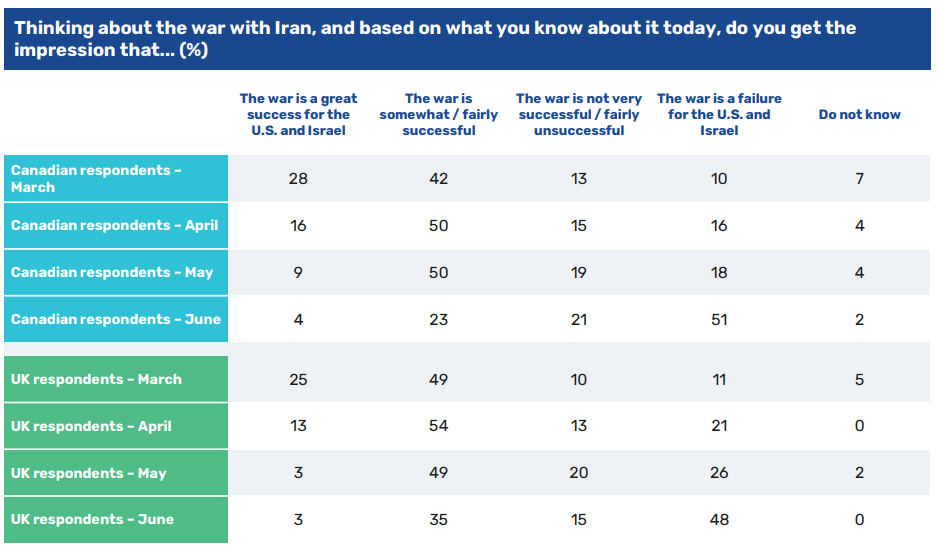
This trend of declining perceptions of the campaign’s success and rising perceptions of it as a failure is not unique to U.S. respondents; it is reflected similarly among Canadian and UK respondents. This month, the share characterizing the war as “a failure for the U.S. and Israel” rose significantly, reaching half of Canadian respondents (compared with 18% last month) and half of UK respondents (compared with 26% in May). At the same time, the share who perceive the campaign as a great success has eroded to negligible levels in both countries.
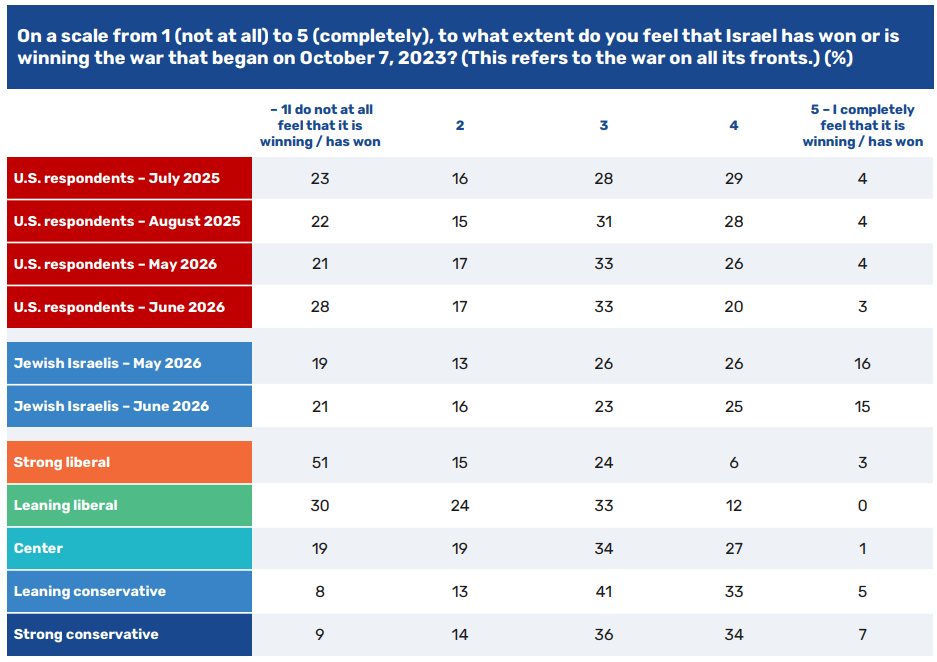
A gradual decline in optimism is evident in assessments of Israel’s victory in the multifront military campaign that began on October 7, 2023, reaching its nadir this month. The share of respondents with a low perception of victory (scores of 1 and 2) rose to 45% (including 28% who feel that Israel is not at all winning), compared with 38% in May and relative stability of about 37% last summer. At the same time, there has been a consistent retreat in the share reporting a high sense of victory (scores of 4 and 5), which has declined from one-third (33%) in July 2025 to one-quarter (23%) today. While U.S. respondents tend toward this negative assessment, Jewish Israelis present a more balanced distribution: in JPPI’s June survey, four in ten (40%) said they feel that Israel is winning or has won (15% “completely” and 25% giving a score of 4), compared with an almost identical share (37%) who reject a sense of victory (scores of 1 and 2).
Assessments of the war’s outcomes are strongly associated with ideological orientation and show an inverse correlation between liberal orientation and belief in an Israeli victory. At the left end of the ideological spectrum, more than half of strong liberal respondents (51%) state unequivocally that Israel is not winning at all (score of 1), and only 9% give the campaign a positive score (scores of 4 and 5). This picture reverses as one moves rightward along the spectrum: among conservatives, only a small minority denies the victory, while the majority tend toward the intermediate and higher scores, with close to 40% saying that Israel is winning or has won the war (scores of 4 and 5 combined).
Confidence in Leaders
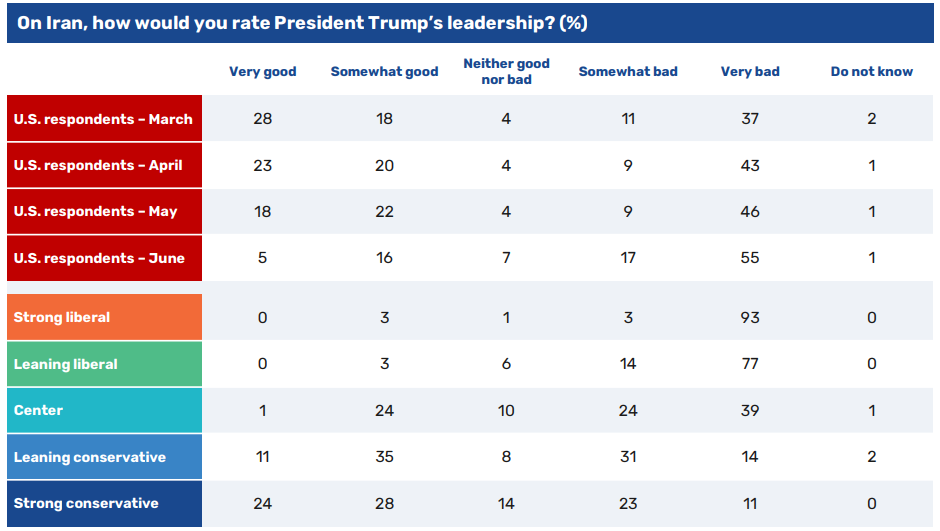
Tracking the views of connected U.S. Jews over recent months on Trump’s leadership in the Iranian arena reveals a trend of consistent erosion. It reached a new low this month: a majority of respondents (55%) characterize Trump’s leadership in the Iran context as very bad an increase from 46% last month and far from the share recorded in March (37%). At the same time, there has been a decline in the share of respondents who think his leadership on Iran has been very good – just 5% this month, compared with 18% last month and 28% in March. With the MOU with Iran taking shape, the share assessing his leadership on Iran negatively rose to 72%, compared with 48% in March.
A breakdown of the findings by ideological orientation shows that the two liberal cohorts regard Trump’s leadership on Iran as poor, while the conservative camp is divided. Among strong liberal respondents, there is an almost complete consensus (93%) characterizing his leadership as very bad, a view that is also predominant among leaning liberal respondents (77%). In the centrist cohort, the largest share rates his leadership on Iran as very bad (39%), with the total share rejecting his leadership (somewhat bad + very bad) reaching two-thirds (63%). The conservative camp does not show monolithic support for the president: among leaning conservative respondents, only 11% think his leadership on Iran is very good; a higher share (14%) perceives it as very bad. Among strong conservative respondents, one-quarter (24%) give him the highest positive rating, while one-third (34%) consider his leadership on Iran somewhat bad or very bad.
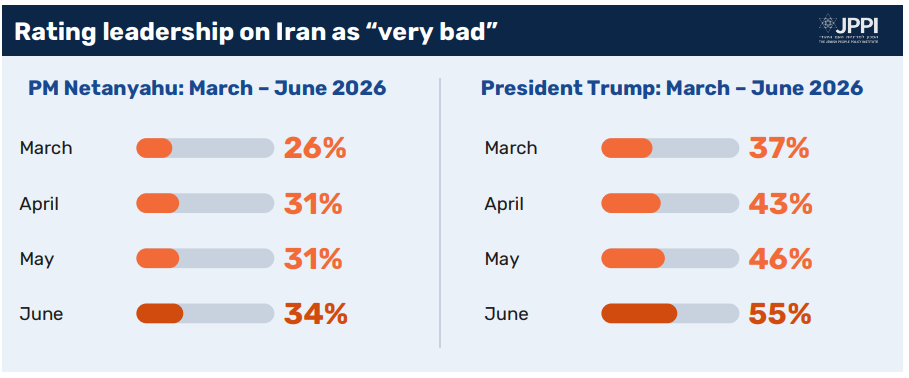
The share characterizing Benjamin Netanyahu’s leadership on Iran as very bad reached a record high this month and now stands at 34%, compared with 31% in April and May and 26% in March. At the same time, the highest positive rating fell by nearly half over the period: in March, 35% of respondents saw Netanyahu’s leadership as very good in the Iranian context, but this month the share fell to 19%. In other words, half of U.S. respondents today (50%) give Netanyahu’s leadership a negative rating on Iran (somewhat bad or very bad), compared with 41% who view him as a good leader on this issue.
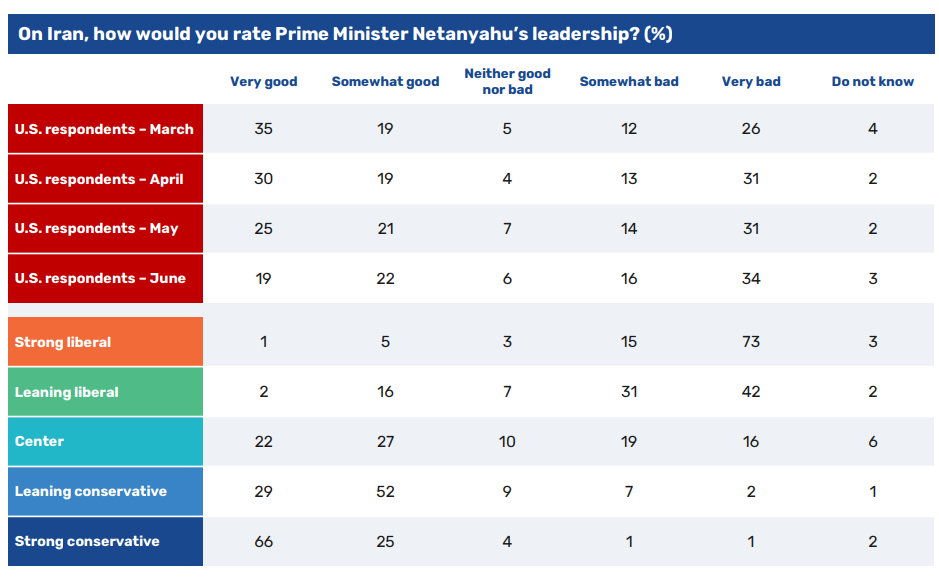
A breakdown by ideological orientation shows that a majority (73%) of strong liberal respondents say his leadership is very bad. A similarly critical, though more moderate, stance is evident among leaning liberal respondents (73% characterize his leadership as somewhat bad or very bad). The picture reverses as one moves rightward along the spectrum: two-thirds (66%) of strong conservative respondents characterize Netanyahu’s leadership on Iran as very good, and half (52%) of leaning conservative respondents characterize it as somewhat good. Among the centrist cohort, views are more dispersed and balanced, with a slight positive tilt: nearly half (49%) view his leadership on Iran positively, compared with one-third (35%) who view it negatively.
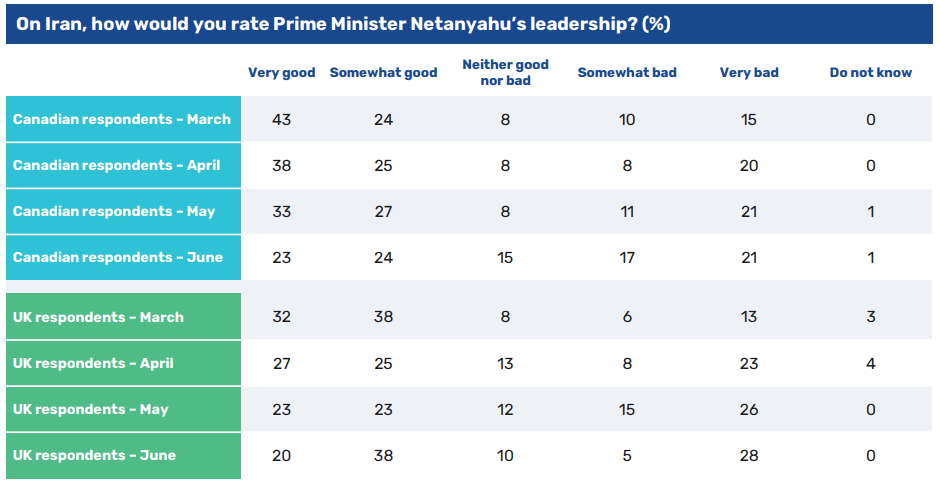
Similarly, in recent months Canadian and UK respondents have shown a continuing erosion in assessments of Netanyahu’s leadership on Iran. Among Canadian respondents, the share who perceive Netanyahu’s leadership as very good has nearly halved, from 43% in March to 23% this month. UK respondents show a similar weakening trend: the highest positive rating (“very good”) declined steadily from one-third (32%) in March to only one-fifth (20%) in June, while extreme negative assessments rose sharply, with the share characterizing his leadership as very bad jumping to 28% in June (more than double the 13% recorded in March).
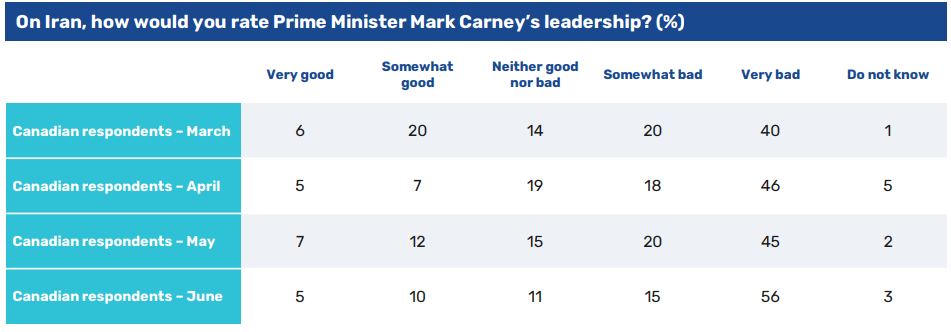
An examination of Canadian respondents’ views of Prime Minister Mark Carney’s leadership on Iran points to broad dissatisfaction and a consistent erosion of his public standing. In June, a majority (56%) of Canadian respondents characterized his leadership on this issue as very bad, compared with 45% in May and 40% in March. His highest positive rating remained consistently low, and across all four months of measurement, only a negligible 5%-7% described his leadership as very good.
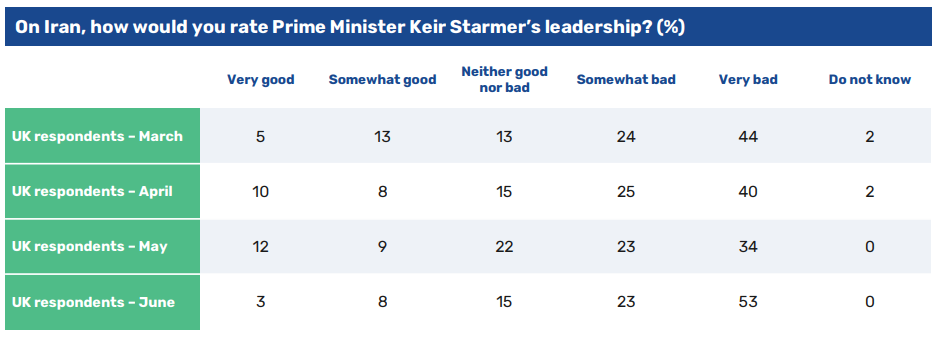
UK respondents also assess Prime Minister Keir Starmer’s leadership on Iran negatively. Starmer stepped down soon after the survey was conducted. This month, the share describing his leadership as very bad rose substantially and reached a 53% majority (an increase of 19 percentage points compared with May). By contrast, his highest positive rating fell to only 3% in June, a figure that speaks to the UK Jewish community’s broad disappointment in his handling of the crisis with Iran.
Domestic U.S. Politics
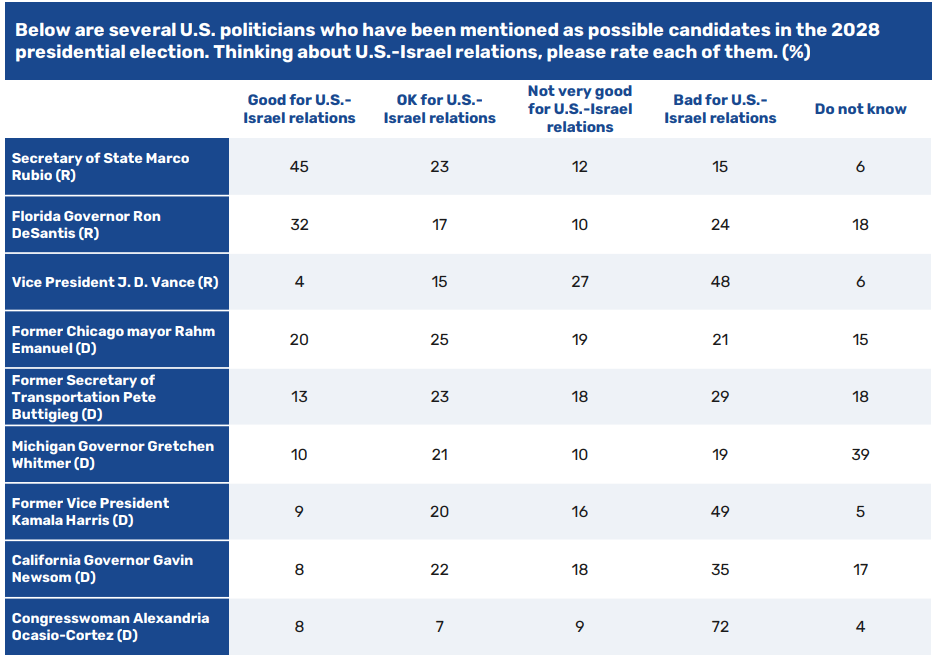
This month, we examined the views of connected American Jews regarding several politicians whose names have been mentioned as possible candidates in the 2028 presidential election. The data reveals a structural preference for Republicans, alongside rejection of the progressive wing of the Democratic Party and senior figures from recent administrations. Secretary of State Marco Rubio is perceived as the leading and most favorably viewed figure in the sample, with 45% saying that he is “good for U.S.-Israel relations,” followed by Florida Governor Ron DeSantis with 32% support. By contrast, Congresswoman Alexandria Ocasio-Cortez received the most sweeping and unequivocal opposition, with a significant majority (72%) saying that she would be “bad for U.S.-Israel relations.” Especially high negative sentiment was also recorded for former Vice President Kamala Harris, whom half of the respondent panel rated negatively (49% “bad”), and for current Vice President J. D. Vance, who received a negative assessment from 48% of respondents.
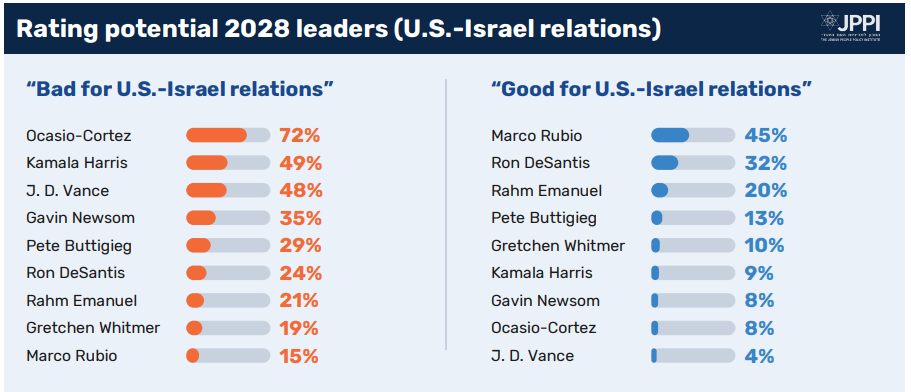
California Governor Gavin Newsom and former Secretary of Transportation Pete Buttigieg are viewed critically, with 35% and 29%, respectively, describing them as bad for the future of U.S.-Israel relations, compared with fairly low favorable assessments (8% for Newsom and 13% for Buttigieg). The Jewish-American politician and diplomat Rahm Emanuel receives the most dispersed assessment, with an almost equal split between positive (20%) and negative (21%) views. A considerable share of the respondent panel is unfamiliar with Michigan Governor Gretchen Whitmer, with just 10% saying that she would be good for relations between the two countries.
Perceptual gaps exist among the different ideological groups regarding most of the political leaders on the list, but the gaps regarding Secretary of State Marco Rubio are especially interesting. A breakdown by ideological orientation shows broad consensus and substantial sympathy toward Rubio as a positive figure vis-à-vis U.S.-Israel relations among those in the conservative and centrist cohorts, but, perhaps unsurprisingly, not among liberal respondents. Among conservatives, there is almost complete consolidation around him, with 86% of leaning conservative respondents and 85% of strong conservative respondents believing that his leadership would be good for relations between the countries. This favorable stance also characterizes the centrist group, where a majority (60%) see Rubio as good for relations and an additional quarter (25%) view him as OK.
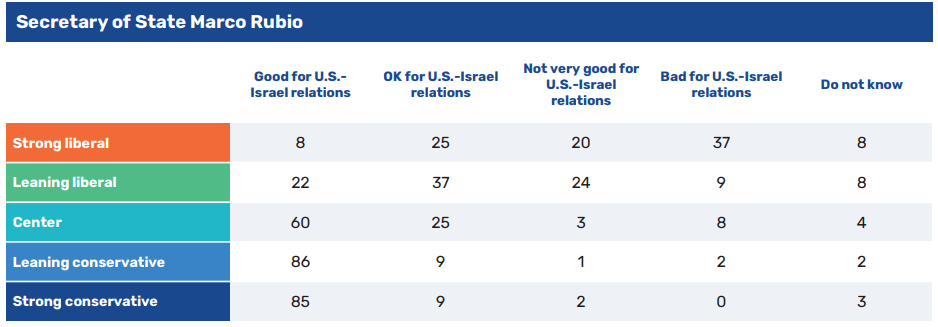
As one moves leftward along the ideological spectrum, support for Rubio gives way to more critical views: the leaning liberal cohort is divided, with the largest subgroup anticipating that he would be OK for U.S.-Israel relations (37%) and only 22% considering him good for relations. Among strong liberal respondents, the picture reverses and skepticism of Rubio reaches its peak: 37% say that he is bad for U.S.-Israel relations, and only a small 8% minority has a positive view of him in this regard.
Jewish and Israeli Attachment
This month, we returned to several questions from a year ago concerning the Jewish and Israeli attachment of the respondent panel and the impact of the current “atmosphere” in the U.S. on that attachment. Most respondents (63%) say that the security and social situation has not affected their participation in public Jewish events. One-quarter (26%) say that the current situation increases the likelihood that they will participate in such events, while 10% say that it has reduced the likelihood of their participation. The data recorded this month resembles the data collected a year ago, with a slight uptick in the share of respondents saying that the current situation does not affect their participation in Jewish events, and a slight decline in the share saying that it reduces their likelihood of participating.
A denominational breakdown shows that the Modern Orthodox cohort has the highest share (36%) reporting that the current situation has increased the likelihood of their participation in public Jewish events. One-third of Haredi respondents (33%), one-quarter of Reform respondents (27%), and one-quarter of Conservative respondents (28%) also answered this way. Across denominations, half or more say that the current situation does not affect their level of participation in Jewish events. As one moves along the religious scale from the more liberal streams toward their conservative counterparts, the share of respondents saying that the current situation lowers the likelihood of their participation in Jewish events declines: 13% of Reform respondents answered this way, compared with a negligible share among Haredim.
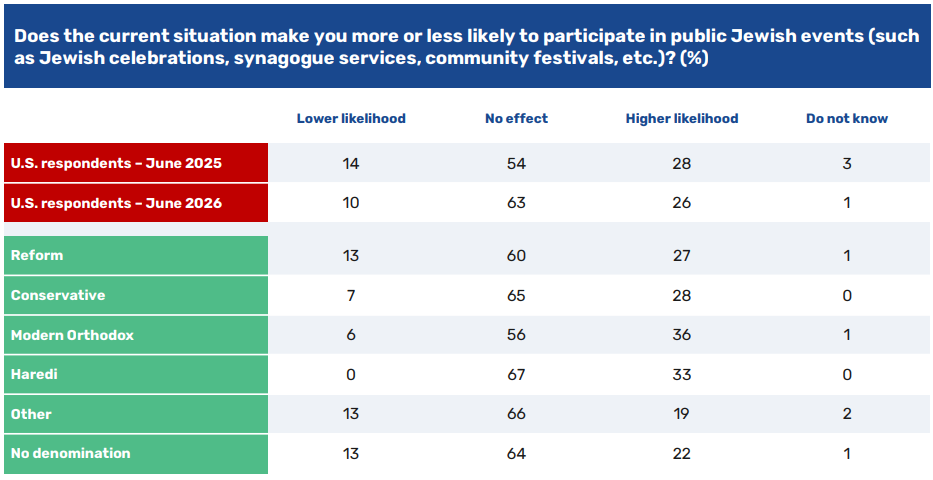
Among respondents with a connection to the Jewish community (affiliated), a higher share say that the situation increases the likelihood of their participation in Jewish events (27%) than say that it reduces this likelihood (8%). By contrast, among those with little institutional connection (unaffiliated), 22% say the current situation increases the likelihood that they will participate in events of this kind, while 17% say that it reduces it.
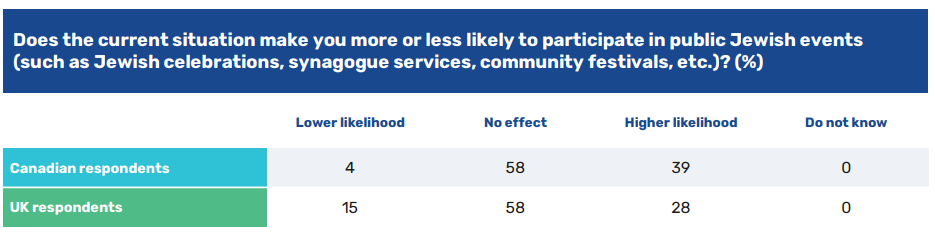
Among Canadian and UK respondents, a majority (58%) say that the current situation does not affect their participation in Jewish public events. Four in ten (39%) Canadian respondents report a higher likelihood of participating, compared with a negligible share (4%) reporting a diminished likelihood. UK respondents report deeper skepticism and concern, reflected in a lower likelihood of attendance than in Canada (15% versus 4%), alongside a more moderate willingness to increase their presence (28%).
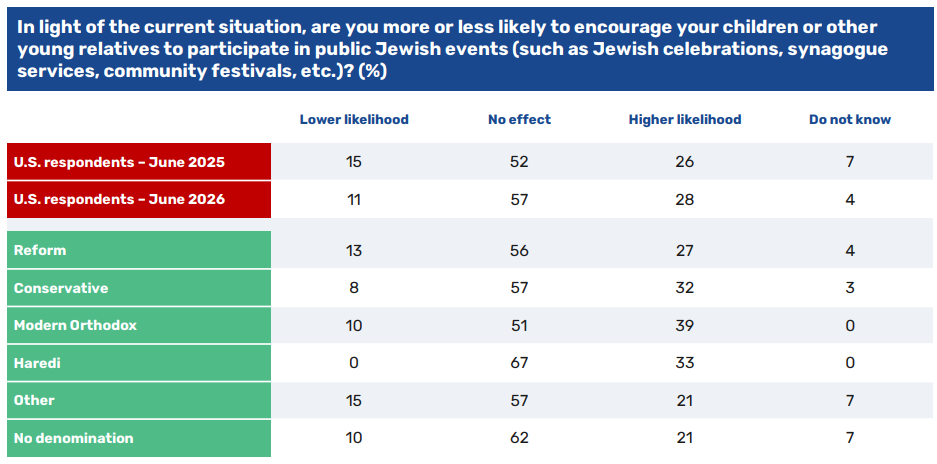
A similar survey question probed, in light of the situation, whether respondents are more or less likely to encourage their children or other young relatives to participate in Jewish events. Most (57%) say that the current situation does not influence the likelihood of such encouragement; 28% say that the situation makes them more likely to encourage the young people in their families to take part in Jewish events; and 11% say that the situation diminishes this likelihood. Almost identical findings were recorded exactly one year ago.
Here too, the Modern Orthodox cohort comprises the largest share (39%) of respondents reporting that the current situation increases the likelihood that they will encourage young family members to participate in Jewish activities. One-third of Haredi (33%) and Conservative respondents (32%), and a quarter of their Reform counterparts (27%), also answered this way. In every denominational cohort, half or more of respondents say that the current situation does not affect the likelihood that they will encourage their children or young family members to participate in Jewish events.
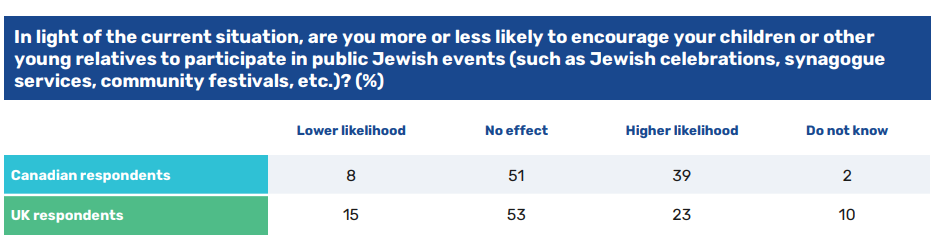
Roughly half of Canadian respondents (51%) and UK respondents (53%) say the current situation does not affect their willingness to encourage their children or young relatives to participate in public Jewish events. However, Canadian respondents show a higher level of encouragement (39%) than UK respondents (23%). Conversely, concern among UK respondents is higher; consequently, a higher share say they are less likely to encourage their children and young relatives to participate in public Jewish events almost double the share of Canadian respondents (15% versus 8%).
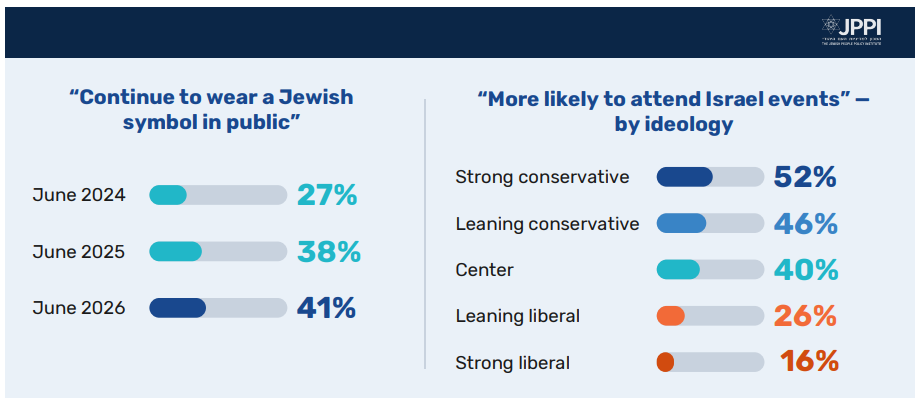
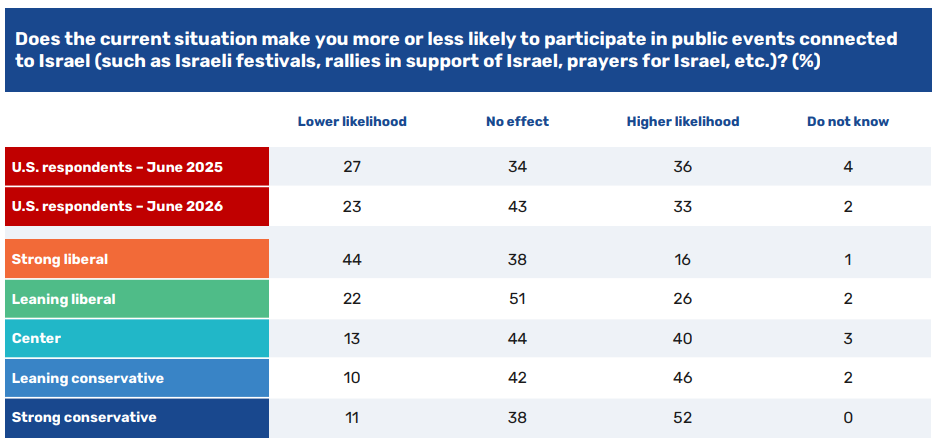
We also examined respondents’ willingness to participate in public events related to Israel. Four in ten respondents (43%) say that the current situation does not affect their participation in such events. One-third (33%) say that the situation increases the likelihood of their participation in Israel-related events, and one-quarter (23%) say they are less likely to do so because of the situation. The data recorded this year is almost identical to the data recorded a year ago, with a slight increase in the share of respondents who say the current situation does not affect the likelihood of their participation in such events, and a slight decrease in the share saying that the situation reduces the likelihood that they will participate in them.
A breakdown by ideological orientation reveals deep divides and gaps in motivations to stand publicly in solidarity with Israel. The conservative cohorts display the highest level of active mobilization: just over half of strong conservative respondents (52%) and nearly half of leaning conservative respondents (46%) report that the current situation, with all its complexity and difficulty, makes them more likely to attend Israel-related events, alongside low reluctance rates of 10%-11%. The picture reverses as one moves leftward along the ideological spectrum: reluctance is most pronounced among strong liberal respondents, with 44% of the cohort saying the likelihood of their attending such events is lower, and only 16% reporting an increased inclination to attend such events. Forty-four percent of respondents in the centrist cohort reported that the current situation has not affected their inclination to participate in Israel-related events, alongside 40% who say they are more likely to participate in such events and just 13% reporting a lower likelihood.
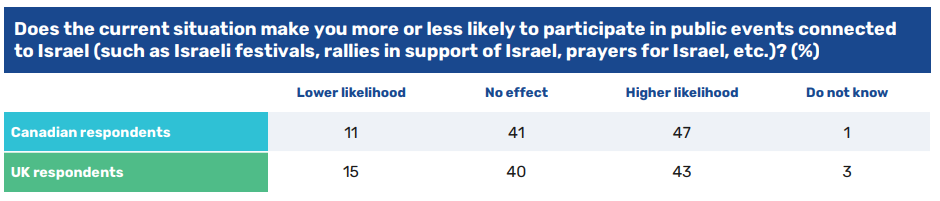
Among Canadian and UK respondents, the current situation seems to generate greater communal mobilization than in the U.S., with increased willingness to participate in public Israel-related events the leading response. Nearly half (47%) of Canadian respondents report a higher likelihood of participating in such events, alongside 41% who say the situation has no effect on their inclination to participate and just 11% who say they are less likely to participate in Israel-related events in light of the situation. The picture is similar for UK respondents.
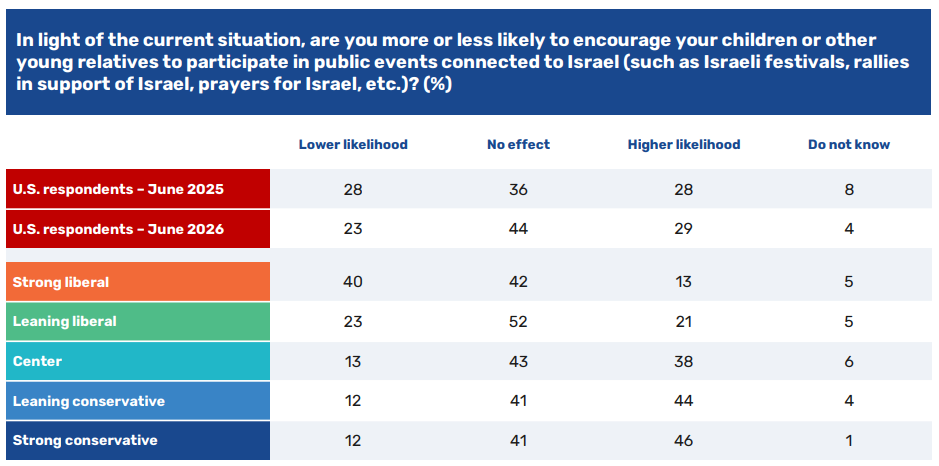
Forty-four percent of U.S. respondents say the situation has not affected their willingness to encourage their children or younger relatives to participate in public activities on behalf of Israel. The remaining respondents show a moderately positive tilt: 29% report that the situation increases their likelihood of encouraging the younger generation, while 23% say the opposite. Compared with data from a year ago, there has been an 8-percentage-point increase in the “no effect” response category, alongside a contraction in the share of parents and relatives reporting a lower likelihood of encouraging young people (from 28% to 23%).
Broken down by ideological orientation, strong liberal respondents display the highest levels of concern and reluctance, with 40% saying they would be less likely to urge young family members to participate in events on behalf of Israel, and only a 13% minority saying the opposite. This picture reverses as one moves rightward along the ideological spectrum: nearly half of strong conservative respondents (46%) and leaning conservative respondents (44%) report encouraging the younger generation to attend such pro-Israel events, alongside low and stable reluctance rates of 12%. The centrist cohort shows a slight positive tilt: most centrist respondents maintain the status quo (43%), alongside a relatively high share (38%) reporting a higher likelihood of encouraging young people, and only 13% expressing reluctance.
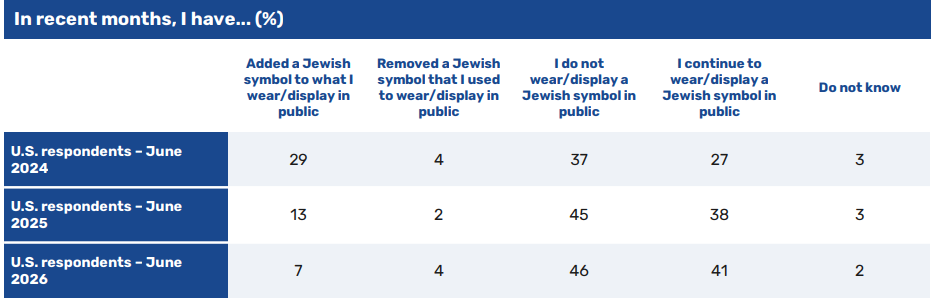
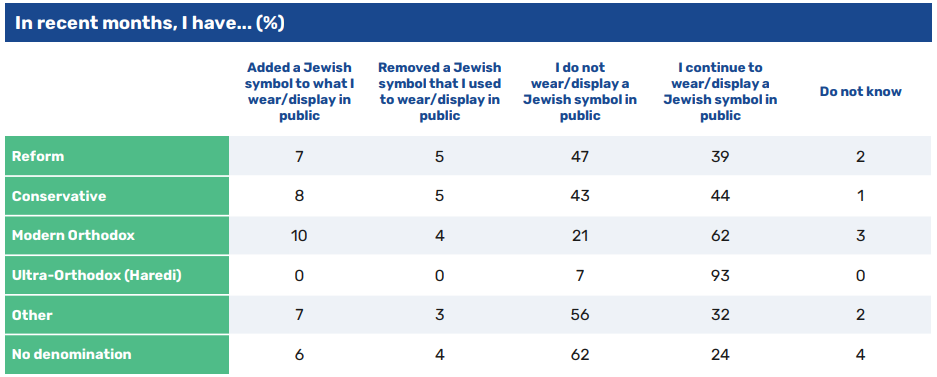
A three-year view of U.S. data from JPPI’s Voice of the Jewish People Index shows a shift from an initial response to the war toward the stabilization of a communal routine. In June 2024, after a turbulent month of campus protests, 29% of respondents said they had added a Jewish symbol to what they wear or display in public as an active act of identification. Over time, this initial impulse has steadily faded, contracting to 13% in June 2025 and to only 7% this month. Nearly half (46%) of June 2026 respondents reported that they do not customarily wear such symbols in public, while 41% said that they continue, as usual, to wear or display a Jewish symbol in public (a steady increase from 27% in June 2024 and 38% in June 2025).
There is a direct correlation between denominational affiliation and wearing or displaying Jewish symbols in public. Among Modern Orthodox respondents, a majority (62%) say that they continue to wear a Jewish symbol as part of their routine, and this group also records the highest active-addition rate in the sample (10%). As one moves along the denominational axis toward the more liberal streams, the point of balance changes: most Reform respondents (47%) and no-denomination respondents (62%) report that they do not customarily wear a Jewish symbol in public, while a stable core of about 39%-44% in these streams continues to routinely wear such a symbol.
Identification with Zionism
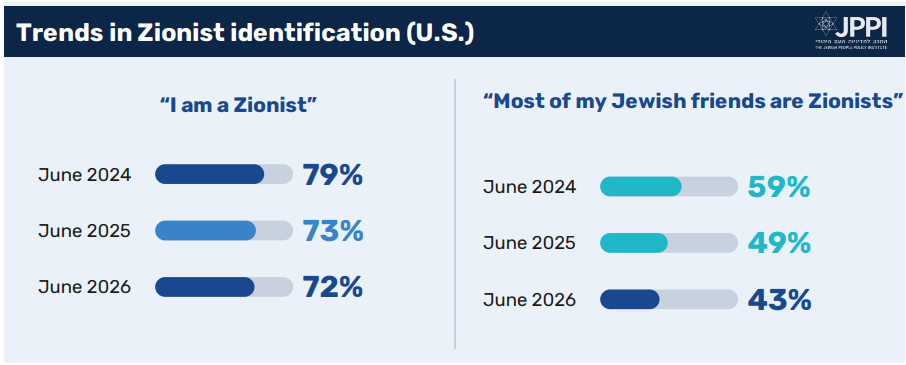
A comparative analysis of U.S. respondent data from recent years shows that attachment to the Zionist idea remains strong among an overwhelming majority, although a slight erosion in the intensity of this identification is evident over time. The share of respondents who self-identify as “Zionists” declined slightly from 79% in June 2024 to 73% in June 2025 and 72% in June 2026. When those who self-identify as somewhat Zionist (a share that remains stable at 13%) are added, the result is that an 85% majority of connected U.S. Jews identify with Zionism at one level or another. By contrast, the share of those who reject this definition has increased only moderately: the share of non-Zionists rose from 5% to 8%, and the share of those self-identifying as anti-Zionist increased from 2% to 4% over the past three years. On this question, it is important to qualify the findings and to emphasize again that the Voice of the Jewish People Index respondent panel is not a representative sample of the general Jewish population in the U.S.; rather, it represents connected U.S. Jews that is, Jews whose attachment to Judaism, Israel, and the community is higher than average.
Among strong liberal respondents, there has been a consistent and significant decline in the share identifying as Zionists 20 percentage points over the three-year period. This decline is reflected in the growth of the non-Zionist group in this camp (from 8% to 18%) and the anti-Zionist group (which almost doubled, from 7% to 13%). This phenomenon is unique to the leftmost pole of the ideological spectrum: in the leaning liberal cohort, the share self-identifying as Zionist remains stable at 73%, while in the center, leaning conservative, and strong conservative groups there is broad communal consolidation around Zionist identity, with high rates of identification and negligible rates of anti-Zionism.
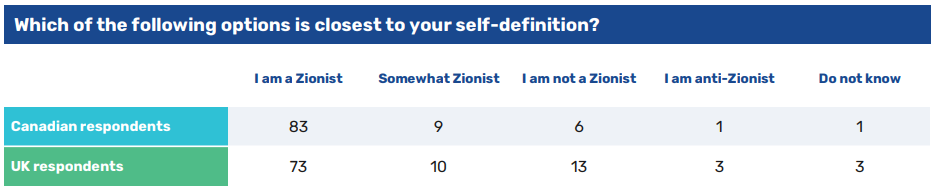
Zionist identity is also a central anchor among connected Jews in Canada and the UK. Its strength is especially pronounced among Canadian respondents, a majority (83%) of whom self-identify as Zionists; together with those who self-identify as somewhat Zionist (9%), the overall identification rate reaches 92%, with only a single percentage point identifying as anti-Zionist. Among UK respondents, the picture is favorable but somewhat more dispersed: the firm Zionist core stands at 73% (10 percentage points lower than in Canada), while those self-identifying as non-Zionist constitute a more substantial 13% (compared with only 6% in Canada), alongside a negligible share of anti-Zionists.
There has been a gradual but consistent change in how U.S. respondents perceive the attitudes of their Jewish friends. The share reporting that most of their friends are Zionists has declined by 16 percentage points over the past three years – from a majority of 59% in June 2024, to 49% in June 2025, and to 43% in June 2026. This erosion has not translated into an increase in anti-Zionism in their Jewish friendship circles (which remains negligible); rather, it appears chiefly in the moderate intermediate category “most are somewhat Zionist,” which rose from 20% to 29%, and in the sense that “there is no clear majority for any kind of Zionist position” (which rose from 8% to 13%).
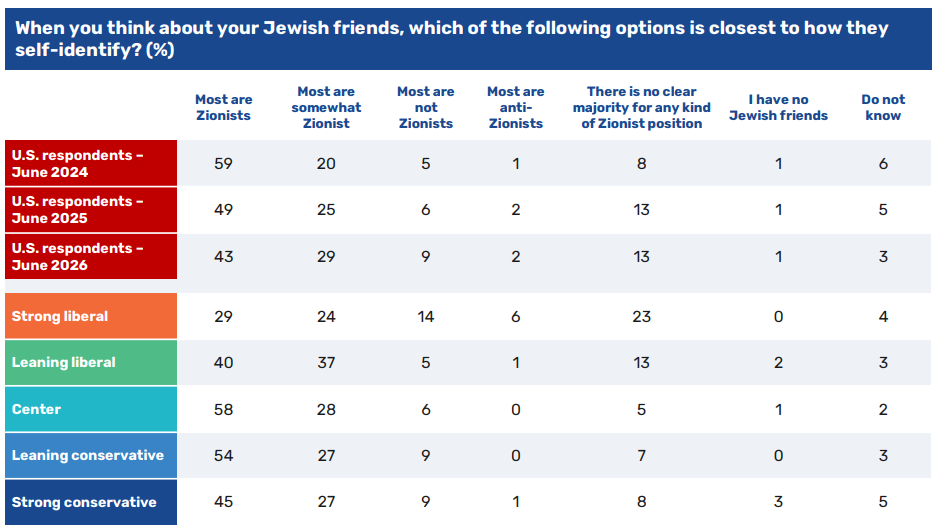
Broken down by ideological orientation, 29% of strong liberal respondents say that most of their friends are Zionists; alongside this, 23% report that their friends have no clear majority, 14% say that most are non-Zionists, and 6% point to an anti-Zionist majority. This social picture changes as one moves rightward along the ideological spectrum: the centrist cohort records the highest score for a clearly Zionist Jewish social circle (58% say most of their Jewish friends are Zionists), and a similar trend is found in the leaning conservative (54%) and strong conservative cohorts (45% “most are Zionists” and 27% “most are somewhat Zionist”).
Survey Data and Implications
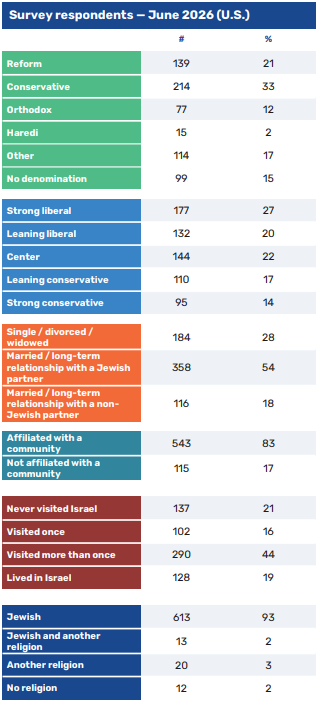
This report is based on a survey of 806 Jews registered for JPPI’s “Voice of the Jewish People” respondent panel. Broadly speaking, the survey reflects the views of “connected” American Jews that is, those with a relatively strong connection to the Jewish community, and/or to Israel, and/or to Jewish identity. The survey included 40 UK respondents and 106 Canadian respondents. Unless otherwise noted, the results reflect the attitudes of U.S. respondents only. JPPI’s Voice of the Jewish People Index surveys are conducted by JPPI fellows Shmuel Rosner and Noah Slepkov, with assistance from Yael Levinovsky. Statistical supervision: Prof. David Steinberg.
This table includes data on the U.S. survey respondents for June 2026.