


In each of the social, economic, and security spheres, a majority of Israelis say the past year was not good. Four in ten say Israel is improving, but a majority believe it is deteriorating.
This report examines attitudes as the new year begins and assessments of the year just ended; the importance of the approaching elections and the issues likely to determine them; the future of the Gaza Strip; the sense of victory in the war; the Qusra incident; the rise in antisemitism worldwide; and the education system.
Additional Findings
▪ A fateful election: Four in ten Israelis believe these elections will be “the most important in the country’s history,” while an equal share say they will be especially important.
▪ The issues emerging as decisive in the coming elections: security, relations between the government and the judiciary, and unity.
▪ Three-quarters of Jewish Israelis would not agree “under any circumstances” to an Israeli withdrawal from the security perimeter in Gaza; support among Jewish Israelis for occupying the Strip has increased over the past year.
▪ One-third of Israelis describe the Jewish youths involved in the Qusra incident as “Israeli terrorists”; virtually no respondents on the right chose that description.
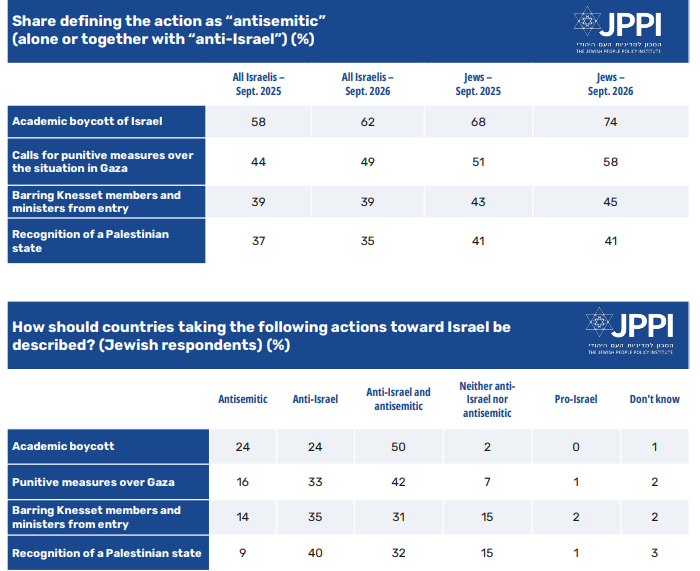
▪ Perceptions of antisemitism: Three-quarters of Jewish Israelis regard an academic boycott of Israel antisemitic, compared with two-thirds a year ago.
▪ One-third attribute the rise in antisemitism worldwide to Israeli policy; two-thirds believe there is no connection, or only a weak one, between Israel’s conduct and antisemitism.
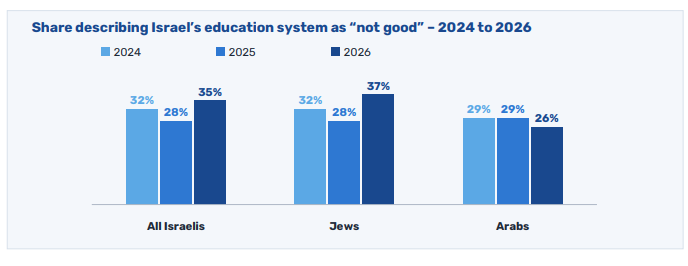
▪ The education system continues to erode: a growing share describe it as “not good.”
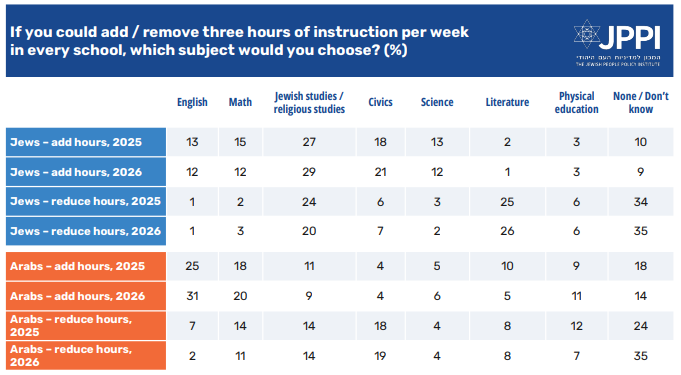
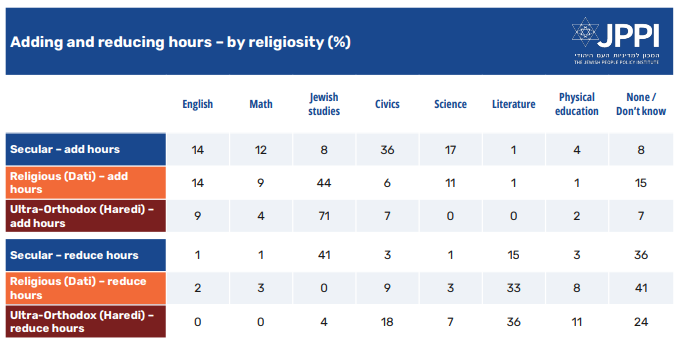
▪ The most contested subject: Many Israelis want to add more hours of Jewish studies to the school timetable, while many others want to reduce them.
Click here to download the PDF version.
As the New Year Begins
For the second year, ahead of Rosh Hashanah, we asked Israelis which statement best reflects their view of Israel’s overall situation. This year’s picture is somewhat more optimistic than last year’s: 35% of all Israelis and 43% of Jewish Israelis chose “Israel is improving, and things will get even better,” compared with 30% and 36%, respectively, in September 2025. At the same time, the share who believe Israel is deteriorating and that the trend will continue fell from 38% to 30% among all Israelis and from 34% to 24% among Jewish Israelis. Among Arab Israelis, by contrast, there was no significant change: just 5% chose the most optimistic option and 54% the most pessimistic – exactly as last year.
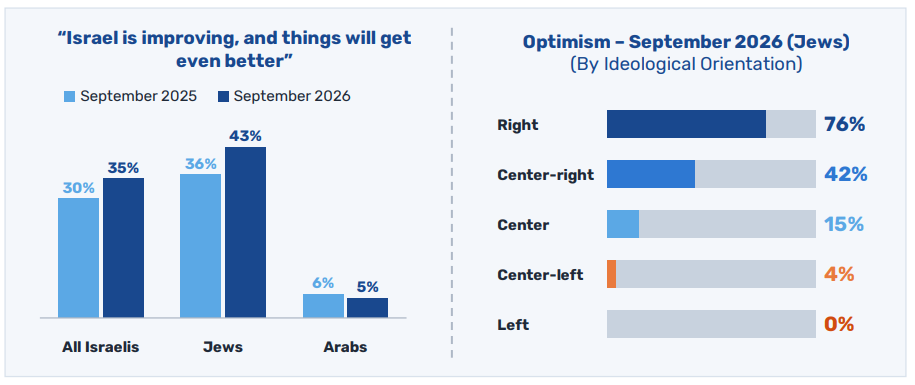
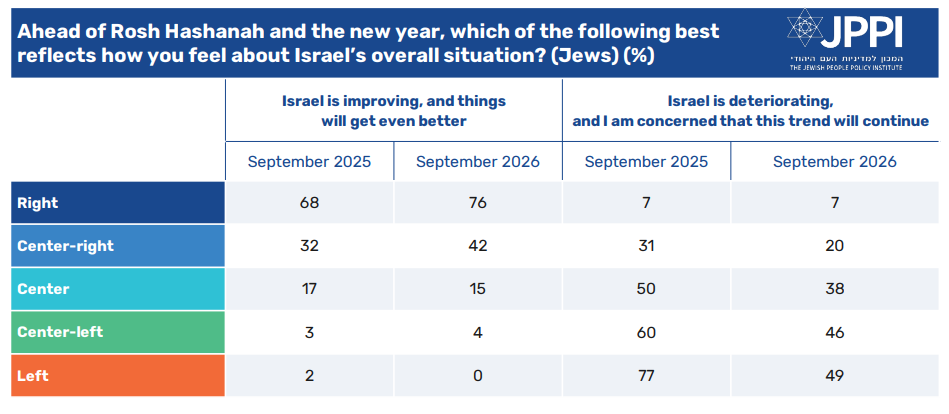
Among Jewish Israelis, optimism is closely associated with ideological orientation. Among those who identify with the right, three-quarters (76%) believe Israel is improving and will continue to improve, up from two-thirds (68%) last year. The increase is even sharper among center-right respondents, from 32% to 42%. There was almost no change in the center, and not a single respondent on the left chose the most positive option.
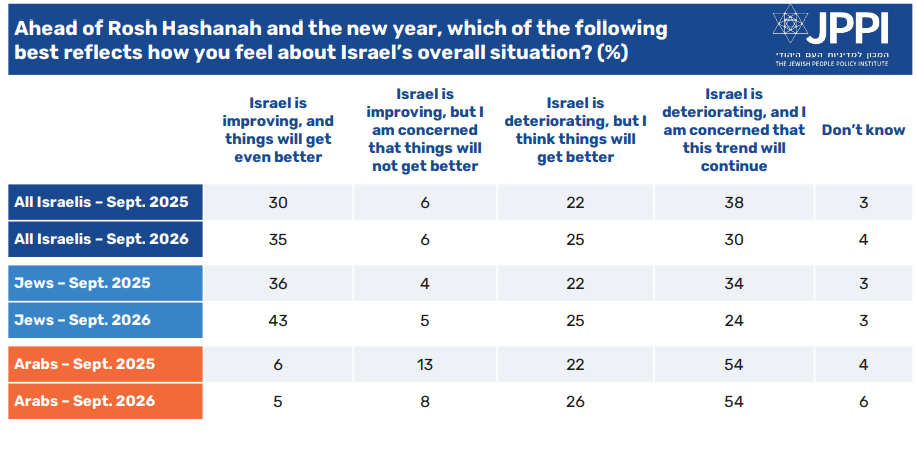
On the left, however, there was movement of a different kind: the share who believe deterioration will continue fell sharply from 77% to 49%, with almost all of those who moved away from that view shifting to “Israel is deteriorating, but I think things will get better” (22% last year versus 49% today). In other words, the right has become more optimistic, while the left has become less pessimistic.
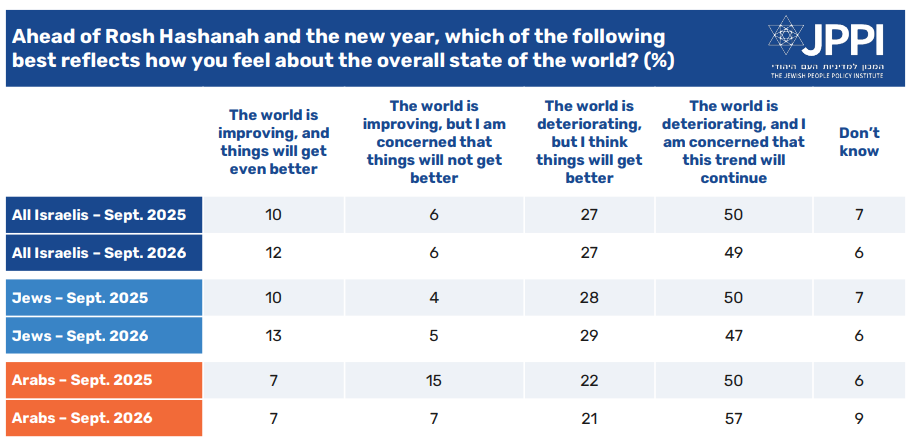
When the same question was asked about the world, half of Israelis (49%) said the world is deteriorating and will continue to do so, while only one in eight (12%) said it is improving and will continue to improve figures almost identical to those recorded last September (50% and 10%, respectively). The gap between Israelis’ assessments of Israel’s condition and of the world, already evident last year, has persisted and widened: Israelis have much more confidence in Israel’s ability to create a better future for itself than in the world’s ability to do so. Notably, the gap between Jewish and Arab Israelis is much smaller on the question about the world than on the question about Israel.
Looking Back at the Past Year
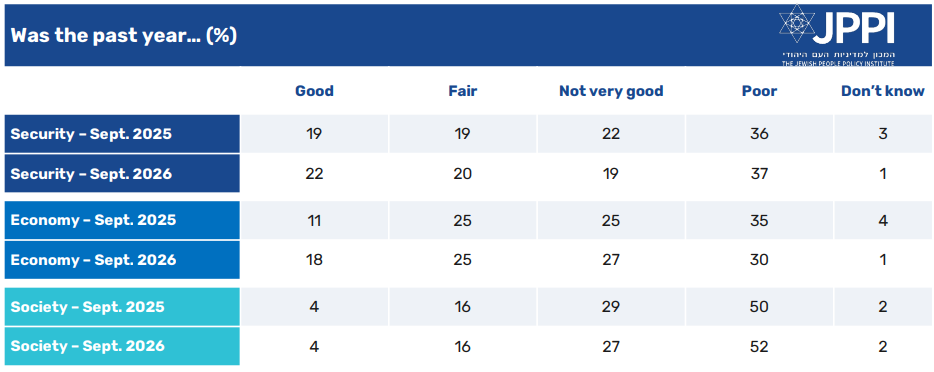
Respondents were asked three identically worded questions to assess the past year in three areas: security, the economy, and society. The results reveal a clear hierarchy. The social sphere receives the lowest rating and is the only one in which there has been no improvement since last year: 52% of Israelis describe the past year as “poor” socially, while only 4% describe it as “good.”
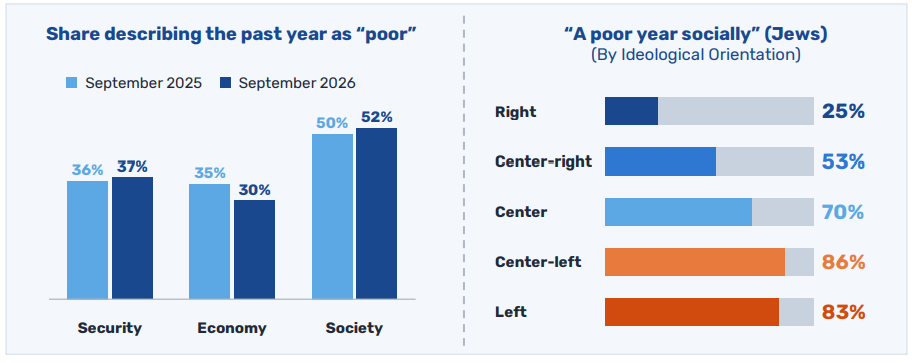
The economic assessment improved slightly: the share describing the year as “poor” fell from 35% to 30%, while the share describing it as “good” rose from 11% to 18%. In security terms, the picture is almost unchanged: 37% describe the year as “poor,” compared with 36% last year. Among Jewish Israelis, however, half (50%) now describe it as a “good” or “fair” year in security terms.
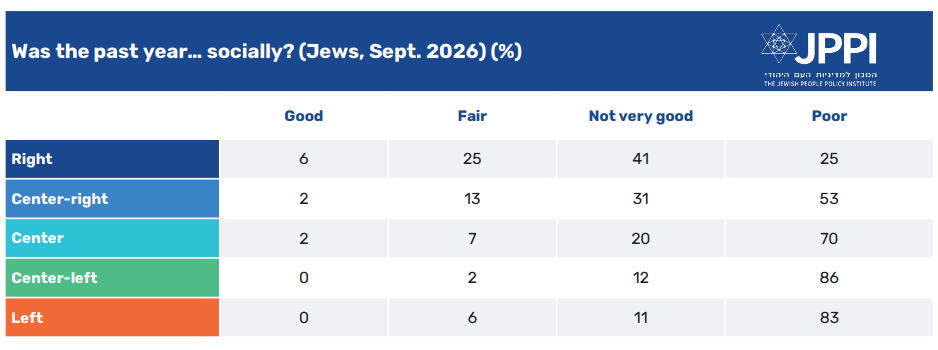
The social sphere is also the only one of the three in which the ideological gap has widened rather than narrowed. Among respondents who identify with the right, the share describing the year as “poor” socially remained at about one-quarter, while it rose from 74% to 86% in the center-left and from 62% to 70% in the center. In other words, the growing sense that Israel is experiencing a social crisis is concentrated almost entirely in the center and on the left of the Jewish ideological spectrum.
The Most Important Elections in the Country’s History
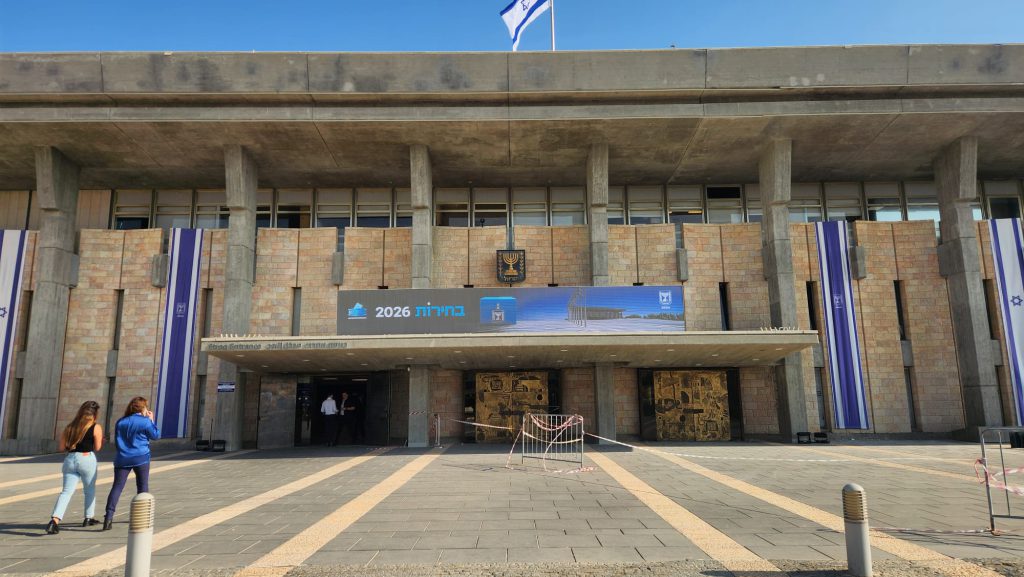
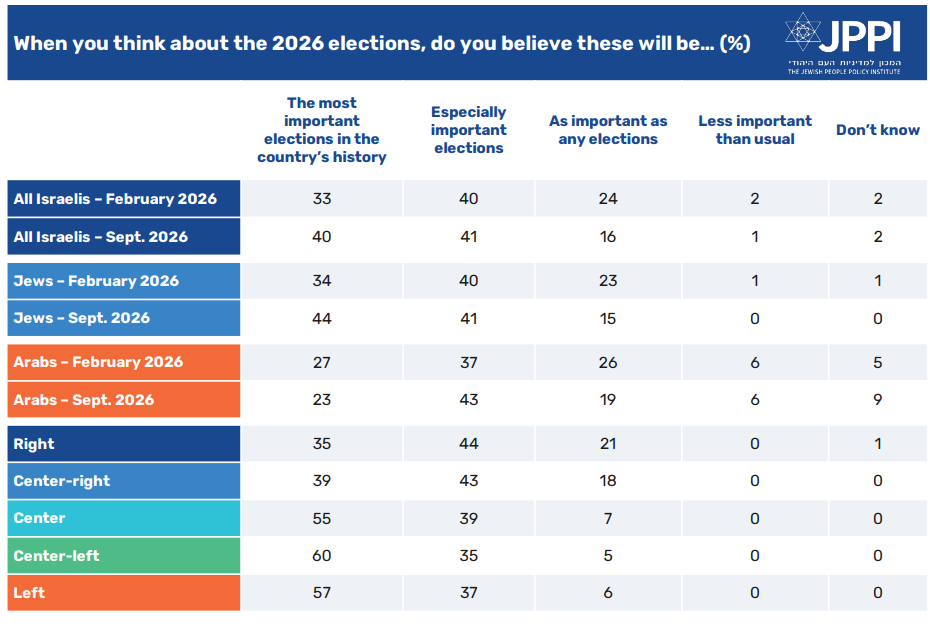
Ahead of the elections expected this fall, the sense that the election is fateful has strengthened. Four in ten Israelis (40%) believe these will be “the most important elections in the country’s history,” up from one-third (33%) in February. Another 41% say the elections will be “especially important.” Overall, eight in ten Israelis therefore see these elections as exceptional in importance, while the share describing them as “as important as any election” fell from 24% in February to 16% today. This sense is stronger among respondents who identify with the center and left: 60% in the center-left, 57% on the left, and 55% in the center say these will be “the most important elections in the country’s history,” compared with 35% on the right and 39% in the center-right. Among Arab Israelis, the sense is more muted: 23% hold this view. This month, we also examined which issue voters regard as decisive in the coming elections. Of the six substantive issues presented, security remains the leading consideration.
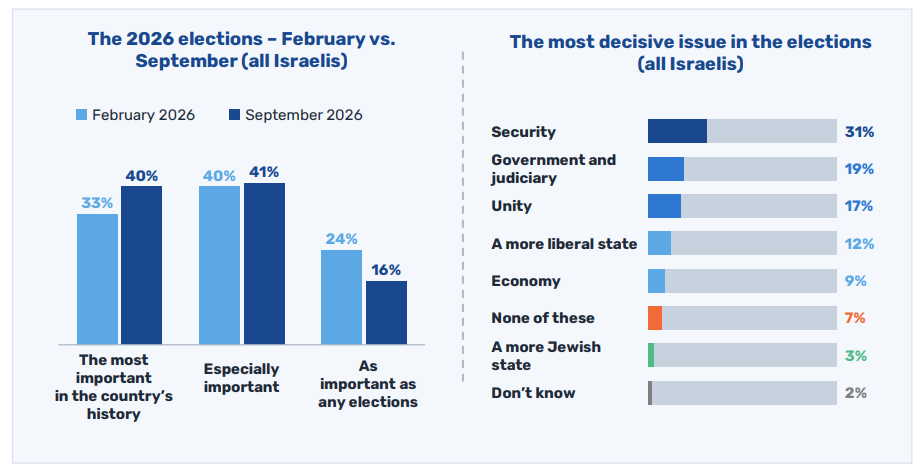
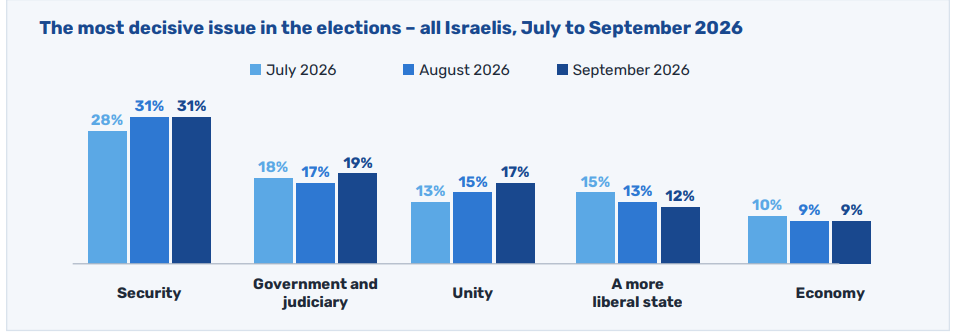
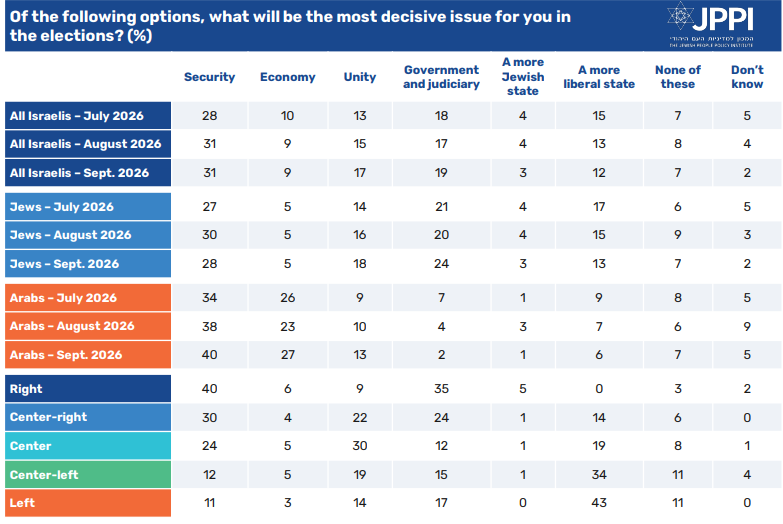
Its increase occurred between July and August and has since stabilized: nearly one-third of Israelis (31%) say the decisive consideration in their vote will be “who will contribute most effectively to maintaining security.” The next two leading issues are relations between the government and the judicial system, and unity. Looking across the past several months, the picture is relatively stable: changes in Israelis’ responses are small, and the ranking of the issues remains similar from month to month. The main differences are between Jewish and Arab Israelis. Management of the economy ranks second in importance among Arab Israelis, while only 5% of Jewish Israelis identify it as the decisive issue in the coming elections. The two findings – the growing sense that these are fateful elections and the rise of unity as a decisive issue are consistent with last month’s finding that Jewish Israelis who had not yet made a final voting decision placed particular emphasis on “more unity and fewer disputes.” In other words, undecided voters are looking for a reduction in polarization and conflict.
In recent days, this group has faced an additional development: some parties in the “third bloc” have announced that they will not contest the coming election, while others have announced that they will merge with larger parties. The ideological breakdown reveals two distinct patterns. On the right, security (40%) and relations between the government and the judicial system (35%) are the decisive issues in the coming elections, and not a single respondent chose “a more liberal state.” On the left and center-left, by contrast, the leading issue is “a more liberal state” – 43% and 34%, respectively. In the center, the leading issue is unity (30%).
Best Suited to Be Prime Minister
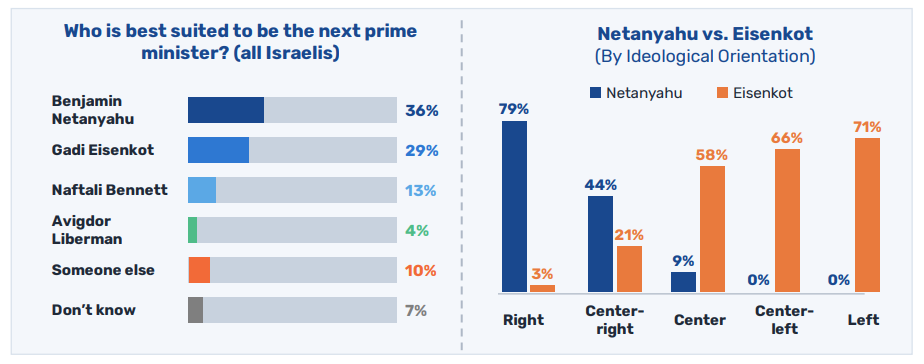
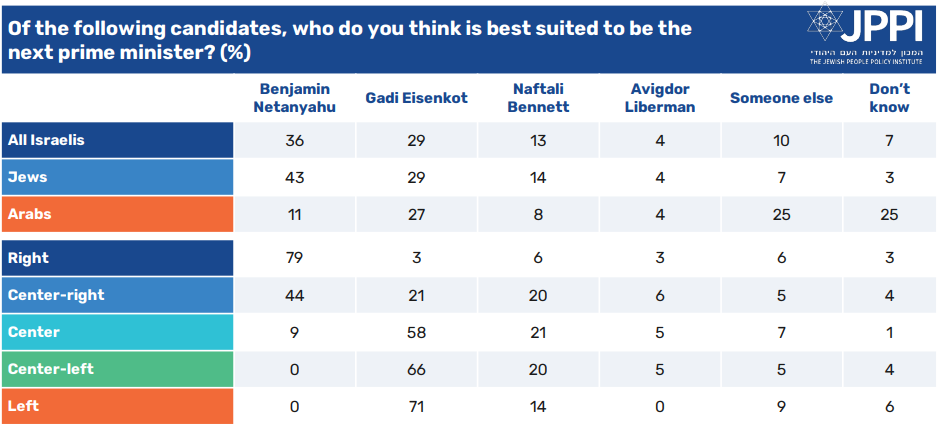
When respondents consider several candidates at once, Benjamin Netanyahu remains the leading candidate for prime minister, but he is not the preferred candidate of a majority of Israelis. Thirty-six percent of all Israelis and 43% of Jewish Israelis regard him as best suited for the position. Gadi Eisenkot ranks second at 29% virtually identical among all Israelis and Jewish Israelis followed by Naftali Bennett at 13% and Avigdor Liberman at 4%. The three named alternatives together account for 46% of Israelis. The ideological breakdown shows Netanyahu as the dominant choice on the right (79%), while Eisenkot leads in all other camps: 71% on the left, 66% in the center-left, and 58% in the center. The center-right is the only camp in which there is a genuine contest: 44% choose Netanyahu, 21% Eisenkot, and 20% Bennett.
Gaza: The Security Perimeter and Occupation
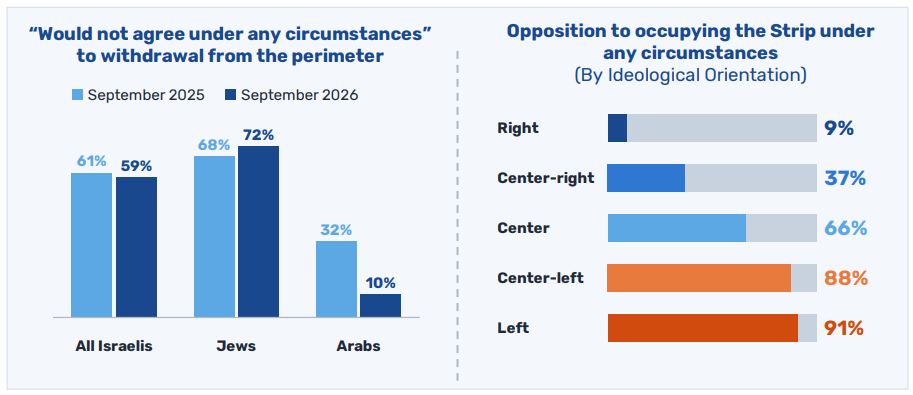
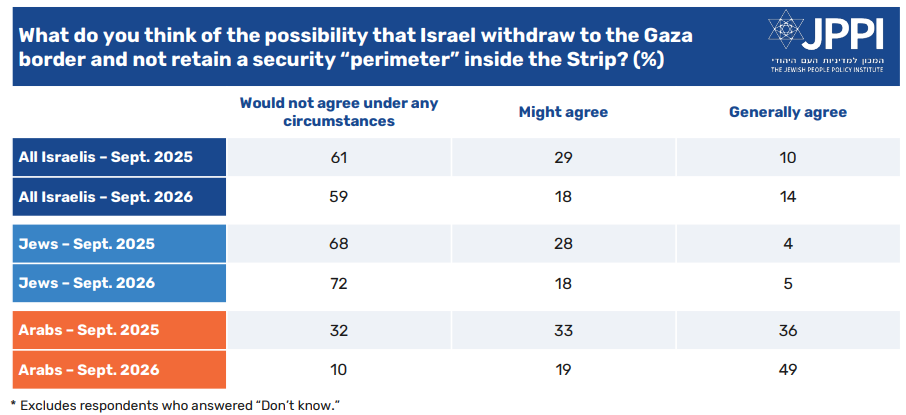
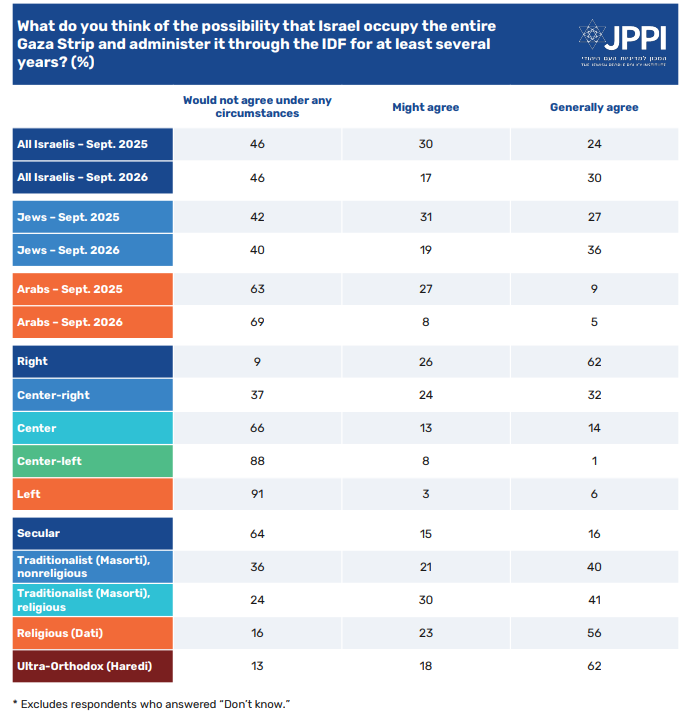
This month, respondents were presented with two options concerning the future of the Gaza Strip, using wording identical to that used in September 2025, before the Hamas-Israel agreement that ended the war in Gaza and led to the return of all the hostages. The results should be read against the background of the August survey: following President Trump’s announcement of an agreement to disarm Hamas, a majority of Israelis (58%) believed it would not be implemented and that the current situation would remain roughly unchanged, while virtually none expected the full scenario of complete disarmament and complete Israeli withdrawal. In other words, this month’s responses concerning Gaza’s future do not refer to an arrangement regarded as imminent, but rather to one that most respondents do not expect to be implemented. The option that Israel withdraw to the Gaza border and not retain a security “perimeter” inside the Strip is rejected outright by nearly three-quarters of Jewish Israelis (72%), who say they would not agree to it “under any circumstances.” A majority of all Israelis (59%) say the same. Among Arab Israelis, by contrast, half (49%) agree that Israel should withdraw to the Gaza border and not maintain a security “perimeter” inside the Strip, up from 36% last year.
The opposite option that Israel occupy the entire Strip and administer it through the IDF for at least several years has gained support among Jewish Israelis over the past year. The share who “generally agree” with full occupation rose from 27% to 36%, while the share opposed “under any circumstances” remained stable. The movement therefore came mainly from those who had previously been hesitant, rather than from opponents. Among Arab Israelis, attitudes hardened in the opposite direction, with opposition to occupation under any circumstances increasing.
The ideological breakdown is stark. On the right, 62% generally agree with occupation and only 9% oppose it under any circumstances; in the center-right, 32% agree and 37% oppose. In the center, center-left, and left, opposition stands at 66%, 88%, and 91%, respectively. The religiosity breakdown follows the same gradient: 64% of secular Jews oppose occupation under any circumstances, compared with 13% of Haredim and 16% of religious Jews.
Sense of Victory in the War
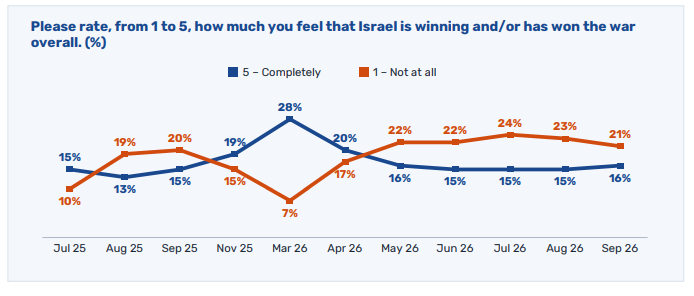
Each month, we ask respondents to rate on a 1-to-5 scale the extent to which they feel that Israel is winning or has won the war that began on October 7. This month, as the year draws to a close, the sense of victory returned almost exactly to where it stood on the eve of last Rosh Hashanah, after considerable fluctuation over the past year. Forty percent rate it at the two highest levels, 4 or 5, compared with 43% in September 2025, while 37% rate it at the two lowest levels, 1 or 2, compared with 32% then.
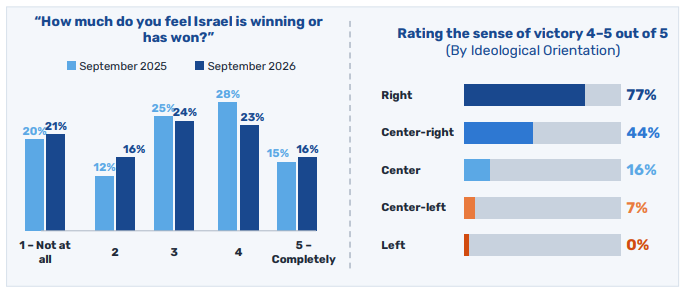
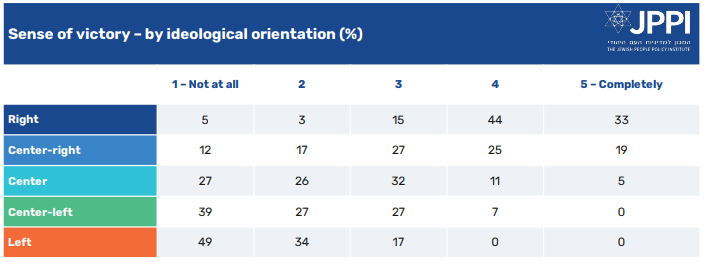
Between these two points from last Rosh Hashanah to this one there were substantial shifts, including a peak in March 2026 after Operation Roaring Lion and a low in recent months. The sense-of-victory question shows the sharpest ideological divide of any survey item measured this month. Among respondents who identify with the right, 77% rate their sense of victory at 4 or 5; in the center-right, 44%; in the center, 16%; in the center-left, 7%; and on the left, none.
The overall increase in the sense of victory, from 37% in August to 40% in September, is entirely concentrated on the right. Among right-wing respondents, the share rating their sense of victory at 4 or 5 jumped from 67% to 77% in a single month, while in every other camp the change is only one or two percentage points in either direction. In other words, what appears to be a slight recovery in the sense of victory is in fact a strengthening of that sentiment among those who already held it, rather than a broad-based change. This occurred in a month with no significant change across the IDF’s various combat arenas, suggesting that the shift may reflect greater exposure to partisan election-campaign propaganda across the political spectrum.
The Situation in Judea and Samaria (the West Bank)
During the past month, a violent incident took place in the village of Qusra in Judea and Samaria (the West Bank), after dozens of masked Israeli civilians arrived in pickup trucks and threw stones at Palestinian residents. Some of the rioters barricaded themselves inside a local home while its residents were present. Several Palestinian residents were injured, including a woman who was evacuated for medical treatment. When security forces arrived, the Israeli rioters fled, and no arrests were made. The incident drew considerable attention and commentary from numerous politicians. It was also widely covered by media outlets around the world and led to condemnation of Israeli policy in Judea and Samaria. This month, we asked respondents to choose the description they considered most appropriate for the group of young Jewish men involved in the incident, selecting from several terms used by Israeli politicians.
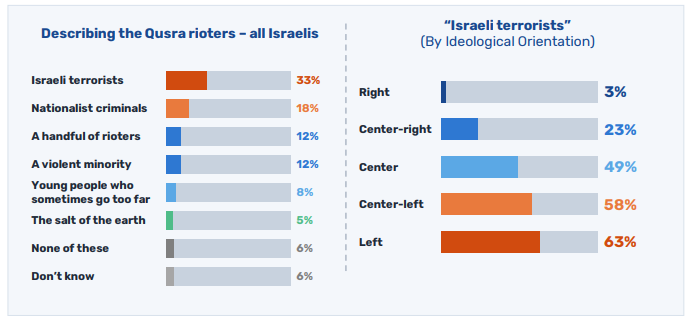
The strongest label – “Israeli terrorists” was also the most frequently selected: one-third of Israelis (33%) described the Qusra rioters as “terrorists.” Together with “nationalist criminals,” 51% chose one of the two harshest descriptions. At the other end of the spectrum, the two most lenient descriptions “young people who sometimes go too far” and “the salt of the earth” were chosen by 13% of Israelis. Among Arab Israelis, the share describing the group as “Israeli terrorists” is substantially higher than among Jewish Israelis (55% versus 27%).
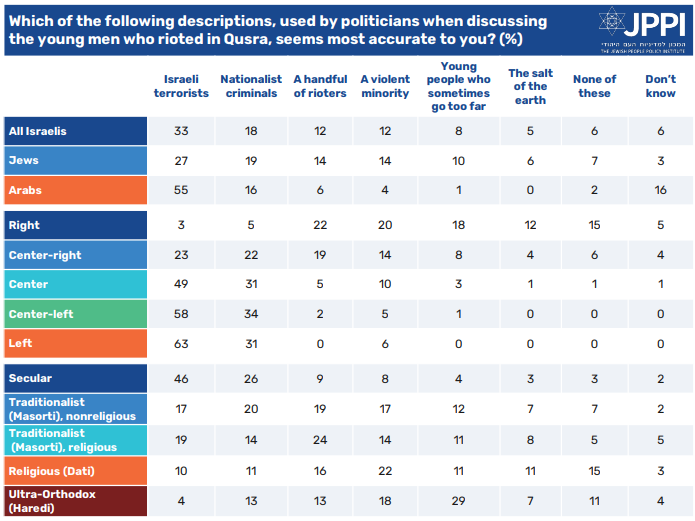
More lenient descriptions are correspondingly rare among Arab respondents: “a handful of rioters,” “a violent minority,” “young people who sometimes go too far,” and “the salt of the earth” together account for only one-tenth of Arab responses. The ideological gap on this question is dramatic. On the left, 63% choose “Israeli terrorists” and another 31% “nationalist criminals” – 94% combined. In the center, about half choose “terrorists” and roughly one-third “criminals.” On the right, only 3% choose “Israeli terrorists”; the most common descriptions are “a handful of rioters” (22%) and “a violent minority” (20%). Overall, 30% on the right choose one of the two most lenient labels, including 12% who choose “the salt of the earth.” By religiosity, 72% of secular Jews choose one of the two harshest descriptions, compared with 17% of Haredim. Conversely, 36% of Haredim choose one of the more lenient descriptions, including 29% who choose “young people who sometimes go too far.”
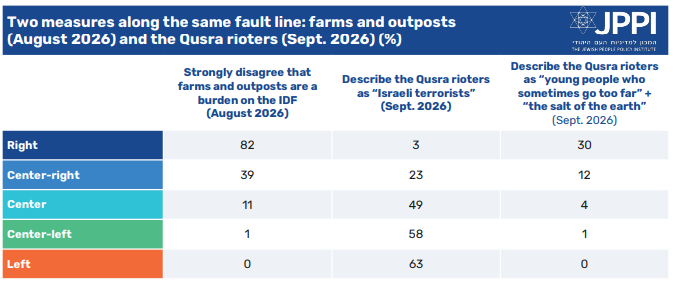
This finding is not an isolated one. Last month, we asked a differently worded question: whether Jewish farms and outposts in the West Bank are a burden on the IDF and harm the security of all Israeli citizens. The result was almost evenly split: 36% of Israelis “strongly disagreed” and 36% “strongly agreed.” Placing the two questions side by side reveals the same ideological ordering, at almost the same intensity. The questions are different and should not be compared directly, but they reveal the same fault line: attitudes toward violence by fringe groups within the settlement movement appear to be shaped less by information or facts than by identity.
Antisemitism and Foreign Relations
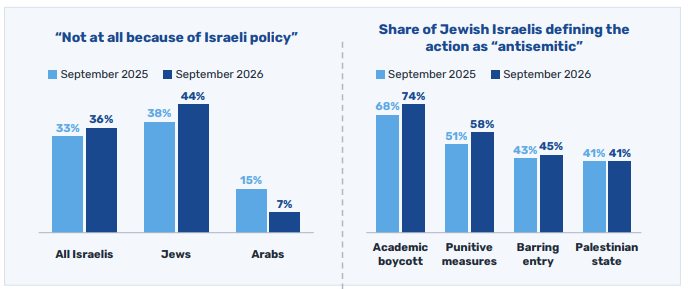
For the second consecutive year, we examined Israelis’ attitudes toward the rise in antisemitism worldwide. The principal finding is an erosion of the middle position. Thirty-six percent of Israelis believe the increase in antisemitism is “not at all because of Israeli policy,” compared with 33% last year; among Jewish Israelis, the share rose from 38% to 44%. At the opposite end, there was little change: 34% of Israelis believe antisemitism is increasing “to a great extent” because of Israeli policy, compared with 32% last year.
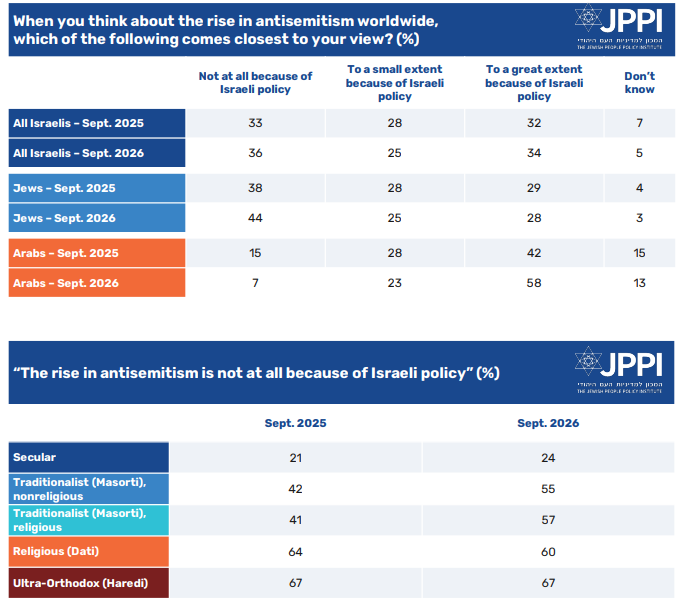
It is the middle position that has contracted. Among Arab Israelis, the share attributing the increase in antisemitism “to a great extent” to Israeli policy rose from 42% to 58%. Among Jewish Israelis, meanwhile, the view that there is no connection at all between Israeli policy and antisemitic phenomena abroad has strengthened. This shift is especially evident in the middle of the religiosity spectrum: among traditionalist (Masorti), nonreligious Jews, the share saying there is no connection at all rose from 42% to 55%; among traditionalist (Masorti), religious Jews, it rose from 41% to 57%. There was no change among Haredim, while among religious (Dati) Jews the share declined slightly.
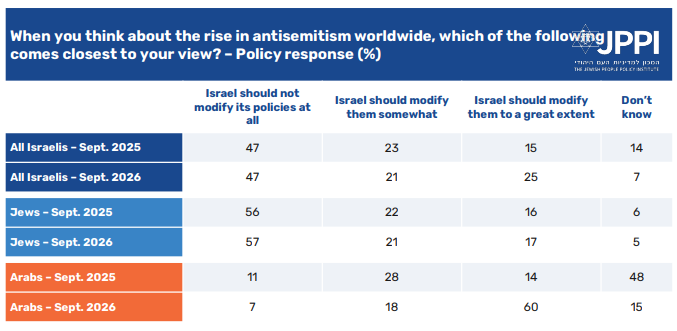
On the practical question of whether Israel should modify its policies because of the rise in antisemitism, the position of Jewish Israelis is essentially unchanged: 57% say Israel should make no changes, compared with 56% last September. Among all Israelis, the figure is 47% – identical to last year. Here too, the only substantial movement is among Arab Israelis, where the share supporting policy change “to a great extent” rose from 14% to 60%. This sharp shift largely reflects a substantial decline in “Don’t know” responses in this group, from 48% to 15%. For the second consecutive year, we also examined how Israelis classify various international actions toward Israel and over the past year, some of these actions have ceased to be hypothetical. The data indicates that Israelis’ definition of what should be considered “antisemitic” has broadened somewhat. For three of the four actions examined, the share of Jewish Israelis who regard them as antisemitic either antisemitic alone or both anti-Israel and antisemitic increased. For an academic boycott, the share rose from 68% to 74%; for calls for punitive measures against Israel because of the humanitarian situation in Gaza, from 51% to 58%; and for barring ministers and Knesset members from entering various countries, from 43% to 45%. The exception is recognition of a Palestinian state, the action that had already been implemented most extensively in practice even before this year. The share of Jewish Israelis defining such a step as antisemitic remained at 41%, unchanged from last year.
The Education System
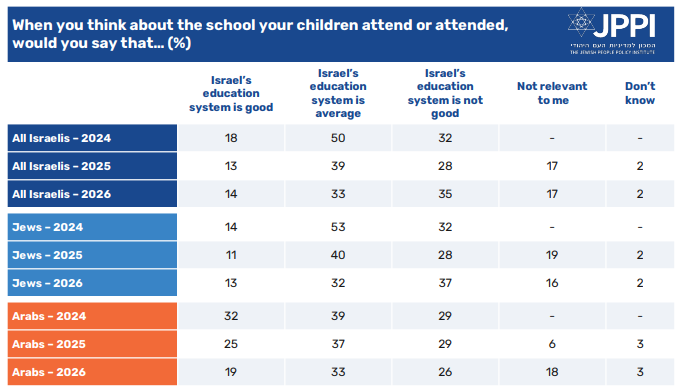
With the opening of the school year, we again examined a series of questions concerning Israel’s education system. This is the third consecutive year we have asked these questions, and the trend has moved consistently in one direction: the share of Israelis who describe the education system as “not good” rose from 32% in 2024 to 35% this year.
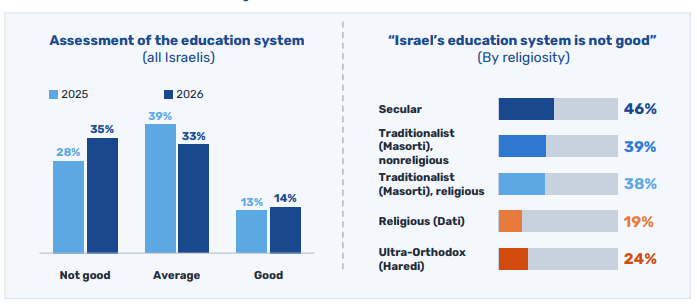
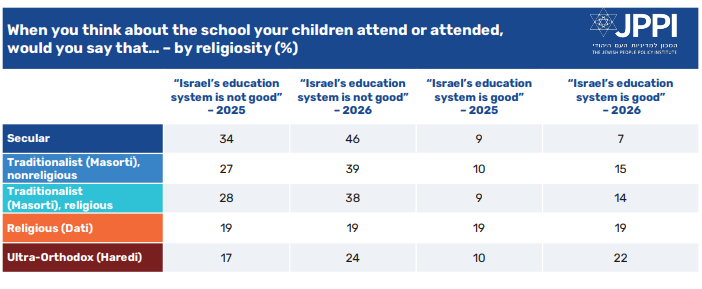
The share who describe it as “good” has fallen by four percentage points over the past two years, to 14%, while the share who describe it as “average” fell from 50% to 33%. Among Jewish Israelis, 37% now say the system is “not good,” compared with 28% last year and 32% two years ago. Among Arab Israelis, there has likewise been a decline over the past two years in the share describing the education system as “good” from one-third (32%) in 2024 to one-fifth (19%) today. A breakdown by religiosity shows that the deterioration is concentrated primarily in secular Jews’ assessment of the education system: the share of secular respondents who describe it as “not good” rose from 34% to 46% over the past year. There was also a substantial increase in negative assessments among traditionalist (Masorti) Jews. There was no change among religious (Dati) Jews, while among Haredim the share satisfied with the system increased: 22% now describe it as “good,” compared with 10% last September.
Responses to questions about the subjects Israelis would add to or reduce in the school timetable are remarkably stable compared with last year. Among Jewish Israelis, “Jewish studies” is the subject the largest share would strengthen (29%, compared with 27% last year), followed by civics (21%). Yet “Jewish studies” is also the second-most frequently chosen subject for cuts (20%, compared with 24% last year) after literature, which just over one-quarter of Jewish Israelis (26%) would cut. Among Arab Israelis, priorities are entirely different: English is the subject most frequently chosen for additional hours (31%, up from 25% last year), followed by mathematics (20%).
The divide between secular and religious Jews is especially stark. Thirty-six percent of secular Jews would add hours to civics and only 8% to Jewish studies; 44% of religious Jews and 71% of Haredim would add hours to Jewish studies, while only 6% and 7%, respectively, would add hours to civics. In the opposite direction, 41% of secular Jews would cut Jewish studies, compared with 0% of religious Jews and 4% of Haredim. Religious Jews and Haredim would direct their cuts primarily toward literature (33% and 36%) and civics (9% and 18%).
Data for JPPI’s September Israeli Society Index was collected between September 1 and 3, 2026, via the Madad.com panel (663 Jewish-sector respondents) and Afkar Research in the Arab sector (206 respondents, approximately half online and half by telephone).
The data was weighted according to voting patterns and religiosity and analyzed to represent the views of Israel’s adult population. Shmuel Rosner and Noah Slepkov compile the JPPI Israeli Society Index, with research, production, and writing assistance from Yael Levinovsky. Prof. David Steinberg provides statistical supervision.