The 250th Anniversary Edition
By: Prof. Gil Troy
To download the full guide, click here.

WHY CAN’T ISRAEL SOLVE THE PALESTINIAN PROBLEM – WHY CAN’T AMERICA?
American presidents keep pressuring Israeli prime ministers to advance a Palestinian peace process. In 2010, leaked diplomatic exchanges repudiated a central assumption behind this push. While Barack Obama assumed that Arabs prioritize the Palestinian cause, Arab leaders actually feared the Iranian “danger.” Obama’s rapprochement with Iran unintentionally spawned the Abraham Accords, by propelling Egypt and Saudi Arabia toward Israel. Similarly, shortly after October 7, while supporting Israel courageously, Joe Biden, like his predecessors, reiterated his endorsement of the “two-state solution.” Even Donald Trump, despite supporting Netanyahu’s government, often proposed solving the Palestinian problem in ways Israel didn’t.
Today, after more than two years of harsh coverage emphasizing Gazans’ suffering from Israel’s counterattack, with many reporters treating the Iran alliance’s seven-front war to annihilate Israel as a one-sided Israeli police action against Palestinians, more Americans criticize Israel’s resistance to a Palestinian state. In autumn 2025, 21 percent of Israelis supported a Palestinian state – a 29-point drop since 2013; 58 percent of Americans supported one, up from 44 percent in 2013.
Furthermore, although Trump criticized European allies for recognizing a non-existent Palestinian state, 47 Democratic representatives and eight Democratic senators endorsed the initiative. “America has a new generation that will recognize a Palestinian state when we come to power,” said Representative Ro Khanna, a California Democrat.
Before looking ahead, better to look backward, asking two questions. First, why can’t Israel solve the Palestinian problem, given how much reputational damage Israel sustains over the issue? And second, after working so hard to establish a Palestinian state, why have Americans also failed so dramatically?
Actually, the pressing question is: why haven’t Palestinians solved their own problem? Assuming others should take responsibility for them is condescending and feeds a paralyzing victim mentality. The biggest obstacle to peace remains Palestinian leaders’ refusal to tolerate a Jewish state of any size on “their territory,” from the Grand Mufti of Jerusalem in the 1940s to the Sinwar brothers of Hamas.
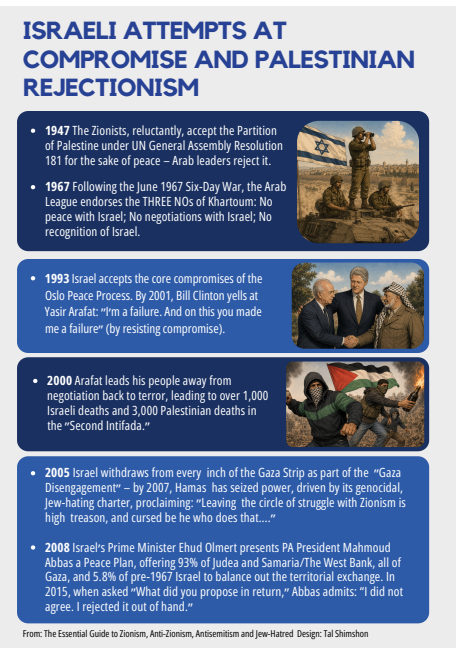
Arab leaders rejected the UN’s 1947 Partition Plan. As various compromise plans percolated years earlier, the Mufti declared: “Those who go to meet the partition commission should take their shrouds with them.” In 1947, the Arab League’s secretary-general, Abdul Rahman Hassan Azzam, vowed that if Jews established a state, Arabs would unleash “a war of extermination and momentous massacre which will be spoken of like the Mongolian massacre and the Crusades.”
In 1964, the Palestine Liberation Organization’s (PLO) founders rejected any Jewish state. “The liberation of Palestine…,” the PLO’s Charter proclaimed, “aims at the elimination of Zionism in Palestine.”
Three years later, when Israel expanded following its Six-Day War of self-defense, the Arab League issued the Three NOs of Khartoum, Sudan: “No peace with Israel, No recognition of Israel, No negotiations with it.” Eventually, Anwar Sadat boldly accepted coexistence, signing the 1979 Israel-Egyptian peace treaty. Two years later, Egyptian Islamic Jihad terrorists assassinated him.
In the 1970s and 1980s, while publicizing their cause through global terrorism, Palestinian nationalists generally avoided religious rhetoric. PLO Chairman Yasir Arafat sought a “secular democratic state in Palestine.” Sadat’s assassination reflected jihadists’ growing power. They made this clash of nationalisms more cosmic and irreconcilable.
By 1988, what Palestinians called the “Intifada” (uprising) spawned the jihadist organization, Hamas. The Hamas Covenant declared, “Israel will exist … until Islam will obliterate it.” Rejecting compromise, interweaving antisemitism with anti-Zionism, the charter proclaimed: “There is no solution for the Palestinian problem except by jihad [struggle].”
Hamas worked hard to sabotage the Oslo Peace Process, which began in 1993 with a conceptual breakthrough. To minimize the number of Palestinians directly under Israeli control, the new Palestinian Authority controlled the six largest Palestinian cities in the territories. Since then, most Palestinians live under the PA. Historians debate Yasir Arafat’s sincerity and some of Israel’s actions – given how divided Israel was, and how the fiery opposition culminated in Yitzhak Rabin’s assassination. But by targeting Palestinian moderates and murdering Israelis during negotiations, Hamas doomed the peace process.
In September 2000, pressured by jihadi radicals led by Hamas, and unwilling to coexist with Israel, Arafat launched the “Second Intifada.” Palestinian suicide bombers and gunmen cumulatively killed over 1,000 innocents – shaking most Israelis’ faith in a two-state solution. If in the 1980s, American conservatives were liberals who were mugged, in Israel, hardliners were “peaceniks” who were bombed.
Nevertheless, in 2005, to placate the Americans – and simplify Israel’s battlelines – Prime Minister Ariel Sharon disengaged Israel from Gaza. Israel dismantled 21 Jewish communities, removing 8,000 Israelis who lived in the coastal strip on Israel’s southwestern flank. President George W. Bush insisted: “Palestinians must undertake an immediate cessation of armed activity and all acts of violence against Israelis anywhere, and all official Palestinian institutions must end incitement against Israel.” Negotiations would then give Israel “secure and recognized borders.”
Instead, by 2007, Hamas violently seized power. Gaza’s new jihadi leaders believed their charter: “Leaving the circle of struggle with Zionism is high treason and cursed be he who does that.”
Occasional attempts to reignite negotiations between Israel and the PA failed amid constant tension between Hamas and Israel, punctuated by periodic military clashes. In 2008, Prime Minister Ehud Olmert offered Palestinians 93 percent of Judea and Samaria (the West Bank), all of Gaza, and 5.8 percent of Israeli territory from within the pre-1967 borders, to balance Palestinians’ pre-1967 claim. Asked in 2015, “What did you propose in return?” the PA president, Mahmoud Abbas, boasted: “I did not agree. I rejected it out of hand.”
On October 7, 2023, Hamas invaded Israel. Seventy-one percent of Palestinians cheered as decades of rejectionism culminated in unspeakable barbarism. Meanwhile, as Israelis bled, a systematic global campaign tried ostracizing the Jewish state, while cancelling any Zionists supporting Israel’s right to exist.
HOW THE ISRAELI UNDERSTANDING OF PALESTINIANS EVOLVED
Rooting Hamas’s crimes in the Grand Mufti’s hatred exposes the Palestinian national movement’s lethal aversion to Zionism, Israel, and the Jews. Nevertheless, it’s important to understand Israel’s evolution on the Palestinian question, especially as more Americans blame the impasse on Israel.
Israel-bashers oversimplify, pitting 7.75 million Israeli Jews against 7 million Arabs living “from the river to the sea,” meaning the Jordan River to the Mediterranean Sea. But Palestinians live under six different political arrangements. Two million Israeli Arabs enjoy full rights in Israel’s democracy. Approximately 350,000 East Jerusalemites are “permanent residents,” refusing Israel’s citizenship offer. Another two million Palestinians live in Gaza, which Hamas has controlled tyrannically since 2007. Three million Palestinians live in what most of the world calls “the West Bank” – of the Jordan River – and many Israelis call “Judea and Samaria” – the territories’ biblical names. There, 55 percent of Palestinians live in Area A, where the PA exercises civil and security control, 43 percent live in Area B, with the PA exercising civil control, while sharing security responsibilities with Israel. Only 2 percent, between 150,000 and 300,000 Palestinians, live in Area C, which Israel controls fully.
To Israelis, the “Palestinian problem” involves the Palestinians in the territories Israel liberated or occupied – your politics determines the verb – during the 1967 war. Hamas’s 2007 coup essentially created three entities, with Israel, the radical Hamas-dominated Gaza strip, and the PA-administered Judea and Samaria/West Bank. Endorsing “two states” ignores the PA-Hamas rivalry. Some analysts propose a confederation with Jordan – whose territory included Palestine until 1921. Others imagine archipelagos of autonomy, noting the tribal and clannish dynamics of Hebron or Jenin, or the way one village might be pro-Hamas, its neighbor PA-oriented, and a third, Greek Orthodox. Westerners shouldn’t impose their conceptions of nationalism on Palestinian Arabs.
Israelis vigorously debate the Palestinian issue. The “peace camp” demands sweeping Israeli concessions. Most settlers deny Palestinian rights to any part of “greater Israel.” The majority remains torn.
Israeli government policy roughly evolved in four phases: Initial Denial; Diplomatic Attempts; Weary Disinterest; and, since October 7, Disgusted Deadlock.
INITIAL DENIAL 1948-1987
For the first four decades of Israel’s existence, the Arab world’s genocidal threats quite reasonably distracted Israel’s government. Most Arabs emphasized pan-Arabism, as Egypt and Syria led the fight to “throw the Jews into the sea.”
Israel’s comeback after the Yom Kippur surprise attack in 1973, marked the last massive clash between Israel and conventional armies. Watching Israel defeat major Arab armies, Yasir Arafat was more innovative. Palestinians targeted Israeli civilians, often beyond Israeli borders, including 1972’s Munich Massacre of Israeli Olympians. Despite this violence killing Westerners too, Palestinians’ accompanying campaign questioning Israel’s legitimacy propelled Palestinian nationalism to the top of the international agenda, making it a defining progressive cause.
Fighting Palestinian terrorism at the Rome and Vienna Airports, the Ma’alot schoolyard, Entebbe, while defending Israel’s legitimacy at the UN, undercut most Israelis’ interest in negotiating. Israel’s Prime Minister Golda Meir said in 1969: “There is no Palestinian people. There are Palestinian refugees.” She later explained: “My statement was based on a lifetime of debates with Arab nationalists who vehemently excluded a separatist Palestinian Arab nationalism from their formulations.” Throughout the 1980s, Prime Minister Menachem Begin dismissed the “PLO” – the Palestine Killers Organization. Israeli law prohibited contact with PLO representatives, considering the blood they shed.
Meanwhile, following the 1967 war, some Israelis rebuilt abandoned communities in the disputed territories, while others founded new ones. These communities, reflecting Labor Zionists’ love for the land and Religious Zionists’ return to Jews’ biblical roots, cover one percent of the mostly unpopulated West Bank. Their regional councils and jurisdictions extend to approximately 42 percent. They are limited to Area C, about 60 percent of the territory.
Although branded “the” monolithic settlements, these communities vary in legal status, with some deemed “legitimate” by the Israeli consensus, others disputed passionately.
Among 750,000 “settlers” in lands Israel controlled after 1967, at least 230,000 live in Jerusalem, across the pre-1967 Green Line. Few Israelis consider the Old City’s Jewish Quarter, or the neighborhoods integrated into the Jews’ historic capital, “occupied” or “settlements.” In 1980, the Jerusalem Law annexed those territories constituting “greater Jerusalem.”
Of the 500,000 Israelis living outside Jerusalem and over the Green Line, over 200,000 live in cities that most Israelis wouldn’t agree to dismantle.
The five largest consensus cities, ranging from 88,000 to 13,000 inhabitants, are: Modi’in Illit, Beitar Illit, Ma’ale Adumim, Ariel, and Efrat.
These cities, and other smaller villages, are mostly suburban, offering backyards, a sense of community, and quality of life, within commuting distance of Jerusalem and Tel Aviv. Some people also find living there ideologically fulfilling.
Some are security settlements. Under the Labor leader Yigal Allon’s plan, the Israeli government, recalling that Jordan invaded Israel in 1948 and 1967, built settlements such as Almog, Beit Ha’arava, and Chemdat, in the Jordan Valley. These settlements secure that border – still rife with smugglers – while protecting some north-south roads. Similarly, in outer Jerusalem, where thousands of terrorists have attacked, neighborhoods like Givat Ze’ev and cities like Ma’ale Adumim, provide some security insulation for over one million Jerusalemites.
Some revived communities, especially Hebron and Gush Etzion, were destroyed by Arab violence then restored after 1967. Kibbutz Kfar Etzion has roots in 1927, growing until the Arab riots of 1929 drove out the founders. Reestablished in 1943, it was overrun by Jordanian troops in 1948. For 19 years, the survivors met regularly on Israel’s side of the Green Line, straining to glimpse the 700-year-old oak, the “Lone Tree of Gush Etzion.” In returning after the 1967 war, they believed they were righting historical wrongs, not invading.
Some villages are ideological homesteads. Some are populated by idealists returning to their biblical roots. Some assert a Jewish presence in overwhelmingly Arab areas, to protect Jewish farmland or distance ambushers from innocents driving on deserted roads. In some regions, Jews and Palestinians cooperate; usually, relations are brittle.
Finally, activists established dozens of unauthorized outposts. These can be as small as two or three caravans or farmers. Some militants established them as “price tags” avenging terrorist attacks to annoy, even displace, Palestinians. Others are shepherds expanding their grazing areas – or security-minded ideologues creating safe corridors. These homesteads are particularly controversial. Israel’s army occasionally dismantles them, but, especially under Netanyahu’s government, enforcement has been erratic. The Biden Administration sanctioned some Jewish extremists for undermining “peace, security, and stability in the West Bank.”
During Oslo, in the 1990s, barely 100,000 Israelis lived over the Green Line. Today, there are over 500,000 – excluding Jerusalem.
ATTEMPTS AT DIPLOMACY 1987-2005
Two political earthquakes changed the status quo. In December 1987, what Palestinians call the “First Intifada” erupted in Gaza then spread throughout the territories. Pilloried globally, many Israelis started considering the situation untenable. For 20 years, most had emphasized the running water, improved universities, and economic opportunities Palestinians enjoyed following 1967. And many experienced warm interactions and productive economic exchanges.
Both Palestinian agitators and genuine frustrations destabilized matters. Then in 1991, the Soviet Union and its Communist satellites collapsed. The PLO wondered how to proceed without its strongest international patron.
Secret meetings between Palestinian officials and Israeli professors near Oslo, Norway, jump-started this second phase of diplomatic attempts. The September 1993 Oslo Accords established the Palestinian Authority (PA) to govern Palestinian territories. Israel recognized the PLO as the Palestinian people’s legitimate representative, while Yasir Arafat recognized “the right of the State of Israel to exist in peace and security.”
For Israelis, Oslo brought high hopes, deep divisions, and devastating violence. Suicide bombings and other terrorist attacks punctuated talk of territorial concessions, Palestinian self-rule, and coexistence. Most Israelis lost faith in diplomacy when Prime Minister Ehud Barak offered sweeping concessions at Camp David, in July 2000. To President Bill Clinton’s frustration, Arafat made no counteroffer, then unleashed the bloody “Second Intifada.” The 1,000 Israelis murdered from 2000 through 2004 – like the 1200 murdered on October 7, 2023 – convinced many Israelis that so many Palestinians threatening to kill “the Jews” made further territorial concessions too risky.
WEARY DISINTEREST 2005-2023
After Israel quashed the “Second Intifada’s” terrorism, most Israelis wearied of “peace process” talk. Ehud Olmert was already indicted and a lame duck when he launched his 2008 “two-state” initiative. Olmert later called the ongoing conflict the “source of livelihood” for Palestinian terrorist groups, explaining why Mahmoud Abbas didn’t counteroffer.
Especially under Benjamin Netanyahu, Israel’s government has shown little interest in solving the Palestinian problem. In 2013, however, pressured by Obama, Netanyahu accepted a demilitarized Palestinian state, if the Palestinians recognized Israel as a Jewish state. In 2018, the PLO Central Council suspended recognition of Israel, advancing a boycott and anti-normalization strategy to isolate the Jewish state.
As Israel became “Start-Up Nation,” most Israelis concentrated on prospering, cultivating diplomatic ties elsewhere, and managing occasional American pressures. Netanyahu worried more about a nuclear Iran than about Palestinian terrorism or Gaza rocket fire. Especially after signing the Abraham Accords in 2020, and while hoping to include Saudi Arabia in 2023, Netanyahu believed the Arab world was fed up with Palestinian violence too.
DEADLOCK
Today, after the October 7 barbarism, few Israelis trust a two-state solution. Rhetoric about Gaza’s “day after” flourishes, but with little planning. Most Israelis want the enclave demilitarized and Hamas’s 400-mile tunnel network destroyed. And few “two-staters” have explained how Palestinians in Gaza and the West Bank will reunite.
Meanwhile, soldiers patrolling the territories chase a seemingly endless flow of weapons and terrorists. In the two years following October 7, the Israel Security Agency counted 10,496 Palestinian terrorist attacks or attempts in the territories and Jerusalem. The UN counted over 2000 acts of “settler violence.”
First, discussions of “settler violence” should start by emphasizing that no state should tolerate any civilian violence. Israel should prosecute every criminal. Second, the IDF identified 75 particularly violent settlers, backed by 300 fanatics, fomenting most troubles. But the UN and reporters exaggerate by counting car accidents, Jewish Temple Mount visits, and electrical fires Palestinians blame on Jewish arsonists as “settler violence.” Third, settlers attack sometimes, inexcusably. Other times, settlers defended themselves.
In short: violent settlers shouldn’t be tolerated, but “settler violence” shouldn’t be exaggerated either.
Thus, today’s deadlock. Few Israelis or Palestinians see their neighbors as peace partners.
AMERICA SHRINKS “THE” CONFLICT – BUT FAILS WITH PALESTINIANS
American policymakers keep trying to solve the Arab-Israeli conflict. That confidence reflects Americans’ pragmatism, assuming every territorial clash can be resolved by just redrawing the right borders.
This rational approach underestimates Palestinian exterminationism – and Jewish territorial maximalism. Palestinian national ideology still aspires to eradicate the Jewish presence anywhere in Palestine. Meanwhile, an influential minority of Jews, some motivated by security, others by ideology, reject any sovereign Palestinian entity in their sliver of land, given that Arabs control 640 times more land than Jews do.
Still, American policymakers have triumphed occasionally – brokering Israel’s peace with Egypt and Jordan, then the Abraham Accords. That spotlights the core impasse, between Israelis and Palestinians.
In the beginning was the Arab-Israeli conflict. Long before Israel’s establishment, until Egypt’s president Anwar Sadat visited Jerusalem in 1977, Arab hostility toward Israel seemed monolithic and intractable. Gradually, persistently, America fragmented the Arab alliance. “The conflict” became “the Arab-Israeli conflicts” – adding an “s” and reducing the clouds of despair.
Today, American policymakers operate on three planes. One dimension is Israel’s occasionally wobbly yet enduring peace with Egypt, Jordan, and the Abraham Accord nations – those who joined, especially the UAE, and those considering joining, especially Saudi Arabia. Each breakthrough required American doggedness. A second dimension involves Iran and its proposed “ring of fire” around Israel, including the Houthis, Hezbollah and Iran’s mullahs. These Jew-hating anti-Zionists make no negotiable claims, beyond seeking Israel’s destruction. Although Israelis, especially Prime Minister Netanyahu, have often been more alarmed by this threat to Israel – and the West – every U.S. president since Iran’s 1979 revolution recognized Iran’s regime as hostile. Finally, the Palestinian question looms.
An intentional ambiguity defines America’s approach. Following the 1967 war, Israel controlled much more territory – and 300,000 more Palestinians. America helped negotiate UN Security Council Resolution 242’s peace formula. Arabs would recognize Israel’s right to exist and terminate the state of “belligerence,” in exchange for “withdrawal of Israeli armed forces from territories occupied in the recent conflict.”
We’ve noted the missing “the.” Israel never intended to leave all “the territories,” which included Jewish areas of Jerusalem the Jordanians seized illegally in 1948 – the UN never accepted Jordan’s occupation of what diplomats named “the West Bank” in 1949.
America’s UN Ambassador, Arthur Goldberg, who resisted the Arab and Soviet pressure, insisted: “The resolution does not explicitly require that Israel withdraw to the lines that it occupied on June 5, 1967, before the outbreak of the war.” He added that 242’s call for “a just settlement of the refugee problem” included 850,000 Jewish refugees expelled from Arab and Muslim lands, not just Palestinians.
America defused the deadliest state-to-state conflict by brokering the Camp David peace with Egypt in 1979. Under President George H.W. Bush, Israel attended the Madrid Conference in 1991. That conference paved the way toward the 1993 Oslo Accords.
Although the Americans didn’t initiate Oslo, Bill Clinton embraced this shot at Middle East peace. At the White House signing, Bill Clinton practically squeezed Prime Minister Yitzhak Rabin and PLO chairman Yasir Arafat together. For seven years, Clinton alternately charmed and bullied the Israelis and the Palestinians to keep negotiating.
Oslo failed primarily because Arafat resisted. At the July 2000 Camp David summit, he didn’t even counter Israeli Prime Minister Ehud Barak’s proposal. It included a demilitarized Palestinian state controlling 92 percent of the territories, with compensating land swaps enabling Israel to keep its largest settlements. Palestinians would control parts of East Jerusalem, including the Old City’s Muslim and Christian quarters, but not the Temple Mount. Arafat’s demand for the Temple Mount and “the right of return” restoring all Palestinians to their former homes, derailed the process.
By then, the president felt betrayed as Arafat triggered new waves of Palestinian terrorism, called the Second Intifada. In his final Oval Office meeting, in January 2001, the oleaginous Arafat called Clinton “a very great man.” Clinton growled, “I’m a failure, and you have made me one.”
Arafat’s return to terror saved the Israelis from their own divisions. Many Israelis always doubted Oslo – with their fears confirmed by Hamas’s suicide bombings, which began before Yitzhak Rabin’s 1995 assassination.
America might have clashed with Israel if Arafat had leaped. Instead, Clinton recognized Arafat’s recalcitrance, leaving Israel’s peace camp undermined by Palestinian rejectionism, far more than Israeli skepticism.
George W. Bush followed with a step-by-step “roadmap” involving more international partners. Prime Minister Ariel Sharon surprised Bush by offering to leave Gaza. Sharon preferred defending one border between Israel and Gaza, rather than guarding 21 settlements while patrolling multiple roads against ambushes.
Supporting Sharon’s “disengagement,” Bush reassured Israelis that Palestinians would “undertake an immediate cessation of … all acts of violence,” while “all official Palestinian institutions” would “end incitement against Israel.” Israel left Gaza in 2005. Alas, the rocket fire never stopped, even before Hamas seized control.
These failures produced more Israeli doubt and greater tensions, culminating in the October 7th massacre.
America succeeded in pressuring state actors to accept Israel’s existence, incentivizing them diplomatically, militarily, and economically. These breakthroughs shrank the Arab-Israel conflict, highlighting Palestinian rejectionism more than Israeli intransigence. But as the media, academia, and the world diplomatic corps obsessed about Palestinian suffering, American policymakers failed to learn lessons from their predecessors. Not quite comprehending Palestinian fanaticism, reasonable American diplomats keep struggling to get fragmented jihadist terrorist organizations to act reasonably.