

According to the JPPI – Voice of the Jewish People Index, half of the Jews surveyed expect the war to harm Israel’s image and increase antisemitism.
To download the PDF file, click here.
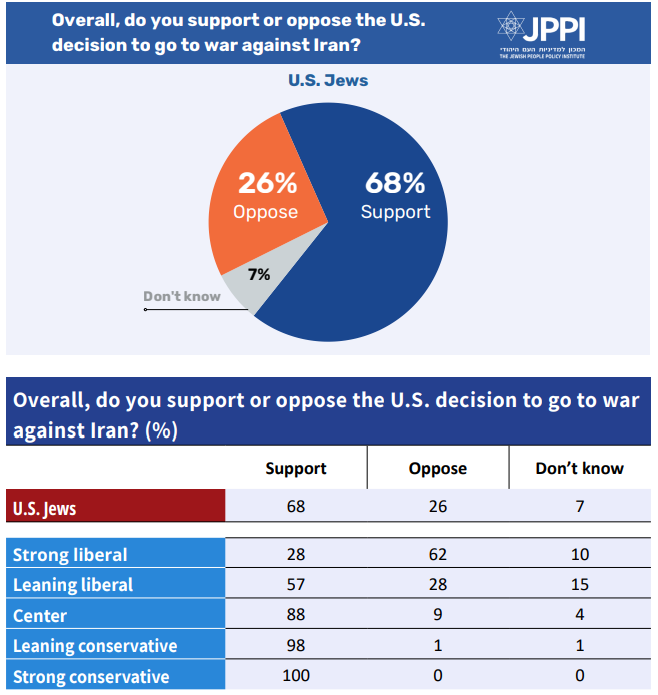
A majority of connected U.S. Jews (68%) support the U.S. decision to go to war against Iran, versus 26% who oppose it. Support rises with ideological conservatism: strong liberal respondents mostly oppose (62% vs. 28% support), leaning liberals tilt toward support (57%), and support is overwhelming among centrists (88%), leaning conservatives (98%), and strong conservatives (100%). By vote choice in the 2024 presidential election, Trump voters are nearly unanimous (99%), while Harris voters are divided (47% support, 42% oppose).
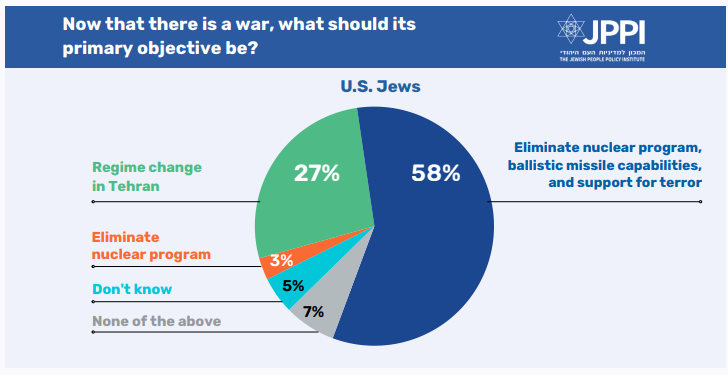
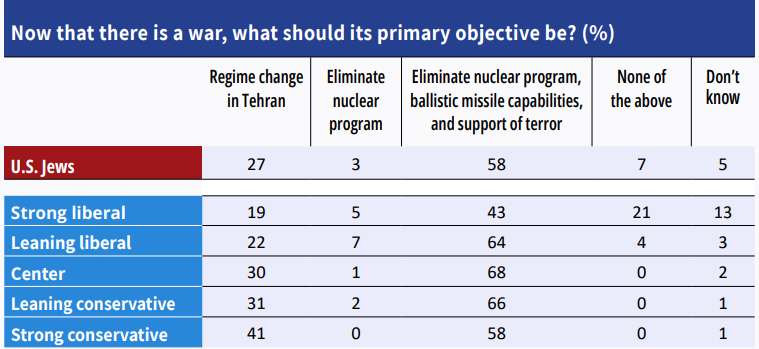
Most respondents (58%) favor a comprehensive goal: dismantling Iran’s nuclear and missile programs and its support for terrorism. A quarter (27%) favor regime change in Tehran, and only 3% support confining focus to Iran’s nuclear program. Support for regime change increases as one moves rightward along the ideological spectrum (19% among strong liberals, 41% among strong conservatives), but the comprehensive security goal is the modal choice in every ideological group.
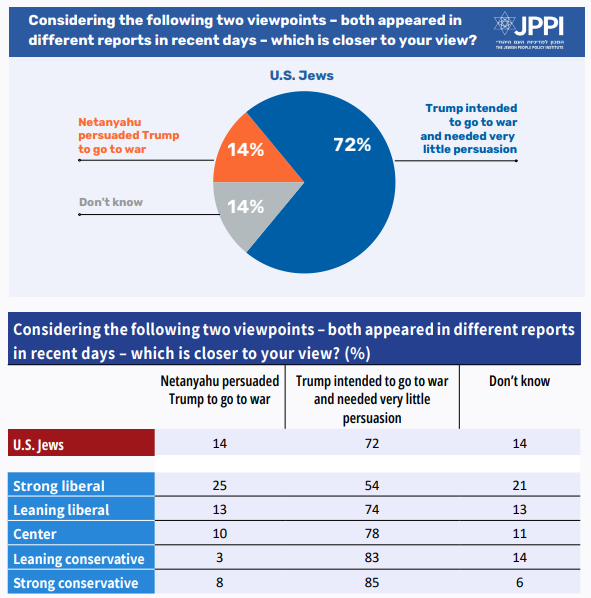
Most respondents (72%) believe President Trump intended to go to war from the outset and needed very little persuasion, whereas 14% think Israel’s Prime Minister Netanyahu persuaded him to do so. As worldviews become more conservative, more respondents attribute the initiative to Trump (54% among strong liberals, 85% among strong conservatives), and fewer attribute it to Netanyahu (25% among strong liberals, 3% among leaning conservatives). Across groups, the dominant view is that Trump pursued the move, with liberals more inclined than others to credit Netanyahu with having pushed it.
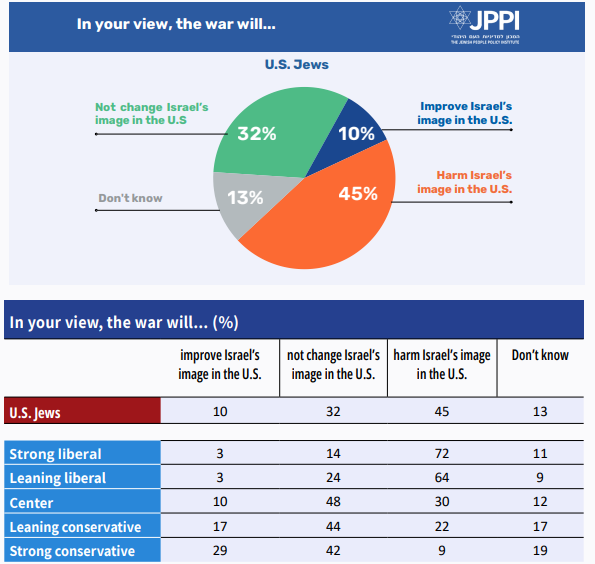
The data also suggests that many U.S. Jews expect the war to further harm Israel’s image in the United States: about half (45%) say its image will be harmed, compared with a third (32%) who expect no change and one in ten (10%) who think it will improve. By ideology, large majorities of the strong liberal and leaning liberal cohorts expect Israel’s image to be harmed (72% and 64%, respectively), and only a very small minority expect improvement.
Moving toward the centrist and the conservative ideological camps, expectations of damage decrease, while expectations of no change or even improvement increase: among centrists, the prevailing view is that there will be no change (48%); among the leaning conservative and strong conservative cohorts, the share expecting improvement rises (17% and 29%, respectively) and the share expecting harm markedly declines. In short, liberals anticipate damage to Israel’s image in the United States, whereas conservatives mainly expect stability or even improvement.
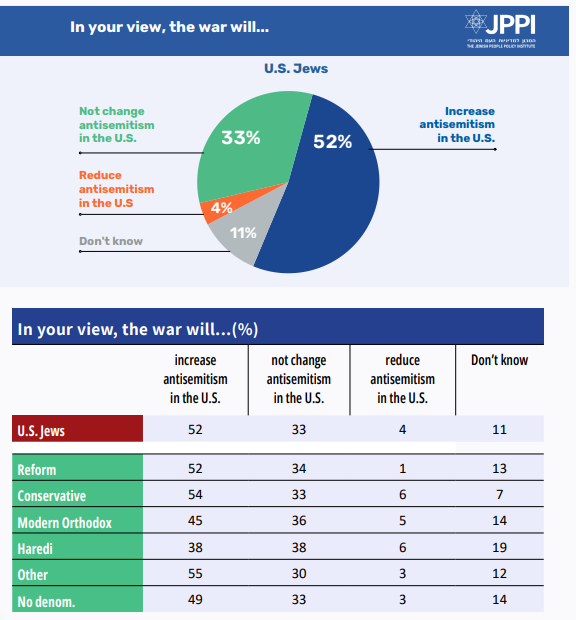
About half (52%) of the U.S. Jews surveyed believe the war is likely to increase antisemitism in the United States, compared with a third (33%) who expect no change, and a small minority (4%) who think antisemitism will decline. This pattern appears across most denominational streams, though with different intensities. Majorities of Reform and Conservative respondents expect an increase (52% and 54%, respectively), whereas among Modern Orthodox and Haredi respondents, expectations are more tempered (45% and 38%, respectively). In every cohort, only a small minority expects a decline in antisemitism. Overall, there is broad concern that the war will increase antisemitism, while more religious groups are somewhat more likely to anticipate stability.
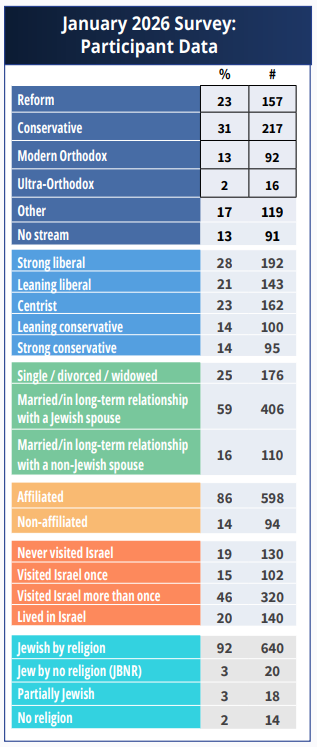
This report is based on a survey of 692 Jews registered for the JPPI – Voice of the Jewish People Index respondent panel. In general, the survey tends to reflect the views of “connected” American Jews – those with relatively strong ties to the Jewish community, and/or Israel, and/or Jewish identity. The JPPI Jewish People’s Voice Index survey was conducted by Institute fellows Shmuel Rosner, Noah Slepkov, and Yael Levinovsky. Prof. David Steinberg served as statistical consultant.
This table includes data on the survey participants: