
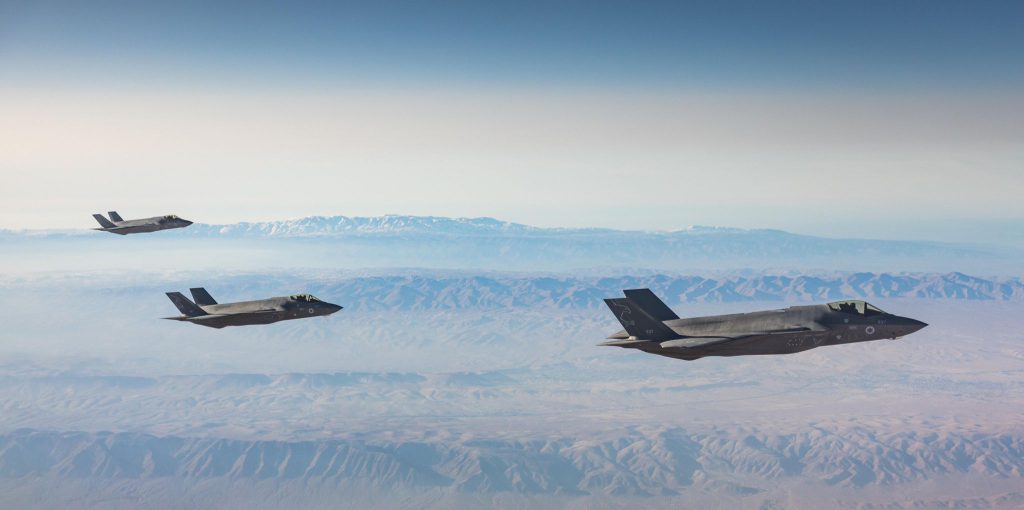


Three in four Israelis believe that the decision to strike Iran was correct, and most believe the war will likely improve the stability of the Middle East over the long term.
Main Findings
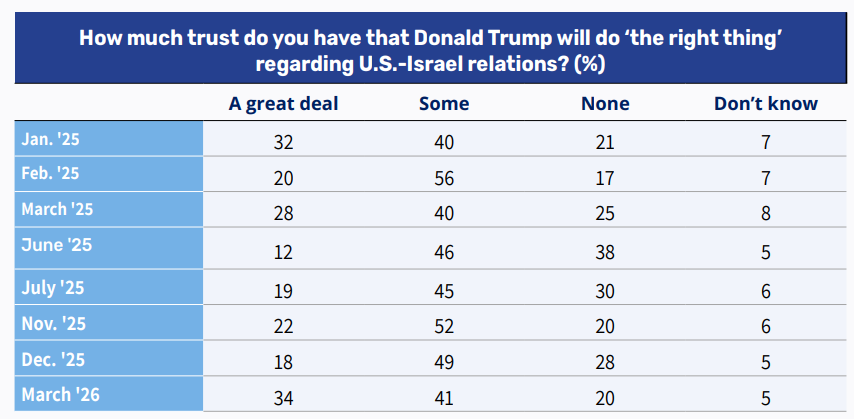
- A new high was recorded in Israelis’ trust in President Trump regarding U.S.-Israel relations.
- Even so, only half believe the U.S. president “deserves” to receive the Israel Prize.
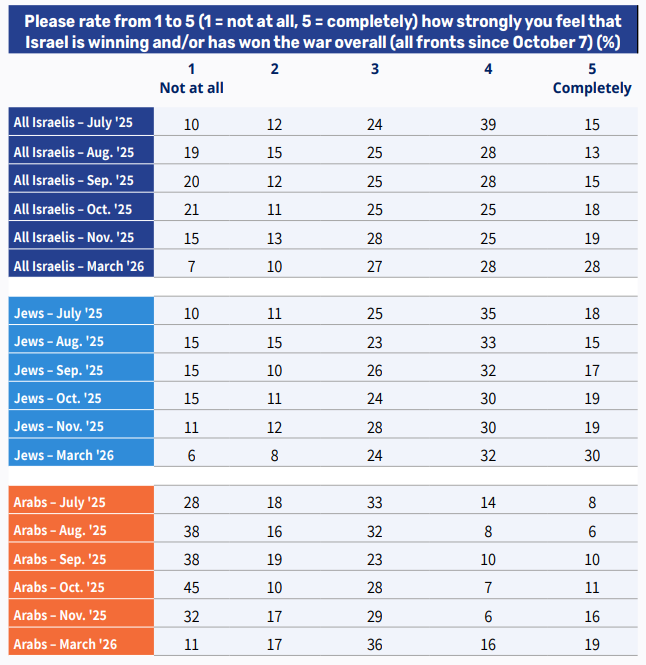
- A rise in the sense of victory in the war: the highest level in the past year.
- Most of the public prefers giving Trump’s Gaza initiative a chance over resuming combat in the Strip.
- Most Haredim support renewing the fighting in Gaza and fully occupying the Strip.
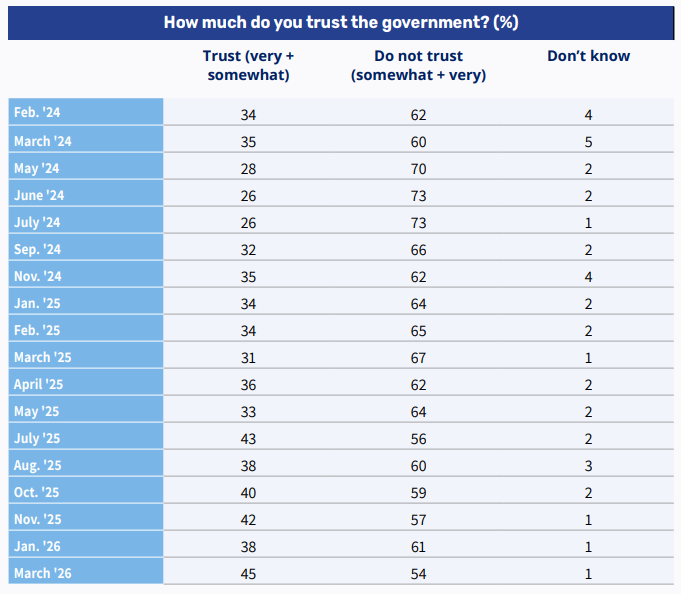
- The public still lacks trust in the government, but the level of trust is at a two-year high.
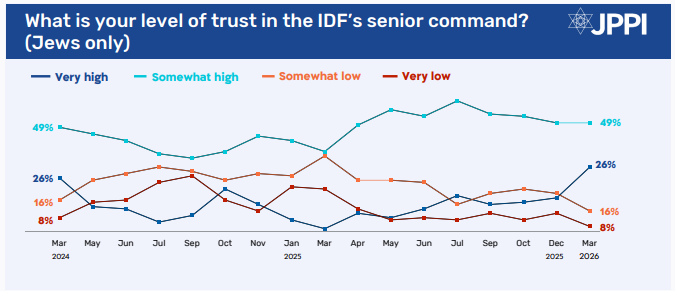
- Public trust in the IDF senior command has also reached a new high.
- An electoral defeat would be “regrettable” for the right; for part of the center-left it would be “intolerable.”
- Although most Israelis believe that there are major disagreements within Israeli society that cannot be bridged, half think Israelis mostly agree on “the important issues.”
- Half of Israelis believe that isolated settlements in Judea and Samaria (the West Bank) contribute to state security.
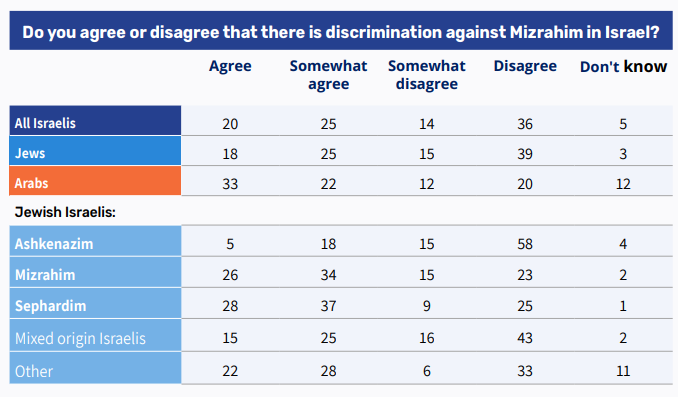
- Most think there is discrimination against Arab Israelis; less than half think there is discrimination against Haredim and Mizrahim.
- Most Arabs, Haredim, and Mizrahim think there is discrimination against Arabs, Haredim, and Mizrahim.
- Although it passed a preliminary Knesset reading, only a third of Israelis support the new Western Wall (Kotel) bill.
- Israelis are mainly curious about artificial intelligence (AI) capabilities; a minority fears them.
To download the PDF file, click here.
The Iran War
At the end of February, Israel launched Operation Roaring Lion against Iran in full coordination and cooperation with the United States. In the opening strike, numerous targets were attacked, and many senior Iranian officials were killed, including Supreme Leader Ali Khamenei. In response, Iran launched dozens of ballistic missiles and UAVs at targets in Israel and other countries in the region, especially the Gulf states. Hezbollah in Lebanon joined the war after Khamenei’s killing, and Israel also began a military operation against it.
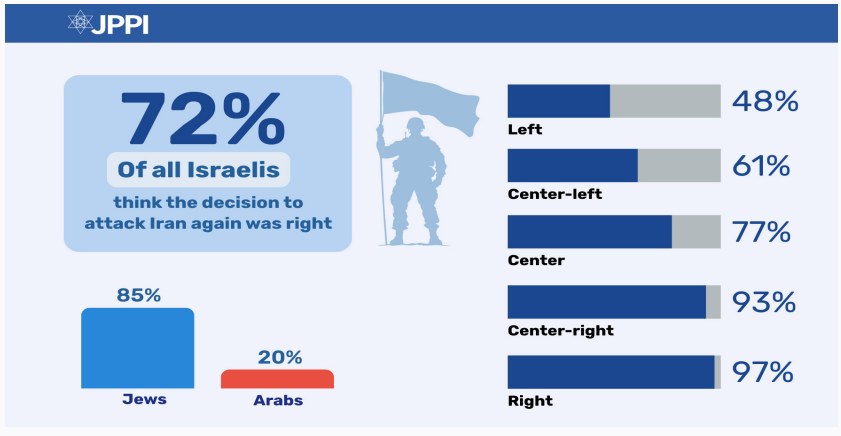
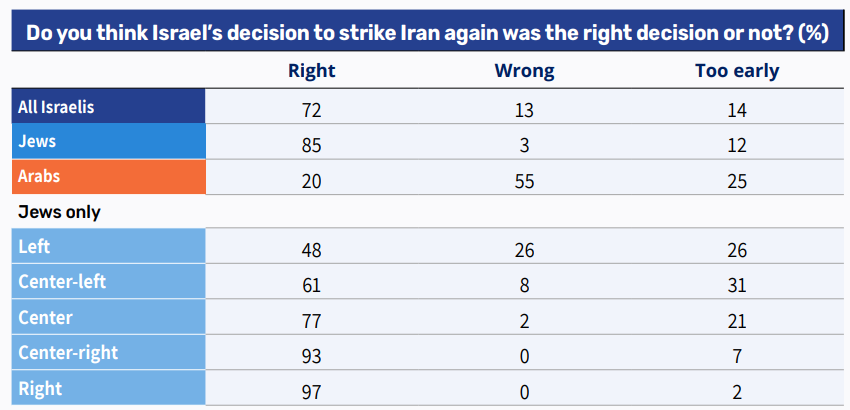
A majority of the Israeli public supports the decision to strike Iran: three in four (72%) believe it was the correct decision, compared with 13% who believe it was a mistake and another 14% who think it is too early to know. At the same time, there are substantial differences among population groups. Among Jewish Israelis, support for the strike is especially high: 85% think the decision was correct and only a negligible share thinks it was not. Among Arab Israelis, by contrast, the picture is almost the reverse: a majority (55%) think the decision to strike Iran was not correct, 20% support it, and 25% think it is too early to know.
A breakdown by ideological orientation shows that support for the strike increases as one moves rightward along the political spectrum. Among those who identify as right and center-right, support is nearly unanimous (97% and 93%, respectively), and it remains substantial among centrists at 77%. Among the center-left, the support declines to six in ten (61%), and among the left to nearly half (48%). Across ideological cohorts, the share of respondents who believe the decision to strike Iran was incorrect is negligible, except for the left-wing group, where one-quarter (26%) think so (it should be remembered in this context that the left is a very small group, about 5% of Israel’s Jewish population). In addition, as one moves from right to left along the political spectrum, the share of respondents who think it is too early to know whether the renewed strike was correct rises (from 2% on the right to 26% on the left).
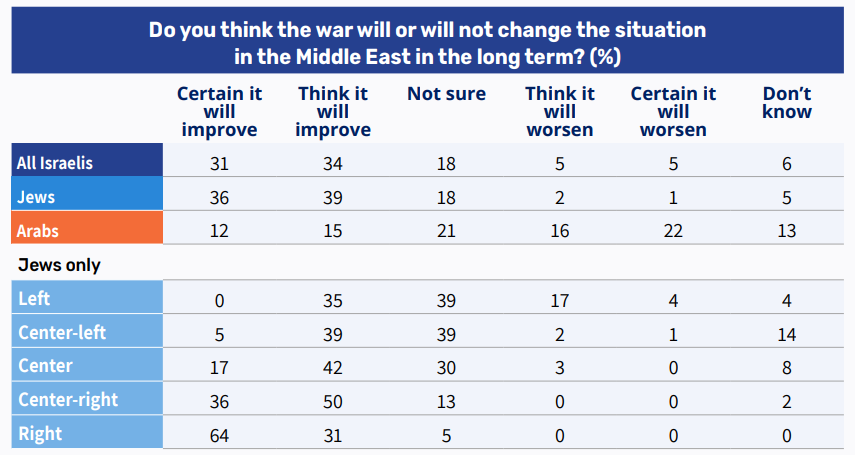
Most Israelis (65%) believe the war is likely to change the situation in the Middle East for the better in the long term (31% are certain of this and 34% think so). Ten percent believe it will change the regional situation for the worse, and 18% are unsure whether it will change the situation in the long term. Here, too, there are substantial differences between Jewish and Arab responses. Among Jewish Israelis, optimism is high: three in four (75%) believe the war will change the situation for the better, and only a negligible share thinks it will make it worse. Among Arab Israelis, by contrast, only a quarter (27%) anticipate a positive change, while four in ten (38%) think the war will worsen the situation, and a fifth (21%) are unsure whether it will have any long-term effect.
U.S.-Israel Relations
Against the backdrop of the joint attack on Iran, this month saw the highest level of Israeli trust that President Trump will “do the right thing” regarding U.S.-Israel relations since his reentry into the White House in January 2025. Thirty-four percent report having “a great deal of trust” in the president on this issue, 41% report some trust, and 20% report that they do not trust him to do the right thing in this regard. After Operation Rising Lion, Israel’s previous campaign against Iran, trust in the U.S. president stood at 64% (July 2025), but this month it stands at 75%. An even more significant difference appears in the share of respondents who report “a great deal of trust” in Trump – one-third (34%) this month, compared with one-fifth (19%) in the JPPI’s July 2025 Israeli Society Index.
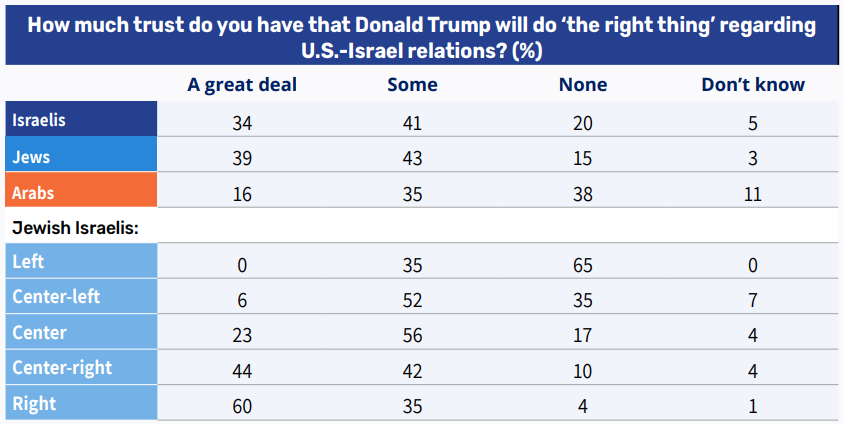
Trust that Trump will act appropriately in the context of U.S.-Israel relations is especially high among Jewish Israelis: 82% express trust in the president, whereas only 15% say they do not trust him. Among Arab Israelis, by contrast, the level of trust is much lower, with half (51%) expressing trust and 38% expressing no trust in him. A breakdown by ideological orientation shows a clear rise in trust as one moves rightward along the political spectrum. Among those who self-identify as right-wing, the level of trust is highest (60% a great deal of trust and 35% some trust), and among respondents who self-identify as center-right, a large majority (86%) expresses some level of trust in him. Among centrists, trust remains high at 79%, but in the center-left and left cohorts, the picture differs: on the left, two-thirds (65%) say they do not trust Trump, while one-third (35%) say they have some trust in him.
At the end of December 2025, it was decided to award the Israel Prize to President Trump. This was a historic decision, recognizing an extraordinary contribution with a lasting impact on the Jewish people in Israel and around the world by a person who is not an Israeli citizen. The prize committee cited Trump’s efforts in combating antisemitism, his contribution to advancing the return of the Gaza-held hostages to Israel, his recognition of Jerusalem as Israel’s capital and the relocation of the U.S. embassy there, and his consistent support for the State of Israel’s right to defend itself, even when it faced complex security challenges on multiple fronts and the Iranian nuclear threat.
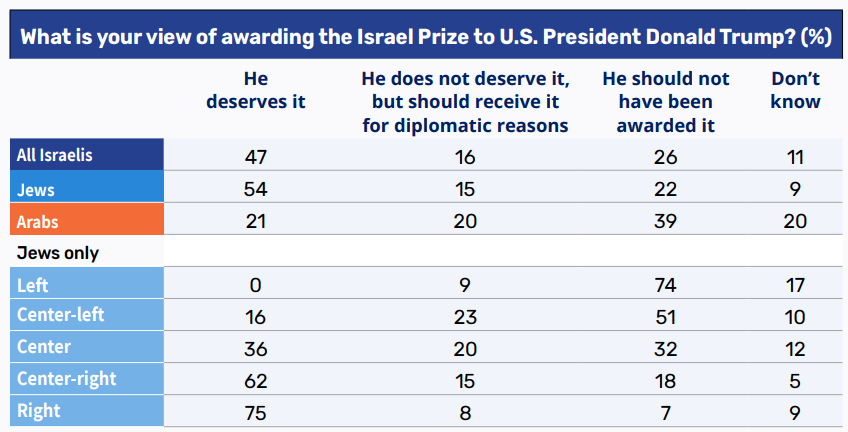
Nearly half of Israelis (47%) believe the U.S. president deserves the Israel Prize, and 16% think he does not deserve it but that it is worth awarding it to him for diplomatic reasons. By contrast, 26% believe he should not have been given the prize at all, and 11% did not know how to answer. Among Jewish Israelis, support is higher: 54% think he deserves the prize and 22% oppose awarding it to him. Among Arab Israelis, however, opposition is stronger – 39% think the prize should not have been awarded to him, 21% think he deserves it, and 20% think he does not deserve the Israel Prize but that it should be awarded to him for diplomatic reasons. One-fifth of Arabs (20%) did not know how to answer this question.
On the right and center-right there is broad support for awarding the prize to Trump: 75% in the right-wing cohort and 62% in the center-right group believe Trump deserves the Israel Prize, and only a small minority in these groups think it should not have been awarded to him. The centrist cohort also shows some support for awarding the prize, though more moderately: one-third (36%) think Trump deserves the prize, one-fifth think it should be given to him for diplomatic reasons, and one-third (32%) think it should not have been awarded to him. As one moves leftward on the political spectrum, support declines and opposition grows. Among the center-left, half (51%) think Trump should not have been awarded the Israel Prize, and only one-sixth (16%) think he deserves it. On the left, opposition is nearly unanimous: 74% think he should not have been awarded the prize, and only a tenth think it should be awarded to him, even if only for diplomatic reasons.
Confidence in Victory and Trust in Leadership
After many months, this month saw a return to a majority of Israelis feeling that Israel has won or is winning the war overall. Moreover, this is the highest level of perceived victory recorded in the past year, among both Jews and Arabs. The sense of victory is strongly influenced by ideological orientation. Among the right-wing and centrist cohorts, there are higher levels of agreement that Israel has won or is winning (4 or 5 out of 5). The feeling is more pessimistic as one moves leftward along the political spectrum. The last time a similar, though somewhat lower, sense of victory was recorded was in July 2025.
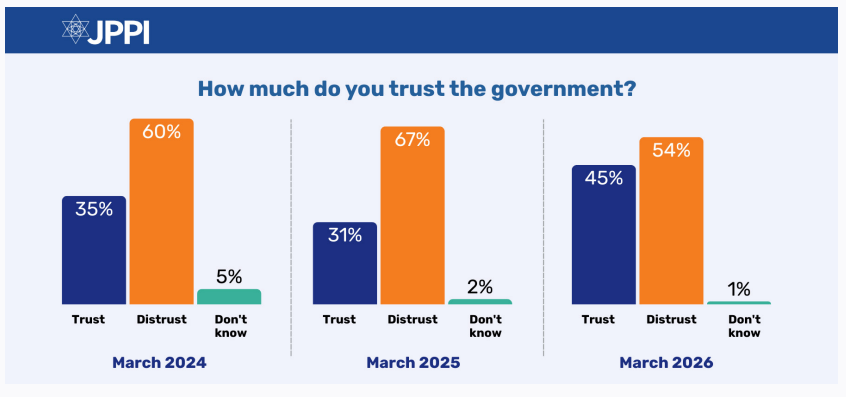
This month saw the highest level of trust in the government in the past two years. This increase can, of course, be attributed to Operation Roaring Lion. Similar levels of trust were recorded in July 2025, after Operation Rising Lion, and in November 2025, after the Hamas-Israel agreement that returned all the hostages. Even so, most Israelis (54%) do not trust the government, and only a minority (45%) trust it. Among Arab Israelis, the share of respondents who do not trust the government (70%) is higher than among Jews (49%).
Broken down by ideological orientation, the right-wing cohorts comprise majorities who trust the government (88% on the right and 55% on the center-right). Among the centrist and the left-wing cohorts, the majority do not trust the government. This majority grows as one moves from the center to the left: while 86% in the center do not trust the government, on the left, 100% say they do not trust it.
A large majority of Israelis (78%) express trust in the IDF senior command, with 30% trusting it very much and 48% somewhat trusting it. Among Jewish Israelis, the figure is even higher at 81%, and among Arab Israelis as well, a majority (53%) report trust in the military leadership. Compared with last December, there has been a significant rise in the share of Jews who trust the IDF (81% versus 70%). This increase in trust can also be attributed to Operation Roaring Lion. Notably, the current level of trust is higher than that measured after Operation Rising Lion.
The Palestinian Arena
In the shadow of the Iran operation, the question of how to deal with the Gaza Strip has been pushed to the margins, but still requires a solution. A majority of the Israeli public (59%) prefers that Israel wait, allow Trump’s plan to proceed, and see what happens “in a few months” before considering an alternative policy. One-quarter of Israelis (26%) think Israel should return to fighting, conquer the remaining territory in the Strip, and maintain Israeli rule there. One-sixth of the public (15%) say they do not know what the right solution is. Among Jews, support for returning to fighting is higher (31%), but a majority (56%) prefer to wait and see how Trump’s plan develops. Among Arabs, two-thirds (66%) support waiting for Trump’s plan to succeed, and only one-tenth (8%) support returning to fighting, alongside one-quarter (26%) who do not know.
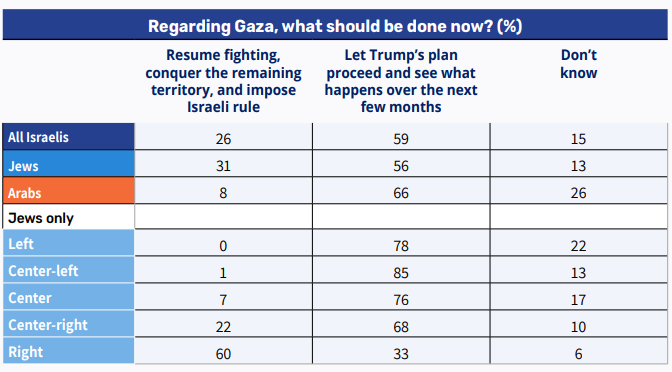
On the right, a relatively high share (60%) supports returning to fighting and conquering the territory, while a third supports giving Trump’s plan more time. From the center-right toward the left, a majority in every cohort believes the plan should be allowed to proceed. As one moves toward the center and the left, support for waiting intensifies. In the center, three-quarters (76%) prefer to let the plan proceed, and only 7% support returning to fighting. On the left and center-left, only a negligible share supports renewed fighting, and large majorities – 78% and 85%, respectively – believe the plan should be allowed to proceed and developments assessed over the coming months. Notably, when broken down by religious affiliation, a majority of Haredim (58%) support returning to fighting to conquer the territory and maintain Israeli rule.
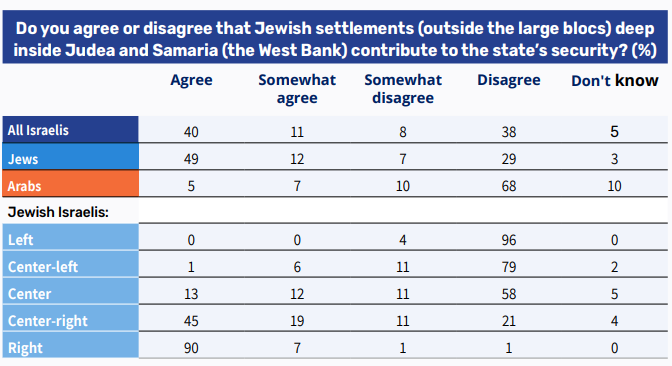
In recent months, reports of confrontations have multiplied deep inside Judea and Samaria between groups of settlers and the Palestinian population. Leaving those clashes aside, half of Israelis (51%) agree that the Jewish settlements deep inside the territory (outside the large blocs) contribute to the defense of state security, while 46% do not agree with this claim. A majority of Jews (61%) agree with the claim, whereas a majority of Arabs (78%) do not.
An overwhelming majority of those who identify as right-wing (97%) think these settlements contribute to the defense of state security, as do most of those who identify as center-right (64%). By contrast, majorities among the center (69%) and the left-wing groups (90% on the center-left and 100% on the left) do not agree with the claim. When broken down by religiosity, a majority in every group except the secular believe that the Jewish settlements deep inside Judea and Samaria, outside the large blocs, contribute to the defense of state security.
2026 Elections
By the end of March, the government will have to pass a state budget for next year or elections will be called. In recent weeks, speculation has grown about the prime minister’s intentions on this matter and the possibility of early elections. In any case, this month we examined which coalition Israelis would most like to see formed after the next elections. One-third of Israelis (34%) want the next coalition to be identical to the current one, or to include the current coalition with the addition of one or two parties from the center-right or center. One-third (32%) would like to see a “change bloc” coalition formed, with the addition of one or two parties from the coalition parties or in cooperation with Ra’am. One-eighth (13%) would like to see a broad “Zionist” coalition without Haredim or Arabs, 7% would like a coalition “without extremists” (from Religious Zionism to Yesh Atid), and 4% prefer a coalition built roughly equally from some of the coalition parties and some of the opposition parties.
Among Jewish Israelis, support for expanding the current coalition or for a coalition with the addition of one or two center-right or center parties is higher (39%), whereas among Arab Israelis, the option of a “change bloc” coalition in cooperation with Ra’am or with the addition of parties from the coalition (36%) is more popular. There is also a relatively high share – one-quarter (26%) – who support none of the options or said they did not know.
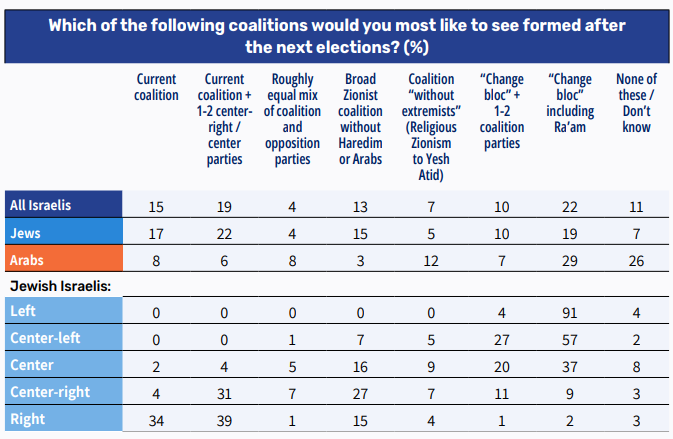
Among the right and center-right, there is a clear preference for the current coalition to continue or be expanded: one-third of the center-right (35%) support the current coalition or its expansion, while on the right, support for these options reaches three-quarters (73%). By contrast, among centrists, a majority support a “change bloc” coalition (57%). Of these, 37% support cooperation with Ra’am and 20% support cooperation with parties from the current coalition. Among left-wing voters, there is near-unanimous support for a “change bloc” coalition in cooperation with Ra’am (91%), and among the center-left, this is also the leading option (57%), alongside support for a “change bloc” coalition with the addition of parties from the current coalition (27%).
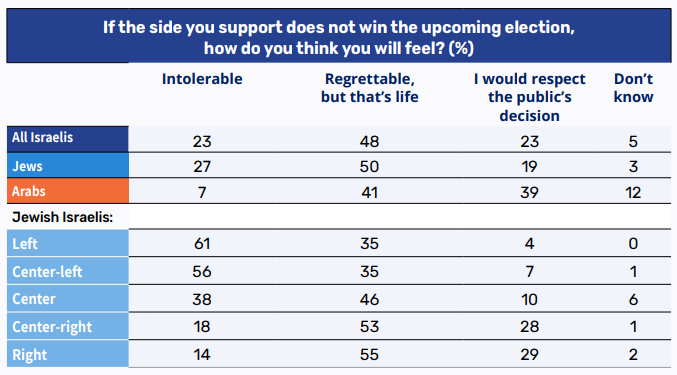
Following the question about preferred coalitions, we examined how Israelis think they will feel if the side they support loses the upcoming elections. Half of Israelis (48%) replied that “it is regrettable, but that’s life,” while a quarter (23%) believe the situation would be “intolerable,” and another quarter (23%) believe they would respect whatever decision the public makes. When Jewish and Arab Israelis are considered separately, differences emerge: among Jews, a higher share say the loss would be intolerable (27%) than among Arabs (7%). Among Arabs, by contrast, the attitude of respecting the public’s decision is more prominent (39% versus 19% among Jews), along with a higher share of those who do not know how they would feel.
Whereas majorities of those identifying as right-wing and center-right say that a loss by “their side” would be “regrettable, but that’s life” (55% and 53%, respectively), majorities on the left and center-left think it would be an intolerable situation (61% and 56%, respectively). The center also includes a fairly large group (38%) that describes such a loss as “intolerable.” The share of respondents saying they would respect any decision of the public rises as one moves from left to right along the political spectrum. Whereas only a negligible share on the left (4%) said this, 29% on the right did so.
Broad Consensus
As part of the range of questions we use to identify trends in cohesion and polarization in Israel, this month we examined how Israelis assess the depth of social gaps. Half of Israelis (52%) think that most Israelis agree with one another on most important issues (19% agree and 33% somewhat agree), whereas 44% express some degree of disagreement with that statement (15% somewhat disagree and 29% do not agree at all). Among Jewish Israelis there is a somewhat stronger tendency toward agreement (54% versus 43% disagreement), whereas among Arab Israelis, a higher share believe there is no broad agreement among Israelis (49%).
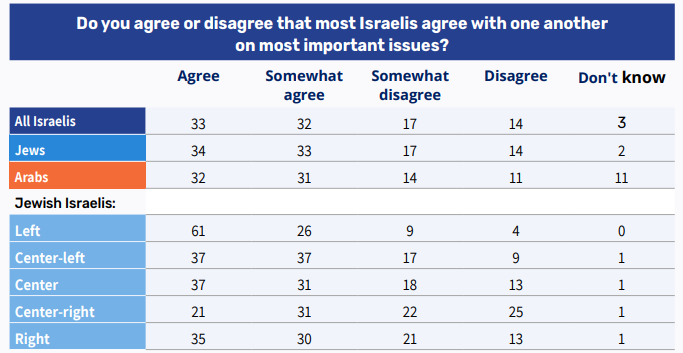
Broken down by ideological orientation, the share who believe there is broad agreement among Israelis rises as one moves rightward along the political spectrum. Among the center-right and right there is a clear tendency to think there is relatively broad agreement in society: 63% of the center-right and 69% of the right agree or somewhat agree with the claim of broad agreement. The center presents a balanced picture between agreement and disagreement. By contrast, the left-wing cohorts do not agree with the claim that there is broad agreement.
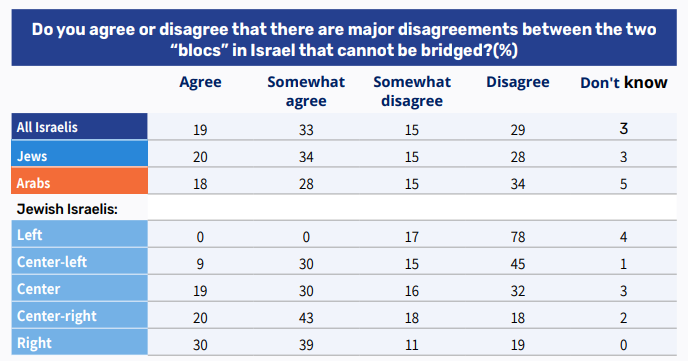
Alongside the majority agreement with the claim that on most important issues Israelis agree with one another, most Israelis (65%) also think that there are major disagreements in Israel between the two “camps” that cannot be bridged. This perception is shared by Jews and Arabs in almost identical proportions. It is also shared by all ideological groups, albeit to varying degrees. The groups at the two poles of the ideological spectrum stand out relative to those closer to the center. On the right, a 65% majority think there are major disagreements in Israel that cannot be bridged, and an even larger majority on the left (87%) think so. When broken down by religiosity, the two groups showing the highest agreement with the claim are those at the poles of the religiosity spectrum – Haredi (76%) and secular respondents (73%).
Discrimination in Israel
The issue of discrimination and the narrowing of social gaps in Israeli society also belongs to the field of social cohesion. This month, we examined whether Israelis agree or disagree that in Israel there is discrimination against three groups – Arabs, Haredim, and Mizrahim (Jews of Middle Eastern origin). The data indicates that discrimination against Arabs is perceived as more strongly discernable than discrimination against the other groups: the share of Israelis who think there is discrimination against Arabs reaches two-thirds (34% agree and 29% somewhat agree). By contrast, the share who think there is discrimination against Mizrahi or Haredi Jews stands at less than half (45%).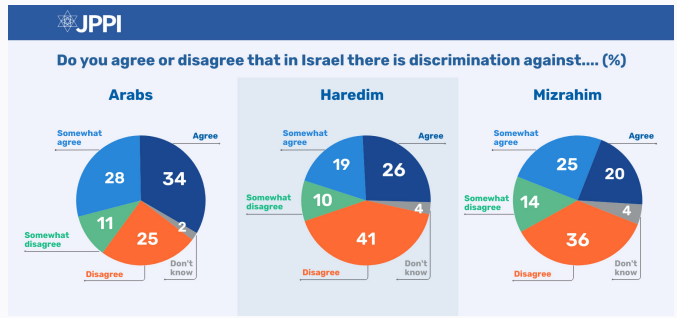
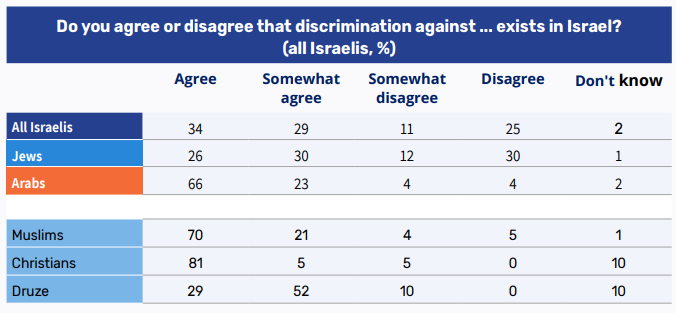
As noted, a majority of Israelis (63%) agree that there is discrimination against Arabs. Among Jewish Israelis, a smaller share (56%) agree or somewhat agree that such discrimination exists, whereas 42% do not. Among Arab Israelis, by contrast, there is near-unanimous agreement that discrimination against them exists in Israel: 89% agree or somewhat agree with the claim.
There are also differences within the Arab public. Among Muslims, a very large majority (91%) agree or somewhat agree that there is discrimination against Arabs in Israel, and among Christians 86% agree or somewhat agree. Among Druze, the picture is different: although a large majority (81%) agree that discrimination against Arabs exists, the share who agree fully is lower (29%), and many (52%) chose the more moderate response of “somewhat agree.”
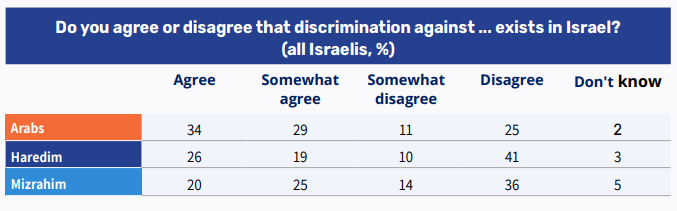
Half of Israelis (51%) do not agree with the claim that discrimination against Haredim exists in Israel, compared with 45% who agree that such discrimination exists. Among Jewish Israelis, the picture is very similar, but it is somewhat different among Arab Israelis: the share agreeing that there is discrimination against Haredim is also 45%, but the share disagreeing is lower (44%), alongside a relatively high share of those who do not know (10%).
Among Haredim, who were oversampled this month through the polling firm Askaria, which specializes in this population, there is a near-unanimous sense of discrimination: 86% agree and another 11% somewhat agree that there is discrimination against them in Israel. Among religious (Dati) respondents as well, the share who agree that there is discrimination against Haredim in Israel is relatively high (56% agree or somewhat agree). By contrast, among secular respondents a clear majority think that discrimination against Haredim does not exist in Israel – 71% disagree with the claim, and 26% agree or somewhat agree.
The Israeli public is divided on the question of whether there is discrimination against Mizrahim, but there is a slight tendency to think there is not. Among all Israelis, 45% agree or somewhat agree that discrimination against Mizrahim exists, whereas one-half (50%) disagree. Among Jewish Israelis, the tendency to think that discrimination does not exist is more pronounced: a majority (54%) somewhat disagree or disagree that there is discrimination, compared with 43% who agree or somewhat agree. Among Arab Israelis, by contrast, a majority (55%) think there is discrimination against Mizrahim, and only a third (32%) express disagreement.
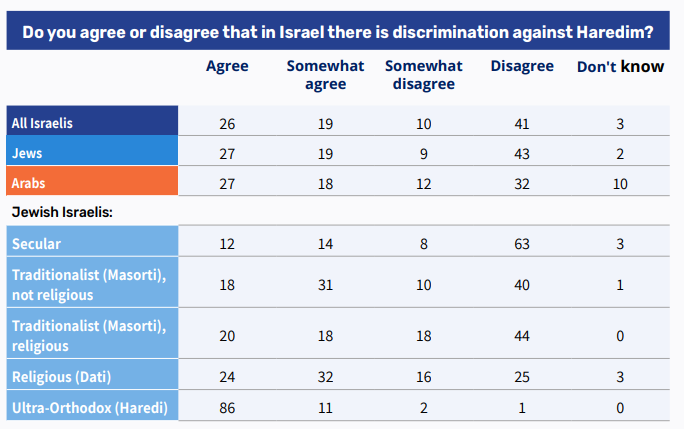
When the data is broken down by ethnic origin, additional gaps emerge: among Ashkenazi respondents, 73% reject the claim that discrimination against Mizrahim exists in Israel, while 23% agree or somewhat agree that it does. Among Mizrahi and Sephardi respondents, by contrast, much larger shares believe that such discrimination exists: 60% and 65%, respectively. Among Israelis of mixed origin, there is a tendency to disagree that such discrimination exists (59%). That is, a clear perception gap exists among the different ethnic groups: Mizrahi and Sephardi respondents are more inclined to feel or identify discrimination against Mizrahim. More broadly, across all three questions about discrimination, the groups most likely to believe there is discrimination are the groups referred to in the question itself: Arabs are more likely than Jews to think there is discrimination against Arabs, Haredim are more likely than the other religious groups to think there is discrimination against Haredim, and Mizrahim and Sephardim are more likely than other groups to think there is discrimination against Mizrahim.
Western Wall Bill
The proposed “Western Wall Law,” which passed a preliminary Knesset reading in February 2026, is intended to amend the Law for the Protection of Holy Places and grant Israel’s Chief Rabbinate exclusive authority to determine prayer arrangements in all areas of the Western Wall (Kotel). This would mean ending the non-Orthodox prayer services held at the “Southern Wall” plaza. Four in ten Israelis (42%) oppose the law, compared with three in ten (31%) who support it. Nine percent say they do not care what happens at the Kotel, and 17% say they do not know enough about the issue. Among Jewish Israelis, opposition is higher than support (45% versus 38%). Among Arab Israelis, support is especially low (10%), and larger shares say they do not know enough about the issue (36%) or do not care (27%).
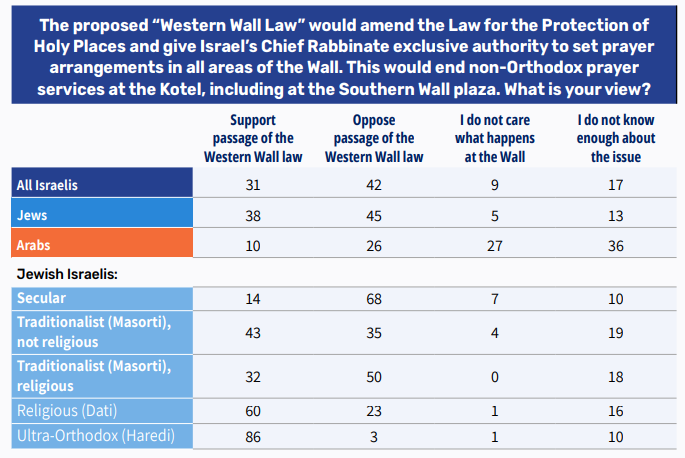
As expected, support for the law rises as one moves along the religiosity spectrum from the secular pole to the Haredi pole: among Haredi respondents, support reaches 86%, and among religious (Dati) respondents, 60%. Among secular respondents, by contrast, opposition to the law is strong (68%), while only 14% support it. Among traditionalist (Masorti) non-religious respondents, however, supporters of the law hold a slight advantage (43% versus 35%).
The proposed “Western Wall Law” would amend the Law for the Protection of Holy Places and give Israel’s Chief Rabbinate exclusive authority to set prayer arrangements in all areas of the Wall. This would end non-Orthodox prayer services at the Kotel, including at the Southern Wall plaza. What is your view?
Artificial Intelligence (AI)
In recent months, AI has occupied a prominent place in global discourse and has also aroused interest and concern in Israel. This month, we examined how Israelis relate to the enhanced capabilities of artificial intelligence. Forty-one percent of Israelis say that AI “mainly makes them curious,” a higher share than for any other option. At the same time, one-quarter of the public (25%) reports that AI “mainly frightens them.” Among Jewish Israelis, curiosity is especially prominent (44%), alongside relatively high shares reporting fear (22%) and excitement (20%). Among Arab Israelis, a higher share reports fear (35%), and lower shares report curiosity (29%) or excitement (12%).
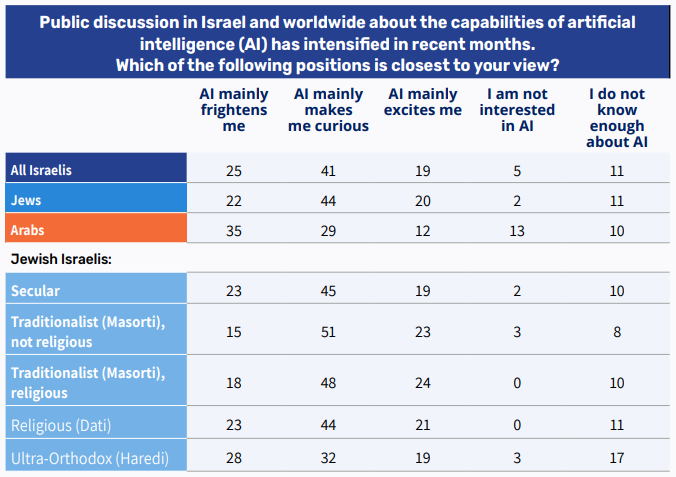
A breakdown by religiosity shows that curiosity about AI is the dominant attitude in every group. Traditionalist, non-religious respondents (51%) and traditionalist, religious respondents (48%) display the highest levels of curiosity, as well as relatively high levels of excitement (23%-24%). Among secular and religious respondents, curiosity remains high (44%-45%), alongside one-quarter who are mainly afraid (23%). Among Haredi respondents, greater reservation is evident: one-quarter (28%) say they are afraid, one-sixth (17%) say they do not know enough about the topic, and the level of curiosity is lower than in the other groups. Even so, only a negligible share of Haredim say they are not interested in artificial intelligence.
Data for JPPI’s March survey was collected between February 25 and 27, 2026, among 100 Haredim through Askaria (online), and among the remaining respondents between March 2 and 5, 2026. Data collection in the Jewish sector (except for some Haredi respondents) was conducted through the TheMadad.com panel (591 Jewish sector respondents), and Afkar Research (201 Arab sector respondents, about half online and half by telephone). Data was analyzed and weighted by voting pattern and religiosity to represent the views of Israel’s adult population. JPPI’s Israeli Society Index is compiled by Shmuel Rosner and Noah Slepkov, with research, production, and writing assistance from Yael Levinovsky. Prof. David Steinberg serves as statistical consultant.