מאמרים
The real story of the Iran war: the strengthening of the Israel-Gulf alliance
The Iron Doom battery Jerusalem sent to the UAE, reportedly along with IDF troops, underscores a new reality. Arab countries understand there is only one country in the region that is both willing and capable of acting against a common threat



Additional Publications
Opinion Articles
Opinion Articles
Companions on a Shared Quest
Tisha be’Av, the ninth day of the Hebrew month of Av, the day on which we commemorate the destruction of the Temples in Jerusalem, relates not only to the past, to what was, but also to what exists today, to the here and now.The Second Temple was destroyed, the Sages tell us, because of sin’at ḥinam—groundless hatred. Today, such hatred…
Opinion Articles
Opinion Articles
A Holy War Over Israel’s Character
From a strategic standpoint, the infuriating statements, including that the Reform movement is not a Jewish movement but a Christian movement, made last month by Rabbi Yigal Levenstein, head of the pre-army academy in Eli, are not as important as the platform from which he made them: the First Zion and Jerusalem Conference. This conference is the opening shot of…
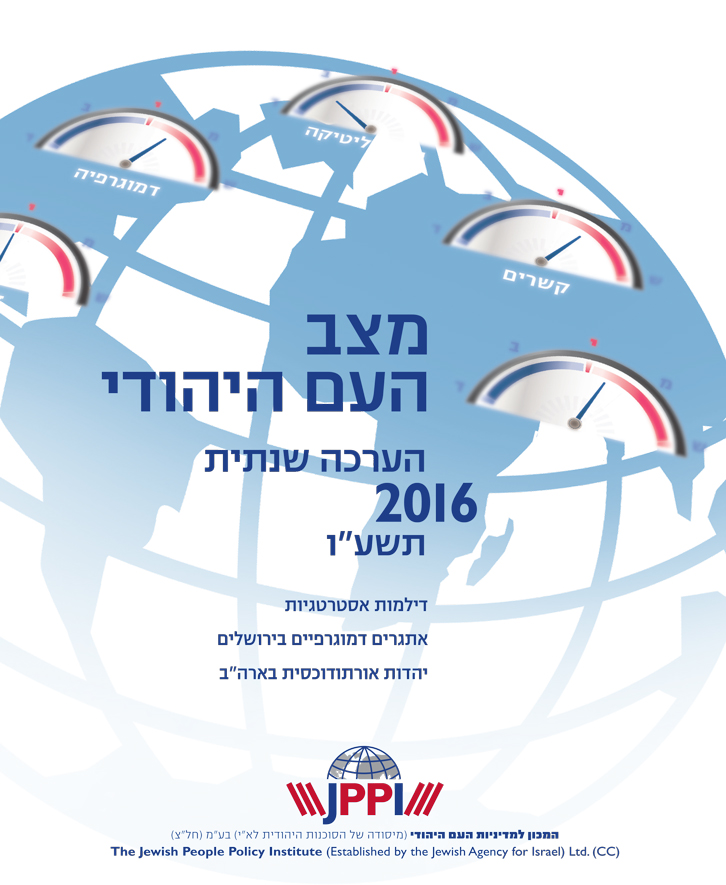
2016
2016
2016 Annual Assessment
Annual Assessment 2016 5776 PROJECT HEAD Dr. Shlomo Fischer CONTRIBUTORS Avinoam Bar-Yosef, Susanne Cohen-Weisz, Rémi Daniel, Chaya Ekstein, Dan Feferman, Avi Gil, Inbal Hakman, Michael Herzog, Simon Luxemburg, David Landes, Dov Maimon, Steven Popper, Uzi Rebhun, Shmuel Rosner, John Ruskay, Noah Slepkov, Shalom Solomon Wald, Einat Wilf EDITORS Barry Geltman Rami Tal
Opinion Articles
Opinion Articles
Time to Allow Everyone to Worship at the Foot of the Temple Mount as they Wish
In the wake of the ultra-Orthodox rejection of the proposal to establish a new prayer space south of the Western Wall plaza for use by non-Orthodox denominations, Prime Minister Benjamin Netanyahu finds himself forced to make a dangerous decision. On the one hand, if he pushes ahead with the new prayer space, he will imperil his political partnership with the…

Opinion Articles
Opinion Articles
Op-Ed: Natan Sharansky on the late Elie Wiesel
This article was orginally published in the Washington Post on July 4, 2016 The writer, a human rights activist and former political prisoner in the Soviet Union, is chairman of the Jewish Agency for Israel. Perhaps better than anyone else of our age, Elie Wiesel grasped the terrible power of silence. He understood that the failure to speak out,…
Opinion Articles
Opinion Articles
The ‘Religionization’ of Israel is Troubling, but the Fears About it are Hysterical
JERUSALEM (JTA) — Religionization! Religionization! To read the newspaper headlines in Israel, to view its documentary films and attend its expert panels with academics, a stranger might think that upon landing at Ben Gurion Airport, he or she will have arrived at nothing less than a Hebrew-speaking version of Iran. According to those who fear for Israel’s Jewish and democratic…
Opinion Articles
Opinion Articles
An Israeli Shabbat
The Ahad Ha’am once said, “More than the Jewish People have kept Shabbat, Shabbat has kept the Jews.” Today, Jews continue to keep and maintain the Shabbat. However, not everyone interprets what it means to keep and maintain Shabbat in the same way. What does Shabbat and its observance look like in the State of Israel? Can every individual enjoy…
Opinion Articles
Opinion Articles
Trump, Clinton and the King of Moab
What do the two candidates for the American presidency — Hillary Clinton and Donald Trump — have in common? Almost nothing at all — except that their children are married to Jews. So while it is not yet clear how the future leadership of the Free World will look, there will most definitely be toddlers running on the White House…
Opinion Articles
Opinion Articles
One Judaism, Two Nations
Shavuot, celebrated June 12-13, is the "Rosh Hashanah of conversion." On this holiday, we read the story of Ruth the Moabitess, the first and most famous Jewish convert. As such, in Israel, in the days leading up to the holiday, there is a proliferation of events, conferences and public debates on conversion and Jewish identity. Unfortunately, while all of these…