The 250th Anniversary Edition
By: Prof. Gil Troy
To download the full guide, click here.
FOUNDATIONS OF THE U.S.-ISRAEL SPECIAL RELATIONSHIP: HOW AND WHY DID IT EMERGE, 1948 TO 1967?
The foreign policy guru Henry Kissinger noted: “America has no permanent friends or enemies, only interests.” And, despite the shared values and overlapping sense of mission linking the U.S. and Israel as yearning, churning, Promised Lands, America’s primary interest in 1948 was being “even-handed” in the Middle East. Wooing the massive, oil-rich Arab world made sense. Still, by 1973, Israel’s 25th anniversary, the “special relationship” had solidified. Conceived in the ABCs of liberal democracy – Aspiring to do good, Biblical values, and Civics, two recurring “Xs” bonded the two countries: Arab exterminationism and Soviet expansionism.
AMERICAN ZIONISM: LIBERAL DEMOCRACY AT ITS BEST
The George Marshall-John Foster Dulles skepticism regarding Israel lingered for years. Cultural disdain and oil hunger limited the military alliance. In December 1947, days after the UN recognized a Jewish state, the U.S. imposed a Middle Eastern arms embargo. Thus, America’s even-handed strategy began. While supporting Jewish statehood, Americans feared infuriating the Arabs, provoking the Soviets, and triggering an arms race. Ultimately, Czechoslovakia sold Israel machine guns, rifles, and 50 single-seat British-made Spitfire airplanes.
Nevertheless, American citizens who smuggled World War II surplus weapons to Israel – along with the $50 million Golda Meir raised in America in January 1948 – anticipated future support. A grassroots all-American Zionism emerged uniting Jews, and many non-Jews. In 1948, American Jews, five million strong, constituted 3.7 percent of America’s population (today it’s 2.4 percent). Reeling from the Nazi mass murders, perhaps feeling guilty about their silence, American Jews mobilized. And many Americans, especially World War II veterans, lived the slogan that eventually emerged – “Never Again” – generating a bipartisan consensus to protect the fledgling Jewish state.
Senator George McGovern flew 35 missions as a B-24 Liberator pilot over Nazi-occupied Europe. He epitomized a generation of American leaders, left to right, whose Zionism reflected their American patriotism and hatred of Nazism. As the Democrats’ 1972 presidential nominee, McGovern noted that, since 1948, supporting Israel has been “an issue that united Republicans and Democrats,” without “one candidate seeking to outbid the other.” And he called his “commitment to Israel” a “moral commitment that began with my entry into public life in 1957. It continues to this day. It is not a function of Cold War, balance-of-power politics.” It was existential.
Still, shared interests help. The Cold War reinforced Americans’ moral instincts. The Soviets found Israel particularly infuriating. The Mossad humiliated them with various intelligence coups – including securing a Soviet MiG-21 fighter jet in 1966. The IDF kept humbling their Arab allies. And Israel inspired Soviet Jewish refuseniks who stirred a broader dissident movement that shook the Soviet Empire.
Before Hitler, many American Jews resisted Zionism. They feared “dual loyalty” accusations. The progressive Supreme Court Justice Louis Brandeis Americanized Zionism. In 1915, he thundered: “Let no American imagine that Zionism is inconsistent with patriotism. Multiple loyalties are objectionable only if they are inconsistent.”
Understanding that ethnic pride enriches distinctly American Citizenship — today’s “multiculturalism” – Brandeis insisted: “Loyalty to America demands that each American Jew become a Zionist. For only through the ennobling effect of its strivings can we develop the best that is in us and give to this country the full benefit of our great inheritance.”
This insight shapes today’s “Identity Zionism.” Feeling rooted in their history, community, and homeland makes Jews more fulfilled individuals and more productive citizens wherever they live. Professor Ruth Wisse celebrates this rich heritage as “double loyalty.” With two countries in sync, grounding individuals and bettering the world, that’s doubly empowering.
Brandeis and others spent the next three decades fusing liberalism, Americanism, and Zionism. As Jews flocked to Palestine, as establishing a state in the ancestral Jewish homeland became foundational to modern Judaism, more American Jews became Zionist. Hitler’s murder of six million Jews, and America’s triumph over Nazism, convinced most remaining doubters, Jews and non-Jews. In 1945, Rabbi Milton Steinberg wrote in The Atlantic: “Amid the House of Israel’s grim devastation, does not Jewish Palestine shine as a joy-bringing, hope-dispensing beacon?” Steinberg saluted the many non-Jewish Americans fired into “incandescence” for Zionism, including the liberal theologian Reinhold Niebuhr, FDR’s First Lady Eleanor Roosevelt, and the Republicans’ 1940 nominee, Wendell Willkie.
On August 16, 1948, Time magazine’s cover featured Israel’s founder, David Ben-Gurion. America met a proud, strong, unapologetic “New Jew,” fighting when necessary, dreaming always. Ben-Gurion was “Premier and Defense Minister, labor leader and philosopher, hardheaded, unsociable and abrupt politician, a prophet who carries a gun.” Transforming the Jewish people’s image, Ben-Gurion evoked the American founders’ best ideals. Time marveled: “The Jews beat the Arabs. Out of the concentration camps, ghettoes, banks, courtrooms, theaters and factories of Europe, the Chosen People had assembled and had won their first great military victory since Judas Maccabeus … 2,109 years ago.” These “tough… smart… vigorous” Jews weren’t victims anymore.
Israel became a rare, successful, post-colonial state following World War II. It was democratic – and, eventually, prosperous – despite lacking natural resources.
Israel’s founding story provides two American benchmarks for assessing the U.S.-Israel partnership:
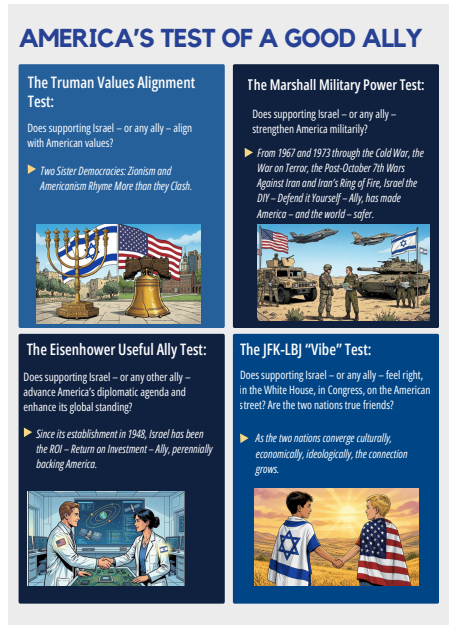
• The Truman Test: Does supporting Israel – or any ally – align with American values?
• The Marshall Test: Does supporting Israel – or any ally – strengthen America militarily?
EISENHOWER’S FRUSTRATION – AND RED LINE LEGITIMIZING ISRAEL
Truman’s successor, Dwight Eisenhower, appreciated the need for a Jewish state, having seen the liberated Nazi concentration camps. And he wanted to cement Israel’s loyalty to the free world. To placate the Arabs, his administration maintained the arms embargo but provided economic aid, mostly loans for food.
This fragile alliance almost collapsed in 1956, when Israel joined Great Britain and France in the Sinai campaign. By nationalizing the Suez Canal, Egyptian dictator Gamal Abdel Nasser antagonized France and England. Israel wanted to stop “fedayeen” terrorists infiltrating from Gaza and the Sinai, while ending Egypt’s blockade of the southern port of Eilat, which violated Israel’s international shipping rights.
Israel’s military campaign succeeded brilliantly. Over five days, Ben-Gurion later recalled, “we defeated three Egyptian divisions in Sinai and the Gaza Strip. We destroyed all the fedayeen bases, and destroyed or captured large quantities of Egypt’s military equipment.”
But Israel also surprised America’s president. Eisenhower feared the invasion would destabilize the Middle East. America pressured Israel to withdraw from the Sinai. In return, a United Nations Emergency Force would patrol on Egypt’s side of the border, creating a buffer zone to protect Israel from invasion.
In February 1957, Israel was resisting, holding onto the Gaza Strip bordering many agricultural settlements, and Sharm El Sheikh, key to the southern Eilat port. Israel demanded more reliable guarantees. Expressing “keen disappointment,” Eisenhower blasted Israel’s arrogant assumption that “a nation which invades another should be permitted to exact conditions for withdrawal.”
Still, Eisenhower wouldn’t equate “a nation like Israel” with the Soviet Union, which was defying the UN in Hungary. “The people of Israel, like those of the United States, are imbued with a religious faith and a sense of moral values,” Eisenhower explained. He expected more from “such peoples of the free world” than “from a nation controlled by atheistic despots.”
Ben-Gurion reciprocated. Emphasizing the “common approach between us and the American people to the heritage of the Bible,” Ben-Gurion acknowledged America’s “moral and material aid,” while expressing “our feelings of appreciation of and friendship for the American people.”
Fearing sanctions, Israel caved. Within days, Egypt re-occupied Gaza, displacing the UN despite the promises. A decade later, the Six-Day War erupted because Nasser expelled the buffering troops and again blockaded Eilat.
Sometimes, culture and good PR trumps geopolitics. What could have been a disastrous breach in 1956 bonded Americans to this plucky country. As quarreling leaders buried the tensions and affirmed their common bonds, Israel’s chief of staff with the dashing
black eye-patch, Moshe Dayan, became an international celebrity. Dayan epitomized the young, bold, native Sabra – the Israeli cactus-fruit, prickly outside, soft inside.
Eisenhower controlled his disappointment – unlike today’s critics who often escalate from disliking what Israel does to repudiating that Israel is. Still, his critique suggests a third benchmark…
• The Eisenhower Test: Does supporting Israel – or any other ally – advance America’s diplomatic agenda and enhance its global standing?
THE JFK-LBJ EMBRACE
Eisenhower’s successor, John Kennedy, visited Palestine in 1939. His dynamic Cold War liberalism – along with the many urban Jews cementing his electoral coalition – made him sympathetic to the Jewish state. During the 1960 campaign, JFK blasted Eisenhower for allowing the Egyptians to violate the post-1956 agreements. Integrating both countries’ biblical tradition and democratic characters, Kennedy proclaimed: “We are in this country the youngest of people. But we are the oldest of republics. Now is our chance in this country to extend the hand of friendship to the oldest of People and the youngest of republics.”
Still, as President, Kennedy viewed the Middle East minefield warily. Once, the Saudi king offered Jacqueline Kennedy magnificent white stallions. Kennedy balked. Intimidated by his wife, the president sent Ambassador Angier Biddle Duke, his chief of protocol, to tell her “it’s hurting me politically: The Arabs give her these horses and then Israelis come along with an old Bible worth about $12.” Squirming, the ambassador conveyed the message. “I understand what you’re saying, Angie,” Mrs. Kennedy replied. “But… I want the horses.”
Kennedy also wooed Nasser as a “neutralist” non-Communist leader from the developing world. America supplied Egypt with food aid while financing grain storage silos and other projects.
Nevertheless, in 1962, Kennedy sold Israel Hawk anti-aircraft missiles. He hoped to blunt Israel’s interest in developing nuclear weapons for self-defense. Although the weapons were defensive, this ended America’s arms embargo. The Middle East arms race had
already begun. The Arab states spent nearly a billion dollars annually buying weapons, often with Soviet subsidies. America’s turning point proved critical after 1967, when France cold-shouldered Israel.
Succeeding Kennedy, bearing a Texas-sized chip on his shoulder, Lyndon Johnson knew most Jews rejected him as a crude hillbilly not an urbane Harvard man. Nevertheless, LBJ told an Israeli diplomat shortly after Kennedy’s assassination, “You have lost a very great friend. But you have found a better one.”
Johnson loved Israel’s pioneering energy. He viewed “the Israelis as Texans, and Nasser as Santa Ana,” one adviser exclaimed. When Levi Eshkol visited Johnson’s ranch, Israel’s Prime Minister bent down to feel the Texas soil. The two farmers bonded. “I may not worry as much as Eshkol does about Israel,” Johnson would say, “but I do worry as deeply.”
Initially, Johnson continued America’s balancing act. LBJ branded Nasser “an instrument of the Kremlin” – Nasser called LBJ a mere “cowboy.” Yet the president unnerved Israelis by selling arms to Jordan. Speaking of King Hussein, Johnson told aides, “This little king has some value to us,” and “we ought to keep him as far away from the Soviets and Nasser as we can.” Johnson appeased Israel by having West Germany sell Israel 150 M-48 tanks secretly, with an “option” for another hundred – including American modernization kits. That marked America’s first sale of offensive weapons to Israel.
In 1966, watching Nasser befriend the Soviets while rallying the Arab world against Israel, Johnson approved direct sales to Israel of 48 A-4 Skyhawk jet bombers. Israel’s foreign minister Abba Eban hailed this “continued intensification of the existing U.S. commitment and the creation of sui generis strategic relations.”
Still, State Department and Pentagon Arabists occasionally cooled relations with Israel. Showing “concern over too close a military relationship,” the State Department ordered American diplomats to boycott Israel’s May 1967 Independence Day Parade.
That 19th anniversary was tense. A day later, on May 16, Egypt deployed 75,000 troops into the Sinai, expelling the UN Emergency Force. The UN complied. Emboldened, Nasser mined the Straits of Tiran leading to Eilat. Arab demagogues vowed to “throw the Jews into the sea.”
Johnson grumbled that by blockading Eilat, Nasser “slit our throat.” Such aggression “brought a new and very grave dimension to the crisis,” since “the right of free and innocent passage of the international waterway is a vital interest of the entire international community.”
Still, LBJ urged Eshkol “to avoid any action on your side which would add further to the violence and tension in your area.” Behind the scenes, Johnson’s National Security Advisor Walt Rostow memoed the president that “our commitment is (a) to prevent Israel from being destroyed and (b) to stop aggression – either through the UN or on our own.”
Hearing heavily armed Arabs threatening another genocide, seeing Nasser mock international law, tracking increasingly menacing Arab troop deployments north and south, Israel attacked pre-emptively. America urged a ceasefire, then pressured Israel into ending its lightning victory after six days. Israel tripled in size. It overran Gaza and the Sinai, the Golan Heights, East Jerusalem, and the biblical territories of Judea and Samaria, on the Jordan River’s “West Bank” – a geopolitical term Jordanian and British diplomats coined when Jordan illegally seized that territory after invading Israel in 1948.
During the war, Israel bombarded a U.S. Navy spy ship, the USS Liberty, killing 34 and wounding 171. Israel’s commander Iftach Spector apologized for mistakenly identifying the ship as Egyptian. America accepted Israel’s apology – although speculation about a “cover-up” lingers.
Johnson and his aides gloated over Nasser’s “stunning loss” – and the Soviets’ foolishness in encouraging this “belligerence.” Privately, the Soviet embassy’s Yuri Tcherniakov told America’s Under Secretary of State for Public Affairs Eugene Rostow that the Arab commitment to exterminating Israel was “nonsense” and caused much of the region’s “tragedy.”
The Six-Day War cemented the U.S.-Israel alliance – casting Israel as a central Cold War asset against the Soviet Union. President Johnson wanted all countries to respect every nation’s “fundamental right to live.” Protecting Israel, the U.S. stubbornly negotiated the wording of UN Security Council Resolution 242. It demanded “Withdrawal of Israel armed forces from territories occupied in the recent conflict” – not “the territories.” That meant some territories, not all.
Two weeks after the war, Johnson hosted Soviet Premier Alexei Kosygin at the “Glasboro Summit” in New Jersey. Johnson recalled Kosygin saying “he couldn’t understand why we’d want to support the Jews – three million people, when there are a hundred million Arabs. I told him that numbers do not determine what was right.”
Sentimental and shrewd, Lyndon Johnson bound America and Israel together with an idea David Ben-Gurion articulated. In 1953, Israel’s founding prime minister estimated the population ratio between Israel and the Arabs as 1 to 60; the territorial ratio was 1 to 3000. Ben-Gurion’s paper, “The Doctrine of Defense and State Armed Forces,” concluded that Israel must maintain its Qualitative Military Edge (QME) over such mammoth adversaries.
LBJ made the QME a fundamental American commitment – in weaponry, soldiering, and strategy. In 2008, Congress codified this promise, obligating every president to ensure Israel’s Qualitative Military Edge, defined as the “ability to counter and defeat any credible conventional military threat from any individual state or possible coalition of states or from non-state actors, while sustaining minimal damages and casualties, through the use of superior military means, possessed in sufficient quantity.”
Professor Michael Mandelbaum analyzed how the 1967 war benefited the U.S. “long-term.” Israel’s emergent “military supremacy … continues to be a major strategic asset for Washington.” This foreign policy expert explains that “unlike in Europe and East Asia,” America did not have to balance out the Soviet Union by deploying “troops on the ground in the Middle East.” Israel was strong and demanded autonomy. “Israel has remained a reliable surrogate ever since, allowing the United States to remain an offshore balancer in the region for long stretches of time.”
This breakthrough suggests a fourth test:
• The JFK-LBJ “vibe” test: Does supporting Israel – or any ally – feel right, in the White House, in Congress, on the American street? Are the two nations true friends?
Recognizing Israel in 1948 established the precedent: America supported Israel. Building on the romantic, ideological, biblical foundations, the 1967 war solidified this partnership’s strategic, diplomatic, and pragmatic bonds. No mere passive recipient of aid, Israel was an active player in advancing Western and American interests. Senator Jesse Helms, who opposed most foreign aid, later asked: “If Israel did not exist, what would U.S. defense costs in the Middle East be?”
Uncle Sam found a true partner in principles too.