The 250th Anniversary Edition
By: Prof. Gil Troy
To download the full guide, click here.
THE ROLLERCOASTER: BIPARTISANSHIP, SHARED VALUES, AND MUTUAL DEFENSE AMID HIGHS AND LOWS, 1974 TILL TODAY
Like all long marriages, the U.S.-Israel relationship is resilient enough to survive repeated conflict. Good partnerships need strong foundations, mutual incentives to rebound, and willpower to outgrow the inevitable tensions. Despite clashing over continuing wars, targeting nuclear sites, sabotaging negotiations, or simply accommodating colliding egos, the buoyant partnership remains, as Ambassador Dennis Ross says, “doomed to succeed.”
A full history charting this rollercoaster is beyond this Essential Guide’s scope. But the overriding headline from ten presidents since 1968, from Richard Nixon through Donald Trump, illuminates the ever-strengthening connection. That bedrock bond unleashed forces that keep overcoming the inevitable stressors between a small democracy, surrounded by Middle Eastern enemies vowing to exterminate it, and the world’s most powerful democracy, spoiled by the world’s longest non-militarized border – with Canada.
RICHARD NIXON – UNSENTIMENTAL BUT MUTUALLY BENEFICIAL JOURNEYS
President Richard Nixon unintentionally tape-recorded some of his Jew-hating outbursts. In April 1973, he fumed: “It’s about goddamn time that the Jew in America realizes he’s an American first and a Jew second.” Yet, when Egypt and Syria invaded Israel six months later, sparking the October 1973 Yom Kippur War, he raised America’s defense posture to DEFCON 3, to restrain the Soviets. Nixon barked: “Send everything that will fly.” America’s record-breaking resupply outdid the 1948-1949 Berlin airlift.
The U.S. Air Force delivered over 22,325 tons of tanks, artillery, and ammunition. This helped Israel counterattack so effectively, America then intervened diplomatically to save Egypt’s surrounded Third Army. Until 1973, many in America’s military wondered, “why support Israel?” Israel shipped back seized Soviet weapons, while improvising tactics that outmaneuvered the Soviet-trained Arab troops. Those successes helped turn the Pentagon pro-Israel.
Nixon’s relationship with Israel was not overly sentimental. More than two-thirds of the Jewish community opposed him. But this master strategist and Cold Warrior recognized Israel as the indispensable ally. Thus, the terrifying Yom Kippur War cemented the military and diplomatic connections. Meanwhile, Israel’s American-immigrant prime minister, Golda Meir, cemented the popular bond between the two peoples. Meir was deemed America’s “Most admired woman” in 1973 and 1974, often surpassing America’s first ladies throughout the decade.
GERALD FORD: REASSESSING AND REBOOTING
When Gerald Ford abruptly succeeded Nixon, Nixon’s Secretary of State Henry Kissinger was busy doing “shuttle diplomacy.” Kissinger laid the groundwork for what became the 1979 Israel-Egyptian Camp David peace treaty. As negotiations dragged, Ford said Israeli “tactics frustrated the Egyptians and made me mad as hell.”
In March 1975, Ford declared a “reassessment of United States policy” – suspending aid. Prime Minister Yitzhak Rabin said this “innocent-sounding term … heralded one of the worst periods in American-Israeli relations.” On September 4, 1975, Israel, caving, signed the Sinai Interim Agreement with Egypt. The aid resumed.
That fall, President Ford declared: “This administration is very, very much opposed” to the UN’s resolution calling Zionism “racism,” which “is contrary to the basic Charter of the United Nations.” Ford added that the Palestinian national movement “refused to recognize the State of Israel. And we, of course, strongly back the State of Israel in its attitude that there must be recognition before there can be any contact or any participation by the Palestinians in any negotiations.”
Spurred by Ford’s UN Ambassador Daniel Patrick Moynihhan, a liberal Democrat, the American people mocked the UN resolution, from left to right, black and white, labor unionists and preachers alike. Recognizing this anti-Zionism as antisemitic, most Americans embraced Israel. On the new program “Saturday Night” – not yet “Saturday Night Live” – the mock newscaster Chevy Chase “reported” on the resolution: “Black entertainer Sammy Davis, Jr., a convert to Judaism, was quoted as saying: ‘What a breakthrough! Now, finally, I can hate myself!’”
JIMMY CARTER – PEACEMAKING AND BOND-BREAKING
In October 1977, in a speech to the Democratic National Committee, President Jimmy Carter said, “I would rather commit suicide than hurt the nation of Israel.” He explained that “If I should ever hurt Israel, which I won’t, I think a political suicide would almost automatically result, because it’s not only our Jewish citizens who have this deep commitment to Israel but there’s an overwhelming support throughout the nation, because there’s a common bond of commitment to the same principles of openness and freedom and democracy and strength and courage that ties us together in an irrevocable way.” Israel was becoming a bipartisan national asset.
In September 1978, Carter’s Camp David Summit generated the once-inconceivable Israel-Egyptian Peace Treaty of 1979. Israel’s Prime Minister Menachem Begin said Carter’s peace effort would “be remembered and recorded by generations to come.”
Today, however, Carter is remembered as “anti-Israel,” especially after publishing a 2006 polemic, Palestine: Peace not Apartheid. Historians – and psychologists – keep speculating about Carter’s post-presidential journey. Still, while befriending anti-Zionists, Carter never negated Israel’s right to exist.
Carter’s restraint reflects America’s consensus supporting Israel’s existence. In January 1978, the former vice president, Hubert Humphrey, dying of cancer, proclaimed: “We must declare without embarrassment, and without apology, that Israel has earned a special relationship with America.” Humphrey, along with Senators Bob Dole, Frank Church, Daniel Inouye, Henry Jackson, and Ted Kennedy, framed supporting Israel as an existential all-American issue – rooted in the Bible, confirmed by World War II’s lessons, defending Cold War America, and transcending partisan disagreements. Nevertheless, Carter’s disenchantment with Israel’s government anticipated the greatest threat to the partnership today, especially among Democrats.
RONALD REAGAN: ROCKY START – GAME-CHANGING FINISH
President Ronald Reagan’s administration began with high-profile clashes. In April 1981, Reagan endorsed Jimmy Carter’s $8.5 billion deal selling Saudi Arabia 62 F-15 fighter aircraft, advanced tanks, and five Airborne Warning and Control Systems (AWACS). The Boston Globe called it “a manifest contradiction of Reagan’s campaign promise to enhance Israel’s security.” Despite passionate lobbying, the pro-Israel community lost.
That June, Israel bombed Iraq’s nuclear power plant at Osirak. Enraged, Reagan halted delivery of the F-16 fighter jets to Israel and supported the UN Security Council resolution condemning the Israeli operation. In December, Israel annexed the Golan Heights. Reagan suspended America’s strategic cooperation agreement with Israel. Prime Minister Menachem Begin snapped: Israel is not a “banana republic.” Then, in August 1982, Reagan called Begin, expressing “outrage” that Israel’s bombing raids during the Lebanon War caused “needless destruction and bloodshed.”
Nevertheless, despite all of this, Reagan is remembered as the most “pro-Israel” of presidents.
Reinforcing Nixon’s Cold War pragmatism with sentiment and idealism, Reagan inspired most Republicans to become enthusiastically pro-Israel, cementing Israel’s bipartisan support nationwide. Reagan united the Evangelical Protestants of the Moral Majority and other religious groups with security-minded neoconservatives and anti-Communists. They supported Israel for deeply idealistic and cold-heartedly pragmatic reasons.
Reagan fought to free Soviet Jews and Ethiopian Jews. He bailed out Israel’s inflation-ravaged economy with a $1.5 billion emergency package. In 1985, he approved America’s first Free Trade agreement with a country outside North America, Israel – which helped launch its capitalist revolution. Two years later, Israel was among the first countries to receive Major Non-NATO Ally status, symbolizing enduring mutual friendship, and facilitating diplomatic, military, economic, and research ties.
Russian muscle-flexing, then international terrorism targeting Americans, proved clarifying. From Hezbollah’s 1983 U.S. Marine Barracks bombing in Beirut, murdering 241 Americans, to the PLO’s 1985 Achille Lauro cruise ship hijacking – with terrorists throwing one wheelchair-bound American Jew overboard – to Libya’s 1988 downing of Pan Am Flight 103, killing 270 innocents, Israel and America united to fight this evil.
Ultimately, Reagan loved Israel. “When it comes to Israel, the United States is not a bargainer or a broker: The United States is a friend and an ally,” he said in 1988. “And that’s why one of the things I’m proudest of is the steps we’ve been able to take during this administration to build a stronger foundation of enduring friendship and cooperation.” He called “strategic cooperation” a “commitment our two governments have made to
each other. It responds to our mutual needs….” Vowing: “We will not leave Israel to stand alone, nor will we acquiesce in any effort to gang up on Israel,” Reagan connected his support for Israel with his campaign to help America regain its “sense of purpose… proclaiming enthusiastically the democratic ideals that inspired our Founding Fathers and the Founding Fathers of Israel.”
GEORGE H.W. BUSH: HARD LINE, SOFT HEART
The Reagan template continued, with bipartisan support, growing interconnectedness, but also acrimonious clashes. In 1991, Israel requested $10 billion in loan guarantees to absorb Soviet Jewish immigrants. Bush didn’t want the money spent in the disputed territories and demanded that Israel join a Palestinian peace conference.
Bush apologized when his melodramatic claim that he was “one lonely little guy” facing “something like 1,000 lobbyists,” emboldened Jew-haters. Secretary of State James Baker denied saying about the Jews: “Fuck ‘em. They don’t vote for us.” And both led a wall-to-wall bipartisan coalition to invalidate the UN’s 1975 “Zionism is Racism” resolution.
Characteristically, these political and diplomatic disputes upstaged the most significant developments. Bush’s Persian Gulf War leadership ensnared America in the Middle East, increasing America’s military and intelligence cooperation with Israel exponentially. Israel’s restraint, as Saddam Hussein’s Iraq bombarded Tel Aviv with SCUD missiles, endeared Israel to policymakers and the public. American sympathy for Israel hit polling highs of 79 percent.
After the Soviet Union collapsed in December 1991, many analysts hailed Israel’s role in repeatedly embarrassing the Soviets. Highlights included easily downing 88 Soviet-made Syrian MiGs in 1982 and providing America’s military with fresh intelligence, freed of CIA conceptions.
CLINTON – LOVE-LOVE AND TOUGH LOVE
Like Truman, Johnson, and Reagan, President Bill Clinton felt a profound non-negotiable commitment to Israel. Clinton’s pastor, W.O. Vaught, pronounced on his deathbed: “God will never forgive you if you do not support Israel.” In bonding with Prime Minister Yitzhak Rabin, and spearheading the Oslo Peace Process, despite Israeli objections and Palestinian terrorism, Clinton demonstrated his reverence for Israel. When an extremist
Jew opposing Oslo assassinated Rabin in November 1995, Clinton was devastated. The President popularized the pitch-perfect phrase memorializing Rabin: “Shalom Chaver.” It meant: “goodbye my close friend,” and “buddy, let’s have peace.”
Rabin’s assassination shocked Americans. While attending Rabin’s funeral along with Clinton, Jimmy Carter, and George H.W. Bush, Senator Ted Kennedy placed earth from his two murdered brothers’ graves onto Rabin’s. The Senate adjourned in Rabin’s memory. American flags flew at half-mast – a rare honor afforded a foreign leader.
Clinton’s relations with Prime Minister Benjamin Netanyahu proved contentious. In 1996, Clinton fumed to staffers: “Who the fuck does he think he is? Who’s the fucking superpower here?” Still, despite Netanyahu’s resistance, despite giving “Bibi” tough love, Clinton blamed Yasir Arafat and the Palestinians for derailing Oslo by turning to terror in September 2000.
Nevertheless, the Palestinian issue subsequently clouded U.S.-Israel relations. Tension between a Netanyahu-dominated Israel and Democrats mushroomed. Still, both houses of Congress voted unanimously to celebrate Israel’s 50th birthday in April 1998. Kevin Costner and Michael Douglas hosted CBS’s prime time special, “To Life! America Celebrates Israel’s 50th,” featuring celebrities like Kirk Douglas, Sid Caesar, Natalie Cole, Jessye Norman, Arnold Schwarzenegger, Noah Wyle, and Stevie Wonder.
GEORGE W. BUSH: FIGHTING TERROR TOGETHER
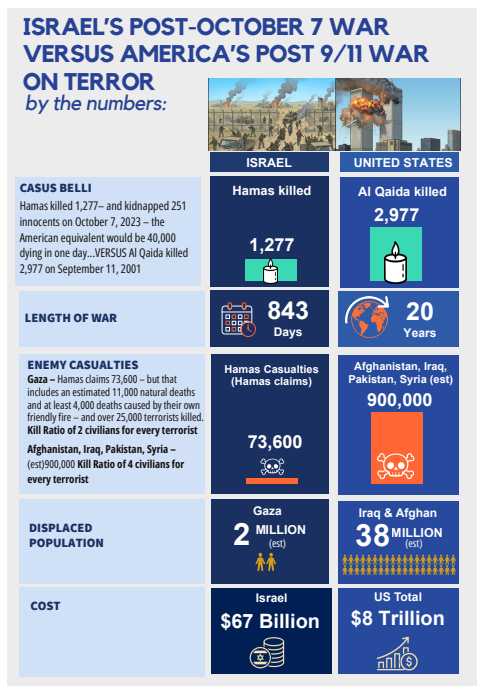
The Palestinian terrorism of the “Second Intifada” exploded in September 2000, following Clinton’s failed Camp David Summit, and persisted for four years. Only after al-Qaida’s devastating attacks against America, on September 11, 2001, did most Americans really begin noticing. Many Americans instantly, viscerally, identified with Israel – and tried learning from Israel about fighting terror.
America’s War on Terror brought the two countries into sync.
Prime Minister Ariel Sharon helped lead this “international struggle of the free world against the forces of darkness who seek to destroy our liberty and way of life.”
In 2006, one Brookings Institution analysis identified “three key areas” where “Israel’s experiences were directly relevant and offered specific lessons for the United States”: “coercing” reluctant governments “to take effective counterterrorism measures; broader defensive measures; and techniques for striking at the leadership of terrorist groups.”
Continuing the cult of Moshe Dayan, American popular culture celebrated Israelis as noble warriors. From 2005 to 2013, the CBS TV series NCIS spotlighted Ziva David’s Mossad training and Sabra toughness-masking-sweetness. Adam Sandler’s 2008 movie “You Don’t Mess With The Zohan” mocked hyper-macho Israeli fighters with hearts of gold – while romanticizing them. By 2017, Miss Israel 2004, Gal Gadot, wowed the world as Wonder Woman.
Bush’s pro-democracy agenda saluted democratic Israel, while his “Road Map for Peace” stirred tension by continuing America’s decades-long search for a two-state solution. Bush backed Sharon’s 2005 Gaza disengagement, reassuring Israelis that withdrawing would bring peace. Bush then discovered that democracy requires civil society and civil liberties, not just voting. Hamas exploited popular frustration with the Palestinian Authority to gain a Gazan foothold through elections, then violently seized control in 2007.
OBAMA – DAYLIGHT AND SURPRISES
Barack Obama’s two terms highlighted the extensive economic, military, diplomatic, and political ties linking Israel and America – despite growing tensions, especially between “blue state” Democrats and Benjamin Netanyahu’s “red state” Israel. America secretly sold bunker buster bombs to Israel in 2009, contributed $235 million to develop the Iron Dome missile defense in 2011, and signed a 2016 Memorandum of Understanding, MOU, providing $3.8 billion annually to Israel for ten years. Visiting Israel in March 2013, Obama celebrated Zionism, insisting: “Israel is not going anywhere.”
Nevertheless, Israel’s ambassador to the U.S. from 2009 to 2013, Michael Oren, claimed Obama broke America’s longstanding vow of “no daylight” and “no surprises.” Obama believed that, under George W. Bush, “there was no space between us and Israel, and what did we get from that? When there is no daylight, Israel just sits on the sidelines, and that erodes our credibility with the Arab states.”
There was much daylight between Israel’s fears of a nuclear Iran and Obama’s commitment to engaging Iran. And there was much daylight, as Obama condemned the settlements and demanded a Palestinian peace process, while Netanyahu resisted. Netanyahu offended Obama by accepting Republican Speaker of the House John Boehner’s 2015 invitation to address Congress. There, Netanyahu condemned Obama’s attempts to negotiate a nuclear deal with Iran. Obama took revenge in December 2016, by withholding the U.S veto of a UN Security Council resolution calling Israel’s settlements “legally invalid.” The vote capped the long, brittle relationship between Obama and Netanyahu – even as Congressional votes for Israel’s security continued with overwhelming support, such as the 410 to 4 vote for the “United States-Israel Rocket and Missile Defense Cooperation and Support Act.”
Obama’s growing coolness to Israel encouraged ever-more enthusiastic Republican support – especially among Evangelical Christians. The Reverend John Hagee and other conservatives opposed the Iran agreement, while blasting Obama for pushing Israel to return to “Auschwitz borders.” And Fox News, which celebrated Israel’s contribution to the post-9/11 War on Terror, continually cheered the Jewish state. That’s why, despite tensions, in 2018 Gallup pollsters found 64 percent of Americans supporting Israel, a post-Gulf-War high.
TRUMP 1.0: BIPARTISANSHIP DOOMED?
Donald Trump repudiated many Obama’s policies, including his chariness toward Israel. Trump recognized Jerusalem as Israel’s capital and moved America’s embassy to Jerusalem – fulfilling a longstanding bipartisan pledge. He recognized Israel’s annexation of the Golan Heights. And he brokered the Abraham Accords, defying the experts. While forging economic, cultural, technological, and diplomatic relationships between Israel and many Gulf States, the agreement created a template that Trump envisioned eventually including Saudi Arabia and transforming the region.
Occasional tensions persisted. Trump leveraged the Abraham Accords to block Netanyahu’s plans to annex the Jordan Valley. But more worrying forces buffeted America’s pro-Israel community. Trump was so polarizing, and he embraced Israel so enthusiastically, it soured some anti-Trump Democrats on Israel. And as partisans left and right rejected bipartisanship, it became harder to keep the U.S.-Israel relationship non-partisan.
AIPAC’s Policy Conferences still consecrated bipartisanship. Until COVID hit, America’s largest pro-Israel hootenanny attracted nearly 20,000 attendees annually, Jewish and non-Jewish. Two-thirds of Congress attended. Beyond politics, Israel’s role as what CBS News called “a living lab,” vaccinating its population against COVID-19 successfully, culminated an extraordinary Israeli makeover. Once, Israel was considered a backward country of Jaffa oranges and goofy “kova tembel” caps; today, it’s this high-tech powerhouse inventing disks-on-key and super-powered chips.
BIDEN – THE DEMOCRATS’ LAST ZIONIST PRESIDENT?
Joe Biden called himself a “Zionist.” While supporting the creation of a Palestinian state, he approached the October 7 horrors with moral clarity. His 2023 trip to Israel, 11 days later, marked the first American presidential trip to Israel during wartime. Over the next 18 months, Biden approved an additional $18 billion in arms shipments to the Jewish state. And in April 2024, when Iran launched 320 missiles at Israel, the seamless way America, Israel, and other allies shot most down, epitomized the multidimensional alliance Biden’s generation built.
Yet, Biden’s “Don’t, Don’t” warning didn’t only stop Hezbollah and Iran from invading on October 8. Biden also blocked Israel from responding immediately to Hezbollah’s rocket fire. He fought a grinding tug-of-war with Benjamin Netanyahu over Israel’s military strategy, especially in Gaza.
Those tensions, progressives’ anti-Zionism, and searing media coverage of Israel’s Gaza bombing, rattled the U.S.-Israel alliance. When Biden left office, he boasted: “Iran’s air defenses are in shambles. Their main proxy, Hezbollah, is badly wounded…. And if you want more evidence that we’ve seriously weakened Iran and Russia, just take a look at Syria.” While adding a ten-word acknowledgment that “Israel did plenty of damage to Iran and its proxies,” Biden didn’t mention that most of those gains resulted because Netanyahu defied him. Meanwhile, Democratic critics, resenting Trump’s embrace, risked making Israel another partisan wedge issue.
TRUMP 2.0: SLEDGEHAMMER DIPLOMACY
As of this writing, Donald Trump remains president, Israel’s Hamas war has evolved from its intense fighting phase after all the hostages returned home, with 168 alive. October 7 also taught Israelis that ongoing threats like Iran and Hezbollah could no longer be tolerated, a lesson Trump also embraced, intermittently. Initially, Trump encouraged
Netanyahu to fight more aggressively in Gaza, defying MAGA’s Tucker Carlson-Candace Owens anti-Israel wing. Trump’s sledgehammer diplomacy also freed the final 20 living hostages, brokering a Gaza ceasefire that left Israel initially controlling 53 percent of Gaza. Still, Trump took jabs at Netanyahu, sold weapons to Saudi Arabia and Qatar, and wooed Turkey. Most unnerving, in June, 2026, he seemed to abandon his and Israel’s original war goals in negotiating his ceasefire with Iran. Such Trumpian zigzagging left Israelis treading carefully to appease this volatile president.
The roller-coaster ride continues. No one knows what will happen in a Democratic Party filled with millions cheering Bernie Sanders, the Squad, and Zohran Mamdani, with a youth wing increasingly forged by anti-Israel encampments. Nor can anyone guarantee that Trump’s successor won’t embrace the isolationist, antisemitic “woke right,” which believes that supporting Israel drains America.
Nevertheless, the U.S.-Israel relationship keeps bouncing back – reflecting a popular foundation far stronger than passing headlines suggest. On January 27, 1970, the New York Times reported that President Nixon and Prime Minister Golda Meir made statements reflecting “an effort on both sides to eliminate the tensions caused by American diplomatic initiatives and Israel’s reaction to them.”
Thousands of articles since, pronouncing a teetering partnership, have described “furor,” “American frustration,” and “Israel’s defiance.” Yet, the alliance has continued to blossom.
That August 1970, the Times covered a conference of “American Jewish and Israeli intellectuals” darkened by “the tension between the universal and the particular in Jewish religion, culture and politics,” clashes over America’s support for Israel, and shared worries about Jewish students’ “alienation.”
History is not destiny. It’s facile to say, “Israel survived it then, Israel will survive it now.” And tracking the ongoing fissures – let alone the recurrent presidential F-bombs – indicates how deep the frustrations can run. But it’s equally facile to surrender prematurely. Present tensions – peaking after a challenging, brutal, war – don’t determine the future either.