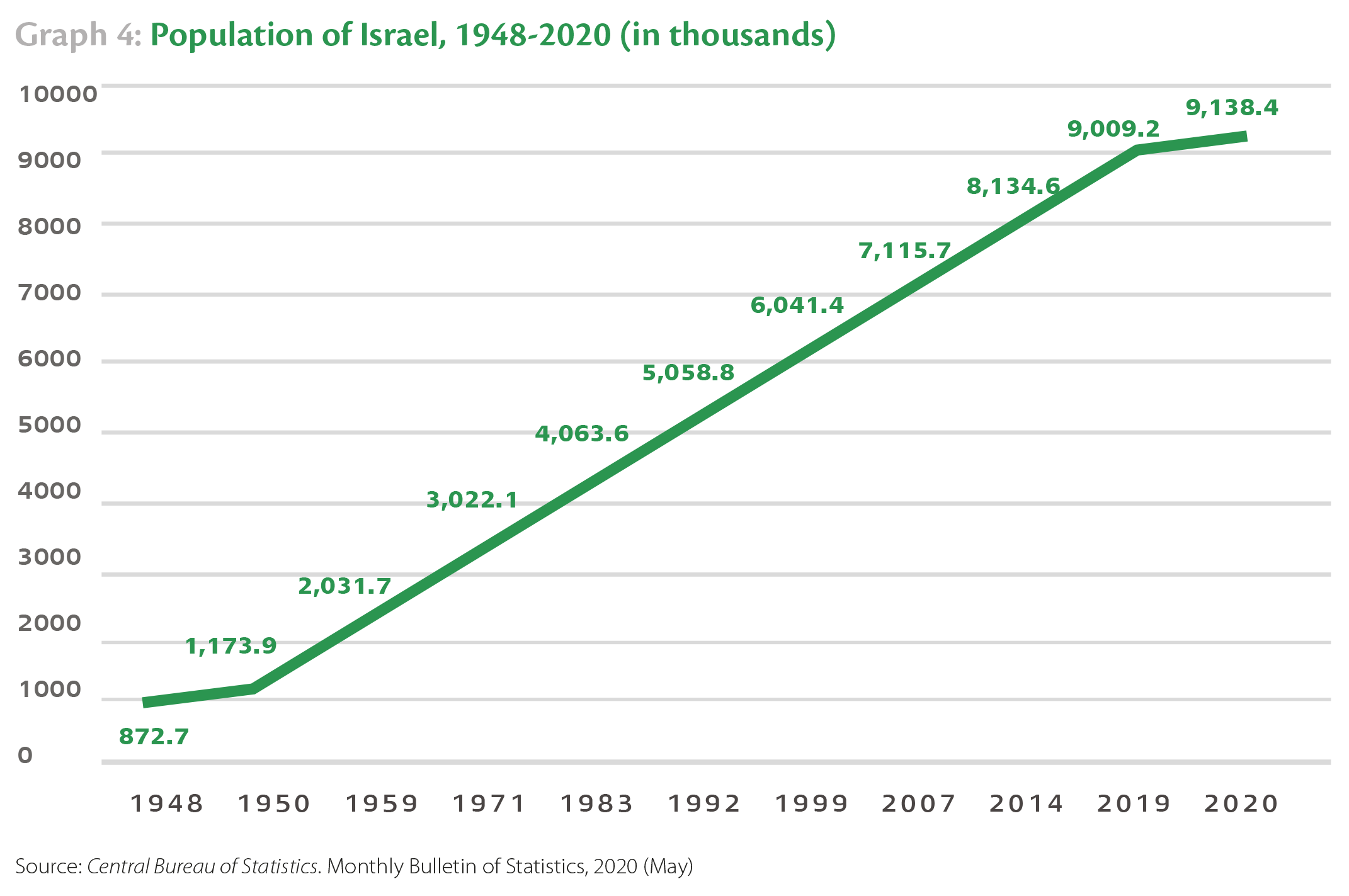
Last year, Israel’s population (Jews and non-Jews) crossed the 9 million mark (Graph 4). In November 1948, shortly after the founding of the state, the local population numbered 873,000. The one million mark was passed in early 1950, the 2 million mark in 1959, 3 million in 1971, 4 million in 1983, 5 million in 1992, 6 million in 1999, 7 million in 2007, 8 million in 2014 and, again, the 9 million mark was passed just recently. A larger population, combined with high fertility rates and positive net migration,is shortening the intervals between each additional million-resident milestone. Thus, while it took Israel 12 years to go from 2 to 3 million residents, it took only nine years to go from 4 to 5 million, and just five years to go from 8 to 9 million. Last year, 2019, the Israeli population grew by nearly 130,000. The Central Bureau of Statistics forecasts that Israel’s population will reach 10.2 million by 2025.13